
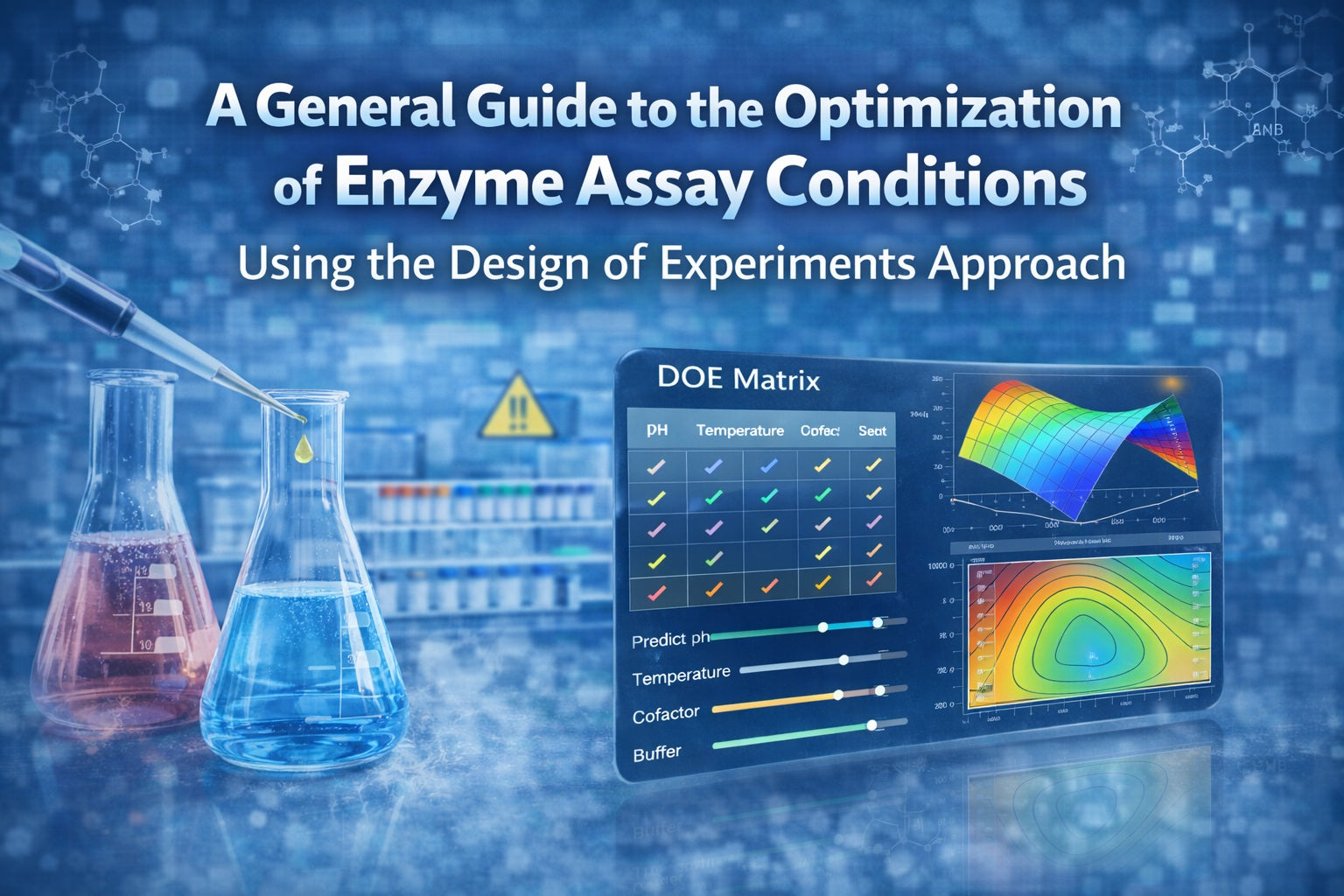
Optimizing an enzyme assay can feel surprisingly time-consuming when you change one variable at a time. You adjust pH, then temperature, then salt, then substrate—only to discover the best setting for one factor depends on the value of another. The good news is that there’s a smarter, calmer way to reach robust conditions with fewer experiments: Design of Experiments (DoE).
explains how to use DoE for enzyme assay optimization, including when to start with a fractional factorial design, how to expand into response surface methodology (RSM), and how to validate a final method that produces stable, repeatable enzyme activity measurements. We’ll also include a practical example mindset using a protease assay—where buffers, temperature, ionic strength, additives, and substrate format influence protease activity.
Why does enzyme assay optimization benefit from DoE
Traditional “one-factor-at-a-time” optimization is simple, but it tends to:
- Miss interactions (where factors influence each other)
- Require many experiments to explore the space
- Produce conditions that work only in a narrow window
Design of Experiments (DoE) flips the workflow. Instead of changing one variable while holding everything else constant, you systematically vary multiple factors. This lets you:
- Quantify which factors truly matter
- Detect interactions that would otherwise stay hidden
- Reach a strong solution with fewer total runs
- Build a method that stays stable when conditions shift slightly
In other words, DoE supports an assay that feels resilient, not fragile.
What you should define before any DoE
DoE works best when you begin with clarity around three core items.
1) The assay goal
Examples:
- Maximize signal-to-background
- Increase the initial rate while keeping linearity
- Improve reproducibility (lower CV)
- Reduce sensitivity to small pipetting differences
2) The response you will measure
In DoE language, the response is the output you care about. For enzyme assays, common responses include:
- Initial velocity (v₀)
- Endpoint product formation at a fixed time
- Slope from a kinetic read
- Signal-to-noise ratio
- Z′ factor for screening readiness
3) The practical constraints
Define what’s truly fixed:
- Plate reader wavelength settings
- Detection chemistry limitations
- Enzyme and substrate availability
- Temperature control options
- Reaction time window
This keeps the DoE design realistic and immediately usable.
Step 1: Choose factors and ranges (the heart of the design)
The most important decision in enzyme assay optimization is which factors to explore and how wide the ranges should be.
Common factors affecting enzyme activity
These are typical starting points for enzyme activity assays:
- pH (buffer system)
- Temperature
- Substrate concentration
- Enzyme concentration
- Salt concentration (ionic strength)
- Cofactors (e.g., Mg²⁺, Zn²⁺) and their concentration
- Additives (glycerol, detergents, reducing agents)
- DMSO tolerance (common in screening)
- Incubation time
Practical range-setting tip
Choose ranges that are wide enough to see changes, yet safe enough to keep the enzyme stable and the detection linear. A pilot run (5–10 quick tests) can help you select ranges with confidence.
Step 2: Start with screening using a fractional factorial design
When you have many factors, begin with a screening design. A fractional factorial design lets you evaluate multiple variables efficiently, using a fraction of the runs of a full factorial experiment.
Why screening first works so well
A screening DoE helps you:
- Identify the 2–5 factors that drive most performance
- Drop variables that don’t meaningfully affect the response
- Find important interactions early
A simple example (screening phase)
Imagine you’re optimizing an in vitro enzyme assay with these factors:
- pH (6.5–8.5)
- Temperature (20–37°C)
- Salt (0–300 mM)
- Substrate concentration (low–high)
- Reducing agent (low–high)
- Detergent (absent–present)
A fractional factorial design can test these systematically with a manageable number of runs while still showing which variables actually matter.
What to analyze
After running the design, you typically look for:
- Main effects (which factors shift the response)
- Interaction effects (which combinations matter)
- Reproducibility and outliers
At this stage, you’re not trying to find “the perfect condition.” You’re identifying the important levers.
Step 3: Move to response surface methodology (RSM) to find the sweet spot
Once screening reveals the key factors, the next step is optimization. This is where response surface methodology (RSM) shines.
What RSM does
RSM models the response as a curved surface across the factor space. This allows you to:
- Identify an optimum (or a robust plateau)
- Quantify non-linear behavior
- Choose conditions that are strong and stable
Common RSM designs
You may see:
- Central composite designs (CCD)
- Box–Behnken designs
These designs are built to estimate curvature and locate a true optimum, not just a “better corner” of the space.
What “robust” looks like
In real labs, the best condition is often not the absolute maximum response. A robust condition is one where:
- Small changes in pH or temperature don’t crash performance
- Signal remains linear over your measurement window
- Replicates stay tight
RSM helps you find that dependable region.
Step 4: Confirm linearity and assay health
A high signal is valuable when it’s trustworthy. Before you lock in conditions, validate that your chosen settings support clean kinetics.
Validation checks that strengthen confidence
- Linearity with time: product formation increases smoothly in your measurement window
- n- Linearity with enzyme concentration: doubling the enzyme gives a predictable rate increase
- Substrate dependence: response changes logically with substrate concentration
- Background stability: blank signal stays flat and low
These checks help ensure your assay measures true enzyme activity rather than artifacts.
Step 5: Special considerations for protease assays (including HRV-3C protease)
Proteases are popular targets because they are useful tools and biologically important enzymes. In protease assays, protease activity can be strongly influenced by buffer composition and substrate format.
Practical notes for HRV-3C protease-style assays
HRV-3C protease (often used for tag cleavage in recombinant protein workflows) is a helpful example because it highlights common optimization themes:
- Reducing agents can improve stability and performance for some proteases
- Buffer pH and salt can shift substrate binding and cleavage efficiency
- Additives can stabilize the enzyme or improve substrate accessibility
- Temperature can trade speed for stability
In a DoE framework, you can treat these as factors and directly quantify which ones matter most for cleavage performance or kinetic readout.
Measuring protease activity in vitro
For an in vitro enzyme assay, protease activity is often tracked using:
- Fluorogenic substrates (signal increases as cleavage happens)
- FRET substrates (signal changes when the peptide is cut)
- Gel-based cleavage quantification (endpoint or time course)
DoE can work with any of these readouts—as long as your response is measurable and reproducible.
How to build a practical DoE plan (template you can reuse)
Here’s a simple structure you can apply to most enzyme assays.
Phase 1: Screening
- Design: fractional factorial design
- Factors: 6–10
- Runs: manageable (often 16–32 plus replicates/center points)
- Goal: identify top drivers and major interactions
Phase 2: Optimization
- Design: response surface methodology (RSM)
- Factors: 2–4 (the winners from screening)
- Goal: locate the optimum/plateau and quantify the curvature
Phase 3: Robustness check
- Confirm performance at small ± shifts around the chosen condition
- Run across multiple days/operators if possible
- Check plate position effects for high-throughput formats
This approach produces conditions that feel stable in real use.
Data handling tips that keep results clean
DoE is powerful, and it becomes even stronger when you standardize how you run plates and record data.
Keep these consistent
- Reaction start method (enzyme added last, consistent mixing)
- Timing (start-to-read interval)
- Temperature equilibration
- Plate type and volume
- Reader settings (gain, wavelength, integration time)
Include quality anchors
- Positive control condition
- Blank condition
- Center points (especially useful in RSM)
- Replicates for variance estimation
These habits improve model fit and make decisions feel confident.
Where FireGene fits in enzyme assay optimization workflows
FireGene supports laboratories working across molecular biology and diagnostic development, where enzymes are central to amplification, cloning, and other reaction systems. In enzyme assays, success usually comes from consistent inputs and controlled conditions.
FireGene’s Molecular Biology Reagents & Kits category aligns naturally with enzyme-driven workflows, and its broader focus on reliable lab performance supports teams seeking assays that are repeatable and scalable. When your assay conditions are tuned using DoE, you often spend less time re-optimizing and more time generating results you can trust.
FAQ
What is Design of Experiments (DoE) in enzyme assay optimization?
Design of Experiments (DoE) is a structured method for testing multiple assay variables simultaneously to identify which factors most affect performance and to find optimal conditions efficiently.
What is a fractional factorial design used for?
A fractional factorial design is used in the screening stage to evaluate many factors with fewer experiments than a full factorial design, while still revealing key effects and interactions.
What is response surface methodology (RSM)?
Response surface methodology (RSM) is an optimization approach that models non-linear relationships between key factors and the response, helping you locate a true optimum or a robust plateau.
How does DoE improve enzyme activity measurements?
DoE improves enzyme activity measurement by identifying the conditions that maximize signal, maintain linearity, reduce variability, and minimize sensitivity to small procedural changes.
Can DoE be used for protease assays, such as the HRV-3C protease?
Yes. DoE is very effective for protease assays. It can quantify how buffer pH, salt, additives, temperature, and substrate concentration influence protease activity in an in vitro enzyme assay, including workflows involving HRV-3C protease.
CONCLUSION
DoE offers a clear, efficient path to enzyme assay optimization. Start broad with a fractional factorial design to identify which variables truly matter, then refine conditions using response surface methodology (RSM) to find an optimum that holds up under real lab variation. The result is a confident, scalable in vitro enzyme assay in which enzyme and protease activity measurements are stable, reproducible, and ready for everyday use.


