
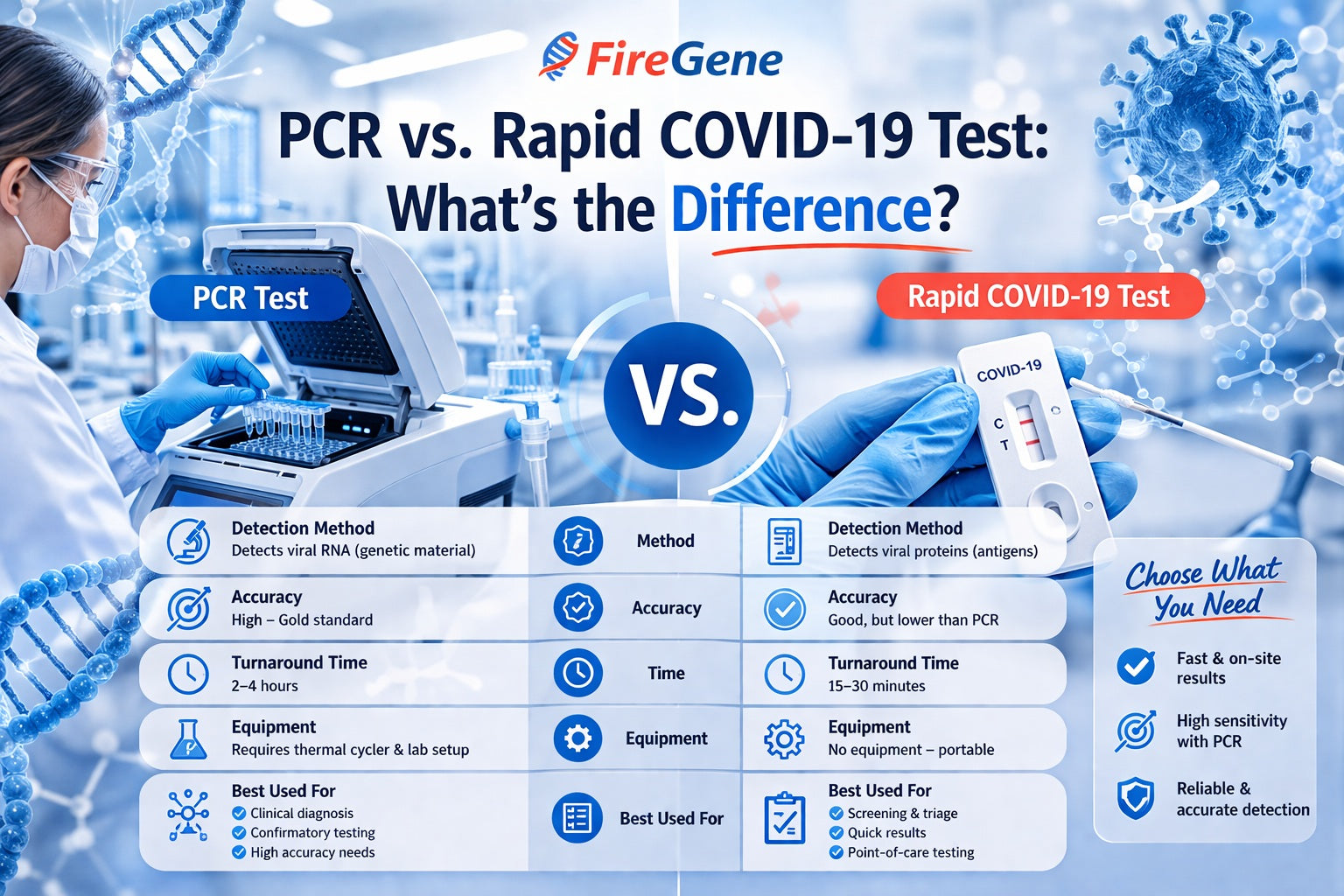
When someone has COVID-like symptoms or needs a test for travel, work, or screening, one common question comes up: PCR vs rapid COVID-19 test: what’s the difference? Both tests are used to detect COVID-19, but they do not work in the same way. They differ in speed, sensitivity, testing method, and ideal use case. Choosing the right COVID-19 test depends on why you are testing, how quickly you need results, and whether accuracy is your top priority.
In this guide, we will explain the differences between PCR and rapid COVID-19 tests in simple terms, including how each test works, when to use it, and which test is more accurate: PCR or antigen.
What Is a PCR Test?
A PCR test is a molecular test that detects genetic material from the SARS-CoV-2 virus. PCR stands for polymerase chain reaction. This method detects viral RNA by amplifying very small amounts of genetic material, which makes it highly sensitive. Because it can find even low levels of the virus, PCR is often considered the most accurate test for confirming infection.
How a PCR Test Works
A sample is usually taken from the nose, throat, or both. The sample is then sent to a laboratory, where specialized instruments detect viral RNA. If the virus is present, even in small amounts, the test can often detect it.
Key Features of a PCR Test
- High sensitivity
- Strong accuracy in early or low-level infection
- Laboratory processing required
- Results usually take longer than rapid tests
What Is a Rapid COVID Test?
A rapid COVID test usually refers to a rapid antigen test. Instead of looking for viral genetic material, it checks for specific viral proteins, often called antigen protein targets. These proteins are found on the surface of the virus. Rapid tests are designed to deliver results quickly, often within minutes, without the need for full lab processing.
How an Antigen Test Works
A swab sample is taken, usually from the nose. The sample is placed in a solution and then applied to a test device. If enough viral antigen is present, the test shows a positive result.
Key Features of a Rapid Antigen Test
- Faster results
- Easier point-of-care or at-home use
- Lower sensitivity than PCR
- Most effective when the viral load is higher
PCR vs Rapid COVID-19 Test: Main Difference
The biggest difference is what the test detects.
- A PCR test detects viral genetic material
- A rapid COVID-19 test or antigen test detects viral proteins
This difference affects accuracy, speed, and the best use case.
Quick Comparison
PCR Test
- Detects viral RNA
- More sensitive
- Usually processed in a lab
- Takes longer for the results
- Better for confirmation
Rapid COVID Test
- Detects antigen protein
- Faster results
- Easier to use in clinics, workplaces, or at home
- Less sensitive than PCR
- Useful for quick screening
Difference Between PCR and Rapid COVID Test
If you want the difference between PCR and rapid COVID test in practical terms, here it is:
1. Testing Method
- PCR tests use molecular technology to detect the virus at a genetic level.
- Rapid antigen tests look for viral proteins instead.
2. Accuracy
- PCR is generally more accurate, especially when the viral load in the body is still low.
- Antigen tests are helpful, but they are more likely to miss infection if the viral load is low.
3. Speed
- Rapid COVID tests are much faster. Results may be available in 15 to 30 minutes.
- PCR results usually take longer because the sample must be processed in a lab.
4. Best Use Case
- PCR is often preferred when confirmation is important.
- Rapid antigen tests are useful when quick screening is most important.
Which COVID Test Is More Accurate: PCR or Antigen?
Many users search for which COVID test is more accurate, PCR or antigen. The answer is clear: PCR is generally more accurate than an antigen test. That is because PCR can detect very small amounts of viral material. This makes it more sensitive and reliable, especially in early or mild infections or when the viral load is low.
However, that does not mean rapid antigen tests are not useful. They are still valuable in many real-world settings, especially when speed matters and when a person has symptoms with a higher viral load.
When Should You Choose a PCR Test?
A PCR test may be the better choice when:
- You need the most accurate confirmation possible
- You have symptoms, but a rapid test is negative
- You were recently exposed and want a reliable follow-up test
- Testing is required for medical, workplace, or travel documentation
- You are testing in a clinical or laboratory setting
PCR is often the preferred option when the goal is confidence and confirmation.
When Should You Choose a Rapid COVID Test?
A rapid COVID test may be the better choice when:
- You need results quickly
- You are doing routine screening
- You want a convenient at-home or point-of-care option
- You need quick testing before a gathering, school, or work shift
- You want to check for a likely active infection fast
Rapid testing is especially helpful when time matters and immediate action is needed.
Can a Rapid Antigen Test Miss COVID-19?
Yes, it can.
Because the antigen test is less sensitive than PCR, it may not detect infection in some cases, especially:
- Early after exposure
- Late in infection
- In people with low viral load
- In improper sample collection situations
This is why a negative rapid test does not always fully rule out infection, particularly if symptoms are present. In some cases, follow-up PCR testing is recommended.
Are Rapid COVID Tests Still Useful?
Yes, absolutely.
Even though PCR is usually more accurate, rapid antigen tests still offer important advantages:
- Fast decisions
- Easy access
- Simple testing process
- Useful screening in high-traffic settings
- Good support for repeated testing strategies
In many settings, rapid testing helps people act faster, isolate sooner, and reduce transmission risk.
Real-World Example
Imagine someone develops mild symptoms in the morning and needs to decide whether to go to work. A rapid COVID test can provide a quick result within minutes, helping with immediate decisions. Now imagine a hospital lab needs to confirm an infection in a patient with symptoms, but a negative rapid test. In that case, a PCR test is usually the more reliable next step. This is why both tests have value. They solve different problems.
PCR vs Rapid COVID-19 Test for Labs and Diagnostic Providers
For labs, manufacturers, and diagnostic companies, understanding this test difference is important for product development and communication. PCR-based testing supports high-sensitivity molecular detection, while antigen-based testing supports fast, accessible screening. Companies working in diagnostics, including FireGene, may find value in addressing both testing needs, depending on the intended use environment. Clear educational content on this topic can also help healthcare buyers, distributors, and end users make better decisions.
Pros and Cons of PCR and Rapid Antigen Testing
PCR Test Pros
- Higher accuracy
- Better sensitivity
- Stronger confirmation value
- Useful in low viral load cases
PCR Test Cons
- Longer turnaround time
- Lab processing needed
- Usually higher complexity
Rapid Antigen Test Pros
- Very fast results
- Easy to use
- More convenient for screening
- Helpful in point-of-care settings
Rapid Antigen Test Cons
- Lower sensitivity
- Higher chance of false negatives in some cases
- Less reliable for low viral load detection
FAQ:
What is the difference between PCR and rapid COVID-19 tests?
The main difference is that PCR detects viral genetic material, while rapid COVID tests usually detect viral proteins through antigen testing.
Which COVID test is more accurate, PCR or antigen?
PCR is generally more accurate and more sensitive than an antigen test, especially when viral levels are low.
Is a rapid COVID test the same as an antigen test?
In most cases, yes. A rapid COVID test usually refers to a rapid antigen test.
Can a rapid antigen test miss infection?
Yes. Rapid antigen tests can miss infection, especially in early stages or when the viral load is low.
When should I use a PCR test instead of a rapid test?
A PCR test is often better when you need confirmation, higher accuracy, or follow-up after a negative rapid test with symptoms.
Conclusion
So, PCR vs rapid COVID-19 test: what’s the difference? The main difference is that a PCR test detects viral genetic material, while a rapid COVID test usually detects viral proteins through an antigen test. PCR is generally more accurate and sensitive, while rapid antigen tests are faster and more convenient. If your priority is confirmation and accuracy, PCR is usually the better option. If your priority is speed and accessibility, a rapid antigen test can be very useful.
The right COVID-19 test depends on your goal, timing, and testing setting. For diagnostic-focused organizations such as FireGene, explaining these differences clearly can help users better understand testing options and make more informed choices. If you want to learn more about molecular diagnostics, antigen-based testing, or COVID-related assay technologies, this topic provides a strong foundation for further exploration.


