
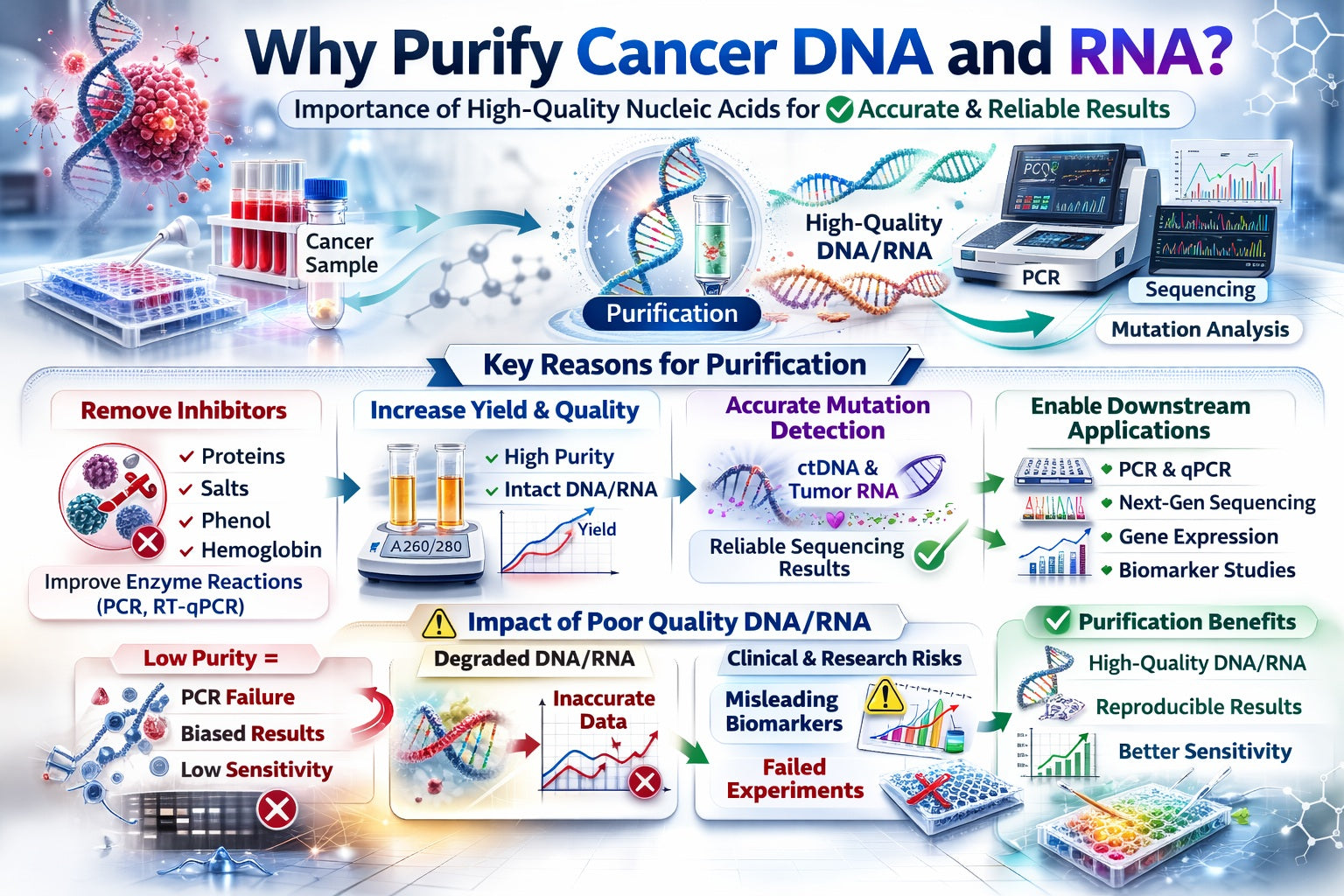
Cancer is often described as a disease of the genome and its regulation. That's because tumors form and evolve through changes in DNA and RNA—changes that shape how cells grow, divide, survive, and respond to therapy. When scientists and clinicians want to understand cancer at a deeper level, one of the most valuable starting points is high-quality DNA and RNA purification.
Purifying nucleic acids from cancer samples enables the detection of mutations, measurement of gene expression, tracking of tumor evolution, and support of clinical decisions. Whether you work in discovery science or applied testing, clean DNA and RNA help produce results that feel consistent, sensitive, and truly informative.
The big picture: cancer biology is written in DNA and RNA
A cell's DNA contains the long-term blueprint. RNA reflects what the cell is actively doing right now—what genes are turned on, which pathways are active, and how the cell adapts to stress.
In cancer, both layers matter:
- DNA changes can initiate and drive tumor formation.
- RNA patterns can reveal how a tumor behaves, responds to treatment, and evolves.
This is why purification of both nucleic acids is so central to modern cancer research and precision oncology workflows.
What makes cancer samples unique (and why purification helps)
Cancer samples can be challenging in productive ways—they contain rich information but also introduce complexity.
Common realities include:
- Mixed cell populations (tumor cells plus immune cells, stroma, normal tissue)
- Variable tumor fraction (the proportion of tumor DNA among all DNA)
- Degraded or fragmented nucleic acids in some sample types
- Inhibitors from tissue components, blood, or preservation reagents
High-quality DNA and RNA purification helps reduce inhibitors and background noise, enabling downstream detection methods to deliver clearer signals.
Why purify cancer cell DNA?
Cancer cell DNA carries the genetic alterations that often define tumor identity and treatment sensitivity.
Purified tumor DNA can support:
1) Mutation detection
Many cancers have point mutations, insertions/deletions, or larger structural changes that influence growth signaling and therapy response.
2) Copy number analysis
Some tumors amplify oncogenes or lose tumor-suppressor genes. DNA quality supports reliable copy-number calling.
3) Tumor monitoring strategies
DNA-based assays can help track tumor dynamics over time by detecting changes in circulating tumor DNA or tumor tissue DNA.
4) Research into cancer development
Studying early genetic events helps researchers understand cancer development, including which changes occur first and how tumors transition from benign to malignant behavior. In all these cases, purification improves accuracy by purifying the input DNA, making it cleaner, more measurable, and more compatible with downstream enzymatic steps.
Why purify RNA from cancer samples?
RNA gives a high-resolution view of tumor behavior. Purified RNA supports:
1) Gene expression profiling
RNA shows which genes are active. This can reveal tumor subtype, pathway activation, and biological aggression.
2) Fusion detection
Some cancers are defined by gene fusions that can be detected through RNA-based workflows.
3) Immune and microenvironment signatures
RNA profiles help characterize immune infiltration and stromal signals—important context for immuno-oncology and response prediction.
4) Mechanisms of cancer progression
As tumors evolve, RNA patterns can shift to support invasion, metastasis, angiogenesis, and therapy resistance—key elements of cancer progression.
Because RNA is more susceptible to degradation than DNA, careful purification and handling often yield a significant boost in data quality.
Purification connects directly to cancer diagnosis.
Molecular testing is now part of many diagnostic pathways. In cancer diagnosis, purified DNA and RNA can enable:
- Tumor genotyping to guide targeted therapy
- Confirmation of specific diagnostic markers
- Classification of tumor subtypes
- Prognostic assessment in certain contexts
Clean nucleic acid inputs support test sensitivity and reduce false signals from inhibitors or poor-quality extraction.
Genetic changes in cancer cells: what purification helps you detect
The phrase "genetic changes in cancer cells" encompasses a wide range of alterations. Purification supports confident detection of:
- Single-nucleotide variants (SNVs)
- Small insertions and deletions (indels)
- Copy number variations (CNVs)
- Structural variants (SVs)
- Gene fusions (often via RNA)
- Epigenetic-related patterns (via specialized workflows)
Different methods require different inputs, and purification helps ensure those requirements are reliably met.
How purification improves downstream workflows
Regardless of whether your next step is PCR/qPCR, sequencing, or another assay, purification improves performance in three practical ways.
1) Better enzyme compatibility
Many downstream workflows rely on enzymes. Cleaner DNA/RNA typically helps polymerases, ligases, and reverse transcriptases perform more consistently.
2) More accurate quantification
Purity improves measurement accuracy, so you can normalize input across samples and reduce variability.
3) Higher reproducibility
When inputs are consistent, results are easier to replicate across batches, operators, and days. That reliability makes purification an enabling step—not just a technical detail.
Common cancer sample types and what they need
Different sample types bring different strengths. Strong purification helps each one deliver its best value.
Fresh or frozen tumor tissue
Often supports high-quality DNA and RNA when handled quickly and stored properly.
FFPE tissue
FFPE is widely available and extremely valuable for retrospective studies. It can also produce fragmented nucleic acids, so extraction methods and downstream assay selection matter.
Blood and plasma (circulating DNA)
Supports minimally invasive monitoring approaches. Purification helps maximize recovery of low-input DNA.
Cell lines and xenografts
Provide stable, controllable inputs for mechanistic cancer research and assay development.
Where FireGene fits: practical purification for molecular cancer workflows
FireGene's platform focuses on molecular testing tools and workflows that support sample-to-answer performance. In cancer-focused projects, purification is a key foundation because it powers the steps that follow.
FireGene-aligned touchpoints include:
Nucleic acid extraction and purification
FireGene's Nucleic Acid Extraction category supports DNA/RNA workflows where consistent yield and clean input improve downstream reliability.
Sample preparation support
For tissue and complex samples, preparation steps can improve consistency before extraction. FireGene's Sample Preparation Kit category supports workflows designed for cleaner inputs.
Downstream molecular workflows
After DNA and RNA purification, many labs move into amplification, detection, or sequencing. FireGene's broader molecular biology and diagnostics focus aligns with building repeatable assays across many samples.
The result is a workflow that feels stable from start to finish—helpful for both research discovery and translational applications.
Best-practice tips for purifying cancer DNA and RNA
These practical habits make purification more consistent.
1) Protect the sample early
Sample handling before extraction is one of the biggest drivers of quality. Rapid stabilization and consistent storage help preserve the integrity of DNA and RNA.
2) Reduce inhibitors
Cancer tissues can carry inhibitors. Use preparation steps that remove debris and keep extracts clean for enzyme-driven downstream assays.
3) Track quality metrics
Measure concentration and consistently evaluate purity indicators. Good tracking helps you catch variation early.
4) Choose a workflow matched to the sample
Tissue, FFPE, plasma, and cells each need slightly different approaches. Matching the method to the sample supports stronger recovery.
5) Standardize across the study
In large projects, consistent protocols are a major advantage. Standardization strengthens downstream comparisons and helps results stay interpretable.
FAQ
Why is DNA and RNA purification important in cancer research?
DNA and RNA purification provides clean nucleic acid inputs that improve assay sensitivity, reproducibility, and downstream performance. This supports mutation detection, gene expression profiling, and a deeper understanding of tumor biology.
How does purification support cancer diagnosis?
In cancer diagnosis, purified DNA and RNA help molecular assays detect clinically relevant alterations more reliably and reduce interference from inhibitors that can affect sensitivity.
What genetic changes in cancer cells can be studied after purification?
Purified samples can be used to study point mutations, indels, copy number changes, structural variants, and gene fusions—key categories of genetic changes in cancer cells.
Why is cancer cell DNA important?
Cancer cell DNA harbors genomic alterations that often drive tumor growth and influence therapeutic response, making it central to genotyping, research, and monitoring strategies.
How does purification relate to cancer progression and cancer development?
Purified DNA and RNA make it easier to track the molecular events involved in cancer development and to study how tumors evolve during cancer progression, including shifts in mutation patterns and gene expression.
conclusion
Purifying cancer DNA and RNA is a powerful first step because it turns complex tumor samples into clean, measurable inputs for molecular analysis. High-quality DNA and RNA purification supports accurate detection of genetic changes in cancer cells, strengthens studies of cancer development and progression, and improves workflow performance in cancer research and diagnosis. With consistent purification and quality control, cancer biology becomes clearer, and downstream decisions are made with greater confidence.


