
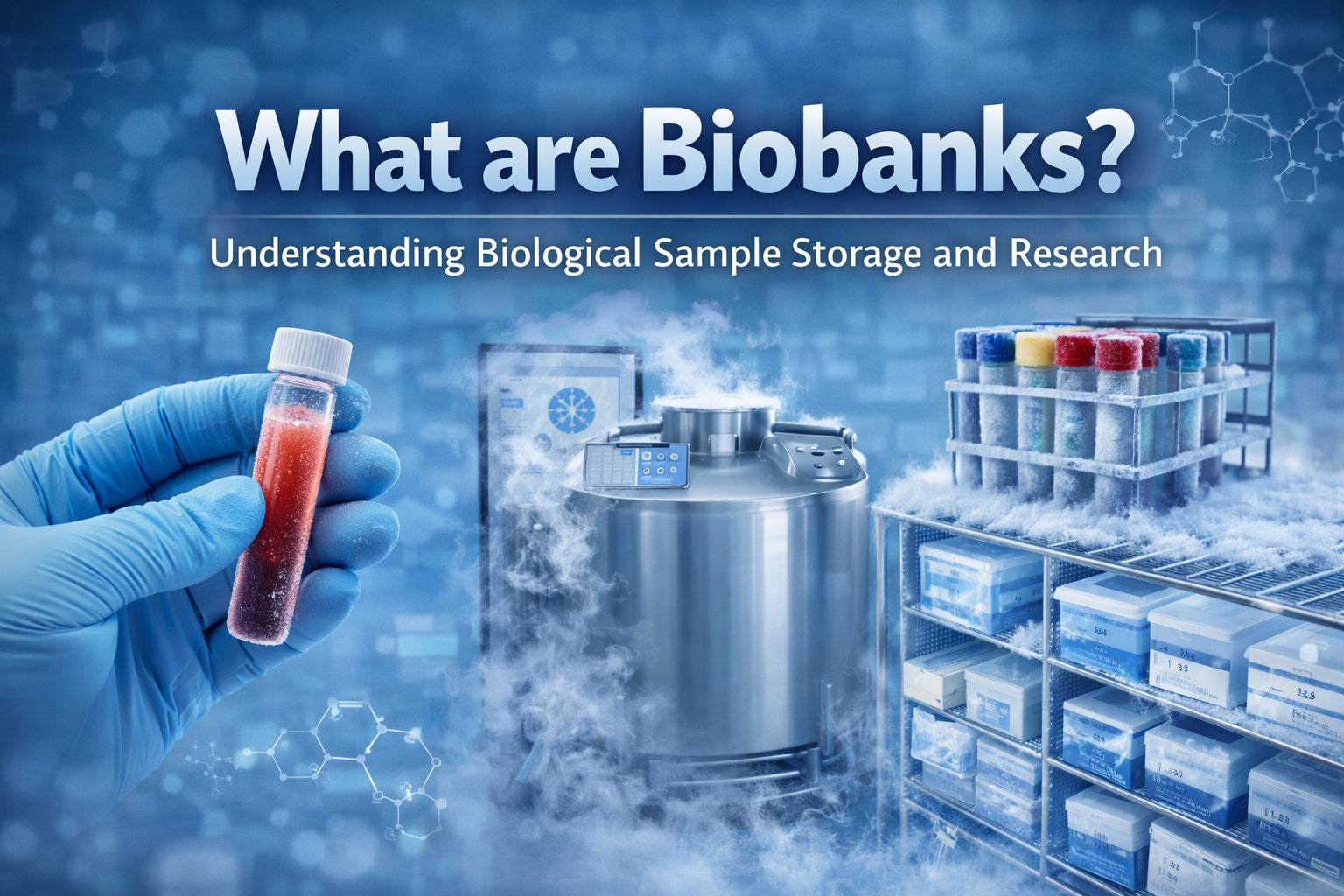
Biobanks are organized facilities that collect, process, and store biological samples such as blood, saliva, tissue, and other biospecimens along with carefully recorded information about those samples. They are the "libraries" of modern science that help researchers and clinicians understand health and disease more clearly, using real-world human material collected ethically and stored under controlled conditions. Because biobanks bring together high-quality biological samples and reliable data, they play a central role in medical research, support smarter healthcare decisions, and accelerate discoveries that power precision medicine.
What is a biobank in simple words?
A biobank is a place (or network of places) that stores human or biological material safely for long-term use. Samples are collected with consent, accurately labeled, tracked through a strict chain of custody, and stored under conditions that protect their integrity. That way, researchers can return to these samples months or years later and still perform testing that produces dependable results.
Biobanks may be based in:
- Hospitals and healthcare systems
- Universities and research institutes
- Government programs
- Pharmaceutical and biotech organizations
Why biobanking matters for precision medicine
Biobanking is one of the strongest foundations of precision medicine—the approach that aims to match prevention, diagnosis, and treatment to each patient's characteristics.
When biobanks store diverse samples from many people over time, researchers can:
- Identify biomarkers that predict disease risk
- Understand why treatments work better for some groups
- Track how diseases change over time
- Develop and validate diagnostic tests
This is how biobanks turn samples into insights that improve care and expand options across healthcare.
Types of biological samples stored in biobanks
Biobanks can store a wide range of biological samples, depending on the program's goals. Common examples include:
- Whole blood, plasma, and serum
- Saliva and buccal swabs
- Fresh or frozen tissues
- FFPE (formalin-fixed paraffin-embedded) tissues
- Cells and cell pellets
- DNA, RNA, and protein extracts
- Microbiome and stool samples
Each sample type has different stability needs, which is why biological sample storage protocols are so important.
The biobanking workflow: from collection to analysis
Strong biobanks follow a repeatable workflow that protects quality at every step.
1) Ethical collection and consent
Participants are informed about the project, privacy protections, and how samples may be used. Consent is documented, and sample collection is performed according to standardized instructions.
2) Sample processing (pre-analytical steps)
Many quality differences begin here. Processing steps may include tissue dissociation, separation of plasma/serum, removal of debris, or stabilization before freezing. Standardized processing keeps results consistent across time and across sites.
3) Labeling, tracking, and documentation
Modern biobanks use barcoding and digital systems to track where each sample came from, what processing was done, and where it is stored.
4) Biological sample storage
Storage conditions depend on sample type:
- Ultra-low freezers (often -80°C)
- Liquid nitrogen systems for long-term cell and tissue storage
- Controlled room temperature storage for certain stabilized formats
5) Retrieval for testing and genomic analysis
When needed, samples are retrieved under controlled conditions for extraction and testing. This is where biobanks power downstream workflows like PCR/qPCR, sequencing, and broader genomic analysis.
What does "sample quality" mean in a biobank?
High-quality biobanking isn't just about having a freezer; it's about ensuring samples behave reliably in downstream assays.
Key quality factors include:
- Integrity: DNA/RNA/proteins remain intact
- Purity: minimal inhibitors for PCR and sequencing
- Consistency: processing is standardized across samples
- Traceability: complete documentation and chain of custody
When these factors are protected, stored samples can support both discovery science and clinical translation with confidence.
How FireGene supports biobanking and biospecimen workflows
FireGene focuses on the practical tools that help labs handle real-world biospecimens smoothly—from collection and preparation to molecular testing. In biobanking settings, teams often prioritize consistency, speed, and dependable downstream performance.
Here are common touchpoints where FireGene aligns naturally with biobank workflows:
Sample preparation and stabilization
Before long-term storage, many programs process tissue or cellular material to improve consistency. FireGene's Sample Preparation Kit category (including tissue dissociation and cleanup-style workflows) supports cleaner inputs for later testing.
Nucleic acid extraction from banked samples
Biobanks frequently retrieve samples for DNA/RNA extraction to support PCR, qPCR, and sequencing. FireGene's Nucleic Acid Extraction solutions are relevant when programs need to recover nucleic acids from complex sample types in a repeatable manner.
Ready-for-testing formats
In large-scale programs, stable formats can simplify logistics and reduce variation. FireGene's Microspheres Reagent Lyophilization service can support workflows that require consistent, shelf-stable reagent formats for molecular assays.
Quality mindset for sensitive downstream testing
When samples are destined for high-impact analysis, programs often use quality checks at multiple stages. FireGene's broader molecular biology and diagnostic focus is built around repeatable performance, exactly what biobanking programs value.
Biobanks in medical research and healthcare: real-world impact
Biobanks help research translate into benefits that people can feel. By enabling robust studies across thousands of participants, biobanks support:
- Earlier disease detection through validated biomarkers
- Better stratification of patients for clinical trials
- Faster development of diagnostic assays
- Safer and more effective therapy design
This is why medical research institutions and healthcare systems worldwide invest in biobanking, thereby strengthening scientific evidence and improving decision-making.
Challenges in biobanking (and how strong programs manage them)
Biobanks succeed when they maintain consistent operations and complete documentation.
Common challenges include:
- Pre-analytical variation (collection and handling differences)
- Storage capacity and temperature control
- n- Data integration and privacy protections
- Long-term sustainability and funding
Well-run biobanks address these challenges through standard operating procedures (SOPs), training, audit-ready documentation, and quality controls that ensure samples remain reliable for years.
FAQ:
What are biobanks used for?
Biobanks store biological samples and related data so researchers can study diseases, validate biomarkers, and improve diagnostics and treatments. They are central to biobanking for precision medicine.
What kinds of biological samples do biobanks store?
Biobanks store blood, saliva, tissue, cells, DNA/RNA extracts, and other biospecimens. Storage methods vary by sample type to protect integrity and support future testing.
Why is biological sample storage important?
Biological sample storage protects sample quality so that DNA, RNA, proteins, or cells remain usable for future experiments. Proper storage improves consistency, reproducibility, and long-term value.
How do biobanks support precision medicine?
Biobanks enable researchers to link biological differences to health outcomes across large populations, which helps personalize risk prediction, diagnosis, and treatment, key goals of precision medicine.
Conclusion
Biobanks are essential infrastructure for modern science: they safeguard biological samples, preserve their value through robust storage, and enable discoveries that power medical research and improve healthcare. As biobanking expands, programs that focus on consistent processing, reliable extraction, and downstream-ready workflows create the strongest foundation for precision medicine.


