
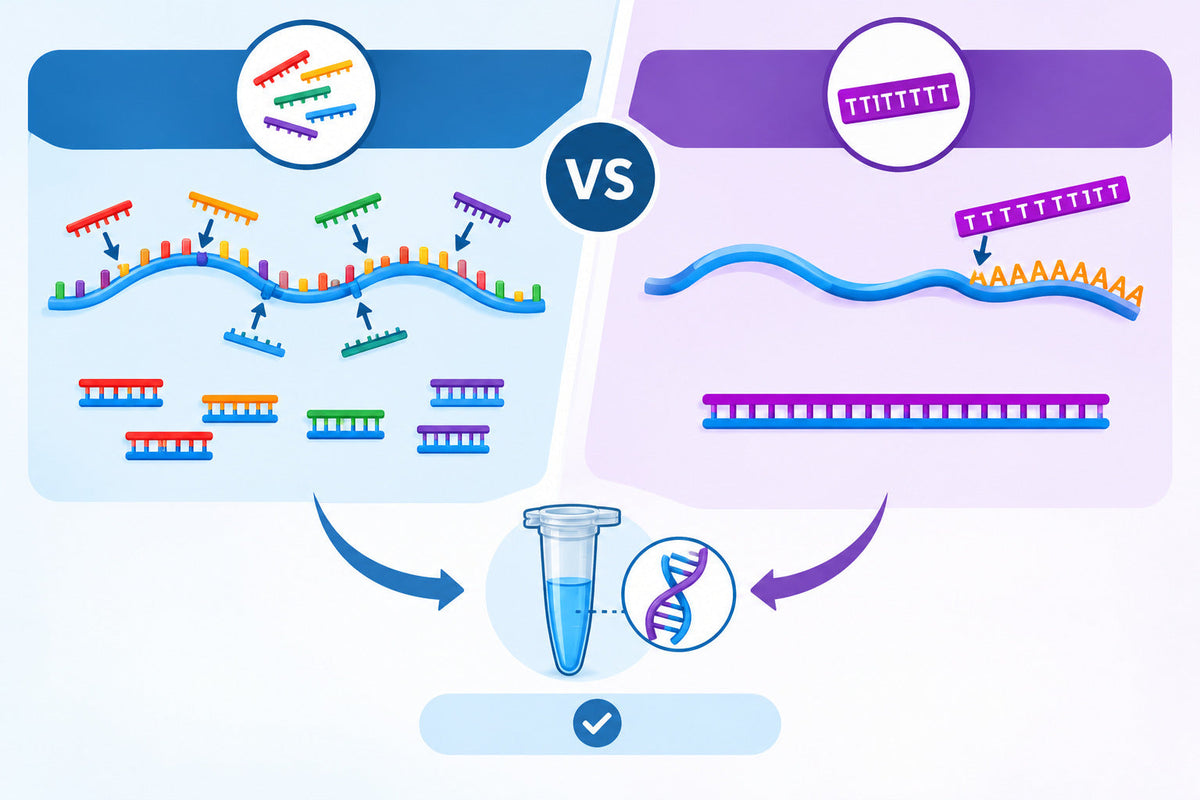
Random primers vs oligo dT comes down to where reverse transcription begins: random primers bind at multiple sites across RNA, while oligo(dT) primers primarily bind to poly(A) tails. The right choice depends on your RNA sample, target transcript and downstream experiment. For researchers preparing cDNA for gene expression analysis, primer selection is an important part of choosing a reverse-transcription kit. A convenient reagent format helps with setup, but the priming strategy must also match the biological question. This guide explains the differences, provides a practical selection table and compares relevant research products. You can also explore the reverse transcription and cDNA synthesis collection to review available reagent options.
What Is the Difference Between Random Primers and Oligo dT?
Random primers contain varied nucleotide sequences and initiate cDNA synthesis at multiple complementary sites. Oligo(dT) primers contain a stretch of thymidines that preferentially anneals to polyadenylated RNA. Random hexamers are one type of random primer. Their six-nucleotide length distinguishes them from other random oligonucleotides, such as random nonamers.
|
Feature |
Random primers, including hexamers |
Oligo(dT) primers |
|
Composition |
A mixture of different nucleotide sequences |
A stretch of deoxythymidine nucleotides |
|
Main binding pattern |
Multiple complementary sites across RNA |
Primarily poly(A) tails |
|
RNA coverage |
Polyadenylated and non-polyadenylated RNA |
Mainly polyadenylated transcripts |
|
Common reason to choose |
Broader transcript coverage |
Preferential representation of polyadenylated RNA |
|
Fragmented RNA |
Often useful when target-containing fragments remain |
More dependent on retaining a usable connection to the poly(A) end |
|
Main consideration |
Can also represent unwanted RNA species |
Can introduce 3′-end bias |
|
Selection question |
Do I need targets beyond polyadenylated mRNA? |
Are my targets polyadenylated and adequately intact? |
Neither option is universally better. Start with your target RNA and assay requirements, then select the reagent format that supports them.

What Are Random Primers?
Random primers are short DNA oligonucleotides supplied as a mixture of sequences. During reverse transcription, suitable primers anneal to complementary regions of an RNA template and provide starting points for reverse transcriptase.
What Are Random Hexamers?
Random hexamers are six-nucleotide random primers, often represented as N₆. They are commonly used for first-strand cDNA synthesis when researchers want coverage beyond the poly(A) end of a transcript. The distinction matters when comparing products. A kit labelled “random primers” may not specify the same primer length or formulation as another kit.
Advantages and Limitations of Random Priming
Random priming can accommodate RNA without poly(A) tails and can be useful for fragmented samples. Its broader coverage also means that cDNA may include RNA species outside your intended targets. A useful purchasing question is therefore: does this primer formulation suit the RNA species I need to measure? A broad primer mixture is convenient, but convenience alone does not establish assay suitability. For protocols requiring separately supplied primers, the Neoscript RTase 1st Strand cDNA Synthesis Kit lists Random 6-mers among its components.
What Are Oligo(dT) Primers?
Oligo(dT) primers contain consecutive thymidine nucleotides. They preferentially anneal to poly(A) tails and initiate reverse transcription from that region. Product names may specify primer length, such as oligo(dT)18 or oligo(dT)20. These details should be read alongside the complete kit protocol.
When Is Oligo(dT) Useful?
Oligo(dT) is a useful option when your experiment focuses on polyadenylated transcripts and the RNA is sufficiently intact for the required target region. It can help limit the representation of many non-polyadenylated RNA species. However, it is not a universal primer for all RNA in a sample.
What Are Its Limitations?
Targets without poly(A) tails require another approach. RNA degradation and the distance between the poly(A) end and the region being measured can also affect target representation. For this reason, “mRNA analysis” is only the starting point for selection. Researchers should also consider RNA integrity and where the downstream assay targets the transcript.
Which Primer Should You Choose for Your RNA Sample?
Use the following table as a planning guide. Your final choice should follow the selected kit’s instructions and application-specific validation.
|
Sample or experimental goal |
Strategy to consider |
Main selection question |
|
Intact, polyadenylated mRNA |
Oligo(dT), or a validated mixed formulation |
Is the target region adequately represented? |
|
Fragmented RNA |
Random priming |
Does the sample retain the sequence needed for the assay? |
|
Non-polyadenylated RNA |
Random or gene-specific priming |
Does the protocol support this RNA species? |
|
Multiple transcripts from one cDNA preparation |
Random, oligo(dT) or mixed priming |
Do all targets fit the chosen strategy? |
|
One defined RNA target |
Gene-specific priming may be suitable |
Is the primer validated for that target and workflow? |
|
Routine two-step RT-qPCR |
An application-appropriate RT kit or mix |
Can the same conditions be maintained across samples? |
Primer selection guidance from manufacturers supports considering RNA type, target location and downstream application together.
Start With the Biological Target
Before comparing kits, write down the RNA species and target regions you need to detect. This makes it easier to distinguish a genuinely suitable product from one that has an attractive feature list. For example, a multi-gene expression project and a single-target research assay may require different purchasing priorities.
Include RNA Preparation in the Decision
The reverse-transcription step is part of a larger workflow. Record the extraction method, sample handling and expected RNA quality when evaluating reagents. For extraction-stage planning, browse RNA extraction kits. Matching sample preparation and downstream requirements creates a clearer basis for product selection.

Random Hexamers vs Oligo dT for RT-qPCR
For RT-qPCR, the useful question is whether the chosen Strategy produces dependable representation of the targets you intend to compare.
Why Target Position Matters
An assay directed near the 3′ end of a polyadenylated transcript may behave differently from one directed much farther upstream. Merck’s technical guidance specifically discusses target position when choosing between oligo(dT), random primers and mixtures. Keep that information in the assay-planning record, particularly when comparing several genes with different target locations.
Compare Strategies With a Small Pilot
When the choice is uncertain, a pilot experiment is more informative than assuming that one primer type will always perform best. Define the comparison before starting: which samples, targets, controls and performance criteria will determine your choice? This gives the purchasing decision a practical basis. Promega’s comparison illustrates that primer formulation can affect Cq values differently across targets, even when other measured performance characteristics are similar.
Keep the Workflow Consistent
After selecting a strategy, document the reagent, primer formulation and protocol used. When changing a kit, identify what has changed and assess whether the existing assay remains suitable. For amplification-stage options, explore PCR, qPCR and isothermal amplification master mixes.
Can You Use Random Hexamers and Oligo(dT) Together?
Yes. Some reverse-transcription formulations combine random primers and oligo(dT) to support different transcript characteristics within one preparation. The important distinction is between a manufacturer-formulated mixture and a mixture prepared by the researcher. Do not assume that an arbitrary ratio reproduces a commercial formulation.
A mixed strategy still needs to fit the targets and experimental design. Manufacturer guidance discusses combining primer types, but does not establish one universal mixture for every sample. When evaluating a mixed-primer product, ask:
- Is the formulation intended for your downstream application?
- Are primers premixed or supplied separately?
- Does the kit include genomic DNA treatment?
- Which controls and protocol documents are provided?
These questions turn a general primer comparison into a useful product shortlist.

Related FireGene Products for cDNA Synthesis
Choose a product by reagent format, documented components and workflow requirements. The following options are directly related to this topic.
|
Product |
Catalog/SKU |
Relevant listed features |
Buying route |
|
FG-PM05 |
Separately listed Oligo(dT)18 and Random 6 mers; RNase H-minus M-MLV-derived enzyme; 100-reaction pack |
View product and protocol |
|
|
FireGene 1st Strand cDNA Synthesis Kit (+gDNA wiper) |
FG-R00112 |
Product description lists oligo dT and random hexamer primers; gDNA wiper format |
|
|
FireGene RT mix for qPCR (+gDNA wiper) |
FG-R00113 |
Mixed random/oligo dT formulation; gDNA wiper Mix; Control No RT Mix; intended for two-step qRT-PCR |
The FG-PM05 page currently displays an ordering option. FG-R00112 and FG-R00113 displays are sold out, so an availability inquiry is the appropriate next step. Product listings were checked on October 10, 2026. RNase H-Minus M-MLV RT
Choose Separate Components for Protocol Flexibility
The Neoscript kit is worth reviewing when you want access to separately listed random and oligo(dT) primers. Its product page provides different incubation instructions depending on primer selection. Use those instructions when planning the experiment rather than treating all priming strategies as interchangeable. firegene.com
Consider a Mix for Routine Workflow Setup
An RT mix may suit a laboratory that wants a defined formulation for repeated experiments. Compare the included components with the steps your team currently performs. For unavailable products, include the catalog number and required quantity in your inquiry. This helps identify the exact product and purchasing requirement.
View Neoscript Kit & Protocol →

RT Primers vs PCR Primers: An Important Distinction
Reverse-transcription primers initiate RNA-to-cDNA synthesis. PCR primers are used in the subsequent amplification reaction to define the target being amplified. In a two-step workflow, these are separate stages. In commonly used one-step workflows, gene-specific primers can participate in the combined process. Understanding this distinction helps prevent confusion when a product lists “primers” without explaining their role. When choosing between workflow formats, review the difference between one-step and two-step RT-PCR. Then return to primer selection with the intended workflow clearly defined.
Before You Order: A Practical Kit Checklist
A useful purchasing decision includes more than the enzyme name. Build your shortlist around the experiment and the laboratory’s routine.
Match the Format to Your Team
Separate components and ready-formulated mixes offer different setup choices. Decide whether your team needs flexibility, a defined formulation, or both across different projects.
Review the Complete Purchasing Unit
Compare the number of reactions, included reagents and any additional materials required. This is more useful than comparing pack prices alone. For a quotation, provide the catalog number, quantity and delivery destination. Include any documentation your laboratory needs for purchasing approval.
Include Controls in the Plan
Identify the controls needed for the experiment before ordering. Ask whether the relevant materials are supplied in the kit or must be purchased separately. The FG-R00113 listing, for example, includes a Control No RT Mix, which is a concrete component to consider during kit comparison. firegene.com
Keep a Clear Decision Record
Record why the selected product fits your RNA targets, workflow and purchasing requirements. This makes repeat ordering easier and gives colleagues a clear explanation of the choice.
Ask About Pricing, Availability & Product Selection →
Frequently Asked Questions
Are Random Primers and Random Hexamers the Same?
Random hexamers are a specific type of random primer containing six nucleotides. Other random primers can have different lengths, so product descriptions should be read carefully.
Which Is Better: Random Hexamers or Oligo(dT)?
The better option depends on RNA type, integrity and the target region. Choose based on the experiment rather than treating either primer as universally superior.
Why Are Oligo(dT) Primers Used for cDNA Synthesis?
They preferentially bind poly(A) tails, making them useful for reverse transcription of polyadenylated transcripts. They do not provide universal coverage of all RNA species.
Can I Combine Random Primers and Oligo(dT)?
Some protocols and commercial formulations combine them. Follow the chosen product’s instructions and validate the Strategy for your targets instead of assuming a universal mixing ratio.
Does Changing the Primer Mean I Need a Different PCR Primer Pair?
Not automatically. However, a change in reverse-transcription strategy should be evaluated within the complete assay before relying on comparisons with earlier results.
Which Product Includes Both Primer Options?
The Neoscript RTase 1st Strand cDNA Synthesis Kit lists Oligo(dT)18 and Random 6 mers as separate components. Its product page provides the protocol and ordering details. RNase H-Minus M-MLV RT.
Conclusion
Begin with the RNA targets and downstream assay, then compare primer formulation, reagent format and included components. A clear shortlist helps you purchase a kit that supports the planned workflow. Explore suitable products, review their protocols and send your sample type, application and required reaction count when requesting assistance.


