

Description
Product Overview
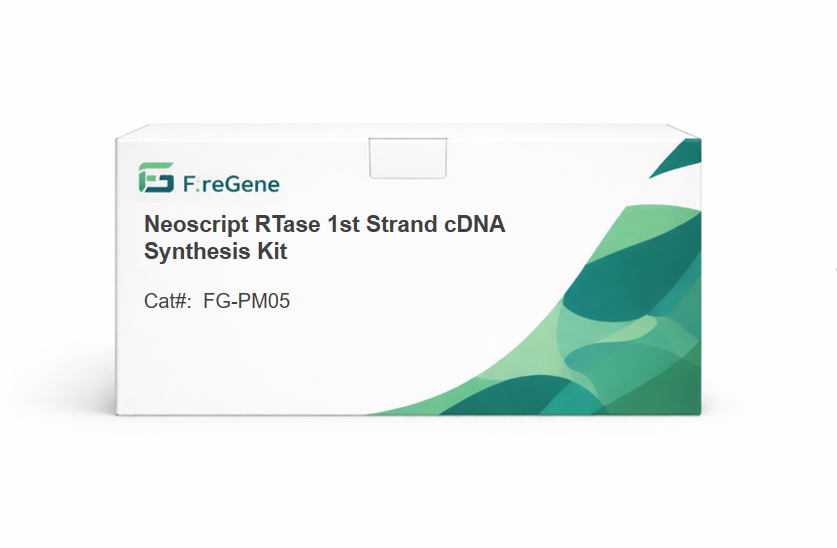
This kit provides all reagents required for first-strand cDNA synthesis. Neoscript RTase is a reverse transcriptase derived from the Moloney murine leukemia virus (M-MLV) gene, obtained through mutation screening and recombinant expression in E. coli. The RNase H activity of this enzyme has been removed, giving it higher temperature tolerance and making it suitable for high-temperature reverse transcription. This helps eliminate the adverse effects of RNA secondary structure and non-specific factors on cDNA synthesis, and provides greater stability and reverse transcription capability. It can synthesize first-strand cDNA fragments up to 12 kb in length.
Kit Components
| Component |
|---|
| 200 U/µL Neoscript RTase |
| 5× First-Strand Buffer |
| 40 U/µL RNase Inhibitor |
| Oligo(dT)18 Primer (50 µM) |
| Random 6 mers (50 µM) |
| 10 mM dNTP Mix |
Specifications
| Product Name | Neoscript RTase 1st Strand cDNA Synthesis Kit |
| Catalog No. | FG-PM05 |
| Enzyme Source | M-MLV reverse transcriptase, RNase H activity removed, recombinantly expressed in E. coli |
| Maximum cDNA Length | Up to 12 kb |
| Optimal RT Temperature Range | 42°C–55°C |
| Unit Definition | 1 U = amount of enzyme required to incorporate 1 nmol of dTTP within 10 min at 37°C, using poly(A)·Oligo(dT)25 as template/primer |
| Purity | SDS-PAGE purity > 98% |
| Key Applications | First-strand cDNA synthesis, PCR/qPCR template preparation, cDNA library construction, 3′ and 5′ RACE |
| Storage Conditions | -20 ± 5°C; mix well before use; avoid repeated freeze-thaw cycles |
Protocol Overview
Step 1 — Primer annealing setup (10 µL):
| Reagent | 20 µL system | Final concentration |
|---|---|---|
| Oligo(dT)18 Primer (50 µM) | 1 µL | 2.5 µM |
| Or Random 6 mers (50 µM) | 1 µL (0.4–2 µL) | 2.5 µM (1–5 µM) |
| Or Gene-specific Primer (10 µM) | 0.2–2 µL | 0.1–1 µM |
| 10 mM dNTP | 1 µL | 500 µM |
| Template RNA | —— | Total RNA ≤ 5 µg; mRNA ≤ 1 µg |
| RNase-free dH2O | To 10 µL | —— |
Heat at 65°C for 5 min, then cool rapidly on ice for 2 min.
Step 2 — Reverse transcription setup (add to reach 20 µL total):
| Reagent | 20 µL system | Final concentration |
|---|---|---|
| 5× First-Strand Buffer | 4 µL | 1× |
| 200 U/µL Neoscript RTase | 1 µL | 10 U/µL |
| 40 U/µL RNase Inhibitor | 0.5 µL | 1 U/µL |
| RNase-free dH2O | To 20 µL | —— |
Step 3 — Incubation:
- If using Random Primers: 25°C for 10 min, then 50°C for 30–60 min
- If using Oligo dT or a gene-specific primer: 50°C for 30–60 min
Step 4 — Reaction termination: Heat at 95°C for 5 min (or 70°C for 15 min for long-fragment applications) to inactivate Neoscript RTase.
The reverse transcription product can be used directly for PCR and real-time qPCR, or stored long-term at -20°C.
Technical Notes
- High-purity, intact RNA template is critical for high-quality, full-length cDNA synthesis. Trace genomic DNA contamination may be co-amplified with the target gene; DNase I pretreatment is recommended if genomic DNA-free amplification is required.
- Adding RNase Inhibitor effectively suppresses nuclease-mediated degradation of the RNA template.
- For long-fragment amplification, inactivating the reverse transcriptase at 70°C for 15 min (instead of 95°C) helps prevent damage to the cDNA structure.
- If amplified band intensity is weak, consider increasing RNA template and primer concentrations.
- Neoscript RTase is suitable for reverse transcription in the 42–55°C range; increasing the RT temperature can improve specificity when amplifying RNA with complex secondary structure.
- Suitable for cDNA library construction and 3′/5′ RACE.
Frequently Asked Questions
Neoscript RTase is a reverse transcriptase derived from the Moloney murine leukemia virus (M-MLV) gene, obtained through mutation screening and recombinant expression in E. coli, with its RNase H activity removed.
The kit can synthesize first-strand cDNA fragments up to 12 kb in length.
Neoscript RTase performs well across 42°C–55°C. Increasing the reaction temperature within this range can improve specificity when reverse transcribing RNA templates with complex secondary structure.
Trace genomic DNA introduced during RNA template preparation may be co-amplified with the target gene. If your downstream application requires complete absence of genomic DNA, DNase I pretreatment of the RNA template is recommended.
For cDNA synthesis under 2 kb, use 1–2 µL of Random 6 mers; for synthesis over 2 kb, use 0.4–1 µL. A gene-specific primer can also be used at a final concentration of 0.1–1 µM, depending on your target and downstream application.
One unit (U) is defined as the amount of enzyme required to incorporate 1 nmol of dTTP within 10 minutes at 37°C, using poly(A)·Oligo(dT)25 as the template/primer.
Neoscript RTase meets SDS-PAGE purity greater than 98%, with quality control testing for amplification sensitivity, lot-to-lot variation, stability, and absence of exogenous nuclease contamination.
Store at -20 ± 5°C. Mix well before use and avoid repeated freeze-thaw cycles.
Yes, Neoscript RTase is suitable for cDNA library construction as well as 3′ and 5′ RACE (Rapid Amplification of cDNA Ends).
Heat at 95°C for 5 min to terminate the reaction. For long-fragment applications, heating at 70°C for 15 min instead is recommended to avoid damaging the cDNA structure.