
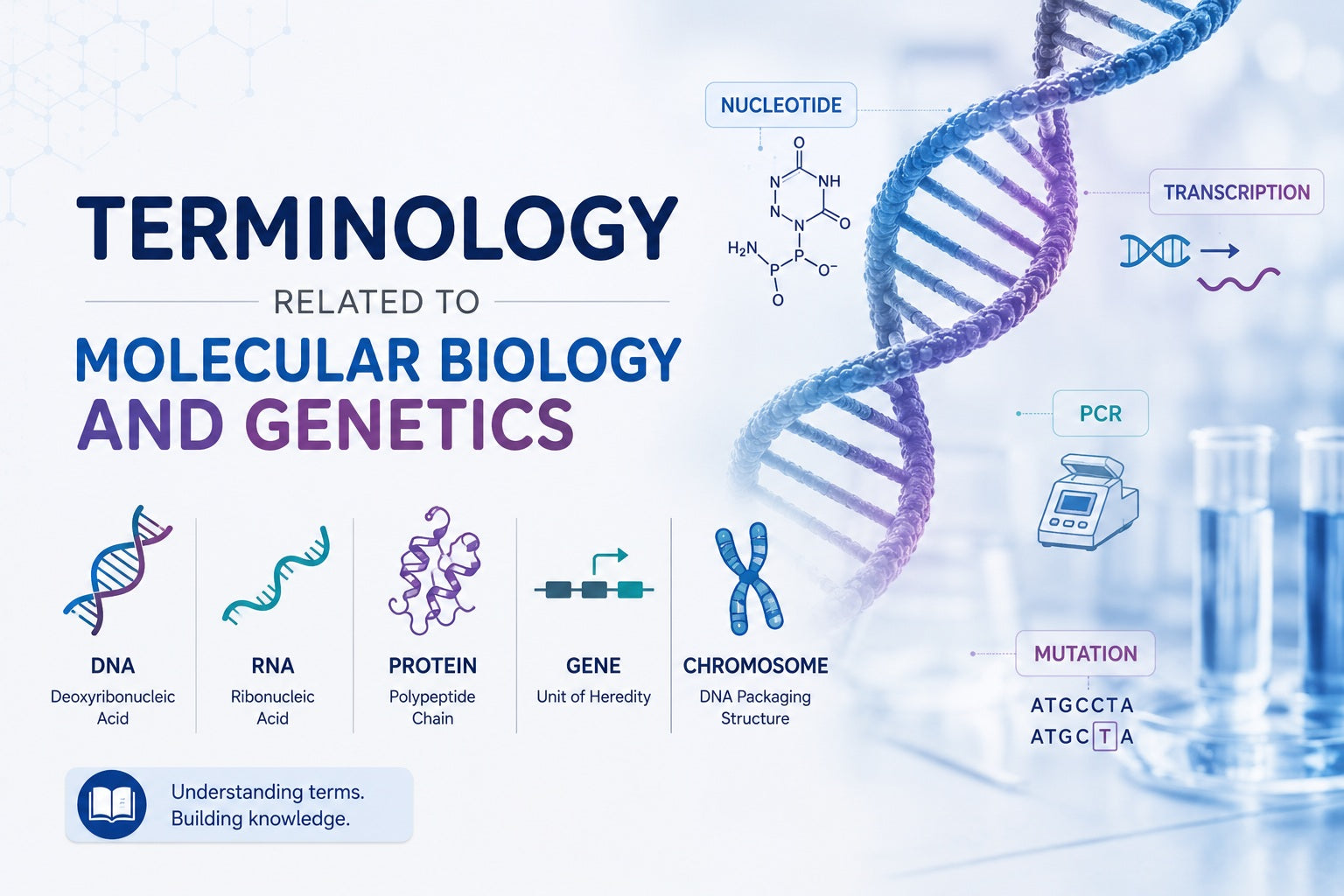
DNA is the primary genetic material in most organisms and carries the instructions used to build, regulate, and maintain biological systems. RNA is a related nucleic acid that helps convert genetic information into functional molecules, including proteins and regulatory RNAs. Understanding molecular biology and genetics terminology helps researchers, lab managers, biotech teams, diagnostics labs, and academic laboratories choose the right reagents, interpret protocols, design assays, and connect sample preparation to PCR, qPCR, RNA sequencing, NGS library preparation, and molecular diagnostics.
What Are the Most Important Molecular Biology and Genetics Terms?
The most important molecular biology and genetics terms include DNA, RNA, nucleic acid, gene, genome, genetic material, coding region, non-coding region, exon, intron, regulatory sequence, promoter, transcription, translation, PCR, qPCR, sequencing, and NGS library preparation. These terms describe how genetic information is stored, copied, expressed, analyzed, and measured in modern research and diagnostic workflows.
What Is DNA?
DNA, or deoxyribonucleic acid, is a nucleic acid that stores genetic information. It is made of nucleotide building blocks containing a sugar, a phosphate group, and a nitrogenous base. The four DNA bases are adenine, thymine, cytosine, and guanine, commonly abbreviated as A, T, C, and G.
DNA is arranged in a double-stranded helix. The base pairing pattern, A with T and C with G, allows DNA to be copied and used as a template for gene expression. In laboratory workflows, DNA may be extracted, purified, amplified, sequenced, cloned, quantified, or analyzed for genetic variation.
DNA-related applications include:
- Genotyping and variant analysis
- PCR and qPCR assays
- NGS library preparation
- Molecular diagnostics research
- Cloning and synthetic biology
- Microbial and viral detection
- Forensic, agricultural, and environmental research
What Is RNA?
RNA, or ribonucleic acid, is a nucleic acid involved in gene expression, regulation, protein production, and many cellular processes. RNA is usually single-stranded and contains the bases adenine, uracil, cytosine, and guanine. Uracil replaces thymine, which is found in DNA.
Several RNA types are important in molecular biology:
- mRNA: Messenger RNA carries coding information from DNA to protein-making machinery.
- rRNA: Ribosomal RNA is part of ribosomes.
- tRNA: Transfer RNA helps bring amino acids during protein synthesis.
- miRNA and other regulatory RNAs: These help regulate gene expression.
- Viral RNA: Some viruses use RNA as genetic material.
RNA is central to RT-PCR, RT-qPCR, RNA-seq, single-cell RNA sequencing, viral detection, gene expression analysis, and transcriptomics.
DNA vs RNA: What Is the Difference?
DNA and RNA are both nucleic acids, but they differ in structure and function.
FeatureDNARNA
- Full name Deoxyribonucleic acid Ribonucleic acid
- Common structure: Double-stranded, usually single-stranded
- Main role: Long-term genetic storage, Gene expression, and regulation
- Bases A, T, C, G A, U, C, G
- Sugar Deoxyribose Ribose
- Common lab methods: PCR, qPCR, DNA-seq, cloning, RT-PCR, RT-qPCR, RNA-seq, transcriptomics
The structure and function of DNA and RNA in molecular biology are closely connected. DNA stores the genetic blueprint, while RNA helps express and interpret that information in cells and laboratory assays.
What Is a Nucleic Acid?
A nucleic acid is a biological molecule made of nucleotide units. DNA and RNA are the two main types. Nucleic acids store, transmit, and express genetic information. In the lab, nucleic acid quality matters because downstream workflows depend on purity, quantity, and integrity. A purified DNA sample may be used for PCR, qPCR, cloning, sequencing, or NGS library preparation. A purified RNA sample may be used for reverse transcription, RT-qPCR, RNA-seq, single-cell sequencing, or viral detection.
What Is Genetic Material?
Genetic material is the molecule that carries hereditary information. In most organisms, genetic material is DNA. In some viruses, the genetic material is RNA. Genetic material contains instructions that influence traits, cellular function, replication, and gene expression.
For life science research, genetic material may come from human samples, animal tissues, plants, microbes, viruses, cultured cells, FFPE tissues, environmental samples, or food samples. The source affects which extraction, purification, amplification, and sequencing workflow is most suitable.
What Is a Gene?
A gene is a functional segment of DNA that contributes to a biological product, such as RNA or protein. A gene usually includes regions that help control expression and regions that are transcribed into RNA.
Gene-related terminology includes:
- Regulatory sequence: A DNA sequence that helps control when, where, or how strongly a gene is expressed.
- Promoter: A regulatory region near a gene where transcription machinery can bind.
- Coding region: A portion of a gene that contains information used to produce a protein sequence.
- Non-coding region: DNA that does not directly code for protein but may have regulatory, structural, or other functions.
- Exon: A gene segment retained in the final mature RNA.
- Intron: A gene segment removed from the RNA transcript during splicing.
Understanding these terms helps researchers design primers, interpret gene expression data, choose sequencing methods, and analyze variants.
Coding vs Non-Coding DNA: What Is the Difference?
Coding DNA contains sequences that can be translated into protein-coding information. Non-coding DNA does not directly encode proteins, but it can have important functions in gene regulation, chromosome structure, RNA production, and genome organization.
The difference between coding and non-coding DNA regions is important for assay design. A PCR assay targeting a coding region may help analyze a gene variant or coding sequence. A study focused on regulatory sequences may examine promoters, enhancers, or other non-coding elements that influence gene expression. In NGS workflows, panels may target coding exons, selected regulatory regions, whole genomes, transcriptomes, or specific amplicons depending on the research question.
What Are Exons and Introns in Gene Structure and Function?
Exons are parts of a gene that remain in the final mature RNA after processing. Introns are transcribed into precursor RNA but are removed during RNA splicing. In many eukaryotic genes, exons and introns alternate along the gene.
This distinction matters in molecular biology workflows:
- RT-PCR primers may be designed across exon-exon junctions to detect RNA-derived cDNA.
- Genomic DNA PCR may amplify both exons and introns if primers flank those regions.
- RNA-seq can measure exon usage and splice variants.
- Variant analysis may focus on exons, splice sites, or regulatory regions.
- Single-cell RNA sequencing may capture expressed transcripts from many cells.
What Is a Regulatory Sequence?
A regulatory sequence is a DNA region that influences gene expression. Promoters, enhancers, silencers, insulators, and other control elements can affect whether a gene is active, where it is active, and how much RNA is produced.
Regulatory sequences are important in genetics, molecular diagnostics research, cancer biology, developmental biology, and functional genomics. When researchers study gene expression changes, they may look beyond coding regions to understand how regulatory DNA affects RNA production.
Key Applications of Molecular Biology Terminology in the Lab
PCR and qPCR
PCR and qPCR rely on DNA, primers, polymerases, templates, amplicons, and fluorescence or detection chemistry. Knowing the difference between genomic DNA, cDNA, exons, introns, and coding regions helps researchers design better assays.
RT-PCR and RT-qPCR
RNA workflows involve RNA extraction, reverse transcription, cDNA synthesis, and amplification. Terminology such as mRNA, transcript, exon junction, and gene expression is central to assay interpretation.
Nucleic Acid Extraction and Purification
Extraction workflows isolate DNA or RNA from cells, tissues, blood, FFPE samples, viruses, or environmental materials. Understanding nucleic acid type, sample source, and downstream assay helps labs choose the right kit.
NGS Library Preparation
NGS workflows depend on fragment size, adapters, indexes, library amplification, target regions, RNA-seq, DNA-seq, and library quantification. Genetics terminology helps connect experimental design to sequencing output.
Single-Cell Sequencing
Single-cell RNA sequencing and single-nucleus sequencing measure gene expression at cellular resolution. Terms such as RNA, transcriptome, nuclei, gene expression, cell recovery, and sequencing library are essential for planning.
How to Choose the Right Kit, Reagent, or Workflow
Use the terminology to guide purchasing decisions. Start with the biological question, then match the product category to the target molecule and workflow.
- Research NeedKey Terms to KnowProduct Category to Review
- Amplify DNA, primer, polymerase, amplicon, PCR/qPCR, and Molecular Biology Reagents
- Measure gene expression RNA, mRNA, cDNA, RT-qPCR RNA Extraction and Reverse Transcription Reagents
- Prepare sequencing libraries, DNA-seq, RNA-seq, adapters, indexes, and NGS Library Prep Kits
- Study cell-level expression transcriptome, cell recovery, nuclei, and Single Cell Sequencing Sample Preparation
- Isolate genetic material nucleic acid, DNA, RNA, sample type: Nucleic Acid Extraction and Purification
- Analyze regulatory regions, promoter, enhancer, non-coding DNA, PCR, qPCR, NGS, and sequencing workflows
- Support QC workflows, assay performance, controls, documentation, Lab Buffers, and General Research Reagents
Important Factors to Consider Before Buying
Before buying molecular biology reagents, ask:
- Are you working with DNA, RNA, or total nucleic acid?
- What is the sample type: cells, tissue, blood, FFPE, virus, or environmental material?
- Is the downstream method PCR, qPCR, RT-qPCR, RNA-seq, DNA-seq, cloning, or single-cell sequencing?
- Do you need high purity, high yield, intact RNA, or inhibitor removal?
- Are primers designed for exons, introns, coding regions, or regulatory sequences?
- Does the workflow require reverse transcription, library preparation, or sequencing cleanup?
- Are protocols, storage conditions, and technical support clearly available?
How FireGene Supports Reliable Molecular Biology Workflows
FireGene supports molecular biology and diagnostic applications with products for nucleic acid extraction and purification, PCR/qPCR and molecular biology reagents, NGS library preparation, single-cell sequencing sample preparation, tissue dissociation, molecular diagnostics and PCR detection, endotoxin testing and QC, and lab buffers. These categories help researchers move from genetic material to purified nucleic acid, amplification, sequencing, and assay analysis.
For scientific buyers, connecting terminology to product categories makes purchasing more practical. A team studying RNA expression may need RNA extraction, reverse transcription, qPCR reagents, or RNA-seq library preparation. A team analyzing DNA regions may need DNA extraction, polymerases, PCR master mixes, or NGS tools.
FAQs
What is DNA in molecular biology?
DNA is a nucleic acid that stores genetic information. It is made of nucleotide bases and is commonly analyzed using PCR, qPCR, sequencing, cloning, and molecular diagnostic research workflows.
What is the difference between DNA and RNA?
DNA usually stores long-term genetic information and is double-stranded. RNA is usually single-stranded and helps with gene expression, regulation, protein production, and viral detection in some workflows.
What is a nucleic acid?
A nucleic acid is a molecule made of nucleotide units. DNA and RNA are the two main nucleic acids used in molecular biology, genetics, diagnostics, sequencing, and research applications.
What is the difference between coding and non-coding DNA?
Coding DNA contains information that can be translated into proteins. Non-coding DNA does not directly encode proteins but may regulate gene expression, contribute to chromosome structure, or produce functional RNA molecules.
What are exons and introns?
Exons are gene segments retained in mature RNA after processing. Introns are transcribed into precursor RNA but removed during splicing. Exons and introns are important for primer design, RNA-seq, RT-PCR, and gene structure analysis.
Conclusion:
DNA and RNA are nucleic acids that form the foundation of molecular biology and genetics. DNA stores genetic information, while RNA supports gene expression and regulation. Terms such as genetic material, coding region, regulatory sequence, exon, intron, promoter, and non-coding DNA help researchers design experiments, interpret results, and choose suitable reagents. By linking terminology to workflows such as nucleic acid extraction, PCR, qPCR, RT-qPCR, NGS library preparation, RNA sequencing, and single-cell sequencing, labs can make clearer scientific and purchasing decisions.


