
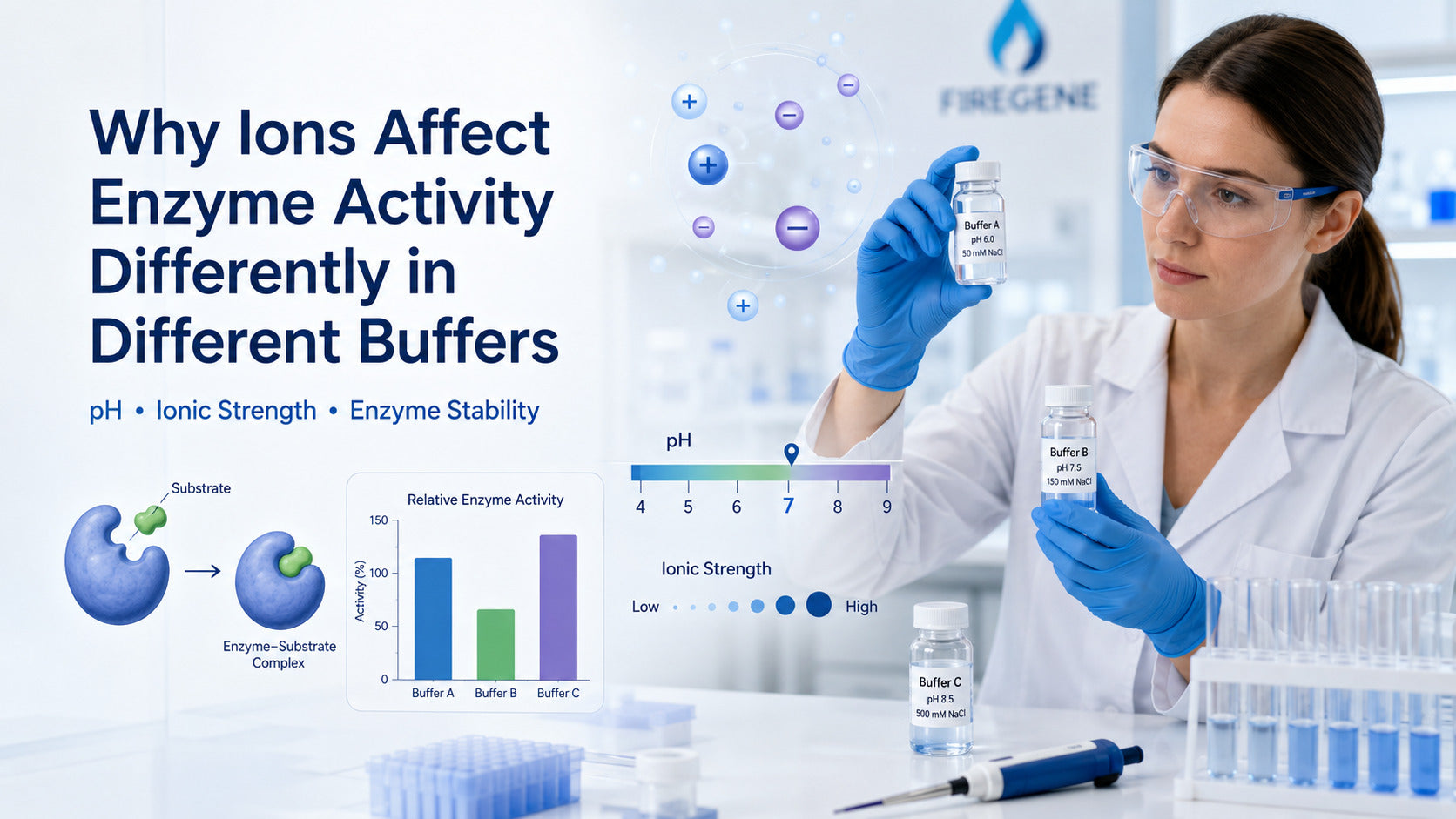
Enzyme activity is the rate or efficiency at which an enzyme converts a substrate into a product under specific reaction conditions. Ions affect enzyme activity differently in each buffer because buffer composition controls pH, ionic strength, metal ion availability, charge interactions, protein stability, and substrate binding. In molecular biology, diagnostics, quality control, PCR/qPCR, nucleic acid extraction, and enzyme-based assays, choosing the right buffer helps create a reaction environment where the enzyme can perform consistently, and the assay can be interpreted with confidence.
Ions affect enzyme activity differently because each buffer has its own pH range, ionic strength, chemical groups, and interaction profile. Cation ions such as calcium, magnesium, sodium, potassium, or manganese can stabilize enzymes, support catalysis, change protein charge, influence substrate binding, or contribute to enzyme inhibition. A phosphate buffer may interact with metal-dependent enzymes differently from the MES buffer because phosphate can bind metals and participate in ionic interactions. At the same time, MES is commonly used as a Good’s buffer with a different chemical behavior and a useful pH range.
What Is Enzyme Activity?
Enzyme activity describes how effectively an enzyme catalyzes a reaction. It can be measured by product formation, substrate consumption, colorimetric signal, fluorescence, luminescence, amplification output, or another assay readout. Enzyme activity depends on many variables, including pH, temperature, substrate concentration, cofactors, inhibitors, ionic strength, buffer type, salt concentration, and reagent quality.
In practical laboratory workflows, enzyme activity matters because enzymes are used in PCR, qPCR, reverse transcription, nucleic acid extraction, NGS library preparation, protein assays, diagnostic research, endotoxin testing workflows, and general molecular biology applications.
What Is a Buffer and Why Does It Matter for Enzymes?
A buffer is a solution that helps maintain a stable pH during a reaction. Enzymes are proteins with charged amino acids that respond strongly to pH and ionic conditions. Even when two buffers are adjusted to the same pH, their ions and chemical structures can influence enzyme behavior differently.
A buffer can affect enzyme activity by influencing:
- Protein folding and stability
- Active site charge
- Substrate binding
- Cofactor availability
- Solubility of salts or metals
- Enzyme inhibition or activation
- Assay background signal
- Compatibility with downstream detection methods
This is why buffer selection is not only a pH decision. It is also a chemistry decision.
Why Ionic Strength Changes Enzyme Performance
Ionic strength describes the total concentration and charge of ions in a solution. It influences electrostatic interactions between the enzyme, substrate, cofactors, and surrounding molecules. Some enzymes perform well at moderate ionic strength because salts help stabilize protein structure and reduce nonspecific interactions. Other enzymes may lose activity if ionic strength becomes too high or if a specific ion interacts with the active site.
For example, increasing sodium chloride concentration may improve solubility for one protein while reducing substrate binding for another. Magnesium ions may be essential for many nucleic acid enzymes, while calcium ions may support or modify the activity of certain enzymes. The exact effect depends on the enzyme structure, substrate, buffer chemistry, and assay design.
How Cation Ions Affect Enzyme Activity
Cation ions are positively charged ions such as Ca²⁺, Mg²⁺, Na⁺, K⁺, Mn²⁺, and Zn²⁺. Their effects can be beneficial, neutral, or inhibitory depending on the enzyme.
Cations may influence enzyme activity by:
- Acting as cofactors for catalysis
- Stabilizing enzyme structure
- Supporting substrate positioning
- Shielding negative charges on DNA, RNA, proteins, or substrates
- Changing active-site geometry
- Competing with required metal ions
- Promoting or reducing aggregation
- Altering the assay signal or background
Example: Effect of Calcium Ions on β-Galactosidase Activity
The effect of calcium ions on β-galactosidase activity depends on enzyme source, assay buffer, substrate, calcium concentration, and pH. In some enzyme systems, calcium may support structural stability or influence activity, while in others it may have little effect or compete with other ions. This is why labs should test ion concentration in the exact buffer and assay conditions used for their workflow.
Difference Between MES Buffer and Phosphate Buffer
MES buffer and phosphate buffer can both be useful, but they are chemically different and may influence enzyme activity in different ways.
|
Feature |
MES Buffer |
Phosphate Buffer |
|
Common use |
Biological and biochemical assays in mildly acidic pH ranges |
Broad biological, molecular biology, and protein workflows |
|
Buffer chemistry |
Good’s buffer with low metal-binding tendency in many workflows |
Inorganic buffer that can interact with some metal ions |
|
Practical pH range |
Often used around pH 5.5–6.7 |
Often used around pH 6–8 depending on formulation |
|
Enzyme impact |
Useful when minimal interaction with many biomolecules is desired |
Can be suitable but may affect metal-dependent enzymes or assays |
|
Buyer consideration |
Good for assays requiring mild pH and controlled interactions |
Familiar, accessible, and useful for many general workflows |
The difference between MES buffer and phosphate buffer is important because enzyme performance may change even when both buffers are adjusted to the same pH. The ions and chemical groups around the enzyme can influence activity, stability, and assay readout.
How Buffer Composition Affects Enzyme Activity
Buffer composition affects enzyme activity through several connected mechanisms.
pH and Active Site Charge
Each enzyme has an optimal pH range. pH changes can alter the charge of amino acids in the active site and influence substrate binding. A buffer with strong capacity near the target pH helps maintain a stable reaction environment.
Metal Ion Availability
Many enzymes require metal cofactors. If the buffer binds, precipitates, or competes with those ions, enzyme activity can change. This is especially important for polymerases, nucleases, kinases, phosphatases, ligases, and other molecular biology enzymes.
Ionic Strength and Electrostatic Interactions
Salt concentration influences the attraction between charged molecules. In nucleic acid workflows, ions can affect DNA/RNA structure, enzyme-template interactions, primer binding, and amplification behavior.
Chemical Compatibility
Some buffers can interact with assay components, substrates, detection reagents, or metal ions. For example, phosphate may not be ideal for every metal-dependent assay, while Tris can interact with certain chemical detection systems. MES, HEPES, MOPS, phosphate, Tris, and acetate systems should be evaluated based on the specific enzyme and readout.
Key Applications Where Buffer and Ion Choice Matter
PCR and qPCR
Polymerase activity depends on magnesium concentration, salt balance, pH, template quality, primer binding, and buffer formulation. Commercial PCR and qPCR reagents are often optimized so users do not need to build reaction chemistry from scratch.
Reverse Transcription and cDNA Synthesis
Reverse transcriptases require compatible salts, pH, cofactors, and stabilizers. Buffer composition can influence RNA-template binding, enzyme stability, and downstream qPCR performance.
Nucleic Acid Extraction and Purification
Extraction buffers use salts, chaotropic agents, wash solutions, and elution conditions to lyse samples, bind nucleic acids, remove impurities, and preserve DNA or RNA quality. Buffer selection affects downstream PCR, qPCR, NGS library preparation, and molecular diagnostics research.
NGS Library Preparation
Enzyme steps in NGS library preparation may include fragmentation, end repair, A-tailing, ligation, amplification, and cleanup. Each step uses optimized buffer conditions to support enzyme specificity and yield.
Endotoxin Testing and QC
Assay buffers and ion conditions can influence protein-based and enzyme-based detection workflows. QC teams benefit from consistent reagents, clear protocols, and compatible sample preparation.
How to Choose the Right Buffer or Reagent System
Choosing the right buffer starts with the enzyme and application.
Step 1: Define the Enzyme Function
Identify whether the enzyme is a polymerase, nuclease, ligase, kinase, phosphatase, protease, glycosidase, oxidase, or another class. Metal requirements and pH preferences vary widely.
Step 2: Match the Buffer pH to the Enzyme Range
Choose a buffer with strong capacity near the enzyme’s working pH. Avoid selecting a buffer only because it is common in the lab.
Step 3: Review Ion and Metal Compatibility
Check whether the enzyme requires Mg²⁺, Mn²⁺, Ca²⁺, Zn²⁺, or another cofactor. Consider whether buffer components may bind, compete with, or precipitate the needed ion.
Step 4: Consider the Downstream Readout
Some buffers are compatible with fluorescence, absorbance, sequencing, amplification, or protein assays, while others may increase background or interfere with detection.
Step 5: Use Validated Kits When Workflow Consistency Is Important
For PCR/qPCR, reverse transcription, nucleic acid extraction, and NGS library preparation, pre-optimized reagent systems can support reliable workflow setup and reduce the need for extensive buffer development.
Important Factors to Consider Before Buying
|
Buying Factor |
Why It Matters |
Product Category to Review |
|
Enzyme class |
Different enzymes need different pH and ions |
|
|
Buffer pH range |
Activity depends on active-site charge |
Lab Buffers and General Research Reagents |
|
Metal cofactors |
Cations may activate, stabilize, or inhibit |
Molecular Biology Reagents |
|
Ionic strength |
Affects electrostatic interactions and stability |
Lab Buffers |
|
Sample type |
Tissue, cells, nucleic acids, or proteins influence conditions |
|
|
Downstream assay |
qPCR, NGS, extraction, QC, or diagnostics may need specific formulations |
Application-specific kits |
|
Documentation |
Supports repeatability and procurement confidence |
Technical protocols and product specifications |
Common Buffer Selection Mistakes to Avoid
A helpful buffer selection process focuses on compatibility and consistency. Labs can improve enzyme assay performance by avoiding a few common workflow habits.
Instead of assuming all buffers at the same pH behave the same way, compare buffer chemistry, ionic strength, and cation compatibility. Instead of changing multiple variables at once, adjust pH, salt concentration, or ion type one at a time. Instead of using a general buffer for every enzyme, choose a system that fits the enzyme class and detection method.
Practical improvements include:
- Confirm the enzyme’s recommended pH range
- Check whether the enzyme needs metal cofactors
- Compare MES buffer, phosphate buffer, Tris, or HEPES based on chemistry
- Keep ionic strength consistent between experiments
- Use high-quality water and clean labware
- Record buffer composition, pH, temperature, and lot number
- Validate buffer changes before applying them to important assays
How FireGene Supports Reliable Research Workflows
FireGene supports molecular biology and diagnostic applications with product areas that include lab buffers and general research reagents, PCR/qPCR and molecular biology reagents, nucleic acid extraction and purification kits, NGS library prep kits, molecular diagnostics and PCR detection, single-cell sequencing sample preparation, tissue dissociation kits, and endotoxin testing and QC.
For enzyme-based workflows, this category range helps researchers connect buffer choice with the full application. A team optimizing PCR can evaluate amplification reagents and buffer formats. A lab preparing RNA can connect extraction conditions to reverse transcription and qPCR. A QC team can review assay compatibility, documentation, and reagent consistency.
Practical Tips for Better Enzyme Activity Results
Better enzyme activity results often come from careful control of simple variables:
- Prepare buffers accurately and verify pH at the working temperature
- Keep ionic strength consistent across assay runs
- Use the recommended metal ion concentration when available
- Avoid unvalidated substitutions between buffer systems
- Protect enzymes from repeated freeze-thaw cycles
- Use compatible reagents for PCR, qPCR, NGS, or extraction workflows
- Document buffer composition and lot numbers
- Run small optimization tests when changing buffer, salt, or ion conditions
These practices help labs build reproducible workflows for research applications, biotech development, diagnostic research, academic laboratories, and pharmaceutical QC settings.
FAQs
What is the difference between the MES buffer and the phosphate buffer?
MES buffer is a Good’s buffer commonly used in mildly acidic pH ranges, while phosphate buffer is an inorganic buffer widely used in biological workflows. They differ in chemical structure, pH range, metal ion interactions, and potential effects on enzyme activity.
Can calcium ions affect β-galactosidase activity?
Yes, calcium ions can affect β-galactosidase activity depending on the enzyme source, buffer composition, substrate, calcium concentration, and assay pH. The effect should be evaluated in the exact assay conditions used by the lab.
How do I choose a buffer for enzyme assays?
Choose a buffer by reviewing the enzyme’s optimal pH, metal cofactor requirements, ionic strength tolerance, substrate compatibility, detection method, and downstream application. A small buffer comparison experiment can help confirm the best condition.
Can a phosphate buffer inhibit enzyme activity?
A phosphate buffer is useful in many workflows, but it may influence certain metal-dependent enzymes or assays because phosphate can interact with some ions and reaction components. Compatibility should be checked for the specific enzyme system.
Why do enzymes behave differently in buffers with the same pH?
Enzymes can behave differently in buffers with the same pH because buffer ions, ionic strength, chemical groups, metal binding, and assay compatibility vary. pH is important, but it is only one part of enzyme reaction chemistry.
Conclusion:
Ions affect enzyme activity differently in each buffer because enzyme structure, active-site chemistry, substrate binding, metal cofactors, pH, ionic strength, and buffer chemistry all work together. Cation ions such as calcium, magnesium, sodium, potassium, and manganese may activate, stabilize, compete with, or inhibit enzymes depending on the system. MES buffer and phosphate buffer can produce different results even at the same pH because their chemical interactions are not identical. By selecting buffers and reagent systems based on enzyme class, sample type, downstream application, and documentation needs, laboratories can create more consistent molecular biology and diagnostic workflows.


