
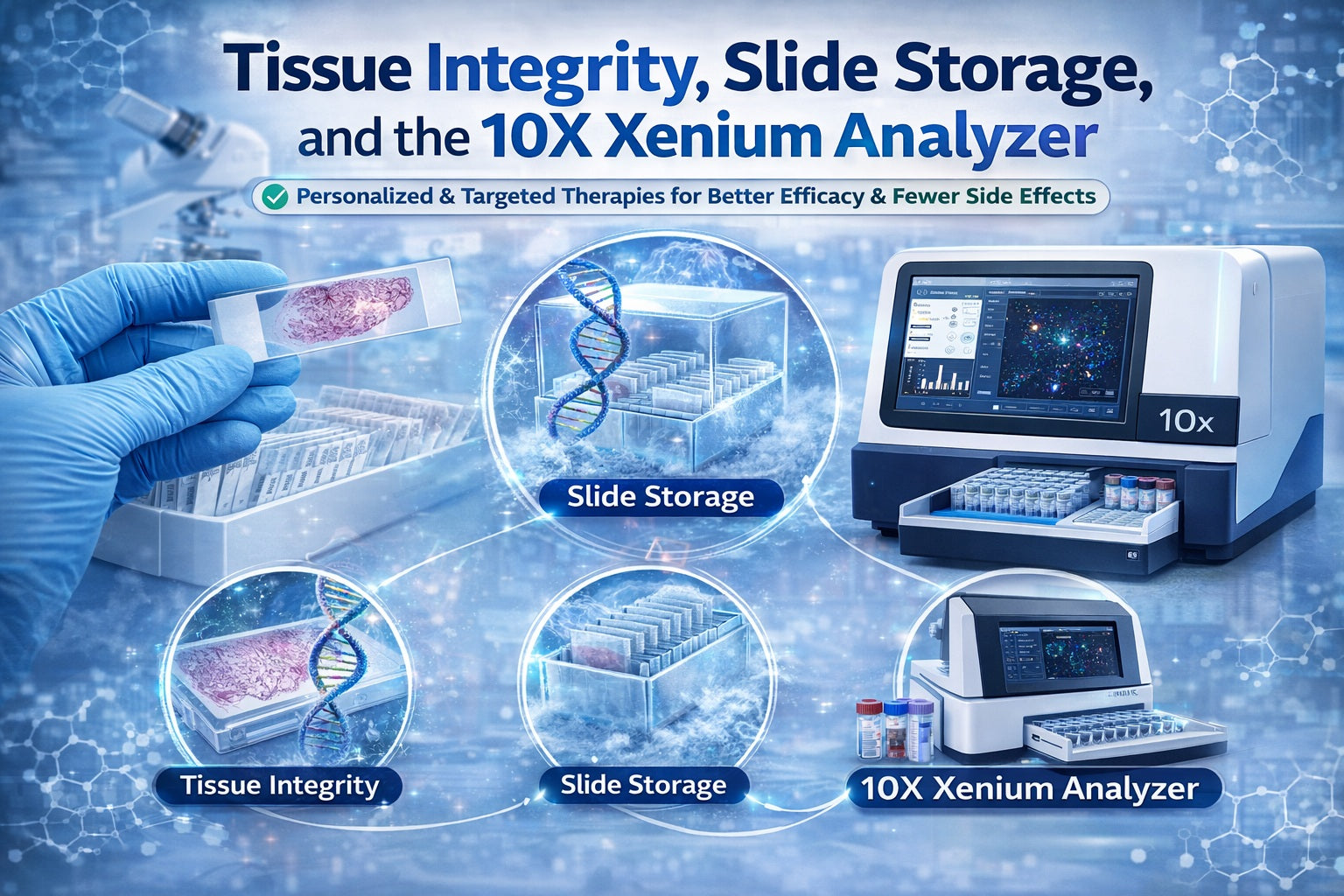
Spatial biology workflows feel most successful when the sample behaves beautifully from the very first step. For platforms like the 10x Xenium system, the quality of your results often starts long before the instrument runs, at tissue handling, sectioning, and slide storage. When tissue integrity is preserved and slide storage is handled consistently, downstream spatial readouts become clearer, more reproducible, and easier to interpret.
Why tissue integrity matters for spatial gene expression
Spatial gene expression methods aim to measure RNA signals while preserving tissue context—where each cell sits, how structures are organized, and how gene expression varies across regions.
When tissue integrity is high, you typically see:
- Clear morphology with minimal tearing or compression
- Strong, consistent RNA signal across sections
- Lower background and fewer artifacts
- Better alignment between tissue features and molecular signal
When integrity is reduced, you can still learn valuable biology, and you may see more variability across regions and slides. The encouraging part is that integrity is strongly influenced by controllable steps: collection, freezing, storage, sectioning, and slide handling.
The practical chain: tissue integrity → slide storage → instrument performance
For Xenium-style workflows, it helps to think in a simple chain:
- Tissue handling and freezing determine initial integrity.
- Frozen tissue storage controls stability over time.
- Sectioning and slide preparation translate tissue quality onto a slide.
- Xenium Analyzer slide storage practices maintain quality until processing.
This chain is powerful because improvements early on often multiply into better performance later.
Tissue integrity: what it means in the lab
“Tissue integrity” is a practical mix of:
- Morphological integrity: tissue structure remains intact
- Molecular integrity: RNA remains usable and consistent across the section
- Handling integrity: tissue avoids repeated thawing, drying, or mechanical damage
Spatial experiments benefit when all three are supported.
Best practices for frozen tissue storage
Many spatial workflows use frozen sections because freezing can preserve RNA well when performed and stored correctly.
Here are strong habits for frozen tissue storage that support long-term success:
1) Freeze quickly and consistently
Rapid stabilization helps preserve molecular signals. Consistency in how samples are frozen reduces sample-to-sample variability.
2) Minimize freeze–thaw cycles
Repeated thawing can change tissue handling properties and molecular signals. Using aliquots or dividing tissue into section-ready blocks helps.
3) Maintain stable storage temperature
Consistency matters. Stable storage conditions support more predictable sectioning and results.
4) Protect from dehydration
Proper packaging reduces freezer burn and protects tissue structure.
5) Track metadata
Record tissue type, collection time, stabilization method, storage date, and any handling notes. This makes troubleshooting and study comparisons much easier.
Slide storage: why it matters as much as sectioning
Once a tissue section is on a slide, it becomes more exposed to environmental factors.
Slide storage can influence:
- Tissue adherence and morphology
- Surface condition and contamination risk
- Moisture exposure and sample stability
- Consistency across batches
A strong slide storage routine keeps samples “analysis-ready” and supports reliable spatial workflows.
Practical slide storage guidance for Xenium workflows
Different labs use different validated protocols, and the best plan is always the one that aligns with your platform requirements and internal SOPs. The tips below focus on universal principles that improve consistency.
1) Standardize the time from sectioning to storage
Short, consistent handling windows reduce variability.
2) Keep slides dry, clean, and protected
Use covered slide containers and avoid unnecessary exposure to room air and humidity.
3) Label clearly and early
Use solvent- and cold-stable labeling methods so slides remain traceable through storage and processing.
4) Avoid repeated temperature cycling
Just as tissue blocks do, slides benefit from stable conditions. Plan workflows so slides are retrieved once and processed smoothly.
5) Build a “processing queue” system
If many slides are produced, store them in a defined order with an easy-to-follow schedule. This keeps handling calm and reduces errors.
6) Align storage with platform compatibility
For Xenium Analyzer slide storage, follow the instrument and chemistry requirements for storage temperature, storage duration, and packaging. A platform-matched SOP is the fastest route to consistency.
What to watch for: early signs your sample needs attention
Before committing valuable time and reagents, labs often benefit from quick checks.
Positive, practical indicators include:
- Tissue sections look intact and well-adhered
- Minimal folding, tearing, or compression
- Consistent section thickness
- Clear morphology across the section
If the sample looks uneven, small workflow adjustments (cutting temperature, blade changes, handling time, or storage packaging) often produce a noticeable improvement.
Where FireGene supports tissue workflows
FireGene is focused on practical molecular workflows—especially those where upstream sample handling determines downstream performance.
Tissue kits and preparation steps
Spatial biology workflows often depend on clean, consistent sample preparation. FireGene’s tissue kits and sample preparation-focused categories align with workflows that aim to improve consistency from the start.
Storage and stability mindset
Whether the goal is freezing, sectioning, or maintaining slides, stable storage habits reduce variation and support better biological interpretation.
Molecular biology technique alignment
Spatial gene expression is a modern extension of the molecular biology technique toolbox: success comes from strong inputs, controlled conditions, and repeatable handling.
A simple SOP-style checklist
Use this as a quick internal checklist for spatial workflows.
Tissue integrity checklist
- Tissue stabilized quickly after collection
- Consistent freezing approach used across samples
- Storage temperature stable
- Freeze–thaw cycles minimized
- Metadata recorded (date, tissue type, handling notes)
Slide storage checklist
- Sections cut consistently (thickness, orientation)
- Slides labeled clearly before storage
- Slides protected from humidity and contaminants
- Storage conditions standardized
- Slides were retrieved once and processed smoothly
Xenium workflow readiness
- Storage and handling aligned with platform SOP
- Slide queue plan established
- Quick morphology check performed before processing
This checklist supports calmer runs and stronger reproducibility.
FAQ
What is tissue integrity in spatial gene expression workflows?
Tissue integrity describes how well tissue structure and molecular signals are preserved from collection through sectioning, supporting reliable spatial readouts.
Why is slide storage important for Xenium experiments?
Slide storage protects tissue sections from environmental exposure and handling variation. Stable storage supports consistent results and smoother processing.
What does “Xenium Analyzer slide storage” mean?
Xenium Analyzer slide storage refers to storing prepared tissue slides in a way that stays compatible with the Xenium workflow requirements, supporting tissue integrity until processing.
How does frozen tissue storage affect spatial results?
Good frozen tissue storage supports stable morphology and molecular signals over time by minimizing degradation and handling stress.
Are tissue kits useful for spatial workflows?
Yes. Tissue kits and preparation workflows can support consistent handling and cleaner inputs, which helps spatial experiments feel more reproducible.
Conclusion
Spatial gene expression workflows shine when sample handling is prioritized. Preserving tissue integrity, standardizing slide storage, and aligning Xenium Analyzer slide storage practices with validated SOPs builds a strong foundation for 10x Xenium spatial gene expression experiments. With consistent frozen tissue storage, careful sectioning, and stable slide handling, your spatial results become clearer, more reproducible, and more confident—exactly what modern molecular biology techniques are designed to deliver.


