
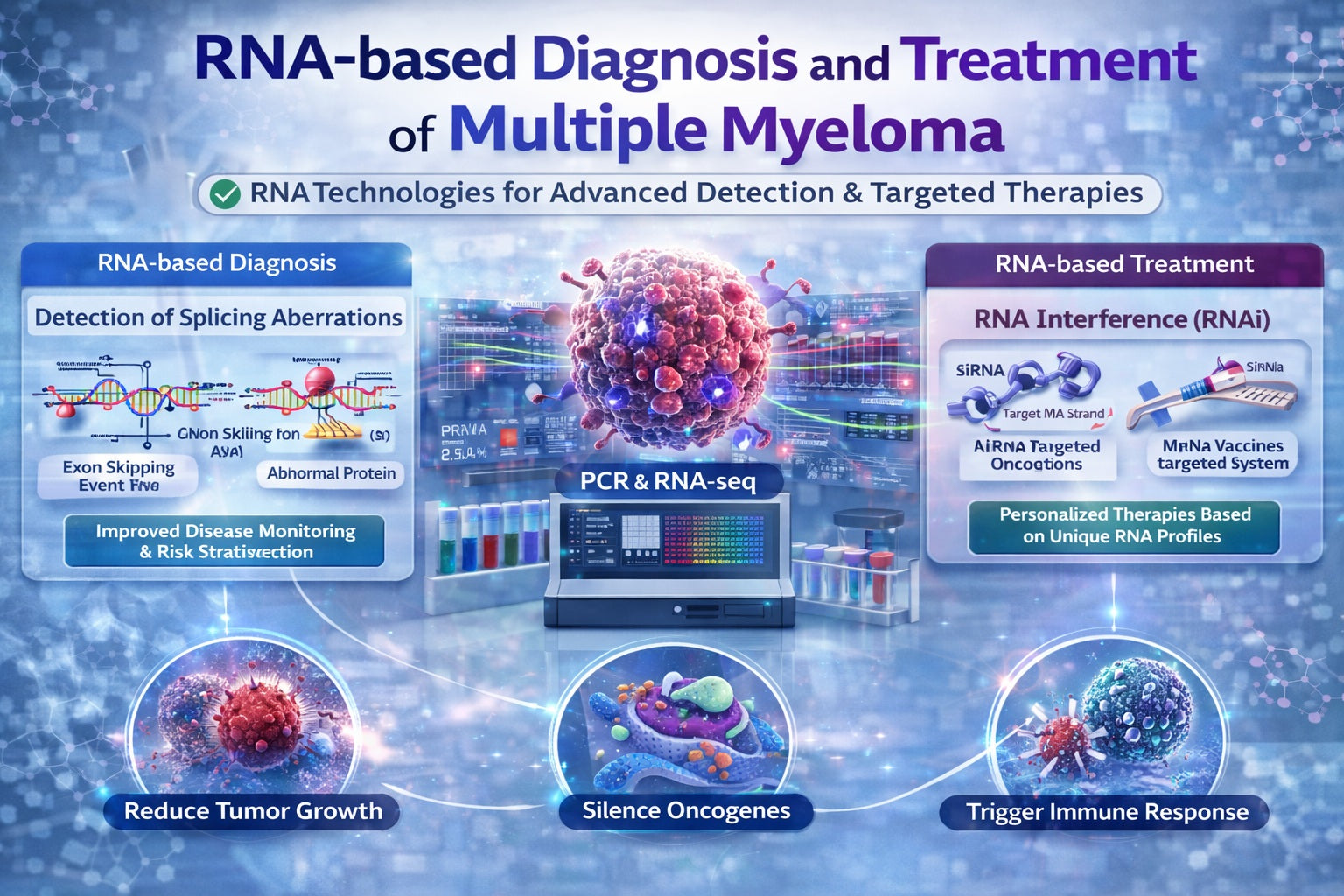
Multiple Myeloma is a plasma cell cancer that has inspired major advances in precision medicine. Researchers and clinicians now have more ways than ever to understand disease biology, monitor response, and tailor care. One of the most promising frontiers is RNA, because it captures what cancer cells are actively doing in real time.
We’ll explore how RNA diagnostics support modern testing, how high-quality RNA isolation enables reliable analysis, why liquid biopsy approaches are gaining momentum, and how emerging RNA-guided strategies connect to the evolving treatment of Multiple Myeloma. We’ll also highlight the growing importance of cell-free RNA as a biomarker source.
Multiple Myeloma in simple terms
Multiple Myeloma begins in plasma cells, immune cells that normally help produce antibodies. In Myeloma, these cells grow uncontrolled, often in the bone marrow, and can affect blood counts, bone health, kidney function, and immune balance.
Because Myeloma can be biologically diverse, molecular testing helps:
- Identify disease subtype and risk features
- Track response over time
- Detect early signs of relapse
- Support treatment planning and monitoring
RNA-based tools add a dynamic layer to that picture.
Why RNA is so valuable in diagnosis and monitoring
DNA changes can explain where cancer started. RNA can help explain how it behaves today.
RNA reflects:
- Which genes are actively expressed
- Which pathways are turned up or down
- How cells respond to therapy stress
- How the tumor microenvironment signals shift
This is why RNA diagnostics are increasingly used to complement traditional methods like protein markers, flow cytometry, and genomic assays.
RNA diagnostics: what they measure
RNA diagnostics often focus on signatures rather than single mutations. Depending on the assay, RNA testing may help:
- Classify disease biology using expression patterns
- Measure pathway activity linked to aggressiveness
- Identify transcripts related to drug sensitivity
- Track minimal residual disease signals in research settings
RNA data can be generated through:
- RT-qPCR panels
- Targeted RNA sequencing
- n- Transcriptome approaches in research environments
The most important foundation is consistent RNA extraction and clean input.
RNA isolation: the foundation for reliable RNA testing
High-quality RNA isolation is essential because RNA is more sensitive than DNA. It can degrade more easily if sample handling is inconsistent.
Strong RNA isolation typically supports:
- Better assay sensitivity
- More accurate quantification
- Lower variability between replicates
- Cleaner signal in sequencing or RT-qPCR
Practical factors that improve RNA isolation success
- Rapid stabilization after collection
- Consistent storage conditions
- Minimizing freeze–thaw cycles
- Using workflows designed to reduce inhibitors
These steps help RNA assays feel stable and interpretable, especially in clinical-adjacent research.
Liquid biopsy: a more flexible view of disease biology
A liquid biopsy uses blood-based material (such as plasma or serum) to capture molecular signals from cancer. In Multiple Myeloma, liquid biopsy approaches can complement bone marrow sampling by offering:
- More frequent monitoring of potential
- A broader view of systemic signals
- Reduced dependence on single-site sampling
Liquid biopsy is especially exciting when paired with RNA-based biomarkers.
Cell-free RNA: a growing biomarker opportunity
Cell-free RNA refers to RNA present in blood plasma/serum that is not contained within intact cells. It can appear in forms such as:
- RNA fragments
- RNA is protected within extracellular vesicles
- RNA associated with proteins
Because cell-free RNA reflects active gene expression signals, it can be informative for:
- Monitoring changes during therapy
- Observing immune and inflammatory patterns
- Exploring early relapse signals in research studies
Cell-free RNA analysis depends heavily on careful handling and strong RNA isolation strategies, because concentrations can be low and inhibitors matter.
How RNA supports the treatment of Multiple Myeloma
The treatment of Multiple Myeloma has expanded greatly with combinations that include proteasome inhibitors, immunomodulatory drugs, monoclonal antibodies, targeted agents, and cellular therapies.
RNA-based approaches support treatment in two key ways:
1) Treatment guidance through molecular understanding
RNA signatures can help researchers and clinicians understand:
- Tumor pathway activation
- Stress response pathways linked to resistance
- Immune environment signals
This can improve stratification and support more personalized care decisions.
2) Direct RNA-based therapies (an emerging area)
Across oncology, RNA-based therapeutics (such as siRNA and antisense approaches) are expanding. In myeloma research, these strategies are being explored to:
- Reduce expression of disease-driving genes
- Modulate survival pathways
- Adjust microenvironment signaling
This is an evolving field, and progress continues to strengthen the pipeline of future strategies.
A practical workflow: from sample to RNA insight
Here’s a simplified, real-lab pipeline for RNA-based myeloma analysis.
Step 1: Choose the sample type
Common research sample sources include:
- Bone marrow aspirate cells
- Peripheral blood mononuclear cells
- Plasma for liquid biopsy
Step 2: Stabilize and store correctly
Consistent storage keeps RNA quality strong and improves comparability across patients and timepoints.
Step 3: Perform RNA isolation
Use an RNA workflow matched to the sample type (cells vs plasma). Clean extraction is central for RT-qPCR and sequencing.
Step 4: QC and quantification
Use RNA quantification and integrity checks appropriate to your assay.
Step 5: Run the diagnostic or profiling method
- RT-qPCR panels for focused targets
- Targeted RNA sequencing for broader transcript detection
Step 6: Interpret results in clinical context
RNA results become most valuable when interpreted alongside clinical markers, imaging, and established diagnostic workups.
Where FireGene fits in RNA-based myeloma workflows
FireGene supports molecular workflows where dependable extraction and sample handling make downstream analysis more reliable.
FireGene-aligned touchpoints include:
RNA isolation and nucleic acid extraction
FireGene’s Nucleic Acid Extraction portfolio supports workflows that aim for clean, enzyme-compatible RNA inputs for RT-qPCR and sequencing.
Sample preparation support
For complex samples, preparation steps can improve consistency before extraction. FireGene’s Sample Preparation Kit category aligns with building cleaner inputs and smoother processing.
Downstream molecular readiness
After extraction, many labs use amplification and sequencing to power RNA-based insights. FireGene’s broader molecular biology reagent focus supports that measurement-driven approach. The practical advantage is consistency: when inputs are clean and protocols are repeatable, RNA diagnostics become more stable and interpretable.
Best-practice tips to strengthen RNA diagnostics in liquid biopsy
Because cell-free RNA can be delicate, these habits are especially helpful:
- Use consistent blood collection and processing timelines
- Separate plasma promptly and carefully
- Store at stable temperatures with minimal freeze–thaw
- Choose RNA isolation workflows designed for low-input material
- Include controls and replicates to track variability
These steps improve sensitivity and ensure signals remain reliable across timepoints.
FAQ
What are RNA diagnostics for Multiple Myeloma?
RNA diagnostics analyze RNA expression patterns to help characterize disease biology, monitor response, or support research into prognosis and treatment sensitivity in Multiple Myeloma.
Why is RNA isolation important?
RNA isolation provides clean RNA for RT-qPCR or sequencing. High-quality extraction improves sensitivity, accuracy, and reproducibility.
What is a liquid biopsy in Multiple Myeloma?
A liquid biopsy uses blood-based samples (often plasma) to detect molecular signals from cancer. It can support more flexible monitoring strategies and complement bone marrow sampling.
What is cell-free RNA?
Cell-free RNA is RNA found in plasma/serum outside of intact cells. It can reflect active biological processes and can be analyzed as part of liquid biopsy research workflows.
How can RNA-based methods support the treatment of Multiple Myeloma?
RNA-based approaches can support the treatment of Multiple Myeloma by improving molecular understanding of tumor behavior, helping monitor response, and contributing to research on RNA-guided therapeutic strategies.
CONCLUSION:
RNA-based approaches are strengthening our understanding and management of Multiple Myeloma. With reliable RNA isolation, modern RNA diagnostics can reveal dynamic biology that complements DNA and protein markers. Liquid biopsy strategies—especially those using cell-free RNA—are expanding the ability to monitor disease over time. As the field continues to advance, these RNA-driven tools support a more personalized, data-informed future for the treatment of Multiple Myeloma.


