
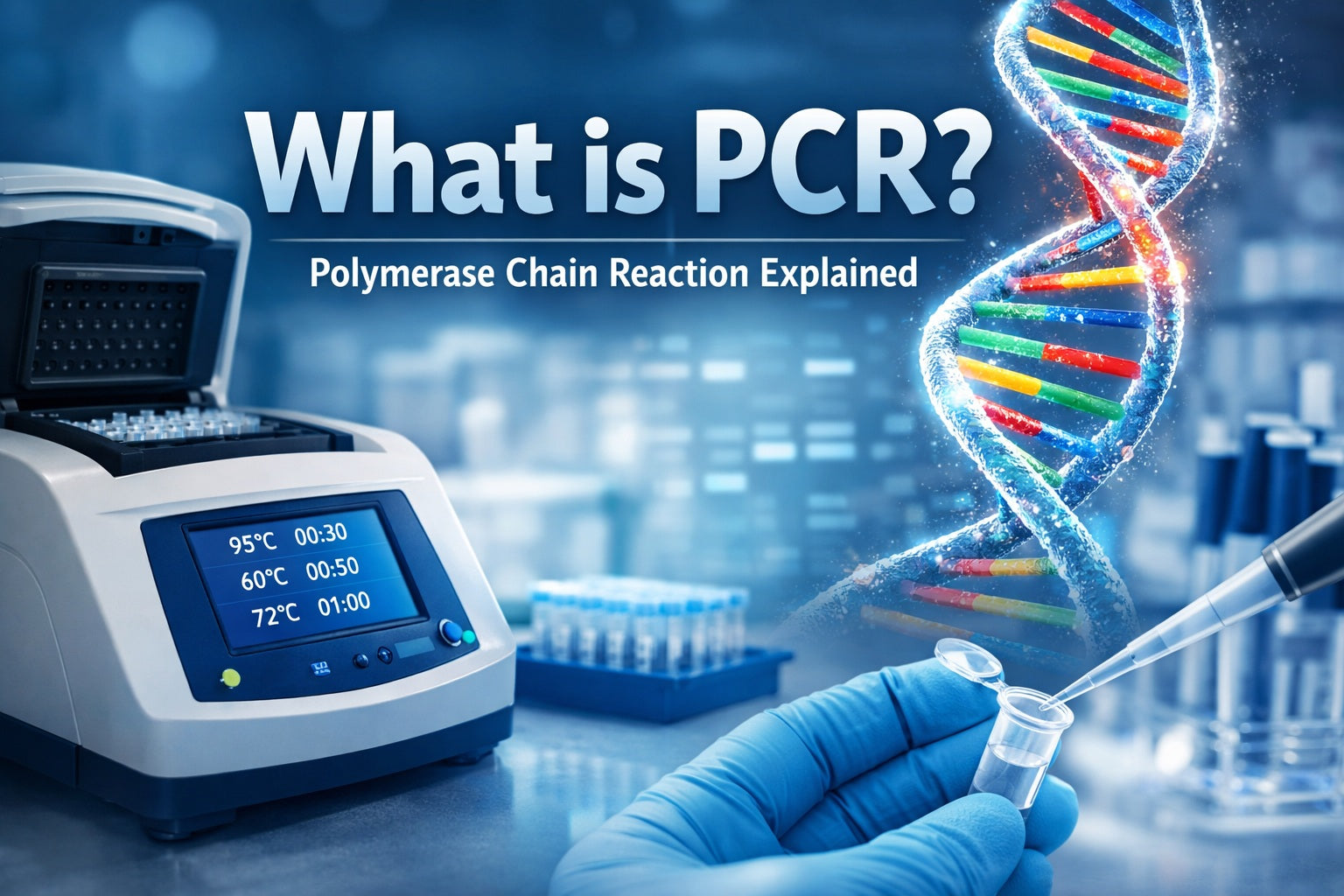
If you’ve ever wondered how scientists can start with a tiny amount of DNA and end up with enough material to analyze, the answer is often PCR. Short for Polymerase Chain Reaction, PCR is one of the most widely used tools in modern life sciences because it enables rapid, precise, and highly practical DNA amplification.
PCR meaning in simple words
PCR is a molecular biology technique that copies a specific DNA region repeatedly, producing millions (or even billions) of copies from a small starting amount. That copying process is called DNA amplification.
PCR is popular because it is:
- Accurate when primers are designed well
- Fast compared with older cloning-based methods
- Flexible (works for many sample types)
- Compatible with many downstream applications
How the Polymerase Chain Reaction works
At its core, Polymerase Chain Reaction uses repeated temperature cycles and a DNA-copying enzyme (DNA polymerase) to amplify DNA.
PCR typically needs:
- Template DNA (the DNA you want to copy)
- Primers (short DNA pieces that mark where copying starts)
- DNA polymerase (the enzyme that builds new DNA)
- dNTPs (DNA building blocks)
- Buffer + salts (to support enzyme activity)
The three classic PCR steps
1) Denaturation
The reaction is heated, so the double-stranded DNA separates into single strands.
2) Annealing
The temperature is lowered so primers attach (anneal) to their matching sequences on the template DNA.
3) Extension
The temperature is adjusted to the polymerase’s working range so the enzyme extends from each primer and copies the target region.
These steps repeat for many cycles. Each cycle increases the amount of target DNA, which is why PCR is such a powerful DNA amplification method.
What is PCR used for?
PCR supports a wide range of research and applied workflows. Common uses include:
- Detecting pathogens and specific genetic targets
- Confirming the presence of a gene or DNA fragment
- Checking cloning results
- Genotyping and mutation screening
- Measuring gene expression (via qPCR after cDNA synthesis)
- Preparing DNA for sequencing workflows
Because PCR is so versatile, it has become a foundation of modern biology and diagnostics.
Types of PCR (most common formats)
There are several types of PCR, each designed for a different goal. Understanding the main categories helps you choose the best method for your experiment.
1) Standard PCR (classic target detection)
Standard PCR is used to amplify a DNA region for later visualization—most often by gel electrophoresis. The goal is usually simple confirmation: “Is the target present, and is it the expected size?”
2) Conventional PCR (traditional workflow)
Conventional PCR is often used as a broad term for PCR methods that measure results at the end of the run rather than during the run. Many labs use “conventional” to describe classic thermal cycling followed by gel-based readout.
3) End-point PCR (results measured after cycling)
End-point PCR is a clear, practical label for assays where you evaluate the final amplified product after cycling is complete. This includes gel electrophoresis readouts and other post-PCR detection formats.
This approach is excellent for:
- Presence/absence testing
- Amplicon size verification
- Quick screening of clones
4) Quantitative PCR (qPCR) (measures amplification as it happens)
Quantitative PCR (qPCR) tracks amplification in real time, usually using fluorescence. Instead of only checking the final product, qPCR measures how quickly amplification crosses a detection threshold.
qPCR is widely used for:
- Viral or bacterial target quantification
- Gene expression analysis (after reverse transcription)
- High-sensitivity detection
- Standard curve or absolute/relative quantification workflows
Because qPCR measures signal during amplification, it can provide deeper insight into starting template quantity and assay performance.
Standard PCR vs qPCR: what’s the difference?
A simple way to compare:
- Standard PCR / Conventional PCR / End-point PCR: You check the amplified DNA after the run.
- Quantitative PCR (qPCR): You measure amplification during the run.
Both are highly useful. The right choice depends on whether you need qualitative confirmation or quantitative measurement.
A beginner-friendly PCR workflow
Here’s a practical structure that fits many labs.
Step 1: Define the target
Choose the gene or DNA region you want to amplify.
Step 2: Design primers
Good primers improve specificity and reduce non-specific products.
Step 3: Prepare the reaction mix
Combine template DNA, primers, polymerase mix, dNTPs, and buffer.
Step 4: Run thermal cycling
Use a thermal cycler with a program designed for your primers and amplicon length.
Step 5: Read results
- For end-point formats: run a gel or use another post-PCR detection method.
- For qPCR: analyze amplification curves and Ct/Cq values.
This simple pipeline helps PCR feel approachable, even for first-time users.
What affects PCR success?
PCR works best when conditions support enzyme performance and primer specificity.
Key variables include:
- Primer design and annealing temperature
- Template DNA concentration and cleanliness
- Polymerase choice (standard vs high-fidelity vs hot-start)
- Mg²⁺ and buffer composition
- Cycle number and extension time
The upside is that PCR is highly tunable. Small adjustments often improve clarity and consistency quickly.
Common PCR troubleshooting signals (and what they usually mean)
No band or no amplification
Often improved by:
- Checking primer design and annealing temperature
- Increasing template slightly (within reason)
- Confirming DNA quality and removing inhibitors
Multiple bands
Often improved by:
- Optimizing annealing temperature
- Reducing primer concentration
- Using a hot-start enzyme system
Smearing
Often improved by:
- Reducing the cycle number
- Improving template quality
- Adjusting extension time
With a few careful tweaks, most PCR setups become stable and repeatable.
Where FireGene fits in PCR workflows
FireGene focuses on practical molecular testing tools and reagent categories that support PCR-based workflows—from extraction through amplification and analysis.
Common FireGene-aligned touchpoints include:
- Nucleic Acid Extraction kits to produce clean DNA/RNA inputs for PCR
- Molecular Biology Reagents & Kits that support amplification workflows (PCR and qPCR categories)
- Solutions designed for consistent performance when scaling testing or running repeated assays
When PCR inputs are clean, and reaction conditions are stable, results become easier to reproduce across samples and days—exactly what busy labs value.
FAQ
What is PCR?
PCR (Polymerase Chain Reaction) is a method used to amplify a specific DNA region, producing large amounts of DNA from a small starting sample.
What is DNA amplification?
DNA amplification is the process of increasing the number of DNA copies. PCR is one of the most common and effective amplification methods.
What are the main types of PCR?
Common types of PCR include Standard PCR, Conventional PCR, End-point PCR, and Quantitative PCR (qPCR).
What is the difference between end-point PCR and qPCR?
End-point PCR measures amplified DNA after the cycling is complete, while Quantitative PCR (qPCR) measures amplification during the run using fluorescence.
Why is PCR considered a molecular biology technique?
PCR is a core molecular biology technique because it enables targeted DNA amplification for detection, analysis, cloning, sequencing preparation, and many other applications.
Conclusion
Polymerase Chain Reaction is the go-to method for fast, reliable DNA amplification. Whether you use Standard PCR for simple target confirmation or Quantitative PCR (qPCR) for real-time measurement, PCR remains one of the most valuable tools in the modern lab. With clean nucleic acid inputs, thoughtful primer design, and stable reaction conditions, PCR workflows become smooth, repeatable, and highly informative.


