

Description
Overview
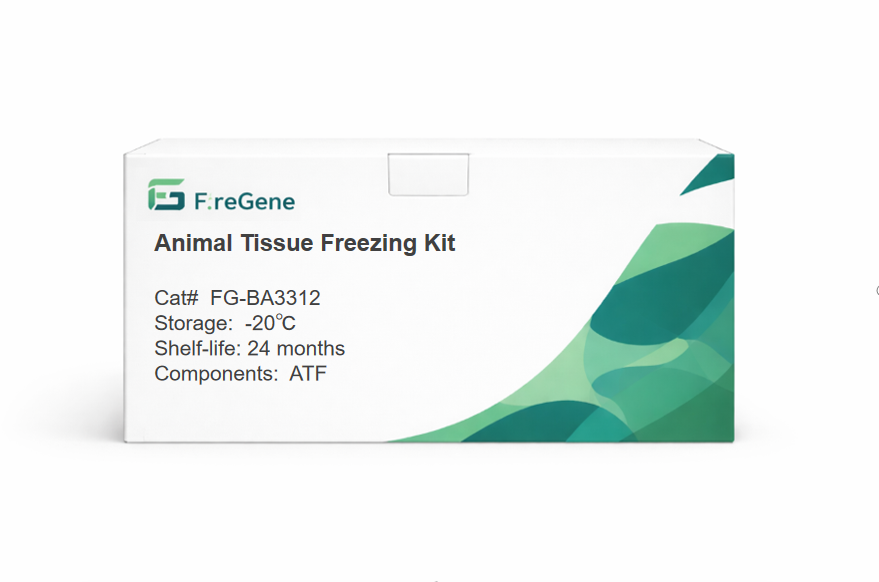
FireGene Animal Tissue Freezing Kit is engineered to preserve animal tissue samples through a gradient freezing process enhanced with cryoprotectants. Ideal for applications such as single-cell sequencing, tissue culture, and molecular biology, this kit ensures tissue integrity and viability post-thaw for high-quality experimental outcomes.
Background Information
- Designed to support:
- Single-cell studies, where tissue architecture must be preserved.
- Immunofluorescence and biomarker analysis in disease models.
- Long-term biorepository storage of experimental tissues.
- Applicable to a wide range of tissues, including skin, liver, muscle, kidney, brain, and fat.
- Suitable for research into disease heterogeneity, drug efficacy, and regenerative medicine.
Detection Principle
- Uses gradient freezing and a proprietary cryoprotectant system:
- Samples are frozen in controlled stages, reducing osmotic stress.
- Prevents formation of damaging ice crystals.
- Upon use, tissues are rapidly thawed and cultured, restoring activity and cellular function.
- End result:
-
Reliable recovery of viable tissue samples ready for histology, cell culture, and genomic analysis.
-
Reliable recovery of viable tissue samples ready for histology, cell culture, and genomic analysis.
Specifications
| Applications | Single-cell sequencing, cell culture or other cell-related detections |
| Compatible Sample Types | Animal tissue |
| Supported Instruments | Cell Freezing Container |
| Storage | -20 °C |
| Shelf-life | 24 months |
Kit Components
100ml/kit
| Component | 100 mL/Kit |
| ATF | 100 mL |
500ml/kit
| Component | 500 mL/Kit |
| ATF | 500 mL |
Product FAQ
1. Q: Is this cryopreservation solution suitable for all animal tissues? What is its cryopreservation effect on sensitive tissues (e.g., neural tissue, embryonic tissue)? Can it be used for plant tissues or microbial samples?
A: The cryopreservation solution is suitable for most mammalian tissues (e.g., liver, kidney, heart, skin) and also has good adaptability to sensitive tissues (neural tissue, embryonic tissue). It contains low-toxicity protective components that reduce ice crystal damage to fragile cells. After resuscitation, the cell viability of sensitive tissues can usually reach over 65% (viability of ordinary tissues ≥80%). However, it is not suitable for plant tissues or microbial samples. The cell wall structure of plant tissues and the metabolic mechanism of microbes are significantly different from those of animal tissues, and the components of this cryopreservation solution cannot meet their protection needs, which may lead to resuscitation failure. When used for sensitive tissues, it is recommended to cut the tissue into smaller pieces (0.5mm×0.5mm×0.5mm) to ensure full infiltration of the cryopreservation solution and enhance the protection effect.
2. Q: The instruction manual requires approximately 200mg of tissue (size of a soybean) for cryopreservation. Will insufficient tissue quantity (e.g., 50mg) or excessive quantity (e.g., 300mg) affect the cryopreservation effect? How to adjust the operation?
A: Yes, it will affect the effect. When the tissue quantity is insufficient (<100mg), the cryopreservation solution is relatively excessive, and the tissue is prone to overexposure to protective components, which may cause cell metabolic disorders after resuscitation. When the tissue quantity is excessive (>250mg), the cryopreservation solution cannot fully wrap the cells inside the tissue, leading to necrosis of local cells due to lack of protection and decreased viability after resuscitation. Adjustment methods: ① For insufficient quantity, multiple small-dose tissue samples (50-100mg each) can be combined in the same cryovial, and the dosage of cryopreservation solution can be calculated based on the total weight (10 times the volume of the total weight) to avoid too little single-dose tissue. ② For excessive quantity, divide the tissue into multiple cryovials for cryopreservation, with each vial containing 150-200mg of tissue, to ensure that each tissue sample is fully covered by the cryopreservation solution and meets the sample quantity requirements of subsequent experiments.
3. Q: Step 5 requires "the volume of cryopreservation solution is 10 times the weight of the tissue". If the tissue contains a lot of water (e.g., edematous tissue) or fat (e.g., adipose tissue), does this ratio need to be adjusted? Will the adjustment affect the cryopreservation effect?
A: The ratio needs to be flexibly adjusted according to the tissue characteristics: ① For edematous tissue (high water content): The volume of cryopreservation solution can be reduced to 8 times the weight of the tissue to prevent the protective components from being diluted after water mixes with the cryopreservation solution, which would weaken the protection effect. ② For adipose tissue (low density, easy to float): The volume of cryopreservation solution needs to be increased to 12 times the weight of the tissue to ensure that the adipose tissue is completely immersed in the cryopreservation solution and avoid local cell necrosis caused by exposure to air. After adjusting the ratio, the tissue type and adjusted dosage should be marked on the cryovial. During subsequent resuscitation, the conventional steps can be followed. As long as the tissue is fully wrapped by the cryopreservation solution, the final cryopreservation effect will not be significantly affected.
4. Q: Step 7 requires "using a programmed freezing box to ensure a cooling rate of approximately 1℃/min". If there is no programmed freezing box in the laboratory, can other methods be used as substitutes? What problems will occur if the tissue is directly placed in a -80℃ refrigerator or liquid nitrogen?
A: Without a programmed freezing box, a homemade alternative device can be used: place the cryovial in a foam box (thickness ≥5cm) filled with isopropyl alcohol, seal the box, and then put it into a -80℃ refrigerator. Isopropyl alcohol can buffer the cooling rate to be close to 1℃/min (error ±0.5℃), but it is necessary to ensure that the foam box is not damaged to prevent isopropyl alcohol from volatilizing. Do not directly place the tissue in a -80℃ refrigerator or liquid nitrogen: Direct placement in a -80℃ refrigerator results in a cooling rate of 5-8℃/min, which easily forms large ice crystals that pierce cells. Direct placement in liquid nitrogen causes an abrupt cooling rate of over 100℃/min, and the tissue will suffer from "vitrification damage" due to the instantaneous low temperature, resulting in almost no viable cells after resuscitation. A programmed cooling transition is essential.
5. Q: The cryopreservation solution needs to be stored at -20℃ in the dark. If it is not used up after thawing, how to handle the remaining cryopreservation solution? Can it be frozen again? What are the effects of repeated freezing and thawing?
A: The remaining cryopreservation solution after thawing should be stored at 4℃ in the dark within 24 hours and cannot be frozen again. Repeated freezing and thawing will damage the protective components in the cryopreservation solution (e.g., decreased stability of DMSO, denaturation of protein protectants), leading to a sharp reduction in antifreeze ability. Each freeze-thaw cycle may reduce the tissue resuscitation viability by 15%-20%; after more than 3 freeze-thaw cycles, the cryopreservation solution basically becomes ineffective and cannot protect tissue cells. It is recommended that after receiving the kit, divide the 100mL cryopreservation solution into 10mL/tube or 5mL/tube (using sterile cryovials) according to the single-use cryopreservation demand, seal them, store at -20℃, and take one tube for each experiment to avoid repeated freezing and thawing.
6. Q: Step 2 requires "quickly shaking and thawing in a 37℃ water bath" during resuscitation. What are the requirements for the frequency and intensity of "quick shaking"? What consequences will occur if thawing is incomplete or the water temperature deviates from 37℃ (e.g., 35℃, 40℃)?
A: Requirements for "quick shaking": Hold the cryovial and shake it gently in a horizontal direction at a frequency of about 1-2 times per second. The intensity should be such that the liquid in the tube rotates slightly without generating violent vortices. The purpose is to allow the cryopreservation solution to be evenly heated and accelerate thawing. If thawing is incomplete (with obvious ice crystals remaining), the ice crystals will melt suddenly during the subsequent addition of medium, causing osmotic shock and damaging tissue cells. When the water temperature is 35℃, the thawing speed is too slow, and the tissue is exposed to a low-temperature environment for a longer time, resulting in an additional 10%-15% decrease in viability. When the water temperature is 40℃, the high temperature will cause heat stress to tissue cells, leading to abnormal enzyme activity and massive cell death after resuscitation. The temperature of the water bath must be strictly controlled at 37℃±1℃.
7. Q: Step 4 requires "adding the cryopreservation solution drop by drop to the pre-warmed medium while shaking". How to control the dropping speed and shaking intensity? What consequences will occur if it is poured all at once quickly?
A: The dropping speed should be controlled at "1 drop every 2-3 seconds", and the shaking intensity should be such that "the liquid in the centrifuge tube rotates slowly without obvious stratification". The core is to allow the cryopreservation solution (containing DMSO) to mix slowly with the medium, gradually reducing the DMSO concentration to avoid severe osmotic fluctuations of cells caused by sudden concentration changes. Do not pour it all at once quickly. Pouring all at once will cause the local DMSO concentration to drop from about 10% to less than 2% instantly. Tissue cells will experience dehydration or swelling due to sudden osmotic changes, leading to cell membrane rupture. The viability after resuscitation may decrease by more than 40%, and in severe cases, the tissue cannot be used for subsequent experiments.
8. Q: The centrifugation parameters require "centrifugation at 4℃, 300×g for 5 minutes". What effects will insufficient centrifugation time (e.g., 3 minutes) or excessive rotation speed (e.g., 500×g) have on the resuscitated tissue? Can room-temperature centrifugation replace 4℃ centrifugation?
A: If the centrifugation time is insufficient (<5 minutes), tissue cells cannot be fully precipitated and will be discarded with the supernatant, resulting in sample loss and reduced yield. If the rotation speed is excessive (>400×g), the excessive centrifugal force will squeeze tissue cells, especially fragile tissues (e.g., embryonic tissue), which may cause cell rupture and a 25%-30% decrease in viability. Room-temperature centrifugation cannot replace 4℃ centrifugation. Room temperature will accelerate the metabolism of tissue cells, and the residual cryopreservation solution has enhanced activity at room temperature, which may further damage cells. Centrifugation at 4℃ can maintain a low metabolic state of cells and reduce viability loss during centrifugation.
9. Q: Step 5 requires "adding an appropriate tissue dissociation solution to digest into a single-cell suspension" after resuscitation. What specifically does "appropriate tissue dissociation solution" refer to? Can other dissociation kits of this brand (e.g., BA3303, BA3305) be used? What should be noted during digestion?
A: "Appropriate tissue dissociation solution" refers to a dedicated dissociation kit matching the type of cryopreserved tissue. For example, BA3323 Liver Tissue Dissociation Kit is used for cryopreserved liver tissue, BA3305 Mouse Brain Tissue Dissociation Kit for cryopreserved brain tissue, and BA3320 Tumor Tissue Dissociation Kit for cryopreserved tumor tissue. Dissociation kits of this brand corresponding to the tissue type can be used, as their enzymatic hydrolysis parameters have better adaptability to the tissue state after resuscitation with the cryopreservation solution. Notes during digestion: ① Resuscitated tissue is relatively fragile, so the digestion time should be 20%-30% shorter than that of fresh tissue. ② Conduct quality inspection every 10 minutes to avoid excessive digestion leading to decreased cell viability and ensure a balance between single-cell yield and viability.
10. Q: If the cryovial is stored in a -80℃ refrigerator for more than 6 months, or if the temperature fluctuates during transportation (e.g., from -80℃ to -20℃ and then back), can the resuscitated tissue still be used for single-cell sequencing experiments?
A: Storage in a -80℃ refrigerator is not recommended for more than 6 months. After 6 months, the viability of tissue cells will gradually decrease over time (5%-8% decrease per month), and the viability may be lower than 50% after 6 months. Forcing its use in single-cell sequencing will lead to reduced data quality (e.g., low cell capture rate, gene expression deviation). Temperature fluctuations during transportation (-80℃ to -20℃) will cause the tissue to undergo repeated "micro-freezing and thawing", damaging the cell structure. Even if the temperature returns to normal, the viability after resuscitation will decrease by more than 30%, so it is not recommended for high-precision experiments such as single-cell sequencing, and can only be used for preliminary experiments or morphological observation. For long-term storage, it is recommended to transfer the tissue to liquid nitrogen (-196℃) within 24 hours of placement in a -80℃ refrigerator, where it can be stored for more than 1 year with stable viability.
Files Download Links