

Description
Product Introduction
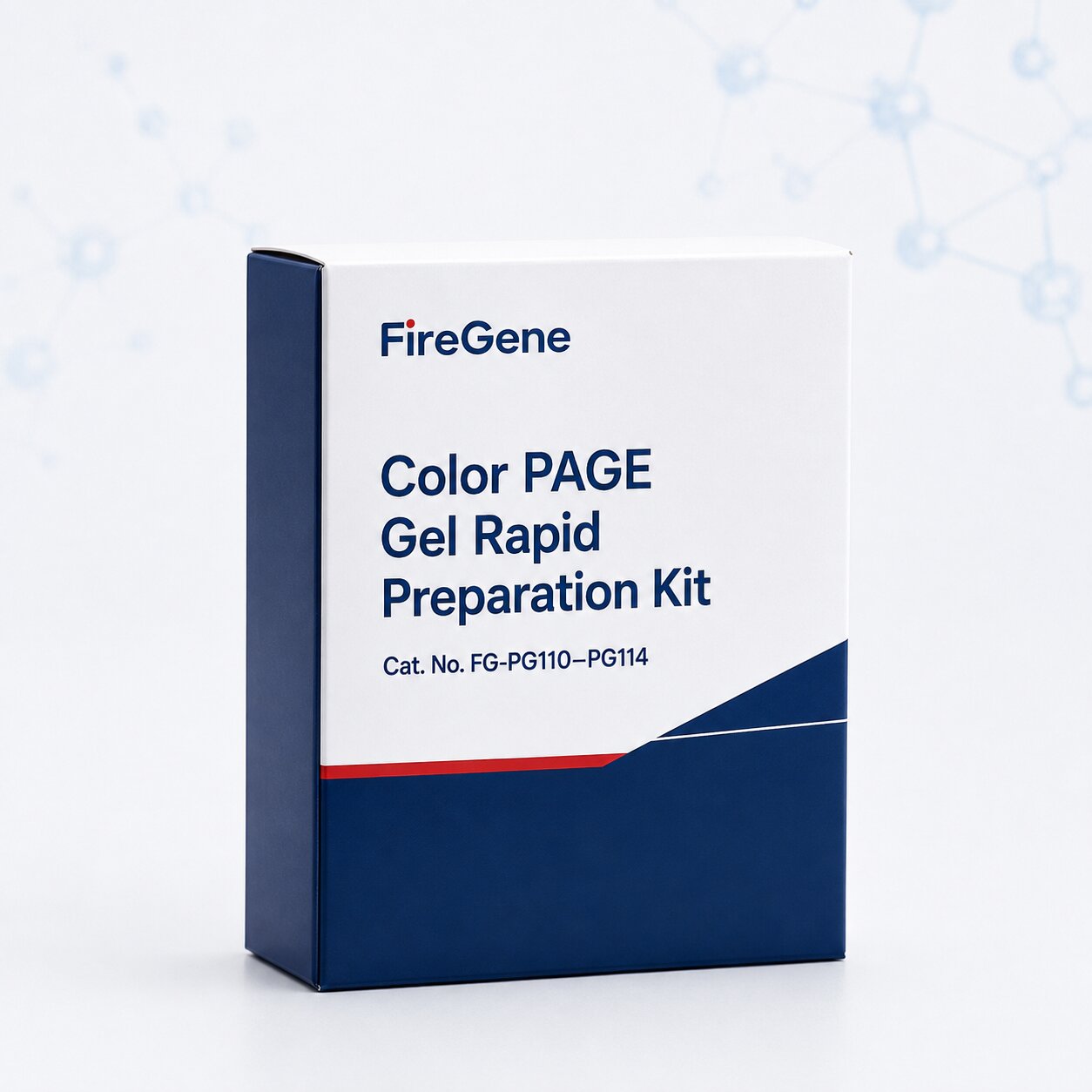
This product is designed for Tris-Glycine electrophoresis systems and features a pre-mixed formulation for both the stacking and resolving gels; polymerization is initiated simply by adding the included modified polymerizing agent, making the process quick and convenient. The prepared stacking gel is colored (red, blue, or green), ensuring that sample wells are distinct and easy to identify for loading. The three-color option allows for the differentiation of gels containing different samples. Gels prepared with this kit are also suitable for non-denaturing PAGE.
This product comes with an improved polymerization accelerator that offers superior stability and catalytic efficiency; no additional TEMED is required during gel preparation. For convenience, the opened accelerator can be stored at 4°C for at least three months.
|
Item No. |
Specification |
|
FG-PG110 (Preparation of 6% PAGE gel) |
>125 gels (0.75 mm gel) or >90 gels (1.00 mm gel) or >60 gels (1.50 mm gel) |
|
FG-PG111 (Preparation of 7.5% PAGE gel) |
|
|
FG-PG112 (Preparation of 10% PAGE gel) |
|
|
FG-PG113 (Preparation of 12.5% PAGE gel) |
|
|
FG-PG114 (Preparation of 15% PAGE gel) |
|
Component Name |
Volume and quantity |
|
Stacking gel solution (2×) |
80 mL |
|
Colored Stacking Gel Buffer (2×) |
80 mL |
|
Lower gel solution (2×) |
250 mL |
|
Lower gel buffer (2×) |
250 mL |
|
Improved coagulant |
8 mL |
Product Features
Rapid gel preparation:Multiple gels can be cast in a short time; no calculation of required solution volume or dilution is necessary;
Colored Top Coat:Stacking gels in red, blue, and green can be prepared, facilitating sample loading and the differentiation of various gels;
Prevent unpleasant odors: Eliminates the need for TEMED, avoiding foul odors.
Bands are distinct: In particular, the bands of low-molecular-weight proteins are clearer than in conventional gels.
Adhesive Preparation Process
(Taking a 0.75/1.0/1.5 mm mini-gasket as an example)
1. Take equal volumes of the lower gel solution and lower gel buffer (2.0, 2.7, and 4.0 mL of each, respectively) and mix well;
2. Add 40, 60, or 80 μL of the modified clot activator to the mixed solution from Step 1 and mix well;
Note: After adding the modified coagulant, mix gently to prevent excessive oxygen incorporation into the gel solution, which would inhibit gel polymerization.
3. Pour the mixed solution from Step 2 into the glass gel-casting assembly, ensuring the distance between the liquid level and the top edge of the short glass plate is 0.5 cm greater than the length of the comb teeth;
Note: This solution is in excess; do not inject the entire amount. You may leave a small quantity in the mixing cup to monitor the gelation process.
then, add an appropriate amount of water or an alcohol (such as isopropanol or n-butanol) to overlay the lower gel layer.
4. After the lower gel layer has set (approximately 15 min), pour off the water or alcohol from the upper layer;
Note: The appearance of a refraction line between the water (or alcohol) and the glue indicates that the glue has solidified.
5. Mix equal volumes (0.5, 0.75, or 1.0 mL each) of the stacking gel solution and the colored stacking gel buffer;
Note: Due to the specific physicochemical properties of the dye, please shake well before use.
6. Add 10/15/20 μL of the modified clot activator to the mixed solution from Step 5 and mix well;
Note: After adding the modified coagulant, mix gently to prevent excessive oxygen incorporation into the gel solution, which would inhibit gel polymerization.
7. Pour the mixed solution from Step 6 into the glass gel-casting plates and insert the comb;
8. Once the upper gel has solidified (approximately 15 minutes), remove the comb, and the gel is ready for electrophoresis.
Note: Please use freshly prepared electrophoresis buffer whenever possible.
|
Base coat formulation |
Top-layer adhesive formulation |
||||||
|
Gel thickness |
Lower gel solution |
Lower buffer |
Improved coagulant |
Gel thickness |
Upper gel solution |
Stacking gel buffer |
Improved coagulant |
|
0.75 mm |
2.0 mL |
2.0 mL |
40 uL |
0.75 mm |
0.5 mL |
0.5 mL |
10 uL |
|
1.00 mm |
2.7 mL |
2.7 mL |
60 uL |
1.00 mm |
0.75 mL |
0.75 mL |
20 uL |
|
2.0 mL |
4.0 mL |
4.0 mL |
80 uL |
2.0 mL |
1.0 mL |
1.0 mL |
40 uL |
Precautions
1. The stacking gel of the gel prepared using this product does not exert a concentrating effect on the sample, similar to precast gels; however, compared to traditional PAGE gels, it offers superior protein band separation—enabling clear resolution of even low-molecular-weight proteins (e.g., 10 kDa)—and produces narrower, sharper bands.
2. The usage amount of the modified coagulant is for reference only; the actual quantity may be adjusted based on individual experimental habits and experience. Adding a larger amount of coagulant accelerates gelation, and vice versa.
3. The gelation rate shows a significant positive correlation with temperature. Under identical conditions, the higher the temperature, the faster the gelation; if the ambient temperature is excessively high, it is advisable to appropriately reduce the dosage of the modified coagulant. Conversely, if the ambient temperature is low, the gelation time may be appropriately extended.
4. This product already contains an appropriate amount of a TEMED substitute; if further acceleration of gel polymerization is required, additional TEMED may be added as needed immediately before preparing the gel.
5. Equilibrating the gel solution and buffer to room temperature (e.g., by letting them sit for a few minutes) before preparing the gel can effectively prevent the formation of air bubbles within the gel.
6. Recommended electrophoresis conditions are: 150 V for approximately 50 min (or 200 V for approximately 35 min);
7. For your safety and health, please wear a lab coat and disposable gloves while performing the procedure.
8. This product is for research use only.
Files Download Links