
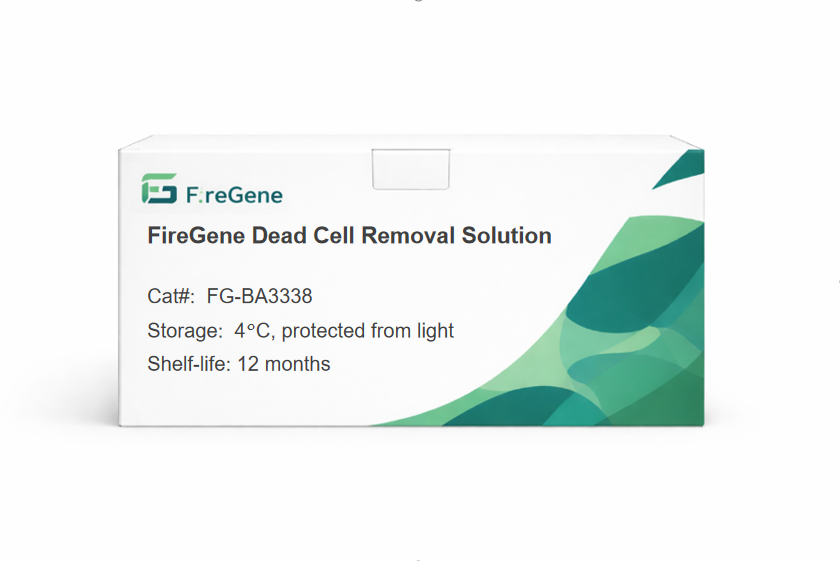

Description
FireGene Dead Cell Removal Solution is designed for removing dead cells from single-cell suspensions derived from dissociated mammalian tissues. The workflow helps reduce dead cell contamination and improve sample background for downstream experiments such as flow cytometry analysis, single-cell sequencing, cell culture, and related cell-based assays. The protocol uses a layered separation workflow with DCRS, followed by centrifugation, collection of the upper layer, washing, resuspension, and quality control.
Background Information
Dead cells can increase background, affect flow cytometry results, reduce single-cell sequencing quality, and interfere with downstream cell culture. A cleanup step after tissue dissociation helps prepare samples for more reliable cell-based analysis.
FireGene Dead Cell Removal Solution for Single-Cell Suspension Cleanup provides a practical workflow for sample preparation while supporting downstream applications that require reliable cell or nuclei suspension quality.
Research Areas
This product is suitable for research fields involving tissue processing, cellular analysis, and downstream molecular or cell-based workflows.
- Single-cell sample preparation
- Flow cytometry assay development
- Mammalian tissue dissociation workflows
- Cancer research
- Immunology
- Cell culture research
- Drug discovery assays
- Translational biomedical research
Key Applications
The prepared samples can be used in downstream workflows that require clean, well-prepared cell or nuclei suspensions.
- Dead cell removal from single-cell suspensions
- Flow cytometry analysis
- Single-cell sequencing preparation
- Cell culture workflows
- Cell counting and quality control
- Post-dissociation sample cleanup
- Cell-based assays
Workflow and Sample-Preparation Value
The processed cell suspension is centrifuged and resuspended in RPMI 1640 medium containing 2% FBS, then mixed 1:1 with DCRS. The mixture is layered over DCRS and centrifuged at 4°C, 700 ×g for 20 minutes. The upper liquid is collected without disturbing the pellet, washed with PBS containing 5% FBS, and resuspended for downstream use.
Specifications
| Product Name | Dead Cell Removal Solution |
| Brand | FireGene |
| Catalog No. | FG-BA3338 |
| Kit Size | 10 reactions |
| Sample Type | Single-cell suspensions from dissociated mammalian tissues |
| Main Function | Removal of dead cells |
| Workflow | Centrifugation, DCRS layering, separation, upper-layer collection, washing, resuspension |
| Downstream Applications | Flow cytometry analysis, single-cell sequencing, cell culture, cell-related assays |
| Separation Conditions | 4°C, 700 ×g, 20 minutes |
| Required Instruments | Horizontal centrifuge, cell counter |
| Required Reagents | PBS, FBS, RPMI 1640 medium |
| Required Consumables | Low-adhesion pipette tips, centrifuge tubes, 20 μm cell strainers |
| Optional Related Reagent | Red Blood Cell Lysis Solution, Catalog No. BA3311 |
| Storage | 4°C, protected from light |
| Shelf Life | One year |
| Research Use | For research use only |
Kit Components
| Component | Catalog Number | Pack Size |
|---|---|---|
| DCRS (Dead Cell Removal Solution) | FG-BA3338 | 25 mL |
Product FAQ
Q: How does DCRS differ from a simple viability stain or cell sorting?
A: DCRS works through density-based layered separation rather than fluorescent labeling or flow-based sorting. Dead cells, being lower density due to membrane damage, separate from viable cells during centrifugation over the DCRS layer. This makes it a faster, instrument-independent cleanup step that can be done before flow cytometry or sequencing — rather than relying on the analysis platform itself to filter out dead cells from the data.
Q: At what step in my workflow should I use DCRS?
A: DCRS is used after tissue dissociation and before downstream analysis — typically right before loading onto a 10x Genomics Chromium, BD Rhapsody, or flow cytometer. If your dissociation protocol produces a suspension with significant blood contamination, use the Red Blood Cell Lysis Solution (Cat. No. FG-BA3311) first, then DCRS as the next cleanup step.
Q: What centrifuge speed and temperature does the protocol require?
A: The validated protocol uses 4°C, 700 × g for 20 minutes. Running at room temperature or at a different speed has not been validated and may reduce separation efficiency — dead cells and debris may not fully separate from the viable cell layer.
Q: Can DCRS be used on suspensions with high debris content, not just dead cells?
A: DCRS is optimized specifically for separating dead cells from viable cells based on density. For suspensions with significant tissue debris or aggregates in addition to dead cells, consider using a dedicated debris removal step first. Contact service@firegene.com if you're unsure which combination fits your tissue type.
Q: Is the 25 mL kit size enough for multiple suspension preps?
A: The 10-reaction kit (25 mL) and 40-reaction kit are both available depending on your throughput. Each reaction requires mixing DCRS 1:1 with your resuspended sample — actual sample volume per reaction depends on your cell suspension concentration. Contact us if you need help calculating how many reactions your typical sample volume requires.
Files Download Links