

Description
Product Overview
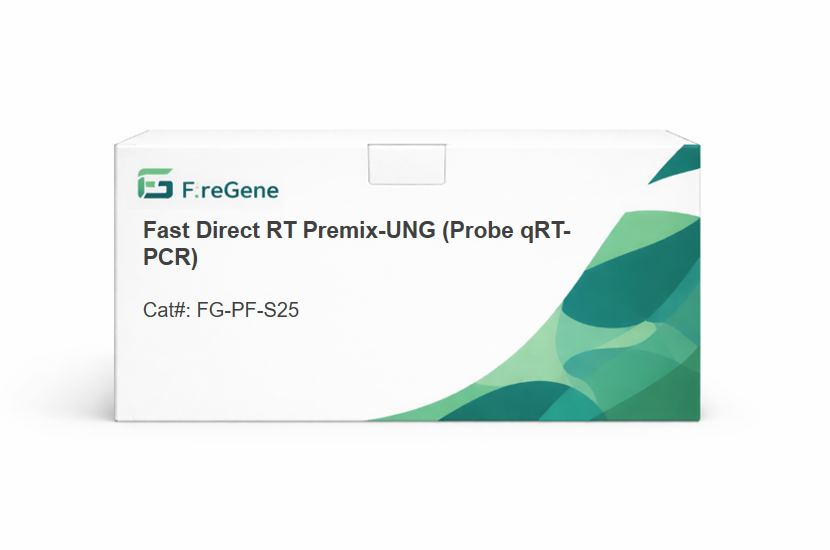
Fast Direct RT Premix-UNG (Probe qRT-PCR)(FG-PF-S25) is a pre-dispensed, freeze-dried bead-form reagent designed for direct target-gene real-time fluorescence detection of RNA (TaqMan probe method) without a nucleic acid extraction or purification step. It contains a genetically engineered, screened fast-amplification reverse transcriptase and DNA polymerase, enabling completion of the PCR reaction within 20–40 minutes. This product exhibits strong tolerance to PCR inhibitors, supporting direct RNA amplification from complex, inhibitor-rich sample matrices without a separate nucleic acid extraction or purification step. The reagent uses a mixed enzyme system of an inhibitor-resistant amplification enzyme and UNG enzyme, together with an optimized buffer system containing dUTP, which not only enables good amplification of the target gene in samples containing inhibitors, but also effectively prevents false-positive results caused by residual PCR products and aerosol contamination. This product is stable at room temperature and can be transported and stored at ambient temperature.
Reagent Composition
Fast Direct RT Premix-UNG (Probe qRT-PCR) (020303) (PF-S25) already contains a fast-amplification DNA polymerase, RTase, TS-UNG, PCR Buffer, MgCl2, dNTPs, stabilizers, lyoprotectants, and other components.
Specifications
| Product Name | Fast Direct RT Premix-UNG (Probe qRT-PCR) (020303) |
| Catalog No. | FG-PF-S25 |
| Format | Pre-dispensed, freeze-dried bead-form reagent |
| Detection Method | TaqMan probe-based real-time RT-PCR |
| Extraction Required | No — direct amplification from raw sample without nucleic acid extraction/purification |
| Sample Matrix Compatibility | Formulated for complex, PCR inhibitor-rich sample matrices for research use. See Instructions for Use for tested input volumes and ratios. |
| Total Reaction Time | 20–40 min |
| Contamination Control | UNG/dUTP carryover-prevention system (TS-UNG, temperature-sensitive) |
| Storage Conditions | Cool, dry place or 2°C–8°C; stable at room temperature for transport/storage |
Instructions for Use
Step 1: Distribute the lyophilized beads into 8-tube strips.
Step 2: Add template, primers, and probe, and top up to 25 µL with water:
| Reagent | 25 µL system | Final concentration |
|---|---|---|
| Fast Direct RT Premix-UNG (Probe qRT-PCR) | —— | —— |
| 25× Primer-Probe Mix | 1 µL | 1× |
| Template RNA | —— | —— |
| ddH2O | To 25 µL | —— |
Primer concentration is typically 0.2 µM for standard PCR (adjustable 0.2–1 µM). Probe concentration is typically optimized within 0.1–0.3 µM.
Reference sample input volumes for research use (50 µL reaction), based on internal testing:
| Sample matrix | Input volume | Maximum input ratio |
|---|---|---|
| Whole blood matrix (anticoagulated) | 2.5 µL | 5% |
| Swab-based matrix | 10 µL | 20% |
These are starting-point reference values for research use; optimal input volume should be determined based on your specific sample type, collection method, and required sensitivity.
Step 3: Cap the tubes, mix and centrifuge, then load onto the instrument.
Reaction Conditions
Standard PCR Program:
| Step | Temperature | Duration | Cycles |
|---|---|---|---|
| Reverse transcription | 50°C | 10–20 min | 1 |
| Denaturation | 95°C | 1–5 min | 1 |
| Denaturation | 95°C | 10–20 s | 40–50 |
| Annealing/Extension | 56–64°C | 20–60 s | (same 40–50) |
Fast PCR Program:
| Step | Temperature | Duration | Cycles |
|---|---|---|---|
| Reverse transcription | 50°C | 5 min | 1 |
| Denaturation | 95°C | 30 s | 1 |
| Denaturation | 95°C | 1–3 s | 40–45 |
| Annealing/Extension | 56–64°C | 3–20 s | (same 40–45) |
The temperature-sensitive TS-UNG (DG) enzyme is active at room temperature and is inactivated during the reverse transcription step.
Technical Notes
- The fast DNA polymerase amplification rate is no less than 1 kb/10 s. Reaction conditions should be optimized for the specific fast PCR instrument used, since heating/cooling rates and thermal conductivity vary by instrument.
- If fluorescence values are too low or amplification inhibition is evident, reduce the sample input volume or dilute the sample before use.
- Sample collection should follow clinical standard operating procedures; freshly collected samples help avoid nucleic acid degradation.
- For primers with lower annealing temperatures or amplicons longer than 200 bp, a three-step protocol is recommended.
- Different target genes vary in their utilization efficiency of dUTP and sensitivity to UNG enzyme; if using the UNG system reduces detection sensitivity, contact our company for technical support to adjust the reaction system.
Frequently Asked Questions
No. This reagent is designed for direct target-gene amplification from raw, complex sample matrices without a separate nucleic acid extraction or purification step, thanks to its inhibitor-tolerant enzyme system. See the Instructions for Use section for reference sample matrices and tested input volumes.
It uses the TaqMan probe method for real-time fluorescence detection of RNA via RT-PCR.
The complete PCR reaction can be finished within 20-40 minutes, depending on whether the Standard or Fast PCR program is used.
For a 50 µL reaction, internal reference testing used 2.5 µL of a whole blood matrix (up to 5% of reaction volume) or 10 µL of a swab-based matrix (up to 20% of reaction volume). These are starting points for research use — optimal input should be validated based on your specific sample type, collection method, and required sensitivity.
The reagent uses a UNG enzyme and dUTP-containing buffer system. The temperature-sensitive TS-UNG enzyme is active at room temperature to degrade contaminating amplicons, then is inactivated during the reverse transcription step.
Store the freeze-dried reagent in a cool, dry place or at 2°C–8°C. The product is stable at room temperature and can be transported and stored at ambient temperature.
For standard PCR programs, a final primer concentration of 0.2 µM typically works well (adjustable within 0.2-1 µM if needed), with probe concentration optimized within 0.1-0.3 µM. For fast PCR programs, increasing primer/probe concentration may improve results.
The Standard program uses a 10-20 min reverse transcription step and 40-50 amplification cycles at 10-20 s per denaturation step. The Fast program shortens reverse transcription to 5 min and denaturation to 1-3 s per cycle, completing 40-45 cycles more quickly. Instrument-specific optimization is recommended for fast protocols.
Different target genes vary in dUTP utilization efficiency and UNG sensitivity. If sensitivity is reduced, the reaction system should be adjusted and optimized — contact our technical support team for guidance.
Yes. For primers with lower annealing temperatures, or when amplifying fragments longer than 200 bp, a three-step protocol is recommended instead of the standard two-step cycling.