

Description
Overview
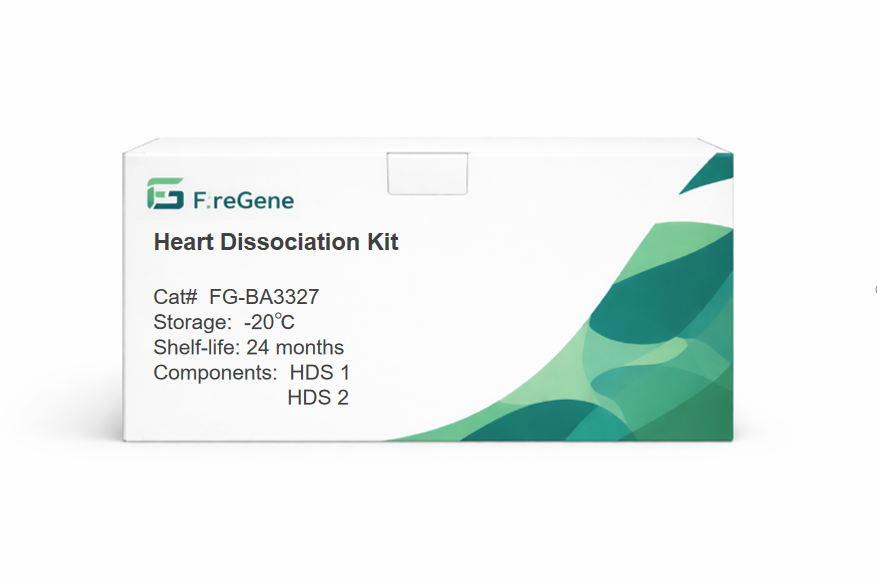
FireGene Heart Dissociation Kit is a specialized enzymatic solution optimized for the dissociation of heart tissue into high-viability single-cell suspensions. This kit is ideal for cardiology research, enabling precise cellular analysis in conditions such as cardiomyopathy, heart failure, and cardiac regeneration.
Background Information
-
Driven by Clinical and Scientific Research Needs:
- Single-cell sequencing of heart tissue is essential for understanding the cellular complexity of cardiovascular diseases.
- Traditional methods struggle to isolate diverse cardiac cells including cardiomyocytes, fibroblasts, endothelial cells, and immune populations.
- This kit supports:
- Analysis of cellular heterogeneity and intercellular signaling.
- Discovery of biomarkers and drug targets related to heart failure and inflammation.
- Research into heart regeneration, development, and personalized therapy.
-
Background of Technological Development:
- Conventional dissociation methods often result in low cell viability and incomplete tissue breakdown.
- FireGene improves outcomes through:
- Advanced enzymatic blends tailored for dense cardiac ECM.
- Carefully optimized concentration, temperature, and reaction time protocols.
- A workflow that ensures reproducible, high-yield single-cell preparation for downstream applications.
Detection Principle
- Implements a stepwise enzymatic digestion process:
- Heart tissue is minced into small fragments.
- Enzyme reagents are added in sequence under precisely managed incubation conditions.
- The digestion gently breaks down the extracellular matrix and cell junctions, releasing intact cells.
- Result:
- A clean, viable single-cell suspension suitable for scRNA-seq, cardiac lineage tracing, functional assays, and drug screening.
Specifications
| Applications | Single-cell sequencing, cell culture or other cell-related detections |
| Compatible Sample Types | Heart tissue |
| Supported Instruments | Water bath, horizontal centrifuge, cell counter |
| Storage | -20 °C |
| Shelf-life | 24 months |
Kit Components
10 Reactions
| Component | 10 Reactions/Kit |
| Heart DS 1 (Heart Dissociation solution 1) | 1*5.1 mL |
| Heart DS 2 (Heart Dissociation solution 2 | 1*3 mL |
50 Reactions
| Component | 50 Reactions/Kit |
| Heart DS 1 (Heart Dissociation solution 1) | 5*5.1 mL |
| Heart DS 2 (Heart Dissociation solution 2) | 5*3 mL |
Product FAQ
1. Q: When dissociating heart tissue, according to the procedure, first add Dissociation Buffer 1 and incubate for 20 minutes, then add Dissociation Buffer 2. It is found that cell viability drops rapidly (from 80% to 50%) after adding Dissociation Buffer 2. What is the reason, and how to adjust the addition method of the two dissociation buffers?
A: The viability decline is because Dissociation Buffer 2 contains specific enzymes targeting cardiac collagen fibers, and direct addition easily stimulates exposed cardiomyocytes. Adjustment methods: ① Before adding Dissociation Buffer 2, take the centrifuge tube out of the 37℃ environment and cool it on wet ice for 1 minute to reduce the cell metabolic rate; ② Dilute 300μL of Dissociation Buffer 2 with 200μL of RPMI 1640 medium, then slowly drop it into the tube while gently pipetting (avoid violence). This can reduce direct enzyme damage to cardiomyocytes and maintain cell viability above 70%.
2. Q: When dissociating heart tissue from mice with myocardial infarction model, the infarcted area tissue is found to be hard. After 35 minutes of enzymolysis, there are still a large number of tissue blocks, and the single-cell yield is extremely low. How to handle the hard tissue in the infarcted area?
A: The infarcted area is hard due to fibrous hyperplasia, so a "pretreatment" step needs to be added: ① Separately mince the infarcted area tissue into pieces smaller than 0.1mm³ (half the size of normal tissue), soak it in PBS for 5 minutes, and repeatedly squeeze the tissue pieces during this period to remove some necrotic substances; ② Increase the dosage of Dissociation Buffer 1 to 600μL (510μL for regular use) and Dissociation Buffer 2 to 350μL during enzymolysis, and extend the incubation time of Dissociation Buffer 1 to 25 minutes. This can increase the decomposition rate of tissue blocks in the infarcted area by 70% and improve the single-cell yield by 50%.
3. Q: In Step 11, add three volumes of red blood cell lysis buffer (about 3mL) and incubate on ice for 10 minutes. For heart tissue with low blood content (such as the heart of juvenile mice), it is found that cardiomyocyte viability drops from 75% to 45% after lysis. How to optimize the red blood cell lysis operation?
A: Heart tissue with low blood content does not require full-volume lysis. Optimization methods: ① Adjust the dosage of lysis buffer according to the blood content of the tissue; the heart of juvenile mice only needs 1.5 volumes (about 1.5mL) of lysis buffer; ② Shorten the incubation time to 5-6 minutes, observe under a microscope every 2 minutes, and terminate immediately when red blood cells are basically lysed; ③ Wash twice with PBS containing 10% FBS after lysis (once for regular use) to fully remove residual lysis buffer. This can maintain cardiomyocyte viability above 65%.
4. Q: When using a hybridization oven for enzymolysis, the operation is carried out at a rotation speed of 20-30 rpm, but it is found that the liquid in the centrifuge tube splashes onto the tube cap, causing some tissue to adhere to the cap and fail to be enzymolyzed. What is the reason, and how to prevent liquid splashing?
A: Liquid splashing is because heart tissue contains elastic fibers, which easily drive the liquid to oscillate violently when the hybridization oven rotates. Prevention methods: ① Control the liquid volume in the centrifuge tube within 3mL (3mL for regular use, which can be reduced to 2.8mL by decreasing the dosage of Dissociation Buffer 1 or medium); ② Stick a piece of sterile paraffin film on the inner side of the centrifuge tube cap; even if liquid splashes, it will adhere to the paraffin film. After enzymolysis, rinse the paraffin film with a small amount of medium to wash the tissue pieces back into the tube; ③ Reduce the rotation speed of the hybridization oven to 15-20 rpm to decrease the liquid oscillation amplitude, which can completely avoid splashing.
5. Q: After opening Dissociation Buffer 1 and Dissociation Buffer 2 in the kit, they are stored at -20℃ for 4 months. When used, it is found that the enzymolysis efficiency decreases (cell yield is only 60% of the original). Is the reagent invalid, and how to judge whether the reagent is still usable?
A: The validity period of the opened dissociation buffers stored at -20℃ is 3 months (2 years for unopened ones), and 4 months may lead to decreased enzyme activity. Judgment methods: ① Take 50μL of Dissociation Buffer 1 and 30μL of Dissociation Buffer 2, mix them, add a small amount of minced heart tissue, and incubate at 37℃ for 25 minutes. If the tissue pieces become significantly smaller and cells are released, it means the reagents are still usable; ② If the enzyme activity is insufficient, increase the dosage of both dissociation buffers by 20% and extend the total enzymolysis time to 40 minutes to supplement enzyme activity. This can restore the cell yield to about 80% of the original (not recommended for high-precision experiments such as single-cell sequencing).
6. Q: In Step 15, when filtering with a 20μm cell sieve, a large number of cardiomyocytes (with a diameter of about 15-20μm) are found to be retained, resulting in the loss of target cells. What is the reason, and how to adjust the filtration operation?
A: The retention of cardiomyocytes is mostly due to slight cell clumping or sieve pore deviation. Adjustment methods: ① Before filtration, gently pipette the cell suspension 20 times with a 1mL low-adhesion pipette tip to disperse small clumps with a diameter <20μm; ② Pre-wet the 20μm cell sieve with PBS containing 5% FBS to reduce cell adsorption to the sieve; ③ Slowly push the liquid with a 5mL syringe during filtration to avoid cell compression and deformation caused by sieve clogging. This can reduce the cardiomyocyte retention rate from 50% to below 10%.
7. Q: After dissociation, a large number of spindle-shaped cell debris (suspected to be myocardial fiber debris) appear in the cell suspension, interfering with cell counting. How to remove these fiber debris?
A: Fiber debris is a product of incomplete enzymolysis of heart tissue. Removal methods: ① Before filtration after enzymolysis, centrifuge the cell suspension at 4℃, 200×g for 3 minutes, and discard the floating fiber debris in the upper layer; ② When filtering with a 70μm cell sieve, rinse the sieve repeatedly 3 times with PBS containing 2% FBS to ensure fiber debris flows out with the filtrate; ③ If there is still residue, filter again with a 20μm cell sieve (only retain the filtrate). This can remove more than 90% of fiber debris without affecting the cardiomyocyte recovery rate.
8. Q: The centrifugation parameters in Steps 9 and 13 are both "4℃, 300×g for 5 minutes", but after centrifugation, the cardiomyocyte pellet is loose, and cells are easily sucked away when discarding the supernatant. What is the reason, and how to obtain a dense pellet?
A: The loose cardiomyocyte pellet is because the cell surface is negatively charged, leading to mutual repulsion and difficulty in aggregation. Solutions: ① Increase the centrifugation speed to 350×g and extend the centrifugation time to 8 minutes to enhance cell sedimentation capacity; ② Before centrifugation, add 5μL of 1% polylysine (self-prepared, non-toxic to cells) to the cell suspension to neutralize the cell surface charge and promote cell aggregation; ③ Retain 50μL of supernatant after centrifugation and mix it with the pellet to avoid the loss of small-volume cells with the supernatant. This can increase the pellet density by 60%.
9. Q: When dissociating heart tissue from newborn rats (within 7 days of birth), a large number of cells tend to die (viability is only 35%), which is much lower than 70% of adult rats. What is the reason, and how to adjust the operation to protect immature cardiomyocytes?
A: The cell membrane of immature cardiomyocytes is fragile and easily damaged by enzymolysis solution and mechanical force. Adjustment methods: ① Shorten the incubation time of Dissociation Buffer 1 from 20 minutes to 15 minutes, and the incubation time of Dissociation Buffer 2 to 3-4 minutes to reduce enzyme damage to cells; ② Use a water bath for enzymolysis, and gently shake every 5 minutes (avoid violent oscillation) to reduce mechanical impact; ③ In the washing step, replace the regular PBS containing 5% FBS with PBS containing 10% FBS to enhance cell membrane protection. This can increase the viability of immature cardiomyocytes to above 60%.
10. Q: In Steps 7 and 8, rinse the centrifuge tube twice to collect a total of 9mL of filtrate. If one rinsing step is omitted and only 6mL of filtrate is collected, what impact will it have on the cell yield? Can the cell loss be compensated by other methods?
A: Omitting one rinsing step will cause about 25% of cardiomyocytes to remain on the inner wall of the centrifuge tube, reducing the cell yield by 30%. Compensation methods: ① If rinsing has been omitted, immediately rinse the centrifuge tube once with 3mL of medium, filter and combine the filtrate; ② In subsequent experiments, mince the tissue more fully (smaller than 0.2mm³) and extend the incubation time of Dissociation Buffer 1 to 22 minutes to increase cell release. This can compensate for the loss to a certain extent, but it is still recommended to rinse twice according to the standard procedure to ensure full cell recovery.
Files Download Links