

Description
Overview
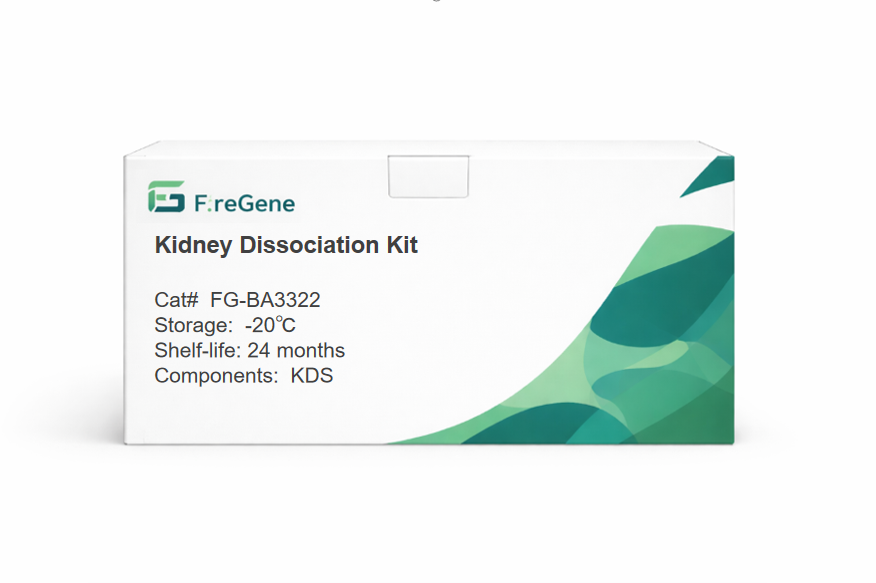
The FireGene Kidney Dissociation Kit is a precision-engineered enzymatic system for the efficient isolation of single cells from kidney tissue. Designed to support cutting-edge research into renal function and pathology, this kit delivers high-viability suspensions for single-cell sequencing, flow cytometry, and biomarker discovery.
Background Information
-
Driven by Clinical and Scientific Research Needs:
- Kidney diseases such as acute kidney injury (AKI) and chronic kidney disease (CKD) require cellular-level investigation to understand their progression.
- Traditional dissociation approaches do not capture the full range of renal cell types and often lead to low yield.
- This kit enables:
- High-resolution profiling of renal tubule cells, podocytes, immune cells, and more.
- Discovery of biomarkers related to renal fibrosis, inflammation, and tissue remodeling.
- Accelerated development of targeted treatments for nephrological disorders.
-
Background of Technological Development:
- Traditional dissociation techniques are limited by low efficiency and cell damage.
- FireGene addresses these challenges by:
- Using refined enzymatic formulations matched to the unique extracellular matrix of kidney tissue.
- Tuning enzyme concentration, incubation time, and buffer composition for optimal results.
- Ensuring maximum recovery of viable, functional cells ready for downstream workflows.
Detection Principle
- Utilizes a stepwise enzymatic digestion process:
- Kidney tissue is finely chopped and exposed to carefully formulated enzymatic reagents.
- Reagents act in synergy under controlled temperature and timing conditions.
- The enzymes degrade the extracellular matrix and intercellular connections, enabling complete tissue dissociation.
- Outcome:
- A high-purity, viable single-cell suspension suitable for scRNA-seq, functional assays, and renal disease modeling.
Specifications
| Applications | Single-cell sequencing, cell culture or other cell-related detections |
| Compatible Sample Types | Kidney tissue |
| Supported Instruments | Water bath, horizontal centrifuge, cell counter |
| Storage | -20 °C |
| Shelf-life | 24 months |
Kit Components
10 Reactions
| Component | 10 Tests/Kit |
| KDS | 2 × 1.25 mL |
50 Reactions
| Component | 50 Tests/Kit |
| KDS | 10 × 1.25 mL |
Product FAQ
Q: Is this kit only suitable for fresh mammalian kidney tissue? Are there differences in dissociation effects on tissues from different parts of the kidney (e.g., cortex, medulla, renal pelvis)? Can it be used for cryopreserved and resuscitated kidney tissue?
A: The kit is only suitable for fresh mammalian kidney tissue. There are differences in dissociation effects on tissues from different parts of the kidney: The renal cortex (containing a large number of glomeruli and renal tubules) has low fiber content and high enzymolysis efficiency, and high-viability single cells can be obtained within 20-30 minutes; the medulla and renal pelvis tissues contain more collagen fibers, so the enzymolysis time needs to be extended to 30-40 minutes, and quality inspection must be conducted every 5 minutes to avoid over-digestion.
2. Q: The instruction manual requires cutting 200mg of fresh kidney tissue. Will insufficient tissue quantity (e.g., 80mg) or excessive tissue quantity (e.g., 300mg) affect the dissociation effect? How to adjust the operation?
A: Yes, it will affect the effect. ① Insufficient tissue quantity (<150mg): The total number of target kidney cells (such as glomerular endothelial cells and renal tubular epithelial cells) is small, and the cell pellet is not obvious during subsequent centrifugation and collection, which easily leads to omission and a yield reduction of more than 50%. It is recommended to combine multiple 80mg tissue samples (to a total weight of 180-200mg) and add 3mL of dissociation solution according to the conventional dosage to ensure the total number of target cells meets the experimental requirements. ② Excessive tissue quantity (>250mg): The space in a 5mL centrifuge tube is limited, and the dissociation solution cannot fully wrap all tissues, which easily causes local over-enzymolysis (e.g., tissue at the bottom of the tube) and local incomplete dissociation (e.g., tissue at the liquid surface). The tissue should be split into two tubes for processing, with each tube containing 180-220mg of tissue and corresponding to 3mL of dissociation solution, to avoid the impact of tissue crowding on enzymolysis efficiency.
3. Q: The enzymolysis time in Step 3 is 20-40 minutes. How to determine the initial enzymolysis time based on the state of kidney tissue (e.g., kidney tissue from young/adult animals, healthy/diseased kidneys)? What consequences will improper enzymolysis time cause?
A: The initial enzymolysis time needs to be adjusted based on tissue characteristics: ① Kidney tissue from young animals (e.g., kidneys of newborn mice) is relatively delicate, so the initial enzymolysis time is set to 20-25 minutes; kidney tissue from adult animals has denser fibers, so the initial enzymolysis time is set to 25-30 minutes. ② The enzymolysis efficiency of healthy kidney tissue is stable, and operation can be carried out within the above time range; diseased kidney tissue (e.g., fibrotic kidneys) contains a large number of abnormal collagen fibers, so the initial enzymolysis time needs to be extended to 30-35 minutes, and the cell dispersion state must be closely observed. Insufficient enzymolysis time: The tissue is not fully dissociated, and a large number of clusters of more than 10 cells can be seen under the microscope, with a single-cell yield of less than 50%. Excessive enzymolysis time: Sensitive kidney cells (such as glomerular cells) will have their cell membranes ruptured due to over-enzymolysis, with viability reduced to less than 50%, and the proportion of target cells in subsequent experiments is less than 30%.
4. Q: Steps 5 and 6 require filtration with a 70μm cell sieve and rinsing of the centrifuge tube to collect a total of 9mL of filtrate. What impact will omitting the rinsing step or replacing with a 50μm/100μm sieve have on the experimental results?
A: Omitting the rinsing step will cause approximately 1/3 of kidney cells to remain on the inner wall of the centrifuge tube, resulting in a final yield reduction of more than 30%. Kidney cells (especially renal tubular epithelial cells) are easily adsorbed on the tube wall, so rinsing is the key to ensuring full cell recovery. A 50μm or 100μm sieve cannot be used as a replacement: ① The 50μm sieve has a too-small pore size. Although it can filter tissue debris, it will retain some smaller kidney cells (such as glomerular mesangial cells, with a diameter of about 8-10μm), leading to the loss of target cells. ② The 100μm sieve has a too-large pore size and cannot effectively filter undigested kidney tissue debris (such as renal interstitial fiber debris). These debris will enter subsequent steps along with cells, interfering with the accuracy of cell counting and may even block the microchannels of the single-cell sequencing chip.
5. Q: The instruction manual mentions that "DMEM medium can replace RPMI 1640 medium". After replacement, is it necessary to adjust centrifugation parameters or enzymolysis time? Is there any difference in the impact of the two media on the viability of kidney cells?
A: There is no need to adjust centrifugation parameters (still 4℃, 300×g for 5 minutes) or enzymolysis time after replacement. Both DMEM and RPMI 1640 are common basal media for mammalian cells. Although they differ in glucose and amino acid content, both can provide a suitable osmotic pressure (280-320mOsm/kg) and pH (7.2-7.4) for kidney tissue dissociation, with no impact on enzymolysis efficiency. The impact on the viability of kidney cells is minimal: Experimental data shows that after dissociating mouse renal cortex tissue with the two media, the difference in the viability of renal tubular epithelial cells is ≤5%, and the difference in the viability of glomerular cells is ≤6%. The medium can be selected based on the existing inventory in the laboratory; if kidney cell culture is required in subsequent steps, it is recommended to prioritize the medium consistent with the culture system to reduce the cost of cell adaptation.
6. Q: Step 11 mentions that "FG-BA3311 Red Blood Cell Lysis Buffer can be used to remove red blood cells". After which step should this operation be performed? What should be paid special attention to during lysis to avoid damaging kidney cells?
A: It should be performed after Step 9 (after two washes) and before Step 10 (before resuspension). At this time, red blood cells and kidney cells have been initially separated, which can reduce the impact of the lysis buffer on target cells. Specific operation: After discarding the supernatant in Step 9, add 1mL of FG-BA3311 Red Blood Cell Lysis Buffer, incubate at 4℃ for 5 minutes (room-temperature incubation is strictly prohibited, as room temperature will accelerate the toxicity of the lysis buffer to kidney cells), then centrifuge at 4℃, 300×g for 5 minutes, discard the supernatant, resuspend with 5mL of PBS containing 5% FBS (add an additional wash), and then proceed to Step 10. Precautions: ① The lysis time should not exceed 8 minutes; the 4℃ environment can minimize the damage of the lysis buffer to renal tubular epithelial cells and glomerular cells. ② If there are many red blood cells (e.g., in vascular-rich areas of the renal cortex), lysis can be repeated once, but an additional two washes with PBS are required to avoid residual lysis buffer affecting subsequent experiments (e.g., non-specific signals in cell immunofluorescence staining).
7. Q: The kidney tissue dissociation solution needs to be stored at -20℃ with a validity period of two years. If the ice pack melts during transportation and the reagent is left at 4℃ for 3 hours, can it still be used? What impact does repeated freezing and thawing have on the enzyme activity of the dissociation solution?
A: It can still be used after being left at 4℃ for 3 hours, but it must be immediately returned to -20℃ and fully mixed before use. The enzymes (such as collagenase and neutral protease) in the dissociation solution lose ≤10% of their activity when stored at 4℃ for a short period (≤3 hours), and can still effectively destroy the extracellular matrix of kidney tissue without affecting the dissociation effect. Repeated freezing and thawing will lead to a significant decrease in enzyme activity: Each freeze-thaw cycle reduces enzyme activity by 12%-15%; after more than 3 freeze-thaw cycles, the activity is less than 50%, which cannot fully decompose the fiber components in kidney tissue. After dissociation, there will still be a large amount of tissue debris, and the release of target cells (such as renal tubular epithelial cells) will decrease by more than 60%, which cannot meet experimental needs. It is recommended that after receiving the kit, aliquot the 30mL dissociation solution into 3mL/tube (each tube corresponds to one experimental dose), seal it, store at -20℃, and take one tube for each experiment to avoid repeated freezing and thawing.
8. Q: The centrifugation parameters for Steps 7 and 9 are "4℃, 300×g for 5 minutes". If only a vertical centrifuge is available in the laboratory or the centrifugation speed is incorrect (e.g., 200×g, 400×g), what impact will this have on kidney cells? Can room-temperature centrifugation replace 4℃ centrifugation?
A: A vertical centrifuge cannot replace a horizontal centrifuge. The direction of centrifugal force of a vertical centrifuge is perpendicular to the centrifuge tube, which will cause uneven precipitation of kidney cells, easily resulting in loose precipitation or adhesion to the tube wall. Sensitive cells (e.g., glomerular cells) are prone to being sucked away when discarding the supernatant; a horizontal centrifuge allows cells to precipitate evenly at the bottom of the tube, facilitating accurate collection. Impacts of incorrect parameters: ① Speed of 200×g: Insufficient centrifugal force causes kidney cells (especially renal tubular epithelial cells) to fail to precipitate fully and be lost with the supernatant, reducing the yield by more than 45%. ② Speed of 400×g: Excessive centrifugal force squeezes fragile glomerular cells and renal tubular cells, leading to cell membrane rupture and a 30%-35% decrease in viability. Room-temperature centrifugation cannot replace 4℃ centrifugation. Room temperature accelerates the metabolism of kidney cells, and the residual enzymolysis solution has enhanced activity at room temperature, further damaging sensitive cells. Centrifugation at 4℃ can maintain a low metabolic state of cells, reduce viability loss, and ensure the quality of target cells.
9. Q: After quality control, it is required to "carry out subsequent experiments immediately". If subsequent experiments cannot be conducted immediately, can the prepared kidney single-cell suspension be stored for a short period? What are the strict restrictions on storage conditions and time?
A: Short-term storage is possible, but the conditions are extremely strict: It must be stored sealed at 4℃ in the dark for no more than 1 hour, and repeated shaking or vibration must be avoided throughout the process. During storage, adjust the cell concentration to 1×10⁶-1×10⁷ cells/mL using PBS containing 5% FBS, and place it in a low-adhesion centrifuge tube to prevent cell adhesion or damage from mechanical force. After 1 hour, the viability of sensitive kidney cells (e.g., glomerular endothelial cells) will decrease rapidly (10%-15% per hour), and cell aggregation is prone to occur; if stored for more than 2 hours, the viability of glomerular cells may be lower than 50%, making it unsuitable for high-precision experiments such as single-cell sequencing and cell function detection. Before use, re-conduct trypan blue staining quality inspection; only cells with viability ≥65% and single-cell ratio ≥80% can be used. At the same time, gently pipette 5-8 times (avoid violent pipetting to damage cell structure) to disperse slightly aggregated cells.
10. Q: Compared with the general tissue dissociation kit of this brand (FG-BA3303), what are the core advantages of this kidney-specific kit? Can FG-BA3303 be used as a replacement for this product to dissociate kidney tissue?
A: The core advantages lie in the "optimization of the enzymolysis system for the characteristics of kidney tissue": ① Better adaptability of enzyme components, containing kidney tissue-specific fiber-degrading enzymes (such as low-concentration hyaluronidase), which can accurately degrade renal interstitial collagen fibers, and the recovery rate of renal tubular epithelial cells is more than 35% higher than that of FG-BA3303. ② Milder enzyme concentration (the enzyme concentration of FG-BA3322 dissociation solution is only 70% of that of FG-BA3303), avoiding over-digestion and damage to sensitive cells such as glomeruli, and the cell viability is 20%-25% higher than that of FG-BA3303. ③ Better adaptability to enzymolysis time, which can balance tissue dissociation efficiency and cell viability without significant adjustments. FG-BA3303 cannot be used as a replacement. FG-BA3303 is a general-purpose kit, and its enzyme concentration and components are designed for ordinary tissues. When used for kidney tissue, it is prone to massive death of glomerular cells, with viability less than 40%, and incomplete tissue dissociation, making it impossible to obtain a single-cell suspension that meets experimental needs. The kidney-specific FG-BA3322 kit must be used.
Files Download Links