
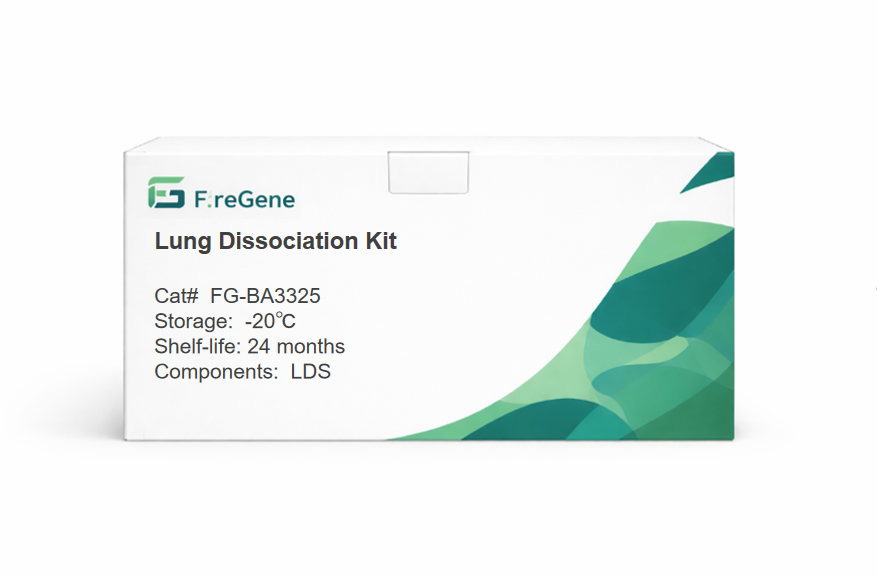

Description
Overview
FireGene Lung Dissociation Kit is specially formulated to isolate high-viability single cells from lung tissue using a powerful enzymatic protocol. Ideal for research in pulmonary diseases and immune profiling, this kit provides clean, consistent cell suspensions for advanced applications such as scRNA-seq and cytometry.
Background Information
-
Driven by Clinical and Scientific Research Needs:
- Research into lung diseases like COPD, pulmonary fibrosis, and lung cancer demands single-cell resolution.
- Traditional dissociation methods fail to preserve fragile lung cell types and introduce cellular stress.
- This kit enables:
- Identification of alveolar, endothelial, epithelial, and immune cells within lung tissue.
- Discovery of new biomarkers and drug targets for precision medicine.
- Deep analysis of cellular responses to disease and therapy.
-
Background of Technological Development:
- Addresses the inefficiencies and limitations of conventional dissociation.
- Employs:
- Optimized enzyme combinations specific to lung matrix composition.
- Controlled protocols for timing, temperature, and concentration.
- Enhanced cell recovery, reduced cellular stress, and high reproducibility.
Detection Principle
- Utilizes a synergistic enzymatic digestion process:
- Lung tissue is sectioned into small fragments.
- A stepwise reagent application is performed under precisely managed incubation conditions.
- Enzymes break down the extracellular matrix and liberate single cells.
- Result:
- A high-quality, viable single-cell suspension ready for sequencing, cytometry, or cell culture workflows.
Specifications
| Applications | Single-cell sequencing, cell culture or other cell-related detections |
| Compatible Sample Types | Lung tissue |
| Supported Instruments | Water bath, horizontal centrifuge, cell counter |
| Storage | -20 °C |
| Shelf-life | 24 months |
Kit Components
10 Reactions
| Component | 10 Reactions/Kit |
| Lung DS (Lung Dissociation Solution) | 2 × 1.25 mL |
50 Reactions
| Component | 50 Reactions/Kit |
| Lung DS (Lung Dissociation Solution) | 10 × 1.25 mL |
Product FAQ
1. Q: When dissociating lung tissue, it is found that the alveolar structure is difficult to destroy, and a large number of intact alveoli remain even after 1 hour of enzymolysis, resulting in extremely low single-cell yield. What is the reason, and how to adjust the operation to destroy the alveolar structure?
A: The failure to destroy the alveolar structure is due to insufficient mincing of lung tissue, which prevents the alveolar cavity from being exposed and the enzymolysis solution from contacting the alveolar wall fibers. Adjustment methods: ① Mince the lung tissue into pieces smaller than 0.2mm³ (1/3 the size of regular tissue) to ensure the alveolar cavity ruptures; ② Repeatedly puncture the minced tissue with a 1mL syringe needle before enzymolysis to physically destroy the alveolar wall; ③ Add an additional 50μL of lung tissue dissociation solution during enzymolysis and extend the enzymolysis time to 1.5 hours. This can increase the alveolar structure destruction rate to over 85% and improve the single-cell yield by 60%.
2. Q: When dissociating lung tissue from mice with chronic obstructive pulmonary disease (COPD) model, a large amount of viscous mucus appears in the cell suspension, which wraps the cells and causes filtration difficulties. How to remove this mucus?
A: The mucus is formed by the mixture of mucin secreted by COPD lung tissue and enzymolysis products. Removal methods: ① Add 100μL of 0.1% hyaluronidase (self-prepared, non-toxic to cells) during enzymolysis to degrade the mucopolysaccharide components in the mucus; ② Centrifuge the cell suspension at 4℃, 500×g for 3 minutes before filtration, and discard the upper mucus layer; ③ Rinse the 70μm cell sieve 3 times with PBS containing 2% FBS to ensure the mucus flows out with the filtrate and avoid sieve clogging. This can increase the filtration speed by 50%.
3. Q: When using a hybridization oven for enzymolysis, the liquid in the centrifuge tube is found to be layered (clear upper layer and turbid lower layer), resulting in uneven enzymolysis efficiency. What is the reason, and how to solve the liquid stratification problem?
A: Stratification occurs because lung tissue contains high-density blood vessels and fiber components, which settle to the bottom of the tube when the rotation speed of the hybridization oven is insufficient, leading to uneven contact between the enzymolysis solution and the tissue. Solutions: ① Increase the rotation speed of the hybridization oven from 20-30 rpm to 25-35 rpm to enhance liquid convection; ② Add 1 sterile magnetic stir bar (3mm in diameter, self-prepared) to the centrifuge tube before enzymolysis to assist mixing by magnetic force; ③ Manually invert the centrifuge tube once every 15 minutes to ensure full contact between the tissue and the enzymolysis solution. This can improve the enzymolysis uniformity by 70%.
4. Q: After opening the kit, the lung tissue dissociation solution is stored at -20℃ for 5 months. When used, it is found that the tissue still remains in blocks after enzymolysis, and the enzyme activity decreases significantly. How to quickly determine if the dissociation solution is completely invalid?
A: It can be judged by a "mini enzymolysis experiment": ① Mix 50μL of the dissociation solution with 10mg of minced lung tissue and incubate at 37℃ for 30 minutes; ② Pipette 10 times. If the tissue pieces are still larger than 1mm³ and no obvious cells are released, the dissociation solution is completely invalid; ③ If a small number of cells are released but enzymolysis is insufficient, double the amount of dissociation solution to 480μL and extend the enzymolysis time to 2.5 hours. This can barely meet the needs of basic experiments (not recommended for single-cell sequencing).
5. Q: When dissociating lung tissue from newborn mice (within 3 days of birth), a large number of cells tend to die (viability is only 40%). What causes this, and how to adjust the operation to protect the immature lung cells?
A: The cell membrane of immature lung cells is fragile and easily damaged by the enzymolysis solution and mechanical force. Adjustment methods: ① Shorten the enzymolysis time from 0.5-2 hours to 20-30 minutes to reduce cell damage caused by enzymes; ② Use a water bath for enzymolysis and gently shake every 5 minutes (avoid violent oscillation); ③ Replace the regular PBS containing 5% FBS with PBS containing 10% FBS for washing to enhance cell protection. This can increase the cell viability to over 75%.
6. Q: After centrifugation, a large number of black particles (suspected to be carbon dust) are found mixed in the cell pellet, which affects subsequent cell counting and staining. How to remove these impurity particles?
A: The black particles are mostly foreign impurities inhaled by lung tissue or formed by the aggregation of cell debris. Removal methods: ① After centrifugation, gently pipette the pellet with 1mL of PBS containing 5% FBS to suspend the particles; ② Let it stand for 2 minutes. After the particles settle, aspirate the upper cell suspension and transfer it to a new centrifuge tube; ③ Repeat the operation twice. This can remove over 80% of the black particles without affecting cell viability (viability loss ≤5%).
7. Q: When using a water bath for enzymolysis, observation is forgotten due to experimental interruption, and the enzymolysis time lasts for 3 hours. It is found that the cell viability drops to 30%. How to remedy to retain some usable cells?
A: A large number of cells die due to over-enzymolysis, and viable cells can be screened by "gradient centrifugation": ① Centrifuge the cell suspension at 4℃, 200×g for 3 minutes, and discard the upper layer of dead cells and debris; ② Resuspend the pellet with 5mL of PBS containing 10% FBS and centrifuge at 4℃, 300×g for 5 minutes; ③ Take the pellet and stain with trypan blue. Viable cells are mostly concentrated in the lower layer of the pellet. This can screen out cells with viability ≥60% (yield is about 30% of the original), which is only suitable for experiments with low cell quantity requirements such as cell culture.
8. Q: After dissociation, red blood cells account for 55% of the cell suspension. When treated with FG-BA3311 Red Blood Cell Lysis Buffer, the viability of pulmonary vascular endothelial cells drops from 80% to 50%. How to optimize the lysis conditions to reduce damage to endothelial cells?
A: The damage to endothelial cells is due to the certain toxicity of the lysis buffer to vascular endothelial cells. Optimization methods: ① Dilute the lysis buffer 1-fold with PBS to reduce its concentration; ② Control the incubation temperature at 4℃ and shorten the time to 2-3 minutes. Terminate the reaction immediately after observing red blood cell lysis under a microscope; ③ Wash 3 times with PBS containing 10% FBS after lysis to fully remove the residual lysis buffer. This can maintain the viability of pulmonary vascular endothelial cells at over 70%.
Files Download Links