

Description
Overview
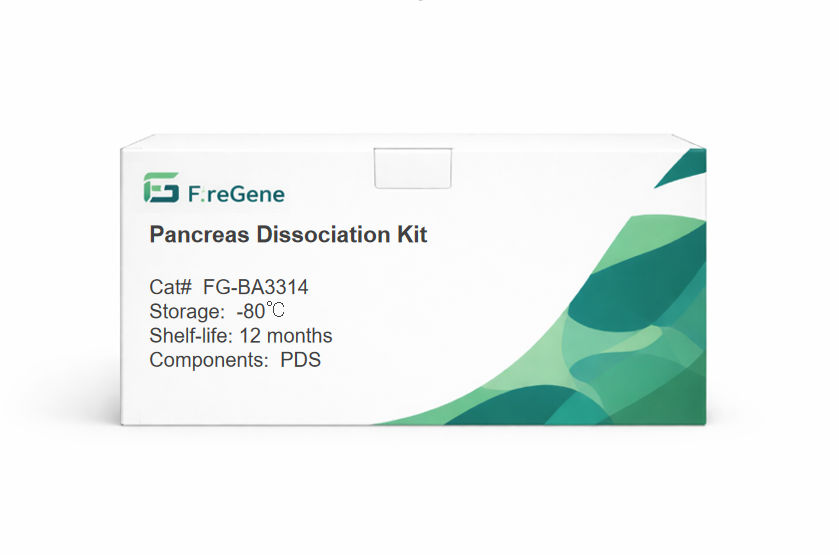
FireGene Pancreas Dissociation Kit is designed for the efficient enzymatic dissociation of pancreatic tissue into viable single-cell suspensions. Ideal for single-cell sequencing and disease modeling, this kit supports investigations into diabetes, pancreatitis, and pancreatic cancer with high precision and reproducibility.
Background Information
-
Driven by Clinical and Scientific Research Needs:
- Understanding pancreatic disease mechanisms, such as diabetes, chronic inflammation, and pancreatic cancer, requires detailed single-cell analysis.
- Traditional methods do not fully preserve islet cells, acinar cells, and other fragile populations.
- This kit enables:
- Isolation and profiling of pancreatic cell types for biomarker discovery.
- Improved insight into immune response, fibrosis, and beta-cell function.
- Development of targeted therapies and regenerative strategies for pancreatic diseases.
-
Background of Technological Development:
- FireGene overcomes the limitations of low cell yield and viability by using:
- A proprietary enzymatic formulation designed specifically for pancreatic ECM.
- Optimized conditions for incubation time, temperature, and enzyme concentration.
- A workflow that preserves cell integrity, ensuring consistent and high-quality single-cell suspensions.
- FireGene overcomes the limitations of low cell yield and viability by using:
Detection Principle
- Based on a synergistic enzymatic digestion process:
- Pancreatic tissue is minced and treated sequentially with prepared reagents.
- The digestion proceeds under controlled conditions, breaking down ECM components and intercellular junctions.
- Final Result:
- A clean, high-viability single-cell suspension ideal for use in scRNA-seq, proteomics, and pancreatic disease research.
Specifications
| Applications | Single-cell sequencing, cell culture or other cell-related detections |
| Compatible Sample Types | Pancreas tissue |
| Supported Instruments | Water bath, horizontal centrifuge, cell counter |
| Storage | -80 °C |
| Shelf-life | 12 months |
Kit Components
| Component | 8 Tests/Kit |
|
Pancreas Dissociation Kit |
8 × 3 mL |
Product FAQ
1. Q: Is this kit only suitable for mammalian pancreatic tissue? Are there differences in dissociation effects on different parts of the pancreas (e.g., islets, exocrine portion)? Can it be used for pancreatic tumor tissue or non-mammalian pancreatic tissue (e.g., avian pancreas)?
A: The kit is only suitable for normal pancreatic tissue and pancreatic cancer tissue, and is not temporarily recommended for non-mammalian pancreatic tissue. The cell membrane characteristics of non-mammalian pancreatic tissue (such as avian pancreas) are significantly different from those of mammals, making it difficult to obtain intact single cells after dissociation. There are slight differences in dissociation effects on different parts of the pancreas: For islet tissue (containing sensitive endocrine cells), the digestion time needs to be shortened (it is recommended to complete quality inspection within 0.5 hours) to avoid reduced viability due to excessive enzymolysis; the exocrine portion has slightly stronger tolerance and can be digested for the conventional 0.5 hours. However, both can eventually obtain high-viability single cells with no significant difference in yield.
2. Q: The kit is labeled "8 rxns", and the dosage of pancreatic tissue dissociation solution per experiment is 3mL. If only 100mg of pancreatic tissue (1/2 of the standard dosage) is processed in a single experiment, can the dosage of dissociation solution be proportionally reduced to 1.5mL?
A: Proportional reduction to 1.5mL is not recommended. The enzyme concentration and buffer system in the pancreatic tissue dissociation solution are designed for 3mL volume to match 200mg of tissue. If reduced to 1.5mL, the contact area between the enzyme and the tissue will be significantly reduced, and the excessively small liquid volume may lead to high local enzyme concentration. On the contrary, this will cause over-digestion of some tissues and incomplete dissociation of others. When processing 100mg of tissue, 3mL of dissociation solution is still required. During subsequent centrifugation to collect cells, the centrifugation time can be extended (from 5 minutes to 8 minutes) to ensure sufficient cell precipitation and avoid cell loss due to the relatively large liquid volume.
3. Q: During digestion in Step 3, a water bath requires "manual shaking every 3-5 minutes", and a hybridization oven requires "a rotation speed of 20-30 rpm". Is the only operational difference between the two devices the mixing method? Which one is more suitable for pancreatic tissue dissociation?
A: Beyond the mixing method, the core difference lies in temperature stability: The temperature control accuracy of the hybridization oven (±0.5℃) is higher than that of the water bath (±1℃). Moreover, the automatic rotation speed enables continuous and uniform contact between pancreatic tissue and the dissociation solution, avoiding local digestion differences caused by uneven density of pancreatic tissue. In terms of effect, the hybridization oven is more suitable for pancreatic tissue dissociation—Pancreatic tissue contains a large number of digestive enzymes. If the frequency or intensity of manual shaking is inconsistent, it is easy to cause "local over-enzymolysis and local undigestion"; the stable rotation speed of the hybridization oven can reduce this risk, and the single-cell yield is 15%-20% higher than that of the water bath. If a water bath is used, it is necessary to strictly shake at 3-minute intervals for 10 seconds each time to ensure no tissue settles at the bottom.
4. Q: Steps 5-7 require filtration with a 70μm cell sieve and rinsing the centrifuge tube 3 times to collect a total of 12mL of filtrate. What impact will omitting one rinsing step have on the experimental results? Can a 40μm or 100μm cell sieve replace the 70μm one?
A: Omitting one rinsing step will result in the loss of approximately 1/3 of residual cells, reducing the final cell yield by 25%-30%. Cells after pancreatic dissociation (such as islet β cells and acinar cells) are easily adsorbed on the inner wall of the centrifuge tube, and 3 rinsing steps are the key to ensuring full cell recovery. A 40μm or 100μm cell sieve cannot be used as a replacement: The pore size of the 40μm sieve is too small and will retain some pancreatic single cells (e.g., islet cells have a diameter of about 10-15μm; although they can pass through, the sieve is easily blocked by fiber debris, leading to filtration difficulties); the pore size of the 100μm sieve is too large and cannot effectively filter the fine fiber debris remaining in pancreatic tissue. These impurities will interfere with subsequent cell counting or single-cell sequencing sample preparation.
5. Q: The centrifugation parameters in Steps 8 and 9 are both "4℃, 300×g for 5 minutes". If only a vertical centrifuge is available in the laboratory or the centrifugation speed is set incorrectly (e.g., 200×g, 400×g), what impact will this have? Can room-temperature centrifugation replace 4℃ centrifugation?
A: A vertical centrifuge cannot replace a horizontal centrifuge. The direction of centrifugal force of a vertical centrifuge is perpendicular to the centrifuge tube, which will cause uneven precipitation of pancreatic cells, easily resulting in loose precipitation or adhesion to the tube wall. Cells are likely to be sucked away when discarding the supernatant; a horizontal centrifuge allows cells to precipitate evenly at the bottom of the tube, facilitating subsequent operations. Impacts of incorrect parameters: ① Rotation speed of 200×g: Cells cannot be fully precipitated and will be lost with the supernatant, reducing the yield by more than 40%; ② Rotation speed of 400×g: Excessive centrifugal force will squeeze fragile islet cells, leading to a 20%-25% decrease in viability. Room-temperature centrifugation cannot replace 4℃ centrifugation. Room temperature will accelerate the metabolism of pancreatic cells, and the residual dissociation solution has enhanced activity at room temperature, further damaging the cells. Centrifugation at 4℃ can maintain a low metabolic state of cells and reduce viability loss.
6. Q: The instruction manual mentions that "DMEM medium can replace RPMI 1640 medium". After replacement, is it necessary to adjust the number of rinsing steps or centrifugation parameters? Do the two media have an impact on the viability of pancreatic cells?
A: There is no need to adjust the number of rinsing steps or centrifugation parameters after replacement. Both DMEM and RPMI 1640 are common basal media for mammalian cells. Although they differ in amino acid and vitamin content, both can provide a suitable osmotic pressure and pH environment for pancreatic cells, with no impact on dissociation efficiency. The impact on the viability of pancreatic cells is minimal: Experimental data shows that the difference in pancreatic cell viability after rinsing with the two media is ≤5%. The medium can be selected based on the existing inventory in the laboratory without deliberate replacement. If the subsequent experiment is cell culture, it is recommended to prioritize the medium consistent with the culture system to reduce the cell adaptation cost.
7. Q: Step 12 mentions that "BA3311 Red Blood Cell Lysis Buffer can be used to remove red blood cells". After which step should this operation be performed? What should be noted during lysis to avoid damaging pancreatic cells?
A: It should be performed after Step 10 (after two washes) and before Step 11 (before resuspension). Specific operation: After discarding the supernatant in Step 10, add 1mL of BA3311 Red Blood Cell Lysis Buffer, incubate at 4℃ for 5 minutes (avoid room-temperature incubation to prevent damage to pancreatic cells), then centrifuge at 4℃, 300×g for 5 minutes, discard the supernatant, and resuspend with 5mL of PBS containing 5% FBS (add an additional wash), then proceed to Step 11. Precautions: The lysis time should not exceed 8 minutes; otherwise, the pancreatic cell membrane will be damaged. If there are many red blood cells, lysis can be repeated once, but an additional wash is required to avoid residual lysis buffer affecting subsequent experiments (e.g., cell capture efficiency in single-cell sequencing).
8. Q: The pancreatic tissue dissociation solution needs to be stored at -80℃. If the ice pack melts during transportation and the reagent is left at 4℃ for 2 hours, can it still be used? What impact does repeated freezing and thawing have?
A: It can still be used after being left at 4℃ for 2 hours, but it must be immediately returned to -80℃ and fully mixed before subsequent use. The enzyme in the dissociation solution loses ≤10% of its activity when placed at 4℃ for a short period (≤2 hours), which does not affect the dissociation effect. Repeated freezing and thawing will lead to a significant decrease in enzyme activity: Each freeze-thaw cycle reduces enzyme activity by 12%-18%; after more than 3 freeze-thaw cycles, the activity is less than 50%, which cannot effectively decompose the extracellular matrix of pancreatic tissue, resulting in a large number of tissue clumps after dissociation. It is recommended that after receiving the kit, aliquot the 4×3mL dissociation solution into 3mL/tube (no further aliquoting is needed, as the original packaging is already in single-use volume), seal it, store at -80℃, and take one tube for each experiment to avoid repeated freezing and thawing.
9. Q: After quality control in Step 13, it is required to "carry out subsequent experiments immediately". If subsequent experiments cannot be conducted immediately, can the prepared pancreatic cell suspension be stored for a short period? What are the restrictions on storage conditions and time?
A: Short-term storage is possible under the conditions of sealed storage in a 4℃ refrigerator for no more than 1.5 hours, with repeated shaking avoided. During storage, the cell concentration should be adjusted to 1×10⁶-1×10⁷ cells/mL using PBS containing 5% FBS, and the suspension should be placed in a low-adhesion centrifuge tube. After 1.5 hours, the viability of pancreatic cells (especially islet cells) will decrease significantly (10%-12% per hour), and cell aggregation is prone to occur; if stored for more than 3 hours, the cell viability may be lower than 50%, making it unsuitable for single-cell sequencing or cell culture. Before use, re-quality inspection is required, and only cells with viability ≥65% can be used. Additionally, gently pipette 5-8 times to disperse slightly aggregated cells.
Files Download Links