

Description
Overview
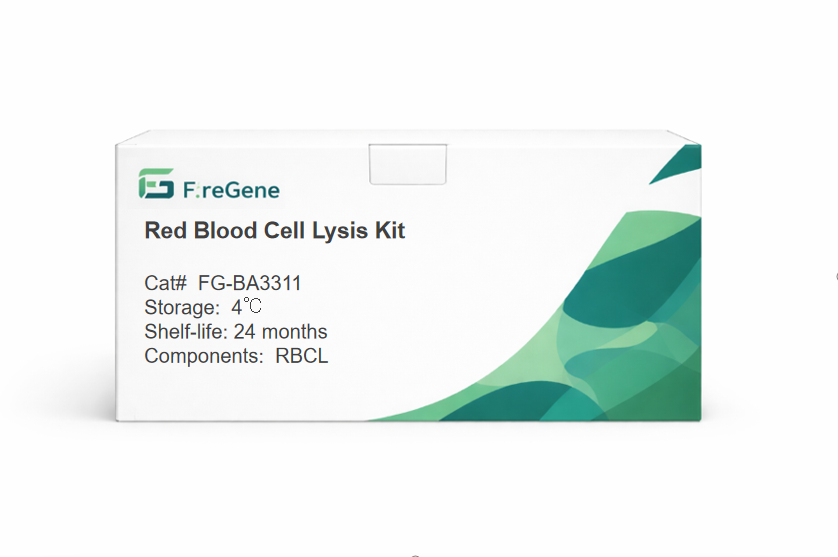
FireGene Red Blood Cell Lysis Kit is formulated for the rapid and effective removal of red blood cells (RBCs) from single-cell suspensions. Widely applied in flow cytometry, immunological studies, and molecular biology, this kit improves the clarity and quality of samples used for downstream cell analysis and extraction workflows.
Background Information
- Crucial for processing peripheral blood and lymphoid tissues.
- Enhances accuracy in:
- Flow cytometry, by isolating white blood cells for phenotypic analysis.
- Single-cell sequencing, by removing cellular noise caused by erythrocytes.
- Protein and nucleic acid extraction, by providing purified cellular material.
- Widely used in clinical diagnostics, immunological research, and biomarker discovery.
Detection Principle
- Combines osmotic shock and enzymatic digestion:
- The buffer induces a hypertonic environment that causes red blood cells to absorb water and rupture.
- Enzymes degrade RBC-specific membrane components, ensuring selective lysis.
- Result:
- White blood cells and other cell types remain intact, suitable for further analysis or functional assays.
Specifications
| Applications | Single-cell sequencing, cell culture or other cell-related detections |
| Compatible Sample Types | Single-cell suspension |
| Supported Instruments | Water bath, horizontal centrifuge, cell counter |
| Storage | 4 °C |
| Shelf-life | 24 months |
Kit Components
100 mL/Kit
| Component | 100 mL/Kit |
| Red Blood Cell Lysis Solution | 100 mL |
500 mL/Kit
| Component | 500 mL/Kit |
| Red Blood Cell Lysis Solution | 500 mL |
Product FAQ
1. Q: Is this lysis buffer only suitable for removing red blood cells after vascular tissue dissociation? Is it effective for red blood cells in samples from other sources (e.g., blood, spleen, tumor tissue)? Can it be used for non-mammalian samples (e.g., avian blood)?
A: The lysis buffer is suitable for red blood cell removal from various sample sources, including vascular tissue dissociation suspensions, peripheral blood, spleen homogenate suspensions, and tumor tissue dissociation solutions. It primarily ruptures red blood cells through osmotic pressure differences, featuring strong versatility. However, it is not suitable for non-mammalian samples. Non-mammalian red blood cells (e.g., avian) contain nuclei and have significantly different cell membrane structures from mammals. This lysis buffer cannot effectively rupture their cell membranes, so a dedicated avian red blood cell lysis buffer must be used. For mammalian samples from different sources, only the lysis time needs to be adjusted based on red blood cell content, with no other operational changes required.
2. Q: The instruction manual requires mixing the single-cell suspension with the lysis buffer at a 1:3 ratio. If the sample has extremely low red blood cell content (e.g., purified endothelial cell suspension) or extremely high content (e.g., whole blood sample), does the ratio need to be adjusted? Should the lysis time be changed accordingly after adjustment?
A: The ratio should be flexibly adjusted based on red blood cell content: ① For extremely low red blood cell content (e.g., endothelial cell suspension with red blood cell ratio <5%), the ratio can be adjusted to 1:1 (1 mL suspension + 1 mL lysis buffer) to avoid excessive lysis buffer damaging target cells, with lysis time shortened to 1-3 minutes; ② For extremely high red blood cell content (e.g., whole blood sample), the ratio should be increased to 1:5 (1 mL whole blood + 5 mL lysis buffer) to ensure red blood cells fully contact the lysis buffer, with lysis time extended to 10-15 minutes and gentle pipetting every 3 minutes to prevent incomplete lysis. After adjusting the ratio, the lysis time must be adapted accordingly, with the core criterion for stopping lysis being a clear and transparent solution.
3. Q: Step 3 requires "red blood cell lysis on wet ice". What is the difference between wet ice and regular ice? What impact will lysis on regular ice (non-wet ice) or at room temperature have on experimental results?
A: Wet ice refers to a mixture of ice cubes and a small amount of water, which allows the centrifuge tube to evenly contact the low-temperature environment and maintain a stable lysis temperature of approximately 4°C. Regular ice (dry ice or block ice) easily causes uneven or excessively low local temperatures in the centrifuge tube, affecting lysis efficiency. Lysis on regular ice may result in uneven lysis (over-lysis in some areas and incomplete lysis in others). Lysis at room temperature (25-30°C) significantly enhances the activity of the lysis buffer, which not only rapidly ruptures red blood cells but also damages target cells (e.g., vascular endothelial cells, immune cells), reducing target cell viability by over 30% and even causing complete cell death in severe cases. Lysis must be strictly performed on wet ice.
4. Q: Step 4 requires "adding an equal volume of PBS containing 5% FBS to stop lysis". Does "equal volume" refer to the volume of the single-cell suspension or the post-lysis mixture? What consequences will occur if PBS without FBS is used to stop lysis?
A: "Equal volume" refers to the volume of the post-lysis mixture (suspension + lysis buffer). For example, 1 mL suspension + 3 mL lysis buffer forms a 4 mL mixture, so 4 mL of PBS containing 5% FBS should be added to stop lysis. Using PBS without FBS cannot neutralize the activity of residual lysis buffer, which will continue to act on target cells, damaging their cell membranes. This leads to a 25%-40% decrease in cell viability after subsequent centrifugation and increases cell debris. The protein components in FBS quickly block the active sites of the lysis buffer and protect cells, making it an indispensable component for stopping lysis.
5. Q: The centrifugation parameters require "4°C, 450×g for 5 minutes". If only a vertical centrifuge is available in the laboratory or if parameters are set incorrectly (e.g., excessively high/low speed), what impact will this have? Can room-temperature centrifugation replace 4°C centrifugation?
A: A vertical centrifuge cannot replace a horizontal centrifuge. The centrifugal force direction of a vertical centrifuge is perpendicular to the centrifuge tube, resulting in uneven cell pelleting (loose pellets or wall adhesion), which increases the risk of aspirating target cells when discarding the supernatant. A horizontal centrifuge ensures uniform cell pelleting at the tube bottom, facilitating subsequent operations. Impacts of incorrect parameters: ① Excessively high speed (e.g., 800×g) compacts the cell pellet, making resuspension difficult and potentially crushing fragile cells (e.g., lymphocytes); ② Excessively low speed (e.g., 200×g) prevents full cell pelleting, leading to target cell loss with the supernatant. Room-temperature centrifugation cannot replace 4°C centrifugation, as room temperature accelerates cell metabolism and enhances residual lysis buffer activity, causing further cell damage. Strict adherence to 4°C centrifugation is recommended.
6. Q: Steps 6 and 7 require "two washing cycles". What impact will omitting one cycle (only one wash) have on subsequent experiments? Is it feasible to replace PBS containing 5% FBS with RPMI 1640 medium for washing?
A: Omitting one wash cycle fails to completely remove residual lysis buffer and red blood cell debris: ① Residual lysis buffer interferes with subsequent experiments (e.g., cell capture in single-cell sequencing, fluorescence signal detection in flow cytometry), leading to data bias; ② Excessive red blood cell debris affects cell counting accuracy and may clog detection instruments (e.g., cell counter channels). RPMI 1640 medium can replace PBS containing 5% FBS for washing—both liquids rinse residual impurities, and RPMI 1640 also provides nutrients for cells. However, ensure the medium contains no antibiotics or other components that may affect subsequent experiments. For protein extraction, both liquids are suitable; for cell culture, PBS containing 5% FBS is preferred to better maintain cell status.
7. Q: After lysis, the solution fails to become "clear and transparent" and remains turbid or has red precipitates. What are the possible causes and how to address them?
A: Common causes and solutions for incomplete clarity: ① Insufficient lysis time (red blood cells not fully ruptured): Add a small amount of lysis buffer (1/3 of the original ratio), continue incubation on wet ice for 3-5 minutes, and pipette gently every 2 minutes until the solution clears; ② Excessive impurities (e.g., tissue debris, fibrous components) causing turbidity: First filter the sample through a 70μm cell sieve to remove impurities, then check the solution status; ③ Uneven mixing of lysis buffer (insufficient concentration in some areas): Pipette the mixture gently 10-15 times to ensure uniform distribution of the lysis buffer. If no improvement is observed, add an equal volume of lysis buffer and extend incubation time.
8. Q: The product requires "storage at 4°C in the dark". If the ice pack melts during transportation and the product is left at room temperature (25°C) for 1 hour, can it still be used? What consequences will occur if stored at room temperature for a long time?
A: The product can still be used after 1 hour at room temperature, but it must be immediately returned to 4°C and fully mixed before use. The osmotic balance system of the lysis buffer remains stable during short-term room-temperature storage (≤1 hour), with ≤5% activity loss, which does not affect lysis efficiency. Long-term room-temperature storage (over 24 hours) causes changes in the salt ion concentration of the lysis buffer, leading to osmotic imbalance. This not only fails to effectively rupture red blood cells but also causes target cell dehydration or swelling. Additionally, it promotes microbial growth (even though the product is sterile, microbes multiply easily at room temperature), resulting in sample contamination. Therefore, strict storage at 4°C in the dark is mandatory, and repeated removal to room temperature should be avoided.
9. Q: Step 8 requires "resuspending with the minimum possible volume of PBS containing 5% FBS". How to determine the specific volume? If the resuspension volume is too large (resulting in low cell concentration), how to concentrate the cells subsequently?
A: The resuspension volume depends on subsequent experimental needs: ① For flow cytometry or single-cell sequencing, resuspend at a concentration of 1×10⁶-1×10⁷ cells/mL (e.g., 1-2 mL PBS for a pellet containing approximately 1×10⁷ cells); ② For protein extraction, adjust based on the requirements of the extraction kit (typically 50-100 μL). If the volume is too large (low concentration), concentrate by centrifuging at 450×g for 5 minutes at 4°C, discard part of the supernatant, and re-adjust the concentration with a small volume of PBS. Operate gently during centrifugation to avoid cell damage, and limit concentration cycles to ≤2 to prevent viability loss.
10. Q: Compared with other brands of red blood cell lysis buffers, this product is labeled "gentle removal". What specific features reflect this? What is the approximate damage rate to sensitive cells (e.g., hematopoietic stem cells, nerve cells)?
A: "Gentle removal" is reflected in two key aspects: ① A mild osmotic gradient design that targets only the osmotic sensitivity of red blood cell membranes, minimizing damage to target cell membranes; ② No irritating components (e.g., proteases) are added, avoiding damage to cell surface proteins and internal structures. The damage rate to sensitive cells is low: Experimental data shows that after treating hematopoietic stem cell suspensions with this product, cell viability remains above 85% (damage rate <15%); for nerve cell suspensions, viability remains above 80% (damage rate <20%), significantly lower than ordinary lysis buffers (which typically cause >30% damage to sensitive cells). For experiments involving sensitive cells, control lysis time to 1-5 minutes to reduce cell exposure to the lysis buffer and further lower the damage rate.
Files Download Links