

Description
Product Introduction
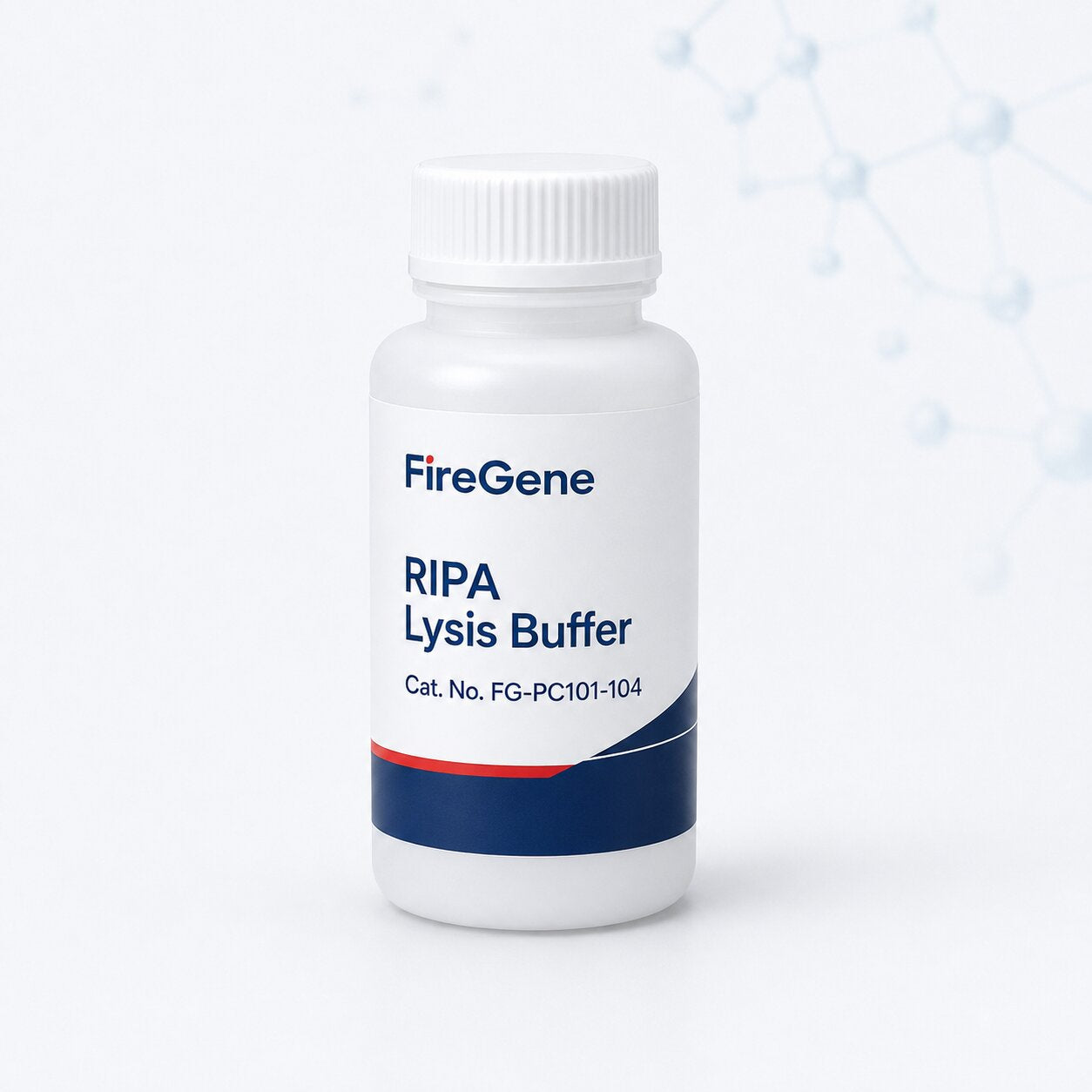
RIPA lysis buffer (where RIPA stands for Radio Immunoprecipitation Assay) is a traditional reagent designed for the rapid lysis of cells and tissues. It is primarily used to extract soluble proteins from animal cells and tissues; the resulting protein samples are suitable for use in standard downstream applications such as Western blotting, immunoprecipitation (IP), and ELISA. There are numerous formulations for RIPA lysis buffer, which can be broadly categorized into three groups—strong, moderate, and mild—based on their respective lysis strengths. The protein concentration of samples obtained through RIPA lysis can be determined using a BCA Protein Quantitation Kit (Catalog No.: FG-ZJ101 or FG-ZJ102).
Instructions for Use
1. Take an appropriate amount of lysis buffer (approximately 50–100 µL per 1×10⁶ cells, or 150–250 µL per 20 mg of tissue sample), and add protease inhibitor at a ratio of 1:100 (v/v) a few minutes prior to use (the protease inhibitor must be purchased separately; Cat. No.: FG-GRF101).
Note: If phosphorylated proteins are to be extracted, a phosphatase inhibitor (Cat. No.: FG-GRF102) must also be added to the RIPA lysis buffer at a ratio of 1:100 (v/v).
2. Sample Lysis (Perform on ice):
For adherent cells
⑴ Discard the culture medium and wash once with 1× PBS, physiological saline, or serum-free medium (washing may be omitted if the proteins present in the serum do not interfere with the experiment);
⑵ Discard the PBS as completely as possible (excess liquid will reduce the concentration of the lysis buffer);
⑶ Add RIPA lysis buffer at a ratio of approximately 50–100 µL per 1×10⁶ cells; for instance, for cells in a single well of a 6-well plate, approximately 150–250 µL of lysis buffer is required. Gently pipette the mixture several times to ensure thorough contact between the lysis buffer and the cells. Typically, cell lysis occurs within 1–2 seconds of contact with the lysis buffer.
⑷ Transfer all liquid into a new centrifuge tube.
For suspension cells
⑴ Transfer the cells to a centrifuge tube, centrifuge to collect the cells, and discard the culture medium.
⑵ Wash once with 1× PBS (or physiological saline/serum-free culture medium) (washing may be omitted if the proteins in the serum do not interfere with the experiment);
⑶ Discard the PBS as completely as possible (excess liquid will dilute the lysis buffer);
⑷ Add RIPA lysis buffer at a ratio of approximately 50–100 µL per 1×10⁶ cells; for instance, for cells in a single well of a 6-well plate, approximately 150–250 µL of lysis buffer should be added. Gently pipette the mixture up and down several times to ensure thorough contact between the lysis buffer and the cells. Upon complete lysis, no visible cell pellet should remain. If the cell density is high, the sample must be aliquoted into smaller portions of 5×10⁵ to 1×10⁶ cells per tube prior to lysis.
For tissue samples
⑴ Cut the tissue into tiny fragments;
⑵ Add the lysis buffer at a ratio of 150–250 μL per 20 mg of tissue sample.
Note: If sample lysis is insufficient, the volume of lysis buffer may be appropriately increased; conversely, if a high-concentration protein sample is required, the volume of lysis buffer may be appropriately reduced.
⑶ Homogenize using a glass homogenizer until the sample is completely lysed.
Note: If the tissue sample is extremely small, it may be appropriately minced and added directly to the lysis buffer; vigorous vortexing should then be performed to ensure complete lysis.
3. After complete lysis, centrifuge at 10,000–14,000 × g for 3–5 minutes. Carefully transfer the supernatant (protein sample) into a new centrifuge tube; it is then ready for downstream procedures such as PAGE gel electrophoresis, Western blotting, and immunoprecipitation. The resulting protein sample may be aliquoted and stored long-term at -80°C.
Product Selection Reference
|
Item No. |
FG-PC101 |
FG-PC102 |
FG-PC103 |
|
Product Name |
RIPA Lysis Buffer (High) |
RIPA Lysis Buffer (Medium) |
RIPA Lysis Buffer (Low) |
|
Effective Lysis Components |
1%Triton X-100, 1% sodium deoxycholate, 0.1% SDS |
1% NP-40, 0.5% sodium deoxycholate, 0.1% SDS |
1% NP-40, 0.25% sodium deoxycholate |
|
Cleavage Strength |
Strong |
Medium |
Mild |
|
Membrane Protein Extraction |
Excellent |
Good |
Average |
|
Cytoplasmic Protein Extraction |
Excellent |
Excellent |
Excellent |
|
Nuclear Protein Extraction |
Excellent |
Good |
Good |
|
Main Uses |
WB, IP |
WB, IP |
WB, IP, CO-IP |
Precautions
1. When stored at 4°C, SDS in the lysis buffer may precipitate. Before use, please incubate the solution at 37°C to ensure complete dissolution; it is ready for use once it has returned to room temperature.
2. All steps of sample lysis need to be performed on ice or at 4°C;
3. A small, transparent, gel-like mass frequently appears within the lysate produced by RIPA buffer. This is a normal occurrence; the substance consists of complexes formed by genomic DNA and similar components. If you do not intend to detect proteins that are tightly bound to genomic DNA, you may simply centrifuge the sample and collect the supernatant for subsequent experiments. However, if the detection of such proteins is required, the transparent gel-like mass can be dispersed via sonication; the supernatant can then be collected after centrifugation for use in downstream applications. Nevertheless, when detecting common transcription factors—such as NF-κB or p53—sonication is typically unnecessary for successful detection.
4. For your safety and health, please wear a lab coat and disposable gloves while performing operations.
5. This product is for research use only.
Files Download Links