
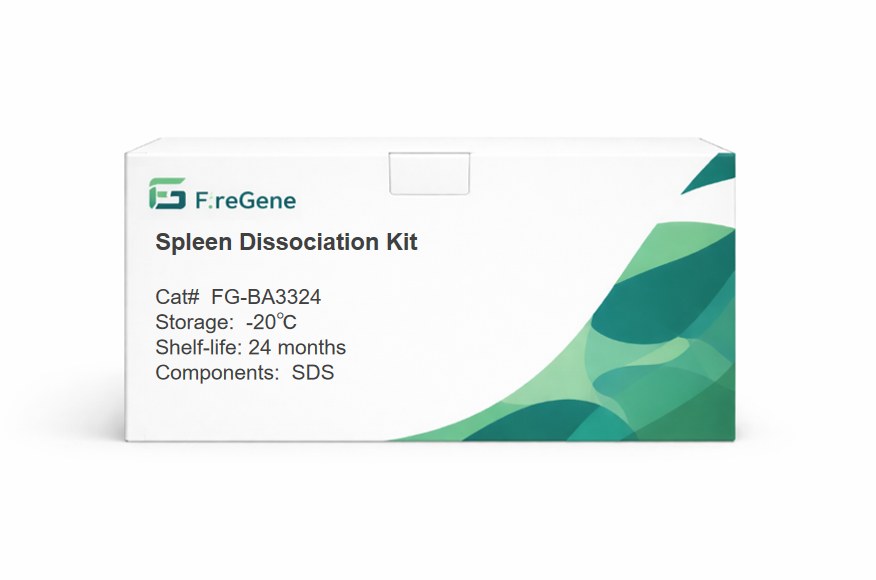

Description
Overview
FireGene Spleen Dissociation Kit is designed to produce high-viability single-cell suspensions from spleen tissue through a carefully optimized enzymatic protocol. It is ideal for immunological studies, single-cell sequencing, and immune profiling applications, offering exceptional cell recovery and integrity.
Background Information
-
Driven by Clinical and Scientific Research Needs:
- Single-cell sequencing of spleen tissue is critical for understanding immune mechanisms and identifying functional cell subsets.
- Traditional methods often fail to preserve rare or sensitive immune populations.
- This kit supports:
- Detailed profiling of T cells, B cells, dendritic cells, and macrophages.
- Investigation of immune responses in sepsis, autoimmune disorders, and cancer.
- Discovery of immunological biomarkers and therapeutic targets for translational and clinical research.
-
Background of Technological Development:
- Mechanical disruption can damage spleen cells and yield inconsistent results.
- FireGene improves performance with:
- Enzyme cocktails tailored to the spleen’s extracellular matrix.
- Optimization of incubation times, temperatures, and concentrations.
- High reproducibility and superior cell viability for downstream assays.
Detection Principle
- Based on a synergistic multi-enzyme digestion process:
- Spleen tissue is minced into small sections to enhance reagent access.
- Enzymes are added sequentially under controlled conditions.
- The digestion breaks down ECM structures and cellular junctions to release single cells.
- Final Outcome:
- A high-quality single-cell suspension suitable for scRNA-seq, flow cytometry, and immunophenotyping.
Specifications
| Applications | Single-cell sequencing, cell culture or other cell-related detections |
| Compatible Sample Types | Spleen tissue |
| Supported Instruments | Water bath, horizontal centrifuge, cell counter |
| Storage | -20 °C |
| Shelf-life | 24 months |
Kit Components
10 Reactions
| Component | 10 Reactions/Kit |
| Spleen DS (Spleen Dissociation Solution) | 2 × 1.25 mL |
50 Reactions
| Component | 50 Reactions/Kit |
| Spleen DS (Spleen Dissociation Solution) | 10 × 1.25 mL |
Product FAQ
1. Q: When dissociating spleen tissue from juvenile mice (within 14 days of birth), the proportion of immune cells (e.g., lymphocytes) in the cell suspension is found to be extremely low. What causes this, and how to adjust the operation?
A: The spleen of juvenile mice is not fully developed, and immune cells are mainly concentrated in the white pulp region. If the tissue is not minced sufficiently, the white pulp fibers remain intact, making it difficult for immune cells to be released. Adjustment methods: ① Mince the spleen tissue into pieces smaller than 0.3mm³ (half the size of adult mouse spleen tissue) to ensure the white pulp structure is disrupted; ② Add RPMI 1640 medium containing 0.1% DNase I (self-prepared) during enzymolysis to prevent immune cell aggregation caused by nucleic acid release; ③ Shorten the enzymolysis time to 10-20 minutes to avoid over-digestion of immune cells. Eventually, the proportion of immune cells can be increased to over 75%.
2. Q: After dissociation, red blood cells account for more than 60% of the cell suspension. After treatment with BA3311 Red Blood Cell Lysis Buffer, the viability of lymphocytes drops from 85% to 55%. How to optimize the lysis operation to reduce damage to immune cells?
A: The decrease in viability is mostly due to excessive lysis time or improper temperature. Optimization methods: ① Adjust the incubation temperature of the lysis buffer from room temperature to 4℃ to reduce its toxicity to immune cells; ② Shorten the incubation time to 3-4 minutes (5 minutes for regular operation), and observe under a microscope to terminate the reaction immediately after most red blood cells are lysed; ③ Wash twice with PBS containing 10% FBS after lysis (once for regular operation) to fully remove residual lysis buffer. This can maintain the viability of lymphocytes at over 75%.
3. Q: When using a hybridization oven for enzymolysis, a large amount of foam appears in the solution in the centrifuge tube, leading to inaccurate subsequent cell counting. What causes this, and how to prevent foam formation?
A: Foam formation is caused by the reaction between surface proteins of immune cells in the spleen tissue and the enzymolysis solution, as well as excessive rotation speed of the hybridization oven leading to violent liquid oscillation. Prevention methods: ① Reduce the rotation speed of the hybridization oven from 20-30 rpm to 15-20 rpm to minimize liquid impact; ② Add 1 drop of defoamer (e.g., 0.1% polyethylene glycol, self-prepared) to the centrifuge tube before enzymolysis, ensuring the defoamer is non-toxic to cells; ③ If foam has already formed, gently aspirate the surface foam with a 1mL pipette tip before filtration to avoid foam interfering with cell counting.
4. Q: After opening the kit, the dissociation solution is stored at -20℃ for 4 months. When used, the enzymolysis efficiency is found to decrease significantly (cell yield is only 50% of the original). Is the dissociation solution invalid? How to determine if the dissociation solution is still usable?
A: The validity period of the dissociation solution after opening is 3 months when stored at -20℃ (2 years for unopened solution). After 4 months, it has exceeded the validity period, and the enzyme activity may decrease significantly. Judgment methods: ① Mix 50μL of the dissociation solution with a small amount of minced spleen tissue, incubate at 37℃ for 30 minutes. If the tissue pieces do not shrink significantly, it indicates insufficient enzyme activity; ② If the enzyme activity decreases slightly but the solution still needs to be used, extend the enzymolysis time and increase the amount of dissociation solution to 300μL to compensate for the reduced enzyme activity. This can restore the cell yield to approximately 70% of the original.
5. Q: During filtration after enzymolysis, severe clogging of the 70μm cell sieve is observed, with extremely slow filtration speed or even no filtration. What causes this, and how to handle the clogged sieve?
A: Clogging is caused by the mixture of red blood cells, immune cell debris, and undigested fibers in the spleen tissue adhering to the sieve pores. Handling methods: ① Before filtration, let the cell suspension stand for 5 minutes, then aspirate the clearer upper liquid for filtration first to avoid direct clogging by bottom precipitates; ② If the sieve is already clogged, rinse both the front and back of the sieve repeatedly with PBS containing 5% FBS until the pores are unobstructed; ③ In subsequent experiments, mince the tissue more finely (smaller than 0.5mm³) and extend the enzymolysis time by 10 minutes to reduce undigested tissue pieces and prevent sieve clogging again.
6. Q: After centrifugation, the cell pellet is loose and flocculent, failing to form a dense pellet, leading to uneven cell dispersion during subsequent resuspension. What causes this, and how to obtain a dense cell pellet?
A: The loose flocculent pellet is due to the negative charge on the surface of spleen immune cells, which causes mutual repulsion and prevents aggregation. Solutions: ① Increase the centrifugation speed from 300×g to 400×g to enhance centrifugal force; ② Extend the centrifugation time from 5 minutes to 8 minutes to provide sufficient time for cell sedimentation; ③ Add 10μL of 1% polylysine (self-prepared, non-toxic to cells) to the cell suspension before centrifugation to neutralize the surface charge of cells and promote aggregation. This can increase the density of the cell pellet by over 60%.
7. Q: When using a water bath for enzymolysis, shaking every 3-5 minutes is forgotten. After 1 hour of enzymolysis, unlysed tissue pieces are found at the bottom of the centrifuge tube. How to remedy this?
A: The unlysed tissue pieces at the bottom are caused by static liquid preventing the enzymolysis solution from contacting the bottom tissue. Remedial methods: ① Immediately take out the centrifuge tube and pipette the bottom tissue pieces repeatedly 10 times to disperse the tissue; ② Add 50μL of spleen tissue dissociation solution and extend the enzymolysis time by 30 minutes; ③ Shake every 2 minutes thereafter to ensure full contact between the enzymolysis solution and the tissue. This can lyse most of the bottom tissue pieces, restoring the cell yield to approximately 80% of the normal level.
8. Q: When the dissociated cell suspension is used for single-cell sequencing, the cell debris rate is as high as 30%, affecting the quality of sequencing data. What causes excessive debris, and how to reduce the debris rate?
A: Excessive debris is caused by the fragile cell membrane of spleen immune cells, which easily rupture due to over-enzymolysis or improper centrifugation. Reduction methods: ① Shorten the enzymolysis time from 0.5-2 hours to 0.5-1 hour to avoid over-enzymolysis; ② Set moderate acceleration and deceleration during centrifugation (avoiding excessive speed) to reduce liquid impact on cells; ③ Use low-adhesion pipette tips for cell resuspension and pipette gently (avoiding violence). This can reduce the cell debris rate from 30% to below 15%, meeting the requirements of single-cell sequencing.
Files Download Links