

Description
Overview
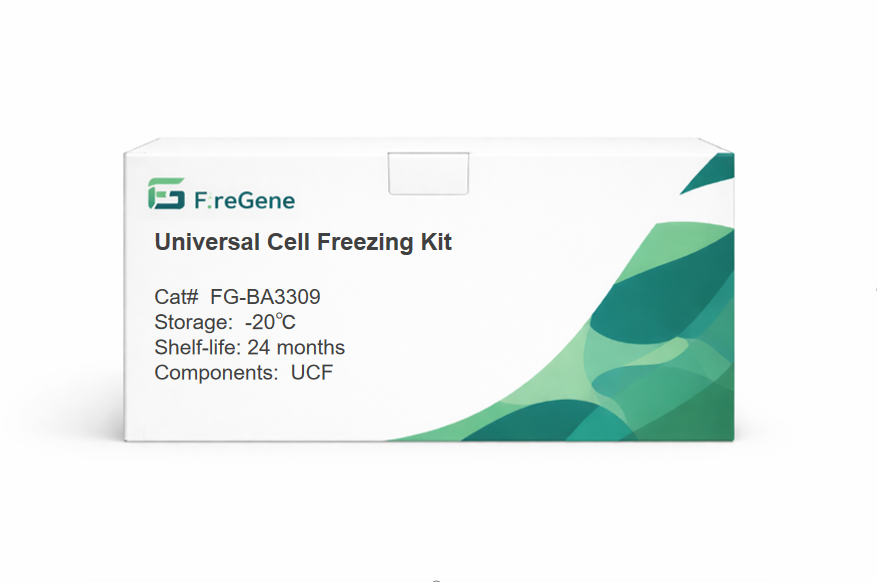
The FireGene Universal Cell Freezing Kit is a high-performance cryopreservation solution engineered to maintain long-term cell viability and functionality. Ideal for preserving primary cells, cell lines, and single-cell suspensions, this kit ensures high integrity of biological samples during ultra-low temperature storage.
Background Information
- Designed for a wide range of research and clinical applications:
- Cell line maintenance in basic research.
- Cell preservation in drug discovery and high-throughput screening.
- Patient-derived cell storage in clinical trials.
- Banking therapeutic cells for future use in cell therapy.
- Ensures post-thaw recovery and functionality, which is critical for:
- Cell-based assays.
- Single-cell analysis and multi-omics workflows.
- Organoid culture and regenerative studies.
Detection Principle
- Utilizes a multi-component cryopreservation system:
- Contains penetrating cryoprotectants that reduce intracellular ice formation.
- Minimizes osmotic stress and stabilizes membranes.
- Compatible with controlled cooling and thawing protocols.
- Benefits:
- Preserves cell structure, membrane integrity, and viability.
- Extends usability of cell samples across long-term storage.
Specifications
| Applications | Single-cell sequencing, cell culture or other cell-related detections |
| Compatible Sample Types | Single-cell suspension; primary cells; cell lines |
| Supported Instruments | Cell Freezing Container |
| Storage | -20 °C |
| Shelf-life | 24 months |
Kit Components
100ml/kit
| Component | 100 mL/Kit |
| UCF | 100 mL |
500ml/kit
| Component | 500 mL/Kit |
| UCF | 500 mL |
Product FAQ
1. Q: The kit is labeled "universal"—is it suitable for all mammalian cells? What is its cryopreservation effect on sensitive cells (such as nerve cells and stem cells)? Can it be used for insect cells or plant cells?A: The kit is suitable for most mammalian primary cells (e.g., hepatocytes, cardiomyocytes) and immortalized cell lines (e.g., HeLa, CHO cells). The cryopreservation solution contains low-toxicity protective components that reduce ice crystal damage, and the survival rate of sensitive cells after resuscitation is usually over 70% (≥85% for ordinary cells). However, it is not suitable for insect cells or plant cells. The cell membrane structure and antifreeze mechanism of these cells are significantly different from those of mammals, so dedicated cryopreservation solutions (e.g., insect cell cryopreservation solution, plant protoplast cryopreservation solution) must be used. Direct use of this kit may lead to resuscitation failure.
2. Q: The instruction manual recommends a cryopreservation density of 1×10⁶ cells/mL. Will insufficient cell quantity (e.g., only 5×10⁵ cells) or excessive quantity (e.g., 3×10⁶ cells) affect the cryopreservation effect? How to adjust?
A: Yes, it will affect the effect. Insufficient density (<5×10⁵ cells/mL) causes cells to be "isolated" during cryopreservation, lacking the synergistic protection of adjacent cells. This increases the risk of ice crystal damage and reduces the survival rate after resuscitation. Excessive density (>2×10⁶ cells/mL) leads to cell aggregation, preventing the cryopreservation solution from fully wrapping each cell; additionally, cells tend to clump during resuscitation, affecting dispersibility. Adjustment methods: For insufficient quantity, concentrate cells by centrifugation (follow the centrifugation conditions for the corresponding cell type, e.g., 300×g for 5 minutes for human PBMCs), discard part of the supernatant to increase density. For excessive quantity, dilute with cryopreservation solution to 1×10⁶-2×10⁶ cells/mL, and aliquot into multiple cryovials to avoid exceeding the density limit in a single vial.
3. Q: The cryopreservation solution should be stored at -20°C in the dark. If unused after thawing, how to handle the remaining solution? Can it be frozen again? What are the impacts of repeated freezing and thawing?
A: Unused thawed cryopreservation solution should be stored at 4°C in the dark within 24 hours and cannot be frozen again. Repeated freezing and thawing damages the protective components in the solution (e.g., decreased DMSO stability, decomposition of nutrients), drastically reducing its antifreeze ability. Each freeze-thaw cycle may lower the cell resuscitation survival rate by 15%-20%; after more than 3 cycles, the solution becomes basically ineffective and cannot protect cells. It is recommended to aliquot the cryopreservation solution into 1mL/tube or 5mL/tube (using sterile cryovials) based on single-use volume upon receiving the kit, seal tightly, store at -20°C, and take one tube per experiment to avoid repeated freezing and thawing.
4. Q: Step 6 mentions "using a programmed freezing box to ensure a cooling rate of approximately 1°C/min". If a programmed freezing box is not available in the laboratory, can other methods be used as substitutes? What problems will occur if directly placing the cryovial into a -80°C refrigerator?
A: Without a programmed freezing box, a homemade alternative can be used: place the cryovial into a foam box (thickness ≥5cm) filled with isopropyl alcohol, then put it into a -80°C refrigerator. Isopropyl alcohol buffers the cooling rate to approximately 1°C/min (error ±0.5°C), but the foam box must be sealed to prevent isopropyl alcohol evaporation. Do not place directly into a -80°C refrigerator—the direct cooling rate can reach 5-10°C/min, causing rapid formation of large ice crystals inside cells, which puncture the cell membrane. The survival rate after resuscitation may be lower than 30%, or even zero.
5. Q: Cells should be transferred to liquid nitrogen for storage 24 hours after cryopreservation. If transfer is delayed beyond 24 hours (e.g., forgotten and left in a -80°C refrigerator for 48 hours), can the cells still be normally resuscitated and used?
A: Cells left in a -80°C refrigerator for 48 hours can still be attempted for resuscitation, but two points should be noted: First, cell viability must be tested after resuscitation (using trypan blue staining; viability ≥60% is required for use). A -80°C refrigerator is for "semi-long-term storage"; beyond 24 hours, some cells gradually lose viability due to slow ice crystal damage, with a potential viability decrease of 10%-25%. Second, for low-temperature-sensitive cells (e.g., stem cells), viability may drop below 50% after 48 hours, making them unsuitable for critical subsequent experiments (e.g., cell culture, drug screening) and only usable for preliminary experiments. For long-term storage, cells must be transferred to liquid nitrogen (-196°C) within 24 hours—liquid nitrogen almost stops cell metabolism, allowing cells to maintain high viability for several years.
6. Q: Step 2 of cell resuscitation requires "shaking the cryovial quickly to thaw the cryopreservation solution rapidly". At what exact thawing stage should it be stopped? What impacts will incomplete thawing or overheating (e.g., water bath temperature exceeding 37°C) cause?
A: Stop thawing when "only a needle-tip-sized ice crystal remains" (usually 30-60 seconds). At this stage, the cryopreservation solution is translucent with no obvious solid particles; immediately remove the vial. The remaining small ice crystal will melt naturally when adding medium in subsequent steps, avoiding cell damage from excessive shaking. Incomplete thawing (with obvious ice crystals) causes osmotic shock when adding medium—sudden melting of ice crystals disrupts the cell membrane. Water bath temperature exceeding 37°C (e.g., 40°C) induces heat stress in cells, leading to abnormal enzyme activity and a large number of dead cells after resuscitation. The water bath temperature must be strictly controlled at 37°C±1°C.
7. Q: Step 4 mentions "adding the cryopreservation solution drop by drop into the pre-warmed medium while shaking". What are the requirements for dropping speed and shaking intensity? What consequences will occur if pouring all at once quickly?
A: Control the dropping speed to "1 drop every 2-3 seconds", and shake with intensity such that "the liquid in the centrifuge tube rotates slightly without violent vortices". The purpose is to slowly mix the cryopreservation solution (containing DMSO) with the medium, gradually reducing the DMSO concentration to avoid severe osmotic changes caused by sudden concentration drops. Do not pour all at once quickly—this causes the local DMSO concentration to drop from 10%-20% to 2%-4% instantly. Cells undergo dehydration or swelling due to sudden osmotic changes, leading to cell membrane rupture. The proportion of dead cells can increase by more than 30%, severely affecting the resuscitation effect.
8. Q: Centrifugation conditions vary by cell type. If the centrifugation parameters for the target cell (e.g., primary cardiomyocytes) are unknown, how to set the conditions? Must the centrifugation temperature be 4°C?
A: For unknown parameters, refer to the "universal centrifugation conditions": 300×g at 4°C for 5 minutes. This condition is suitable for over 90% of mammalian cells—it effectively pellets cells without crushing them (e.g., fragile cardiomyocytes are prone to rupture if centrifugal force exceeds 500×g). If cells are not sufficiently pelleted after centrifugation (e.g., suspension cells), slightly increase the centrifugal force to 400×g while keeping the time unchanged. The centrifugation temperature is recommended to be 4°C, as 4°C reduces cell metabolism and minimizes energy consumption during centrifugation. Room-temperature centrifugation (around 25°C) has little impact on ordinary immortalized cells but may reduce the viability of sensitive cells (e.g., nerve cells) by 5%-10%, so 4°C is preferred.
9. Q: After resuscitation, the supernatant is discarded and cells are resuspended in medium. Are there any requirements for medium selection? Must RPMI 1640 medium be used? Can DMEM or serum be used as a substitute?
A: Medium selection must match the cell type and is not limited to RPMI 1640: Adherent cells (e.g., HeLa) commonly use DMEM medium, suspension cells (e.g., Jurkat) commonly use RPMI 1640, and primary cells require dedicated medium (e.g., DMEM/F12 for cardiomyocytes). The core requirement is that the medium meets the cell's growth needs. Serum cannot be used as a substitute—serum lacks basic nutrients required for cell growth (e.g., amino acids, vitamins) and only provides partial factors. Resuspending cells in serum will prevent normal cell proliferation and even cause gradual cell death.
10. Q: If the cryovial leaks during storage in liquid nitrogen (e.g., loose seal at the cap), and the cryopreservation solution is turbid with white flocculent precipitates during resuscitation, can the cells still be used? How to prevent leakage?
A: Turbid cryopreservation solution with white flocculent precipitates indicates liquid nitrogen has infiltrated the vial—cells are either contaminated or dead due to sudden osmotic changes, so they cannot be used and must be discarded directly to avoid laboratory contamination. Key measures to prevent leakage: First, select "liquid nitrogen-compatible" cryovials (marked "LN2 Compatible" on the wall) and never use ordinary centrifuge tubes. Second, when tightening the cap, follow the steps: "tighten gently → loosen half a turn → retighten" to avoid over-tightening or under-tightening caused by temperature changes. Third, when transferring to a liquid nitrogen tank, first pre-cool the vial in the liquid nitrogen gas phase zone (<-150°C) for 10 minutes, then move it to the liquid phase zone to reduce stress-induced leakage at the cap due to temperature differences.
Files Download Links