
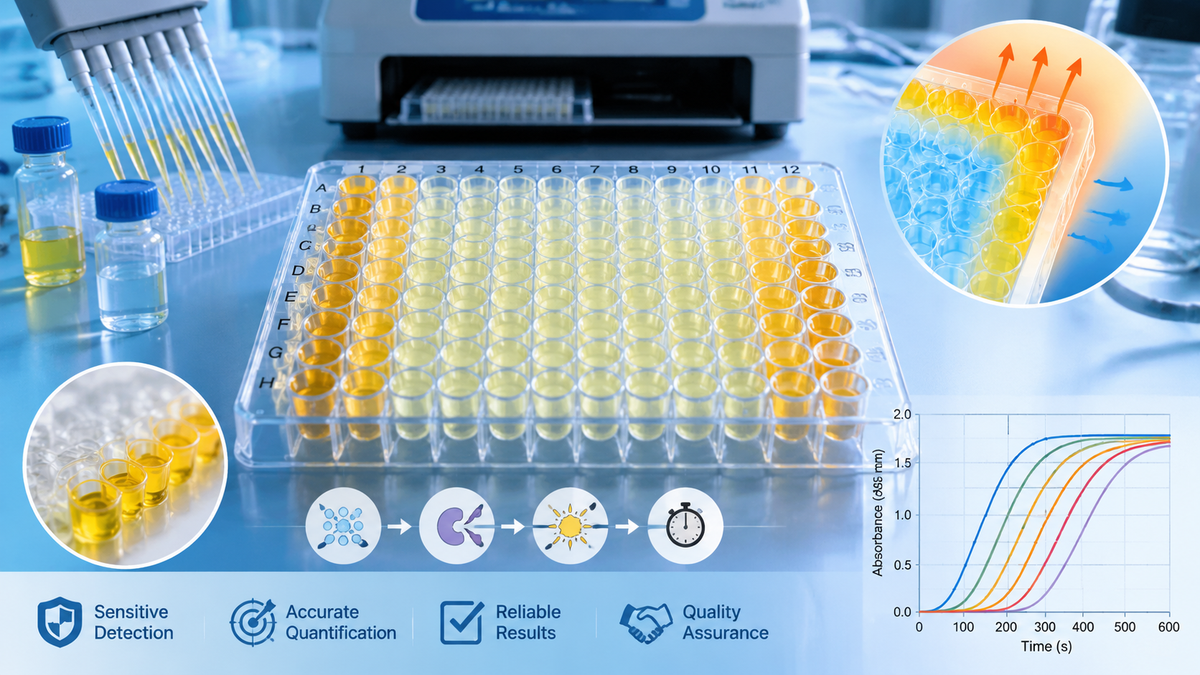
The kinetic chromogenic Limulus Amebocyte Lysate (LAL) assay is widely used for sensitive bacterial endotoxin detection in pharmaceutical, biotechnology, and biomedical research applications. Although the assay provides high sensitivity and quantitative results, 96-well plate-based workflows may encounter edge effects that influence reaction kinetics and assay accuracy. This article explains the causes of edge effects in kinetic chromogenic endotoxin testing, including evaporation, temperature variation, and pipetting inconsistencies. It also discusses practical strategies to minimize plate variation and improve assay reliability, reproducibility, and quality control performance.
1. Introduction to Kinetic Chromogenic LAL Assay
Bacterial endotoxin testing is a critical quality control step in pharmaceutical manufacturing, biologics development, medical device production, and laboratory research. The Limulus Amebocyte Lysate (LAL) assay remains one of the most commonly used methods for detecting Gram-negative bacterial endotoxins due to its high sensitivity and reliability.
Among different LAL testing formats, the kinetic chromogenic LAL assay has become increasingly popular because it enables quantitative endotoxin measurement through real-time monitoring of color development.
The principle of the assay is based on an enzymatic cascade:
Endotoxin
↓
Activation of Factor C
↓
Activation of downstream coagulation enzymes
↓
Chromogenic substrate cleavage
↓
Release of p-nitroaniline (pNA)
↓
Yellow color development
The time required to reach a defined absorbance value, often called the reaction time (T value), is inversely related to endotoxin concentration.
Because the assay relies on precise reaction kinetics, small environmental variations can influence results. One important factor that laboratories should consider is the 96-well plate edge effect.
2. What Is Edge Effect in a 96-Well Plate?
The edge effect refers to systematic differences in assay performance between wells located at the outer edges of a microplate and wells located in the center.
In a typical 96-well plate:
· Outer wells include:
o Row A and Row H
o Column 1 and Column 12
· Inner wells include:
o B2 to G11
During kinetic chromogenic LAL testing, edge wells may show differences in:
· Reaction time
· Absorbance values
· Color development rate
· Standard curve consistency
· Replicate precision
These variations may result in:
· Higher or lower calculated endotoxin concentrations
· Increased coefficient of variation (CV)
· Poor standard curve performance
· Reduced assay reproducibility
3. Why Does Edge Effect Occur in Kinetic Chromogenic LAL Testing?
3.1 Evaporation-Induced Concentration Changes
Evaporation is one of the primary causes of edge effects in 96-well plate assays.
The outer wells have greater exposure to surrounding air compared with central wells. During incubation, especially at 37°C, water loss from edge wells can occur faster.
For kinetic chromogenic LAL assays, reaction volumes are usually small, commonly around:
· 50 μL sample + 50 μL LAL reagent
· 100 μL total reaction volume
Even minor volume loss can alter:
· Endotoxin concentration
· Reagent concentration
· Enzyme activity
· Reaction kinetics
As a result, edge wells may develop color faster than expected, potentially causing artificially elevated endotoxin readings.
3.2 Temperature Gradient Across the Microplate
The kinetic chromogenic LAL assay requires controlled incubation conditions, typically:
37 ± 1°C
However, temperature distribution inside microplate readers or incubators may not always be completely uniform.
Edge wells are more exposed to:
· Heat exchange with the environment
· Air circulation
· Temperature fluctuations
Since the LAL reaction is an enzyme-mediated process, temperature differences can influence enzymatic activity.
A small temperature change may affect:
· Factor C activation
· Protease activity
· Chromogenic substrate conversion rate
This can lead to differences in reaction time between edge and center wells.
3.3 Small Volume Pipetting Variation
Microplate-based endotoxin testing uses very small liquid volumes, making pipetting accuracy extremely important.
Potential issues include:
· Uneven dispensing
· Different mixing efficiency
· Air bubbles
· Delayed addition of reagents
Because kinetic assays measure reaction speed, timing differences between wells can directly affect results.
For example:
If the first wells receive LAL reagent several minutes earlier than the last wells, the reaction may already be progressing before measurement begins.
4. How Does Edge Effect Influence Endotoxin Test Results?
The impact of edge effects depends on assay sensitivity and experimental design.
For kinetic chromogenic LAL assays, possible consequences include:

4.1 Increased Variation in Standard Curve
A reliable standard curve is essential for accurate endotoxin quantification.
Edge effects may cause:
· Irregular standard curve points
· Reduced correlation coefficient (R²)
· Increased deviation between replicates
A poor standard curve may indicate:
· Plate temperature inconsistency
· Evaporation problems
· Reagent handling issues
4.2 Higher Replicate CV
Quality control requires consistent replicate measurements.
Edge-related variation may increase:
· Duplicate variability
· Sample-to-sample differences
· Inter-plate variation
High CV values can reduce confidence in test results.
4.3 False Endotoxin Quantification
Because kinetic chromogenic assays calculate endotoxin concentration based on reaction time, even small changes in reaction rate can influence calculated results.
For low endotoxin samples, these differences may become more significant because the assay operates near the detection limit.
5. Strategies to Minimize Edge Effect in 96-Well Plate LAL Assays
5.1 Avoid Using Outer Wells When Possible
One common strategy is to avoid using the outermost wells for critical samples.
Recommended layout:
· Use B2–G11 wells for standards and samples
· Fill unused edge wells with:
o Endotoxin-free water
o Pyrogen-free buffer
This creates a more uniform environment across the plate.
5.2 Use Plate Sealing Film
A proper microplate seal helps reduce:
· Water evaporation
· Contamination risk
· Temperature variation
For kinetic chromogenic LAL assays, low-evaporation sealing materials are recommended.

5.3 Pre-Equilibrate Reagents and Plates
Before starting the assay:
· Bring reagents to recommended conditions
· Allow microplates to equilibrate
· Maintain consistent incubation temperature
Avoid sudden temperature differences between:
· Cold reagents
· Warm incubation environment
5.4 Standardize Pipetting Procedures
To improve reproducibility:
· Use calibrated pipettes
· Use multichannel pipettes when appropriate
· Maintain consistent dispensing speed
· Avoid introducing bubbles
· Keep reagent addition timing consistent
5.5 Optimize Plate Layout Design
A well-designed plate map can reduce systematic errors.
Recommended practices:
· Place standards consistently
· Distribute samples randomly when possible
· Avoid placing all critical low-concentration samples at plate edges
· Include appropriate controls
6. Edge Effect Control as Part of LAL Method Validation
For laboratories developing or validating kinetic chromogenic LAL methods, edge effect evaluation can be included as part of assay performance verification.
Important validation parameters include:
Standard Curve Performance
· Correlation coefficient (R²)
· Linear range
· Reaction time consistency
Precision
· Replicate CV
· Inter-plate variation
Accuracy
· Spike recovery testing
· Positive product control (PPC)
Robustness
Evaluation under small variations in:
· Plate position
· Incubation conditions
· Pipetting timing
A robust assay should minimize well-to-well differences and maintain consistent endotoxin recovery.
7. Conclusion
The 96-well plate edge effect is an important consideration in kinetic chromogenic LAL endotoxin testing. Although modern microplate readers and optimized reagents provide excellent sensitivity and reproducibility, factors such as evaporation, temperature gradients, and pipetting variation can still influence assay performance.
By implementing practical solutions—including avoiding outer wells, using plate seals, maintaining temperature control, and standardizing pipetting procedures—laboratories can reduce edge-related variability and improve endotoxin detection reliability.
For high-sensitivity endotoxin testing workflows, controlling microplate conditions is just as important as selecting a high-quality LAL reagent system. Proper plate management helps ensure accurate, reproducible, and regulatory-compliant endotoxin testing results.


