
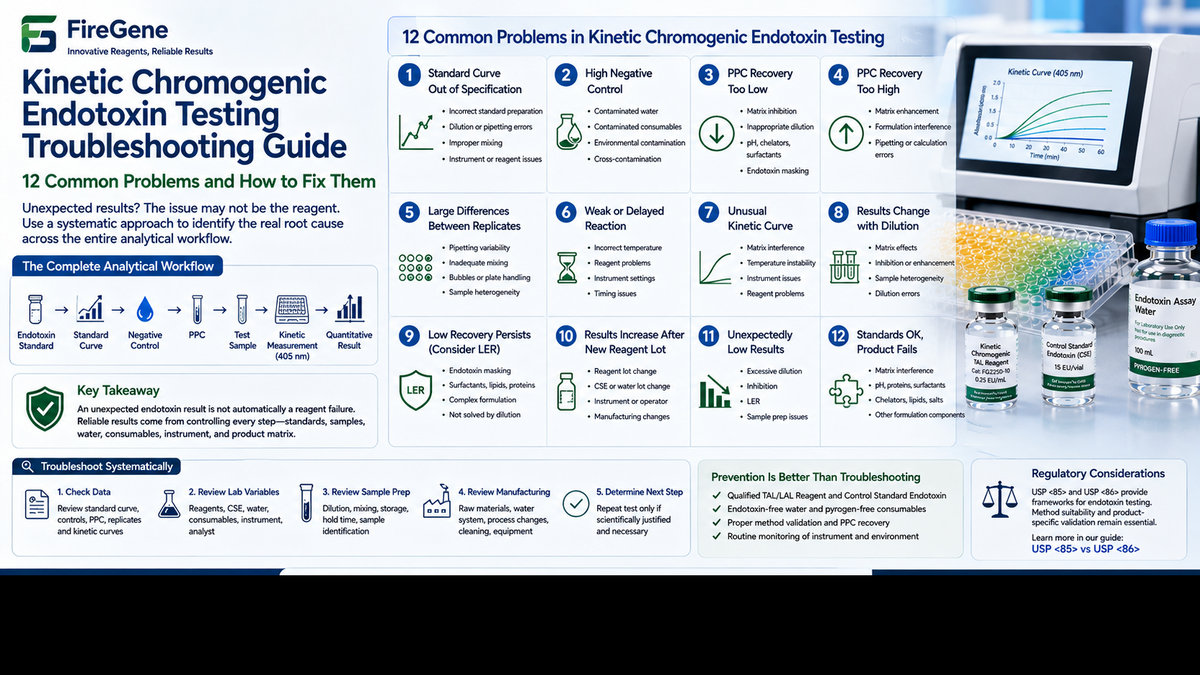
Introduction: Why Do Kinetic Chromogenic Endotoxin Assays Fail?
Kinetic chromogenic endotoxin testing has become an important quantitative approach for bacterial endotoxin detection in pharmaceutical, biotechnology, and medical device laboratories.
Unlike the traditional Gel-Clot method, which provides a qualitative or limit-test result, kinetic chromogenic testing measures the development of a chromogenic reaction over time and uses a standard curve to calculate endotoxin concentration.
FireGene's Ultimate Guide to Kinetic Chromogenic Endotoxin Assays provides a broader overview of the assay principle, validation, applications, and best practices.
But quantitative testing also creates a more complicated troubleshooting environment.
A laboratory may encounter:
- Failed standard curves
- Poor Positive Product Control (PPC) recovery
- High negative-control values
- Unexpectedly high endotoxin results
- Unexpectedly low endotoxin results
- Large differences between replicates
- Abnormal kinetic curves
- Plate-to-plate variability
- Results that change significantly with dilution
- Unexpected performance after a reagent-lot change
Importantly, these problems do not automatically indicate a TAL/LAL Reagent failure.
The root cause may be related to:
Sample Matrix + Dilution + Standards + Water + Consumables + Pipetting + Temperature + Instrument + Data Analysis
This is why troubleshooting should be approached as a complete analytical-system investigation, rather than simply replacing the reagent.
1. Start With the Complete Kinetic Chromogenic Workflow
Before investigating an abnormal result, understand the complete analytical pathway:
Endotoxin Standard
↓
Standard Curve
↓
Negative Control
↓
Positive Product Control
↓
Test Sample
↓
Kinetic Absorbance Measurement
↓
Quantitative Calculation
↓
Final Endotoxin Result
If any upstream component is compromised, the final result may also be compromised.
For example, a sample result may appear reasonable even when the standard curve is invalid. Conversely, an apparently high endotoxin result may actually be caused by contamination from water or laboratory consumables.
This is why analysts should always ask:
Is the assay itself valid before interpreting the sample result?
For laboratories reviewing the basic workflow, FireGene's Step-by-Step Guide to the Kinetic Chromogenic Endotoxin Assay covers standard preparation, sample dilution, plate setup, kinetic measurement, and data analysis.
2. Problem #1: The Endotoxin Standard Curve Does Not Meet Acceptance Criteria
The standard curve is the foundation of a quantitative kinetic chromogenic endotoxin test.
If the standard curve is invalid, sample results should not simply be accepted because the calculated concentration appears reasonable.
Common symptoms include:
- Poor linearity
- Unexpected slope
- Irregular dilution response
- Large variation between standard replicates
- One standard concentration behaving abnormally
- Unexpected reaction times
Common Causes
Incorrect endotoxin standard preparation
Serial dilution errors can have a significant impact because an error early in the dilution series can propagate through subsequent standards.
Inadequate mixing
Incomplete mixing may result in inconsistent endotoxin concentrations.
Pipetting variability
Small volume errors can become significant when preparing low-concentration standards.
Improper CSE storage or handling
Control Standard Endotoxin should be prepared and handled according to the manufacturer's instructions.
Instrument problems
Incorrect wavelength, temperature, kinetic interval, or optical performance can affect the standard curve.
Troubleshooting Sequence
Start with:
Standard concentration → Dilution calculation → Pipetting → Mixing → Reagent → Temperature → Reader settings
Do not immediately blame the reagent lot.
3. Problem #2: The Negative Control Is Higher Than Expected
A high negative control is one of the clearest warning signs of possible endotoxin contamination.
The negative control is designed to establish the background of the analytical system.
If it is unexpectedly high, investigate:
- Endotoxin Assay Water
- Tubes
- Microplates
- Pipette tips
- Reservoirs
- Reagents
- Environmental contamination
- Cross-contamination
- Analyst handling
In many cases, the source of the endotoxin is introduced before the test sample even reaches the plate.
This is why consumables and water should be considered part of the endotoxin testing method.
FireGene's Endotoxin Assay, Reagents, and Kits Collection includes Endotoxin Assay Water and pyrogen-free consumables intended for endotoxin testing workflows.
For laboratories investigating unexpected positive results, FireGene also covers contamination-related causes in False Positive Endotoxin Results? Hidden Sources of Endotoxin Contamination Every QC Laboratory Should Know.
4. Problem #3: PPC Recovery Is Too Low
Low PPC recovery is one of the most common signs of potential matrix interference.
The basic concept is straightforward:
Known Endotoxin Spike + Product Matrix → Measured Recovery
If the expected recovery is not achieved, possible causes include:
- Product inhibition
- Inappropriate sample dilution
- Extreme pH
- Chelating agents
- Surfactants
- High protein concentration
- Organic solvents
- Other formulation components
- Endotoxin masking
The first step should be to determine whether the product matrix is interfering with the endotoxin reaction.
This is where method suitability testing becomes critical.
FireGene's How to Validate an Endotoxin Test Method: A Step-by-Step Guide for USP <85> Compliance explains how sample-specific method suitability, dilution, PPC recovery, and interference evaluation fit into endotoxin method validation.
5. Problem #4: PPC Recovery Is Too High
PPC failure does not only occur when recovery is too low.
Unexpectedly high recovery may indicate enhancement of the endotoxin response.
Possible causes include:
- Sample matrix enhancement
- Formulation components affecting the reaction
- Sample preparation problems
- Incorrect dilution
- Pipetting errors
- Calculation errors
This is an important distinction.
Low Recovery
May indicate:
Inhibition or endotoxin masking
High Recovery
May indicate:
Enhancement or analytical interference
Therefore, PPC should not be viewed simply as a checkbox.
It provides information about how the product behaves within the endotoxin assay.
6. Problem #5: Replicate Wells Show Large Differences
Kinetic chromogenic endotoxin testing is quantitative, so significant differences between replicate wells deserve investigation.
Potential causes include:
Pipetting variability
Small differences in sample or reagent volume can affect reaction kinetics.
Inadequate mixing
Uneven distribution can cause different endotoxin concentrations between wells.
Air bubbles
Bubbles may interfere with optical measurements.
Temperature differences
Kinetic reactions are sensitive to temperature.
Sample heterogeneity
The product itself may not be homogeneous.
Plate handling
Differences in timing or handling can introduce variability.
Instrument performance
Optical or temperature-control problems can affect individual wells or the entire plate.
A useful troubleshooting sequence is:
Pipetting → Mixing → Bubbles → Plate handling → Temperature → Sample → Instrument
7. Problem #6: The Entire Plate Shows Weak or Delayed Reaction
If standards, controls, and samples all demonstrate unexpectedly slow reaction kinetics, investigate system-level variables.
Potential causes include:
- Incorrect incubation temperature
- Reagent preparation problems
- Reagent storage issues
- Incorrect reagent volume
- Reader temperature-control problems
- Incorrect wavelength
- Incorrect kinetic settings
- Timing problems
A localized problem affecting one or two wells suggests a different root cause from a problem affecting the entire plate.
One or two abnormal wells
Think:
Pipetting / bubbles / local contamination / sample issue
Entire plate abnormal
Think:
Reagent / temperature / reader / timing / plate preparation
This distinction can significantly reduce investigation time.
8. Problem #7: The Kinetic Curve Looks Unusual
One of the biggest advantages of kinetic chromogenic endotoxin testing is that the reaction is monitored over time.
This means the kinetic behavior itself can provide troubleshooting information.
An abnormal curve may suggest:
- Matrix interference
- Incorrect standard preparation
- Temperature instability
- Instrument problems
- Reagent problems
- Timing problems
- Sample-related effects
Instead of looking only at:
Final EU/mL
analysts should also consider:
How did the reaction develop?
For example, if the standards behave normally but the PPC behaves abnormally, the sample matrix becomes a more likely suspect.
If standards, PPC, and samples all behave abnormally, the problem may be associated with the assay system itself.
9. Problem #8: Endotoxin Results Change Significantly After Sample Dilution
Dilution is an important tool for controlling matrix interference.
But dilution must be scientifically justified.
Suppose a sample produces:
1:2 → 0.12 EU/mL
1:4 → 0.08 EU/mL
1:8 → 0.04 EU/mL
If the dilution-adjusted results do not demonstrate acceptable consistency, the laboratory should investigate.
Potential causes include:
- Matrix inhibition
- Enhancement
- Endotoxin masking
- Sample heterogeneity
- Incorrect dilution preparation
- Concentration-dependent interference
The solution is not simply to select whichever dilution gives the most convenient result.
Instead, the laboratory should evaluate:
PPC recovery + dilution factor + analytical range + MVD + matrix effects
FireGene's method-validation guidance discusses the role of dilution and Maximum Valid Dilution (MVD) in determining whether an endotoxin test method is suitable for a specific product matrix.
10. Problem #9: Low Endotoxin Recovery Continues Despite Appropriate Dilution
Not every low-recovery problem is ordinary inhibition.
If endotoxin recovery remains unexpectedly low even after appropriate dilution, laboratories should consider Low Endotoxin Recovery (LER).
LER can occur when endotoxin interacts with formulation components and becomes less detectable.
Potentially relevant formulation components include:
- Surfactants
- Chelating agents
- Lipid systems
- Proteins
- Stabilizers
- Complex biologic matrices
FireGene's Low Endotoxin Recovery (LER): Causes, Endotoxin Masking Mechanisms, Regulatory Expectations, and Practical Solutions provides a dedicated discussion of endotoxin masking and formulation-related interference.
For biologics-focused investigations, FireGene also has Low Endotoxin Recovery (LER) in Biologics Manufacturing.
The key distinction is:
Dilution can often reduce ordinary matrix inhibition, but it does not automatically eliminate LER.
11. Problem #10: Results Suddenly Increase After a New Reagent Lot
When endotoxin results change after introducing a new reagent lot, it is tempting to immediately blame the reagent.
However, a proper investigation should review the entire analytical system.
Compare:
- Reagent lot
- CSE lot
- Endotoxin Assay Water
- Consumables
- Instrument
- Analyst
- Sample preparation
- Dilution factor
- Environmental conditions
- Manufacturing process
A controlled lot-to-lot comparison can help determine whether the change is truly associated with the reagent.
FireGene's Kinetic Chromogenic Endotoxin Test Kit uses a 96-well quantitative workflow with kinetic absorbance measurement at 405 nm and is compatible with standard microplate readers capable of the required detection.
When evaluating reagent performance, it is therefore important to separate:
Reagent performance
from
Method performance
and
Product performance.
12. Problem #11: Results Are Unexpectedly Low
Unexpectedly low endotoxin results can be just as important to investigate as unexpectedly high results.
Possible causes include:
- Excessive sample dilution
- Product inhibition
- Endotoxin masking
- LER
- Incorrect sample preparation
- Standard preparation errors
- Reagent problems
This is particularly relevant for biologic formulations.
A low result should not automatically be interpreted as a good result if the analytical system has not demonstrated appropriate endotoxin recovery.
This is one reason why PPC recovery, method suitability, and product-specific validation remain essential components of a robust endotoxin testing strategy.
13. Problem #12: The Assay Works With Standards but Fails With the Product
This is one of the clearest indications of a matrix-related problem.
For example:
Endotoxin Standard + Reagent → Acceptable
but:
Product + Endotoxin Spike → Poor Recovery
The reagent may be functioning correctly.
The issue may instead be associated with:
- Product pH
- Protein concentration
- Surfactants
- Chelators
- Salts
- Preservatives
- Lipids
- Nanoparticles
- Other formulation components
This is particularly important for modern biologics.
For example, complex matrices encountered in cell and gene therapy manufacturing can include high protein concentrations, LNPs, viral-vector-related materials, surfactants, cryoprotectants, and other components capable of affecting endotoxin analysis.
For laboratories working with advanced therapies, FireGene's Kinetic Chromogenic Endotoxin Testing for Cell and Gene Therapy Manufacturing provides additional discussion of complex biological matrices and assay interference.
14. Instrument Troubleshooting for Kinetic Chromogenic Endotoxin Testing
Because kinetic chromogenic testing depends on optical measurement, instrument performance should always be part of the troubleshooting process.
Important parameters include:
Wavelength
Verify that the reader is configured for the wavelength specified by the validated method.
Temperature
The assay requires controlled reaction conditions.
Kinetic interval
Incorrect measurement intervals can affect kinetic calculations.
Plate positioning
Improper plate placement may affect optical measurements.
Optical performance
The reader should be appropriately maintained and qualified.
Software settings
Incorrect calculation parameters can generate incorrect endotoxin concentrations even when the raw absorbance data are acceptable.
FireGene's Kinetic Chromogenic Endotoxin Test Kit uses 405 nm kinetic absorbance detection and is designed for standard microplate readers capable of the required optical measurement.
15. Why Pipetting Accuracy Matters
Pipetting errors can affect every stage of a kinetic chromogenic endotoxin assay.
Consider the workflow:
CSE Reconstitution
↓
Standard Dilution
↓
Sample Dilution
↓
PPC Preparation
↓
Plate Transfer
↓
Reagent Addition
↓
Kinetic Measurement
An error introduced early in the workflow can propagate into the final result.
Best practices include:
- Use appropriately calibrated pipettes
- Follow validated volume requirements
- Use suitable endotoxin-free tips
- Change tips appropriately between dilutions
- Mix samples consistently
- Minimize unnecessary transfers
- Standardize analyst technique
For laboratories establishing the workflow from the beginning, FireGene's Step-by-Step Kinetic Chromogenic Endotoxin Assay Guide provides a detailed overview of sample and standard preparation.
16. Water and Consumables: The Often-Overlooked Variables
Endotoxin testing operates at very low concentrations.
Therefore, contamination introduced from laboratory materials can have a disproportionate impact on the result.
Important materials include:
- Endotoxin Assay Water
- Tubes
- Vials
- Microplates
- Pipette tips
- Reservoirs
- Sample containers
A laboratory investigating unexpected background should therefore review the entire consumables chain.
This is especially important when:
- Negative controls are unexpectedly high
- Background increases suddenly
- Multiple samples show similar elevated results
- A new consumables lot has been introduced
FireGene's endotoxin product portfolio includes Endotoxin Assay Water, pyrogen-free vials, and other endotoxin testing consumables alongside TAL/LAL Reagents and CSE.
17. What to Do When an Endotoxin Result Is Unexpectedly High
An unexpected high result should not automatically trigger a simple repeat test.
Instead, investigate systematically.
Step 1: Review the Raw Data
Check:
- Standard curve
- Negative control
- PPC
- Replicates
- Kinetic curves
- Plate layout
Step 2: Review Laboratory Variables
Check:
- Reagent lot
- CSE lot
- Water
- Consumables
- Instrument
- Analyst
Step 3: Review Sample Preparation
Check:
- Dilution
- Mixing
- Storage
- Hold time
- Sample identification
Step 4: Review Manufacturing Variables
Investigate:
- Raw material changes
- Water system changes
- Process deviations
- Cleaning
- Equipment
- Supplier changes
Step 5: Determine Whether Repeat Testing Is Scientifically Justified
A repeat test should answer a defined analytical question.
It should not simply be used to obtain a more favorable result.
For a broader discussion of contamination-related unexpected results, see FireGene's False Positive Endotoxin Results? Hidden Sources of Endotoxin Contamination.
18. Method Suitability Is the Foundation of Reliable Troubleshooting
Troubleshooting becomes much easier when the method has been properly characterized during development.
Before routine testing, the laboratory should understand:
- Product endotoxin limit
- Assay sensitivity
- MVD
- Sample dilution
- PPC recovery
- Matrix interference
- Standard curve performance
- Precision
- Instrument suitability
The key principle is:
A qualified endotoxin reagent does not automatically mean that the method is suitable for every product.
The reagent demonstrates its own performance.
The laboratory must still demonstrate that the specific product matrix can be tested reliably.
FireGene's method validation guide specifically addresses this distinction and explains why product-specific suitability testing remains necessary even when using a qualified TAL/LAL Reagent.
19. Kinetic Chromogenic Testing and Complex Biologics
Modern pharmaceutical pipelines increasingly include:
- Monoclonal antibodies
- Recombinant proteins
- Cell therapies
- Gene therapies
- mRNA therapeutics
- Lipid nanoparticles
- Viral vectors
- Antibody-drug conjugates
These products can create more complicated analytical matrices.
For example, high protein concentrations, surfactants, lipids, stabilizers, and nanoparticles may affect endotoxin recovery or optical measurements.
This makes product-specific method development increasingly important.
FireGene's content on Kinetic Chromogenic Endotoxin Testing for Cell and Gene Therapy discusses these challenges in more detail.
For monoclonal antibody workflows, the same principle applies: complex formulations require careful evaluation of inhibition, enhancement, dilution, and LER.
20. Where USP <85> and USP <86> Fit Into Troubleshooting
The regulatory environment for bacterial endotoxin testing continues to evolve.
USP <85> remains the established Bacterial Endotoxins Test chapter, while USP <86> expands the compendial framework for recombinant reagent-based approaches.
FireGene's USP <85> vs. USP <86>: Understanding the Future of Endotoxin Testing and Validation provides a detailed comparison of the two chapters and their implications for pharmaceutical QC laboratories.
FDA's 2026 guidance likewise discusses the broader pyrogen and endotoxin testing framework and continues to address method suitability and the use of photometric approaches.
The important point is that changing technologies does not eliminate the need for analytical troubleshooting.
Whether a laboratory uses:
- Traditional TAL/LAL Reagent
- Kinetic Chromogenic testing
- Kinetic Turbidimetric testing
- Recombinant Factor C
- Recombinant cascade reagents
the laboratory still needs to demonstrate that the method is suitable for the intended product and application.
21. A Practical Troubleshooting Decision Tree
When a kinetic chromogenic endotoxin assay produces an unexpected result, use the following sequence.
Step 1
Did the standard curve meet the applicable acceptance criteria?
If no:
→ Investigate standards, reagent, pipetting, temperature, and instrument.
Step 2
Did the negative control meet the applicable requirement?
If no:
→ Investigate contamination.
Step 3
Did PPC recovery meet the applicable acceptance criteria?
If no:
→ Investigate matrix interference, dilution, and LER.
Step 4
Are replicate results consistent?
If no:
→ Investigate pipetting, mixing, bubbles, sample homogeneity, and instrument performance.
Step 5
Are results consistent across appropriate dilutions?
If no:
→ Investigate matrix effects and dilution strategy.
Step 6
Did anything change recently?
Check:
Reagent → CSE → Water → Consumables → Instrument → Analyst → Sample → Manufacturing
Step 7
Does the problem persist?
If yes:
→ Consider a deeper method suitability or product investigation.
22. How FireGene Kinetic Chromogenic Testing Fits Into the Workflow
FireGene's Kinetic Chromogenic Endotoxin Test Kit is designed as a 96-well quantitative endotoxin testing workflow.
The kit includes key assay components such as:
- TAL/LAL Reagent
- Chromogenic substrate system
- Control Standard Endotoxin
- Pyrogen-free water
- Reconstitution solution
- 96-well microplate
The assay uses kinetic absorbance measurement at 405 nm and supports quantitative endotoxin determination from a standard curve.
A typical workflow can therefore be represented as:
FireGene Kinetic Chromogenic TAL/LAL Reagent
↓
CSE Standard
↓
Endotoxin Assay Water
↓
Sample Preparation
↓
96-Well Plate
↓
Kinetic Measurement
↓
Standard Curve + PPC
↓
Quantitative EU/mL Result
For laboratories that require a broader portfolio, FireGene's Endotoxin Assay, Reagents, and Kits Collection also includes Gel-Clot Endotoxin Test Kits, Endotoxin Assay Water, Control Standard Endotoxin, and pyrogen-free consumables.
23. How to Prevent Kinetic Chromogenic Assay Failures
Troubleshooting is important, but prevention is better.
A robust endotoxin testing program should establish standardized procedures for:
Reagent Management
Control:
- Storage
- Lot tracking
- Preparation
- Expiration
Standard Preparation
Control:
- Reconstitution
- Serial dilution
- Mixing
- Pipetting
Sample Preparation
Control:
- Dilution
- Hold time
- Temperature
- Mixing
Consumables
Control:
- Pyrogen-free status
- Supplier qualification
- Lot changes
Instrument
Control:
- Calibration
- Temperature
- Wavelength
- Kinetic settings
Method
Control:
- MVD
- PPC
- Acceptance criteria
- Product-specific suitability
This turns troubleshooting from a reactive process into a preventive quality strategy.
24. Kinetic Data Can Help Laboratories Identify Root Causes
One of the most valuable features of kinetic chromogenic testing is the amount of information contained in the reaction profile.
Instead of evaluating only the final result, analysts can compare:
- Standard curves
- PPC curves
- Sample curves
- Historical curves
- Different dilution curves
- Different reagent lots
This allows a more sophisticated question:
Where does the abnormal behavior begin?
For example:
Standards normal + PPC abnormal
Potential sample matrix issue.
Standards abnormal + PPC abnormal
Potential assay-system problem.
One replicate abnormal
Potential pipetting or local well issue.
Entire plate abnormal
Potential reagent, temperature, instrument, or timing issue.
This is one of the reasons kinetic chromogenic endotoxin testing is particularly useful for laboratories that need quantitative data and trend monitoring.
25. Frequently Asked Questions
Why does my kinetic chromogenic endotoxin standard curve fail?
Possible causes include incorrect CSE preparation, serial dilution errors, inadequate mixing, pipetting variability, reagent preparation, temperature variation, contamination, or instrument settings.
What does poor PPC recovery indicate?
It may indicate product inhibition, inappropriate dilution, or other matrix effects. LER should also be considered when recovery remains unexpectedly low.
What causes a high negative control?
Potential causes include contaminated water, tubes, tips, plates, reagents, environmental contamination, or cross-contamination.
Why are replicate results different?
Possible causes include pipetting variation, inadequate mixing, bubbles, temperature differences, sample heterogeneity, or instrument issues.
Can dilution solve every endotoxin testing problem?
No. Dilution can reduce some types of matrix interference, but excessive dilution may compromise quantification, and LER may require a separate investigation.
Why did my endotoxin results increase after changing reagent lots?
The reagent lot may be a contributing factor, but the laboratory should also review CSE, water, consumables, instrument performance, sample preparation, and manufacturing changes.
Can a low endotoxin result be caused by assay interference?
Yes. Inhibition, excessive dilution, or LER can all contribute to unexpectedly low apparent endotoxin recovery.
Is PPC required when validating an endotoxin method?
Product-specific method suitability and recovery testing are essential considerations when demonstrating that a bacterial endotoxin test method is suitable for a particular product. The exact procedure and acceptance criteria should follow the applicable compendial requirements and validated method.
Does USP <86> replace USP <85>?
No. USP <86> expands the available compendial approaches for recombinant reagent-based endotoxin testing; it does not simply eliminate USP <85>. FireGene's USP <85> vs. USP <86> guide provides more detail.
What should I check first when an endotoxin assay fails?
Start with the standard curve, negative control, PPC, sample dilution, water, consumables, pipetting, temperature, and instrument settings before concluding that the reagent itself has failed.
Key Takeaways
Reliable kinetic chromogenic endotoxin testing depends on much more than reagent sensitivity.
When an assay produces an unexpected result:
1. Check the standard curve first.
2. Review the negative control for contamination.
3. Use PPC recovery to evaluate matrix interference.
4. Verify sample dilution and MVD.
5. Investigate LER when low recovery persists.
6. Check water and pyrogen-free consumables.
7. Verify pipetting and mixing.
8. Confirm wavelength, temperature, and kinetic settings.
9. Review the kinetic curve—not only the final EU/mL result.
10. Investigate reagent-lot and manufacturing changes systematically.
Most importantly:
An unexpected endotoxin result is not automatically a reagent failure. It is a signal to investigate the complete analytical system.
Conclusion
Kinetic chromogenic endotoxin testing provides pharmaceutical QC laboratories with quantitative information that can improve measurement, throughput, reproducibility, and data trending.
However, its sensitivity also means that seemingly small changes in:
Standards
Sample preparation
Dilution
Matrix composition
PPC recovery
Water
Consumables
Temperature
Pipetting
Instrument settings
can influence the final result.
A reliable troubleshooting strategy therefore needs to look beyond the final number.
The most effective approach is to follow the entire analytical pathway:
Standard → Reagent → Water → Consumables → Sample → Dilution → PPC → Instrument → Kinetic Data → Manufacturing Process
This approach helps laboratories distinguish between:
Analytical error
Matrix interference
LER
Contamination
Instrument problems
and
genuine product-related endotoxin contamination.
For laboratories developing or optimizing quantitative endotoxin workflows, FireGene provides a complete range of Endotoxin Assay Reagents and Kits, including Kinetic Chromogenic and Gel-Clot TAL/LAL Reagents, Control Standard Endotoxin, Endotoxin Assay Water, and pyrogen-free consumables.
The ultimate goal of endotoxin testing is not simply to obtain a passing result.
It is to generate a result that the laboratory can understand, reproduce, defend, and trust.
FireGene Endotoxin Testing
Ready to run your endotoxin assay?
FireGene offers a complete endotoxin testing toolkit — from TAL reagents and CSE standards to pyrogen-free consumables and LAL reagent water. All products are aligned with USP <85>, EP 2.6.14, and JP 4.01.


