
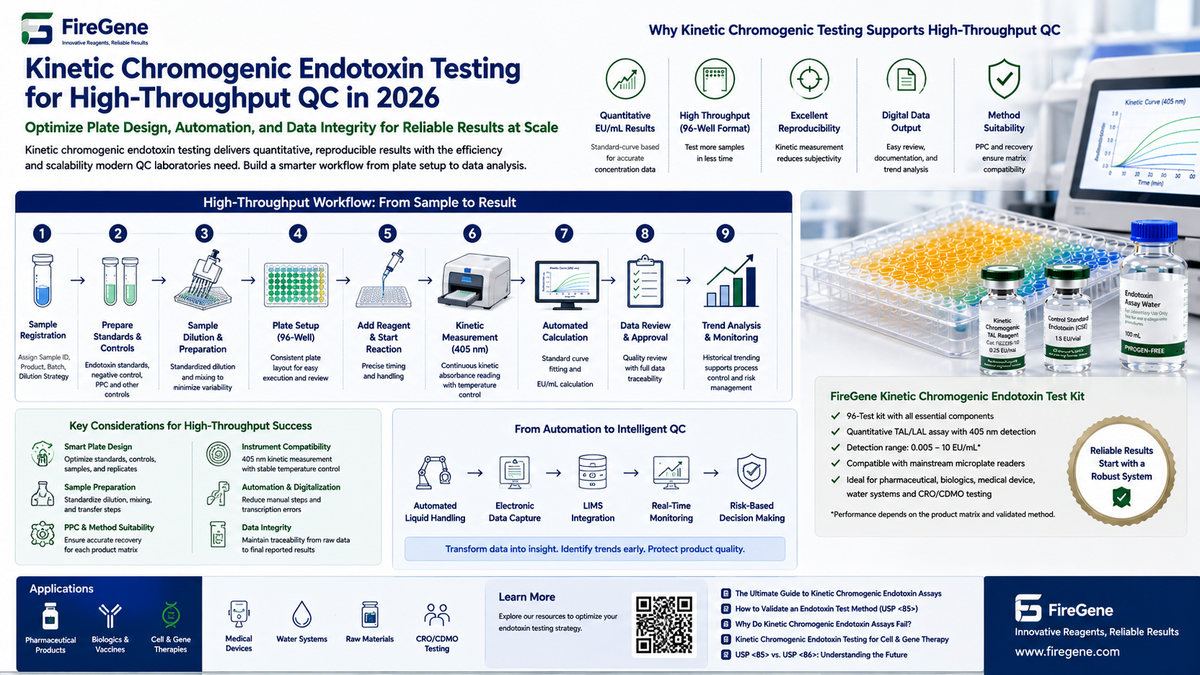
Introduction: Why High-Throughput Endotoxin Testing Is Becoming More Important
Pharmaceutical quality control laboratories are testing more samples than ever.
As manufacturing portfolios expand to include biologics, vaccines, cell and gene therapies, recombinant proteins, injectable drugs, and increasingly complex process intermediates, endotoxin testing can become a significant part of the laboratory workload.
The challenge is no longer simply:
Can we detect endotoxin?
For many modern QC laboratories, the more important questions are:
Can we test dozens of samples efficiently?
Can we maintain consistent assay performance across an entire plate?
Can we minimize manual errors?
Can we generate traceable and reviewable quantitative data?
This is where kinetic chromogenic endotoxin testing becomes particularly valuable.
Unlike Gel-Clot testing, which provides a qualitative result around a defined endotoxin limit, kinetic chromogenic testing generates quantitative endotoxin concentrations through kinetic optical measurement and a standard curve. FireGene's current Kinetic Chromogenic Endotoxin Test Kit is a 96-well quantitative TAL/LAL assay using 405 nm absorbance detection and is designed for microplate-reader workflows.
But simply moving from tubes to a 96-well plate does not automatically create a high-throughput testing system.
A truly efficient workflow requires laboratories to optimize:
- Plate layout
- Sample allocation
- Standard curve design
- PPC strategy
- Pipetting
- Timing
- Reader configuration
- Data processing
- Documentation
- Result review
- Trend monitoring
This guide explains how to build that workflow.
1. What Does “High-Throughput” Really Mean in Endotoxin Testing?
High-throughput endotoxin testing does not simply mean using a 96-well plate.
A laboratory could use a 96-well plate inefficiently and still spend considerable time on:
- Manual dilution
- Plate setup
- Reagent preparation
- Sample identification
- Data transfer
- Result calculations
- Review
- Documentation
A high-throughput workflow should instead optimize the entire analytical process.
A useful way to think about it is:
High Throughput = Sample Capacity × Workflow Efficiency × Data Reliability
If sample capacity increases but error rates also increase, the laboratory has not necessarily improved its process.
Therefore, high-throughput endotoxin testing should achieve three objectives simultaneously:
1. More samples per analytical run
2. Less manual intervention
3. Consistent and reviewable results
Kinetic chromogenic testing is well suited to this model because the assay can monitor absorbance kinetics across multiple wells and calculate quantitative endotoxin concentrations from a standard curve.
2. Why Kinetic Chromogenic Testing Fits Modern QC Laboratories
The traditional Gel-Clot assay remains useful for many applications, particularly where a simple qualitative limit test is appropriate.
However, high-volume QC environments often need more information.
Kinetic chromogenic testing can provide:
- Quantitative EU/mL results
- Standard-curve-based calculations
- Parallel sample testing
- Automated optical measurement
- Reduced subjectivity
- Digital data output
- Easier trend analysis
- Compatibility with microplate workflows
FireGene's existing Ultimate Guide to Kinetic Chromogenic Endotoxin Assays provides a more comprehensive explanation of the assay principle, validation, applications, and best practices.
For laboratories that are new to the method, the Step-by-Step Guide to the Kinetic Chromogenic Endotoxin Assay covers the practical workflow from standard preparation through kinetic measurement.
The next challenge is therefore not understanding how the assay works.
It is optimizing how the assay is deployed at scale.
3. Start With Capacity Planning Before Designing the Plate
One of the most common mistakes is designing a plate first and asking how many samples can fit afterward.
Instead, start with the laboratory's testing requirements.
Consider:
- Number of samples per day
- Number of samples per batch
- Required dilution levels
- Number of replicates
- PPC requirements
- Standard curve requirements
- Negative controls
- Repeat testing requirements
- Expected investigation rate
For example, suppose a laboratory has:
30 samples per batch
and each sample requires:
- Two replicate wells
- One PPC
- One dilution
The actual well requirement becomes much larger than simply allocating two wells per sample.
This is why high-throughput planning should begin with:
Sample Count → Dilution Strategy → Replicates → Controls → Standards → Available Wells
rather than:
96 wells → Fill as many as possible
4. How to Design an Efficient 96-Well Plate
A well-designed plate should make the experiment easy to perform and easy to review.
A simplified structure could look like:
Columns 1–2
Endotoxin standards
Columns 3–4
Negative controls and assay controls
Columns 5–12
Samples and PPCs
The exact layout should be determined by the validated method and laboratory SOP.
The most important principle is consistency.
For example, if the same type of sample is always assigned to the same region of the plate, analysts and reviewers can identify deviations more easily.
A standardized plate map also reduces transcription errors.
5. Standard Curve Allocation Should Be Consistent
The standard curve is the quantitative foundation of the kinetic chromogenic assay.
FireGene's Kinetic Chromogenic Endotoxin Test Kit includes Control Standard Endotoxin and uses quantitative measurement through a standard curve.
The laboratory should establish a consistent approach for:
- Number of standard concentrations
- Replicate allocation
- Standard dilution
- Standard placement
- Acceptance criteria
- Data processing
The purpose of standardization is not merely convenience.
It creates historical comparability.
If the plate layout changes every day, it becomes more difficult to identify whether a performance shift is related to:
- Reagent lot
- Instrument
- Analyst
- Plate position
- Sample type
- Standard preparation
A standardized plate design makes long-term trend analysis much easier.
6. Positive Product Controls Should Be Integrated Into the Plate Strategy
Positive Product Controls, or PPCs, provide important information about product-specific interference.
This becomes particularly important when testing complex matrices.
A sample may appear to have an extremely low endotoxin concentration, but if the product inhibits endotoxin detection, the apparent result may not represent the actual endotoxin level.
Therefore, high-throughput testing should not sacrifice method suitability for speed.
A useful principle is:
High throughput should increase testing efficiency, not reduce analytical controls.
FireGene's Endotoxin Test Method Validation Guide explains the relationship between method suitability, PPC recovery, dilution, and product-specific matrix effects.
7. Sample Dilution Is One of the Biggest Bottlenecks
For many QC laboratories, the microplate reader is not the slowest part of the workflow.
Sample preparation is.
Each sample may require:
- Initial dilution
- Serial dilution
- Mixing
- Transfer
- PPC preparation
- Replicate preparation
When dozens of samples are tested, manual dilution can quickly become the dominant source of labor and variability.
Therefore, laboratories should standardize:
- Dilution ratios
- Dilution containers
- Mixing procedures
- Pipette settings
- Transfer sequence
- Sample identification
If the same product is tested repeatedly, validated dilution schemes can significantly simplify routine testing.
8. Avoid Designing the Workflow Around the Maximum Number of Wells
It can be tempting to fill every available well.
But maximum plate utilization does not always equal maximum productivity.
A better question is:
What plate configuration gives the best balance between throughput, controls, reviewability, and repeatability?
For example, leaving some wells available may allow:
- Additional PPCs
- Dilution confirmation
- Investigation samples
- Additional controls
- Repeat measurements
This can reduce the need to run an entirely new plate when an unexpected result appears.
In a regulated QC environment, flexibility has operational value.
9. Kinetic Chromogenic Testing Can Support Automated Data Acquisition
One of the biggest advantages of microplate-based kinetic chromogenic testing is that the optical measurement can be automated.
Instead of manually observing a reaction endpoint, the reader continuously measures the optical response according to the programmed kinetic method.
FireGene's kit uses 405 nm kinetic absorbance detection and is compatible with standard microplate readers capable of the required measurement.
This can reduce manual intervention during the measurement stage.
However, automation should not be confused with validation.
The laboratory still needs to establish:
- Reader suitability
- Method parameters
- Temperature control
- Measurement wavelength
- Kinetic interval
- Calculation parameters
- Acceptance criteria
10. Instrument Compatibility Matters More Than You Think
A high-throughput endotoxin workflow places greater demands on the microplate reader than a simple endpoint assay.
The reader should be capable of:
- 405 nm absorbance detection
- Kinetic measurements
- Appropriate temperature control
- Multiwell plate compatibility
- Reliable data export
- Appropriate software configuration
FireGene states that its Kinetic Chromogenic Endotoxin Test Kit can work with mainstream microplate readers capable of 405 nm absorbance measurement and kinetic monitoring.
This means laboratories do not necessarily need a dedicated endotoxin reader.
For facilities that already have a suitable microplate reader, this can lower the barrier to adopting kinetic chromogenic testing.
11. Automation Should Begin With the Most Error-Prone Steps
Not every part of the workflow needs to be automated immediately.
A better strategy is to identify the steps with the greatest combination of:
High frequency + high labor + high error risk
These commonly include:
- Serial dilution
- Plate transfer
- Sample identification
- Data entry
- Result calculation
For example, automating calculations may be easier and less disruptive than automating the entire liquid-handling workflow.
A practical automation roadmap can therefore be:
Stage 1
Standardized SOPs
↓
Stage 2
Standardized plate maps
↓
Stage 3
Automated calculations
↓
Stage 4
Electronic data capture
↓
Stage 5
Automated liquid handling
↓
Stage 6
Integrated LIMS workflow
This allows laboratories to improve throughput without attempting a complete automation project at once.
12. Data Integrity Becomes More Important as Throughput Increases
High-throughput testing generates large amounts of data.
A single plate can produce:
- Raw absorbance data
- Kinetic curves
- Standard curve data
- Control results
- PPC results
- Sample concentrations
- Dilution factors
- Final EU/mL values
As the number of plates increases, manual transcription becomes increasingly risky.
This is why digitalization is becoming an important trend in endotoxin testing. FireGene's broader discussion of Endotoxin Testing in 2026: How AI Is Improving Risk Assessment and Contamination Control highlights the growing role of digital tools and data-driven approaches in modern endotoxin quality control.
A robust data workflow should preserve the relationship between:
Sample ID → Plate Position → Raw Data → Calculation → Final Result
This makes the result easier to review and defend.
13. Why Manual Transcription Is a Hidden QC Risk
Imagine a laboratory testing 50 samples.
The instrument generates:
50 raw results
The analyst then manually transfers those values into a spreadsheet.
Then the analyst manually applies:
Dilution Factor
and calculates:
Final EU/mL
Every manual transfer creates another opportunity for:
- Wrong sample ID
- Wrong dilution factor
- Decimal-point errors
- Copy-and-paste errors
- Incorrect plate position
- Calculation mistakes
The assay chemistry may be excellent.
But the final reported result can still be wrong.
Therefore:
Analytical automation is only as reliable as the data workflow surrounding it.
14. Use Historical Data to Establish Endotoxin Trends
Quantitative endotoxin testing creates an advantage that simple qualitative testing cannot provide as easily:
Trend information.
Suppose a manufacturing process consistently produces:
0.02–0.05 EU/mL
over several months.
Then one batch produces:
0.12 EU/mL
Even if the result remains below the applicable specification, the change may be worth investigating.
This is where quantitative kinetic chromogenic testing can support process monitoring.
The objective is not simply:
Pass / Fail
but:
What is changing over time?
Trend analysis can potentially help identify:
- Raw material changes
- Water-system changes
- Process deviations
- Cleaning issues
- Equipment changes
- Supplier changes
- Environmental trends
15. Kinetic Chromogenic Testing and Process Monitoring
The quantitative nature of the method makes it particularly useful for laboratories interested in process trending.
Consider a simplified manufacturing trend:
Batch 1 → 0.02 EU/mL
Batch 2 → 0.03 EU/mL
Batch 3 → 0.04 EU/mL
Batch 4 → 0.07 EU/mL
Batch 5 → 0.10 EU/mL
A traditional pass/fail mindset might classify every batch as acceptable.
A trend-based QC strategy asks a different question:
Why is endotoxin gradually increasing?
This can trigger earlier investigation before the process reaches an actual specification failure.
16. High Throughput Does Not Mean Testing Without Controls
One of the biggest misconceptions about high-throughput testing is that controls should be minimized to maximize sample capacity.
This can be counterproductive.
The laboratory should retain the controls required by the validated method.
Important controls can include:
- Standard curve
- Negative control
- PPC
- Appropriate system suitability controls
- Replicates where required
The goal is not to maximize the number of sample wells.
The goal is to maximize the number of valid analytical results.
That distinction is fundamental.
17. How to Handle Complex Biologic Matrices
High-throughput endotoxin testing becomes more complicated when laboratories test biologics.
Potentially challenging matrices include:
- Monoclonal antibodies
- Recombinant proteins
- Vaccines
- Cell therapy products
- Gene therapy products
- Viral vectors
- Lipid nanoparticles
- Other advanced biologics
These products may contain components that affect endotoxin recovery.
For example:
- Proteins
- Surfactants
- Lipids
- Chelators
- Salts
- Stabilizers
This makes dilution strategy and PPC recovery particularly important.
FireGene's article on Kinetic Chromogenic Endotoxin Testing for Cell and Gene Therapy Manufacturing explores the increasing importance of quantitative endotoxin testing in advanced therapy manufacturing.
18. Don't Confuse High Throughput With High Sensitivity
These are two different concepts.
Sensitivity
How low an endotoxin concentration can the assay reliably detect.
Throughput
How many samples can be processed within a defined period.
An assay can be:
Highly sensitive but low throughput
or:
High throughput but poorly controlled
The goal is to achieve both appropriate analytical performance and efficient sample processing.
FireGene's current Kinetic Chromogenic Endotoxin Test Kit lists a detection range of 0.005–10 EU/mL and a 96-test format, while actual suitability depends on the validated application, product matrix, and laboratory method.
19. High-Throughput Testing Requires Stronger Lot-to-Lot Control
When a laboratory runs only a few tests each week, a reagent-lot change may affect a relatively small number of samples.
When the laboratory runs hundreds of samples per month, the same lot change can affect a significant volume of QC data.
Therefore, laboratories should consider establishing routine lot-to-lot comparison strategies.
Review:
- Standard curve behavior
- Control performance
- PPC recovery
- Historical sample performance
- Background
- Reaction kinetics
The purpose is to determine whether the new lot performs consistently within the established method.
For laboratories that need broader information about reagent selection, FireGene's Guide to Selecting TAL/LAL Reagent: Gel-Clot vs. Kinetic Chromogenic Assays provides additional guidance.
20. The Role of Endotoxin-Free Water and Consumables
As throughput increases, the amount of consumables used by the laboratory also increases.
This can create an unexpected risk.
More:
Tubes
Tips
Plates
Water
Reservoirs
means more opportunities for contamination.
A high-throughput workflow therefore requires strict control of pyrogen-free materials.
FireGene's endotoxin testing portfolio includes Endotoxin Assay Water, Control Standard Endotoxin, and pyrogen-free consumables alongside its TAL/LAL Reagent systems.
This is particularly important when investigating:
- Elevated negative controls
- Unexpectedly high background
- Sudden plate-wide increases
- New consumable lots
21. What About USP <85> and High-Throughput Kinetic Chromogenic Testing?
Kinetic chromogenic testing is one of the recognized photometric approaches used for bacterial endotoxin testing under applicable compendial frameworks.
However, selecting a kinetic chromogenic reagent does not mean that every product can automatically be tested without additional method work.
The laboratory still needs to consider:
- Product-specific endotoxin limits
- Method suitability
- Dilution
- PPC recovery
- MVD
- Standard curve performance
- Interference
- Instrument suitability
FireGene's How to Validate an Endotoxin Test Method for USP <85> Compliance provides a detailed framework for method validation and suitability.
For laboratories evaluating recombinant alternatives, FireGene also provides a comparison of USP <85> vs. USP <86> and the changing regulatory landscape.
22. A Practical High-Throughput Kinetic Chromogenic Workflow
A well-organized workflow can be structured as follows:
Step 1: Sample Registration
Assign:
Sample ID → Batch → Product → Dilution → Plate Position
Step 2: Prepare Standards
Prepare the endotoxin standard curve according to the validated procedure.
Step 3: Prepare Controls
Set up:
- Negative control
- PPC
- Other applicable controls
Step 4: Prepare Samples
Apply the validated dilution strategy.
Step 5: Load Plate
Follow the standardized plate map.
Step 6: Add Reagents
Maintain consistent timing and handling.
Step 7: Start Kinetic Reading
Measure absorbance under validated conditions.
Step 8: Review Raw Data
Check:
- Standard curve
- Controls
- Kinetic curves
- Replicates
Step 9: Calculate Results
Apply the appropriate dilution factors.
Step 10: Review
Perform technical and, where applicable, quality review.
Step 11: Trend
Compare results against historical data.
Step 12: Release or Investigate
Use predefined procedures for acceptable and unexpected results.
This creates a complete system rather than simply an assay.
23. How FireGene's Kinetic Chromogenic Kit Fits Into a High-Throughput Workflow
FireGene's Kinetic Chromogenic Endotoxin Test Kit is provided in a 96-test format and includes the key components required for the assay workflow, including TAL/LAL Reagent, Control Standard Endotoxin, pyrogen-free water, reconstitution solution, and a microplate.
The workflow can be summarized as:
CSE
↓
Standard Curve
↓
Negative Control
↓
PPC
↓
Sample Dilution
↓
96-Well Plate
↓
405 nm Kinetic Reading
↓
Automated Calculation
↓
Quantitative EU/mL
↓
Trend Analysis
The major advantage is that these steps can be standardized across repeated analytical runs.
That consistency is particularly valuable for laboratories processing large numbers of samples.
24. When Should a Laboratory Choose Kinetic Chromogenic Testing?
Kinetic chromogenic testing may be particularly attractive when the laboratory needs:
Quantitative Results
When actual EU/mL concentrations are more useful than simple positive/negative results.
Higher Sample Capacity
When many samples must be processed within a defined QC window.
Digital Data
When laboratories want electronic data acquisition and automated calculations.
Trend Monitoring
When historical endotoxin concentrations are useful for process monitoring.
Complex Product Testing
When product-specific interference needs to be characterized quantitatively.
Microplate-Based Workflows
When the laboratory already operates a compatible microplate reader.
FireGene's product documentation specifically identifies quantitative analysis, high throughput, data trending, and compatibility with standard microplate readers as important use cases for its Kinetic Chromogenic Endotoxin Test Kit.
25. Common Mistakes When Building a High-Throughput Workflow
Mistake 1: Maximizing Samples Per Plate
More samples do not necessarily mean higher productivity.
Mistake 2: Reducing Controls
Controls are essential for determining whether results are valid.
Mistake 3: Excessive Manual Data Entry
Manual transcription creates unnecessary data-integrity risks.
Mistake 4: Ignoring Sample Preparation
The plate reader may be automated, but sample preparation remains a major source of variability.
Mistake 5: Changing Plate Layout Frequently
Inconsistent layouts make historical comparison more difficult.
Mistake 6: Treating Every Product the Same
Different matrices may require different dilution and method suitability strategies.
Mistake 7: Looking Only at Final EU/mL
Raw kinetic behavior can provide valuable troubleshooting information.
Mistake 8: Treating Throughput as the Only KPI
A better KPI is:
Valid Results per Analyst Hour
rather than:
Samples per Plate
26. How to Measure the Success of a High-Throughput Endotoxin Program
Laboratories should consider tracking several performance indicators.
Throughput
How many samples are completed per day or week?
First-Pass Success Rate
How many analytical runs are valid without repeat testing?
Analyst Time
How many labor hours are required per sample?
Repeat Rate
How often does testing need to be repeated?
PPC Failure Rate
How frequently does method suitability fail?
Standard Curve Failure Rate
How frequently are analytical runs invalidated?
Data Review Time
How long does result review take?
Investigation Rate
How often do unexpected results trigger investigations?
These metrics provide a much more meaningful picture of laboratory performance than simply counting wells.
27. The Future: From High-Throughput Testing to Intelligent Endotoxin QC
The next stage of endotoxin testing is unlikely to be simply:
More samples per plate.
Instead, laboratories are moving toward:
Automated → Connected → Trend-Based → Risk-Based QC
Imagine a system where:
Sample Registration
automatically connects to
Plate Layout
which connects to
Instrument Data
which connects to
Calculation
which connects to
LIMS
which connects to
Historical Trending
and finally to
Quality Decision-Making
This could allow laboratories to identify abnormal patterns much earlier.
For example, a system might recognize that endotoxin values have gradually increased over several batches even though every individual result remains within specification.
That could trigger a process investigation before a formal failure occurs.
This direction is consistent with the broader digitalization trend discussed in FireGene's Endotoxin Testing in 2026 article.
28. Frequently Asked Questions
Is kinetic chromogenic endotoxin testing suitable for high-throughput QC?
Yes, the 96-well format and kinetic optical measurement make the method well suited to multi-sample quantitative workflows, provided the laboratory establishes and validates an appropriate method. FireGene's current kit is supplied in a 96-test format and uses 405 nm kinetic absorbance measurement.
How many samples can be tested on one 96-well plate?
The number depends on the validated standard curve, replicate strategy, controls, PPC requirements, and sample dilution scheme. Laboratories should calculate capacity based on the entire method rather than simply dividing 96 wells by the number of samples.
Do I need a dedicated endotoxin reader?
Not necessarily. FireGene states that its Kinetic Chromogenic Endotoxin Test Kit is compatible with standard microplate readers capable of 405 nm absorbance and kinetic monitoring.
Does automation eliminate the need for method validation?
No. Automation improves workflow efficiency but does not replace method suitability, validation, system suitability, or appropriate controls.
Why is PPC important in high-throughput testing?
PPC helps demonstrate that the product matrix does not significantly interfere with endotoxin detection. It should remain part of the validated method even when throughput is a priority.
Can kinetic chromogenic testing be used for biologics?
Yes, but complex biologic matrices may require careful evaluation of dilution, interference, and endotoxin recovery.
Is high-throughput endotoxin testing only useful for pharmaceutical manufacturing?
No. It can also be useful for biotechnology, medical device testing, water monitoring, raw materials, research laboratories, and CRO/CDMO environments. FireGene lists pharmaceutical products, biologics, medical devices, water systems, raw materials, and CRO/CDMO testing among potential applications for its kinetic chromogenic kit.
Conclusion: The Goal Is Not More Wells—It Is More Reliable Results
Kinetic chromogenic endotoxin testing provides an important foundation for modern, quantitative endotoxin QC.
But high-throughput testing requires more than a 96-well plate.
A successful workflow integrates:
- Standardized Plate Design
- Efficient Sample Preparation
- Reliable TAL/LAL Reagent
- PPC and Method Suitability
- Compatible Instrumentation
- Automated Data Acquisition
- Data Integrity
- Historical Trending
- Risk-Based Quality Control
The ultimate objective is not to test the maximum number of samples in the shortest possible time.
It is to generate the maximum number of reliable, traceable, scientifically defensible results with the minimum unnecessary manual intervention.
As pharmaceutical manufacturing becomes increasingly complex in 2026, this distinction will become even more important.
For laboratories looking to build or optimize a quantitative endotoxin testing workflow, FireGene's Kinetic Chromogenic Endotoxin Test Kit provides a 96-well TAL/LAL-based platform with kinetic 405 nm absorbance detection.
And for laboratories developing a complete endotoxin testing strategy, the FireGene Endotoxin Assay Reagents and Kits collection brings together Kinetic Chromogenic and Gel-Clot TAL/LAL Reagents, Control Standard Endotoxin, Endotoxin Assay Water, and pyrogen-free consumables.
In modern QC, high throughput is valuable. But high-throughput reliability is the real competitive advantage.
FireGene Endotoxin Testing
Ready to run your endotoxin assay?
FireGene offers a complete endotoxin testing toolkit — from TAL reagents and CSE standards to pyrogen-free consumables and LAL reagent water. All products are aligned with USP <85>, EP 2.6.14, and JP 4.01.


