
Abstract
Endotoxin contamination is one of the most critical safety concerns in pharmaceutical and biotechnology manufacturing. Accurate and reliable endotoxin detection is essential for ensuring the safety of injectable drugs, vaccines, biologics, and advanced therapies. Among various endotoxin testing methods, kinetic chromogenic endotoxin testing has gained increasing attention due to its high sensitivity, quantitative capability, rapid detection speed, and excellent automation potential. This article explores the major advantages of kinetic chromogenic assays and explains why this technology has become an important tool in modern pharmaceutical quality control.
Keywords: kinetic chromogenic endotoxin assay, endotoxin detection, LAL testing, pharmaceutical quality control, bacterial endotoxin test, biologics safety
Advantages of Kinetic Chromogenic Endotoxin Testing in Modern Biopharmaceutical Quality Control
Introduction: The Importance of Reliable Endotoxin Detection
Endotoxins are lipopolysaccharide (LPS) components found in the outer membrane of Gram-negative bacteria. Even extremely low levels of endotoxin contamination can trigger serious immune reactions, including fever, inflammation, and septic shock. Therefore, controlling endotoxin levels is a fundamental requirement in the production of pharmaceutical products, medical devices, and biological therapies.
Traditional endotoxin detection methods, such as the gel-clot Limulus Amebocyte Lysate (LAL) assay, have been widely used for decades. However, with the rapid development of modern biopharmaceuticals—including monoclonal antibodies, cell therapies, gene therapies, and recombinant proteins—higher requirements for sensitivity, accuracy, and automation have emerged.
Kinetic chromogenic endotoxin testing provides an advanced solution by combining the biological specificity of LAL technology with real-time optical measurement, enabling faster and more precise endotoxin quantification.
What Is Kinetic Chromogenic Endotoxin Testing?
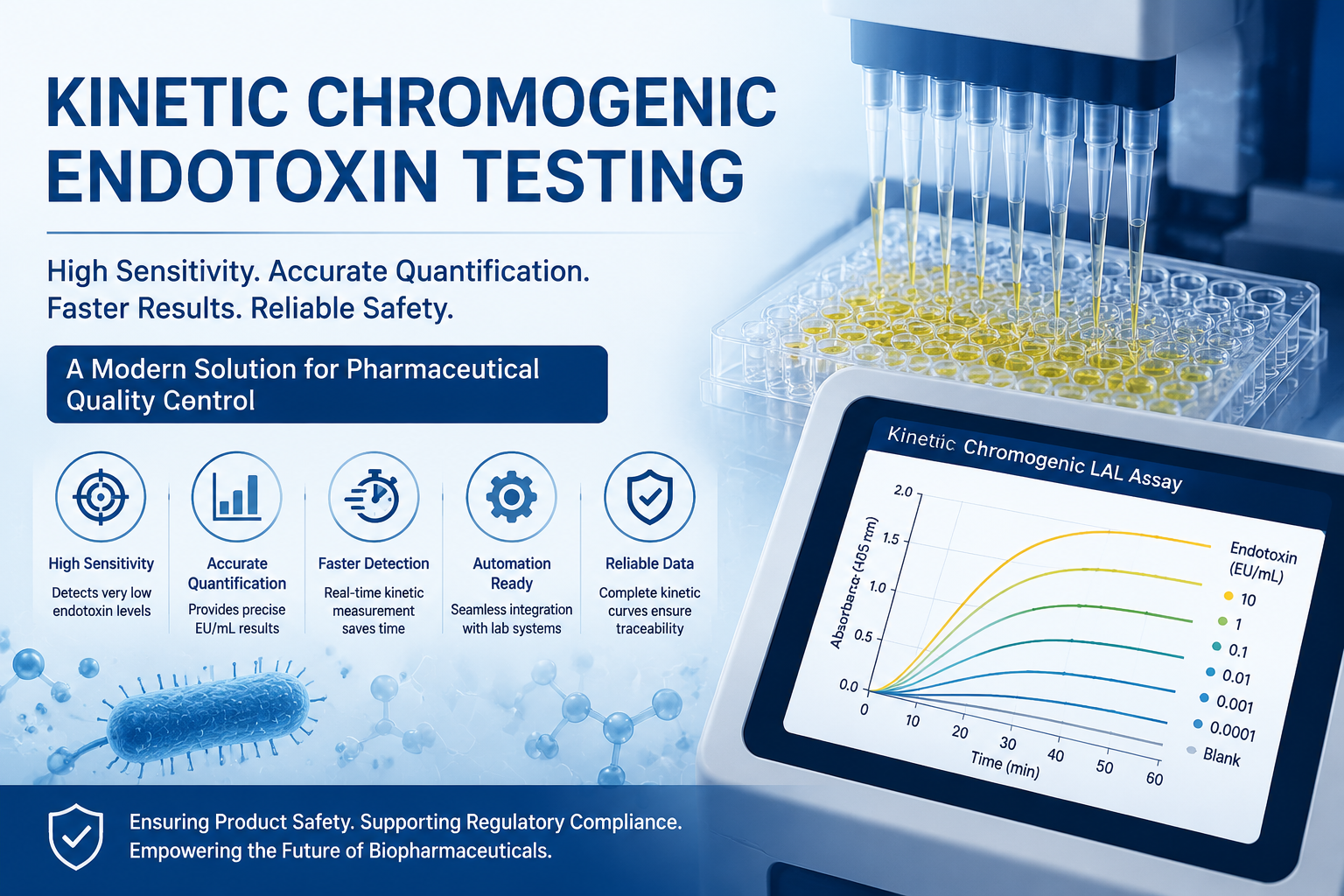
Kinetic chromogenic endotoxin testing is a quantitative bacterial endotoxin detection method based on the enzymatic reaction pathway of LAL.
During the reaction process:
1. Endotoxin activates Factor C in the LAL cascade.
2. A series of enzymatic reactions occur.
3. Activated enzymes cleave a synthetic chromogenic substrate.
4. A yellow-colored compound, p-nitroaniline (pNA), is released.
5. The increase in absorbance is monitored continuously over time.
Unlike endpoint chromogenic methods that measure only the final color intensity, kinetic chromogenic assays analyze the reaction rate, allowing accurate calculation of endotoxin concentration through a standard curve.
1. High Sensitivity and Wide Detection Range
One of the most significant advantages of kinetic chromogenic endotoxin testing is its excellent sensitivity.
The method can detect very low levels of endotoxin contamination while maintaining reliable quantitative performance. This makes it particularly suitable for products with strict endotoxin limits, such as:
· Injectable pharmaceuticals
· Vaccines
· Recombinant proteins
· Monoclonal antibodies
· Cell therapy products
· Gene therapy products
Because the assay measures reaction kinetics rather than a single endpoint value, small differences in endotoxin concentration can be detected more accurately.
For modern biologics, where contamination risks must be controlled at extremely low levels, this high sensitivity provides an essential safety advantage.
2. Accurate Quantitative Results
Traditional gel-clot assays provide mainly qualitative results, indicating whether endotoxin levels are above or below a specified limit.
In contrast, kinetic chromogenic assays provide precise quantitative results expressed as:
Endotoxin Units per milliliter (EU/mL)
This allows manufacturers to:
· Determine exact endotoxin concentrations
· Monitor contamination trends
· Evaluate purification processes
· Improve manufacturing control strategies
Quantitative data also support regulatory compliance and quality risk management in pharmaceutical production.
3. Faster Detection and Improved Laboratory Efficiency
Time efficiency is another important advantage of kinetic chromogenic testing.
The traditional gel-clot method requires visual observation of gel formation, which can involve longer incubation and manual evaluation.
Kinetic chromogenic assays use automated optical measurement systems to continuously monitor reaction development. The entire testing process can often be completed within a shorter time frame while simultaneously analyzing multiple samples.
Benefits include:
· Faster batch release decisions
· Increased laboratory productivity
· Reduced waiting time during quality control testing
For pharmaceutical manufacturers producing large numbers of samples, improved testing efficiency can significantly enhance workflow.
4. Excellent Automation Capability
Modern pharmaceutical laboratories require highly standardized and reproducible testing methods. Kinetic chromogenic endotoxin testing is well suited for automation.
The method can be integrated with:
· Microplate readers
· Automated endotoxin detection systems
· Laboratory information management systems (LIMS)
Automation provides several benefits:
✔ Reduced operator error
✔ Improved repeatability
✔ Automated calculation of results
✔ Digital data storage and traceability
This makes kinetic chromogenic assays particularly valuable in GMP-compliant manufacturing environments.
5. Better Data Reliability and Traceability
A major advantage of kinetic analysis is the generation of complete reaction curves rather than a single final measurement.
The system records:
· Absorbance changes over time
· Standard curve performance
· Sample reaction curves
· Control results
This creates a comprehensive analytical record that supports:
· Regulatory inspections
· Quality audits
· Process validation
· Laboratory documentation
Compared with visual endpoint judgment, automated kinetic measurement provides more objective and reproducible results.
6. Suitable for Complex Biopharmaceutical Products
The pharmaceutical industry is rapidly moving toward advanced therapies with increasingly complex formulations.
Examples include:
· CAR-T cell therapies
· mRNA-based therapeutics
· Viral vector products
· Recombinant biological drugs
These products may contain components that interfere with traditional endotoxin assays. Kinetic chromogenic testing allows researchers to perform dilution studies and interference testing to ensure accurate measurements.
Its flexibility makes it an important analytical tool for next-generation medicine development.
7. Reduced Sample and Reagent Consumption
Kinetic chromogenic assays commonly use microplate-based formats, allowing multiple reactions to be performed simultaneously.
Advantages include:
· Lower sample volume requirements
· Reduced reagent consumption
· Higher testing throughput
· Lower operational costs
For laboratories performing frequent endotoxin testing, these benefits can improve both economic efficiency and resource utilization.
8. Improved Standardization Compared with Traditional Methods
Traditional endotoxin detection methods may depend heavily on manual interpretation.
For example, gel-clot testing requires analysts to visually determine whether a gel has formed, which may introduce subjective variation.
Kinetic chromogenic testing relies on:
· Instrument-based detection
· Mathematical calculation
· Automated analysis
This improves consistency between operators, laboratories, and production batches.
Kinetic Chromogenic Method vs Other Endotoxin Detection Methods
|
Method |
Detection Principle |
Main Advantages |
|
Gel-clot LAL |
Gel formation |
Simple and cost-effective |
|
Turbidimetric LAL |
Turbidity increase |
Quantitative detection |
|
Kinetic Chromogenic LAL |
Color development rate |
High sensitivity, automation, accurate quantification |
|
Recombinant Factor C (rFC) |
Fluorescence reaction |
Animal-free alternative |
Among these methods, kinetic chromogenic testing remains one of the most widely adopted quantitative endotoxin assays in pharmaceutical quality control.
Conclusion: Why Choose Kinetic Chromogenic Endotoxin Testing?
As pharmaceutical products become more advanced, endotoxin testing technologies must provide higher accuracy, sensitivity, and efficiency. Kinetic chromogenic endotoxin testing offers significant advantages, including precise quantification, rapid detection, automation compatibility, strong data traceability, and suitability for complex biological products.
For modern pharmaceutical and biotechnology companies, this technology provides a reliable approach to ensuring product safety and meeting increasingly strict regulatory requirements.
With continued growth in biologics, cell therapy, and gene therapy markets, kinetic chromogenic endotoxin assays will continue to play a critical role in the future of pharmaceutical quality control.


