
Introduction
Maintaining a sterile environment is one of the most critical requirements in cell culture research. Microbial contamination, including bacteria, fungi, spores, and mycoplasma, can significantly affect cell growth, alter experimental results, and compromise research reliability.
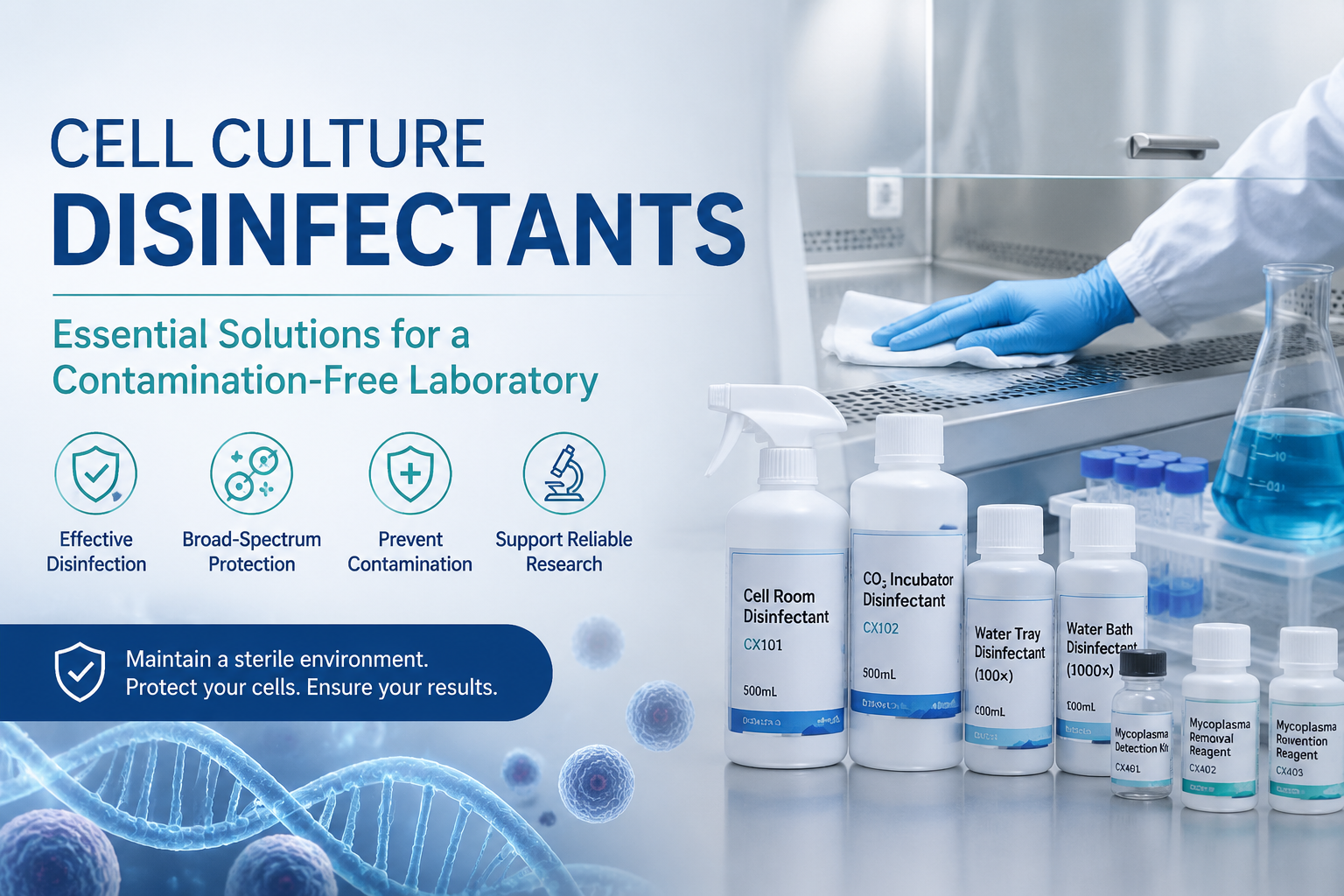
Cell culture disinfectants are specially designed laboratory reagents used for environmental cleaning, equipment decontamination, and contamination prevention in cell culture facilities. They help researchers maintain aseptic conditions in cell rooms, biosafety cabinets, CO₂ incubators, water baths, and other laboratory equipment.
A complete contamination control strategy combines proper aseptic techniques, regular environmental disinfection, and targeted removal solutions for specific microorganisms.
Why Are Cell Culture Disinfectants Important?
Cell cultures provide an ideal environment for microbial growth because they contain nutrients, moisture, and suitable temperatures. Even low-level contamination can cause:
· Reduced cell viability
· Abnormal cell morphology
· Altered gene expression
· Unreliable experimental data
· Loss of valuable cell lines 
Common contaminants include:
· Bacteria
· Yeasts and molds
· Mycoplasma
· Spore-forming microorganisms
Therefore, effective disinfectants are essential tools for maintaining reliable and reproducible cell culture experiments.
Product Categories of Cell Culture Disinfectants
1. Cell Room Disinfectant (CX101)
Specification: 500 mL
Product Overview
Cell Room Disinfectant is formulated for routine cleaning and microbial control in cell culture laboratories.
Applications
Suitable for:
· Biosafety cabinet surfaces
· Laboratory benches
· Cell culture room equipment
· Frequently touched laboratory areas
Key Benefits
· Helps reduce environmental microbial contamination
· Supports daily laboratory hygiene management
· Suitable for routine aseptic maintenance
2. CO₂ Incubator Disinfectant (CX102)
Specification: 500 mL
Product Overview
CO₂ incubators provide stable temperature and humidity conditions, which can also promote microbial growth. Regular cleaning with specialized incubator disinfectants helps minimize contamination risks.
Applications
Used for:
· CO₂ incubator interior surfaces
· Incubator trays and accessories
· Routine incubator maintenance
Advantages
· Helps control bacterial and fungal contamination
· Supports long-term cell culture stability
· Designed for cell culture equipment maintenance
3. Water Tray Disinfectant (100×) (CX103)
Specification: 100 mL
Product Overview
Water trays inside CO₂ incubators maintain humidity but can become potential sources of microbial contamination.
Water Tray Disinfectant is designed to help control microbial growth in humid incubation environments.
Benefits
· Reduces bacterial proliferation
· Helps prevent fungal growth
· Maintains cleaner incubator humidity systems
4. Water Bath Disinfectant (1000×) (CX104)
Specification: 100 mL
Product Overview
Water baths are widely used for warming cell culture media and reagents. However, warm water environments can support microbial growth.
Water Bath Disinfectant provides concentrated microbial control for laboratory water systems.
Applications
· Cell culture water baths
· Laboratory temperature-controlled water systems
Features
· High dilution efficiency
· Long-lasting contamination control
· Helps reduce biofilm formation
5. Contamination Removal Solutions
Black Mold / Fungal Contamination Remover (500×) (CX201)
Specifications:
· 400 μL
· 400 μL ×5
Product Overview
Designed for targeted removal of persistent contamination in cell culture environments.
Applications
· Contaminated cell culture areas
· Laboratory contamination treatment
Features
· Effective contamination management
· Suitable for specialized cleaning procedures
Bacillus-Type Contamination Remover (2000×) (CX301)
Specifications:
· 100 μL
· 100 μL ×5
Product Overview
Spore-forming microorganisms such as Bacillus species are highly resistant and may survive standard cleaning procedures.
This specialized remover is designed for laboratories requiring targeted control of resistant microbial contamination.
Applications
· Laboratory contamination elimination
· Cell culture environment restoration
6. Mycoplasma Detection and Control Products
Mycoplasma Detection Kit (CX401)
Specifications:
· 20 tests
· 50 tests
Product Overview
Mycoplasma contamination is one of the most common and problematic issues in cell culture laboratories.
Unlike visible microbial contamination, mycoplasma often does not cause obvious changes in culture appearance.
Effects of Mycoplasma Contamination
It may lead to:
· Altered cell metabolism
· Reduced proliferation rate
· Changes in protein expression
· Unreliable experimental outcomes
The Mycoplasma Detection Kit provides a convenient method for routine contamination monitoring.
Mycoplasma Removal Reagent (CX402)
Specifications:
· 200 μL
· 200 μL ×5
Product Overview
Designed to eliminate mycoplasma contamination from cell culture systems.
Applications
Suitable for:
· Mammalian cell cultures
· Long-term cell lines
· Research cell banks
Benefits
· Helps restore contaminated cultures
· Supports improved cell culture quality
Mycoplasma Prevention Reagent (CX403)
Specifications:
· 500 μL
· 500 μL ×5
Product Overview
Mycoplasma Prevention Reagent is used as part of a preventive contamination control strategy.
Applications
Recommended for:
· New cell line establishment
· High-frequency cell culture workflows
· Routine laboratory protection
How to Choose the Right Cell Culture Disinfectant?
|
Laboratory Application |
Recommended Product |
|
Cell culture room cleaning |
Cell Room Disinfectant CX101 |
|
CO₂ incubator maintenance |
CO₂ Incubator Disinfectant CX102 |
|
Incubator humidity tray |
Water Tray Disinfectant CX103 |
|
Water bath systems |
Water Bath Disinfectant CX104 |
|
Persistent contamination removal |
CX201 / CX301 |
|
Mycoplasma monitoring |
Mycoplasma Detection Kit CX401 |
|
Mycoplasma elimination |
Mycoplasma Removal Reagent CX402 |
|
Mycoplasma prevention |
Mycoplasma Prevention Reagent CX403 |
Advantages of Our Cell Culture Disinfectant Solutions
1. Comprehensive Contamination Control
Provides solutions for different contamination challenges, including bacteria, fungi, spores, and mycoplasma.
2. Designed for Cell Culture Applications
Products are developed specifically for laboratory environments where maintaining sterile conditions is essential.
3. Easy Integration into Laboratory Workflows
Suitable for routine cleaning, preventive maintenance, and contamination treatment.
4. Improved Experimental Reliability
Effective contamination management helps protect valuable cell cultures and improves reproducibility.
Conclusion
Cell culture disinfectants are essential components of modern laboratory contamination control systems. From routine environmental cleaning to targeted mycoplasma removal, selecting the appropriate disinfectant solution helps researchers maintain stable cell growth conditions and obtain reliable experimental results.
By combining proper aseptic techniques with effective contamination control reagents, laboratories can significantly reduce contamination risks and improve research efficiency.


