
Introduction
Single-nucleus sequencing has become a powerful technology for exploring cellular heterogeneity and gene regulation in complex plant tissues. However, plant samples present unique challenges for single-cell analysis due to their rigid cell walls, large vacuoles, abundant chloroplasts, and complex secondary metabolites.
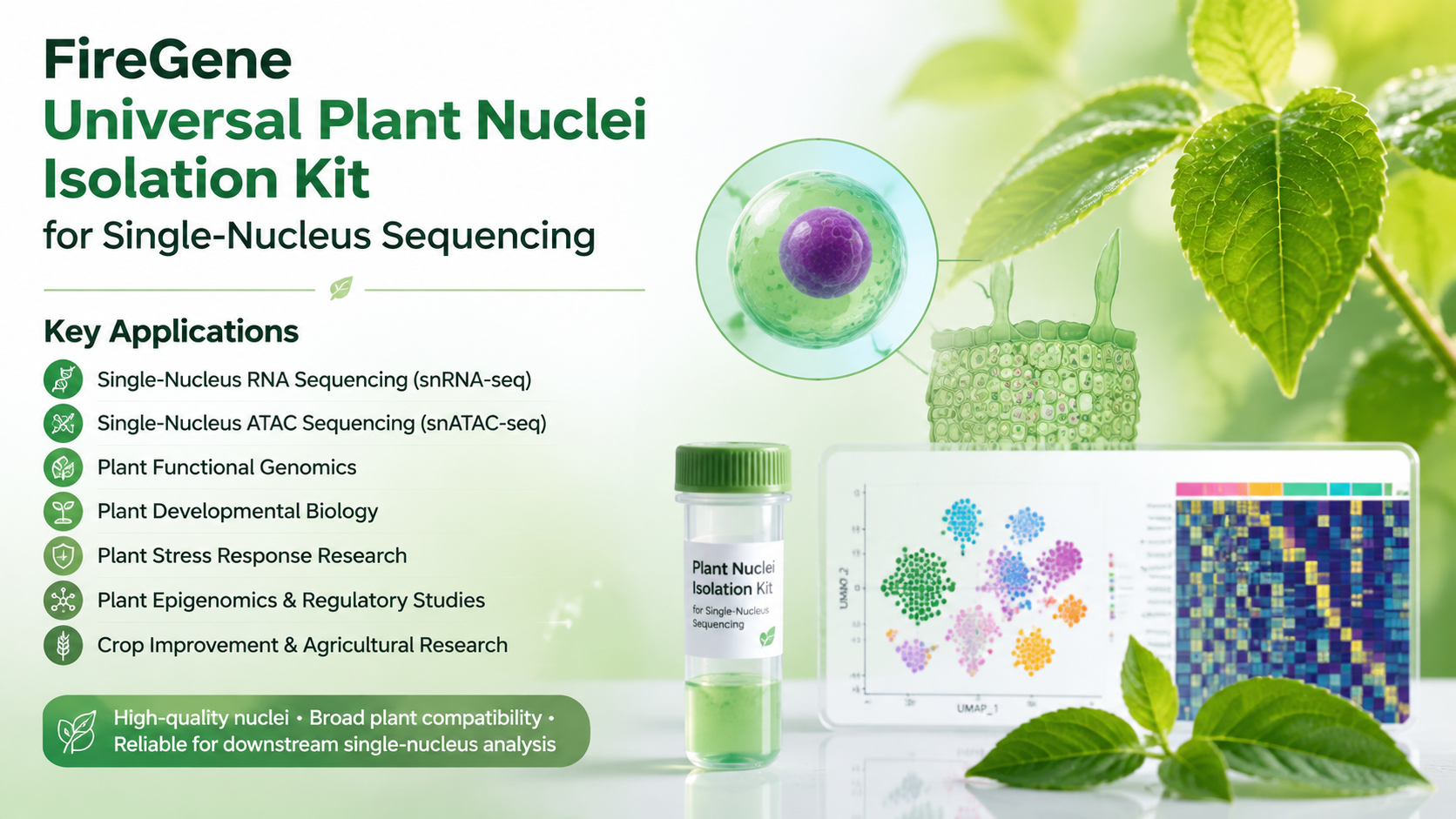
The FireGene Universal Plant Nuclei Isolation Kit for Single-Nucleus Sequencing provides an efficient solution for isolating high-quality plant nuclei from diverse plant tissues. By generating clean and intact nuclei suspensions, this kit supports downstream applications including single-nucleus RNA sequencing (snRNA-seq), single-nucleus ATAC sequencing (snATAC-seq), plant developmental studies, functional genomics, and stress response research.
This article highlights the major applications of plant nuclei isolation technology in modern plant molecular biology and single-cell research.
1. Single-Nucleus RNA Sequencing (snRNA-seq)
The primary application of the FireGene Universal Plant Nuclei Isolation Kit is the preparation of plant nuclei for single-nucleus RNA sequencing.
Unlike animal cells, many plant tissues are difficult to dissociate into intact single cells because of their rigid cell walls and tissue structures. Nuclei isolation provides an alternative approach by enabling researchers to profile gene expression at the single-cell level without requiring complete cell dissociation.
Plant snRNA-seq can be used to analyze:
· Cell-type-specific gene expression patterns
· Cellular heterogeneity within plant tissues
· Rare cell populations
· Tissue-specific transcriptional programs
Common research samples include:
· Leaves
· Roots
· Stems
· Flowers
· Seeds
· Developing plant tissues
By generating high-quality nuclei suspensions, researchers can obtain reliable transcriptomic information for detailed plant cell atlas construction.
2. Plant Functional Genomics Research
Functional genomics aims to understand how genes contribute to plant growth, development, and environmental adaptation.
The FireGene Plant Nuclei Isolation Kit supports functional genomics studies by enabling researchers to investigate gene expression profiles from individual plant cell populations.
Applications include:
· Identification of cell-type-specific genes
· Discovery of novel gene functions
· Analysis of molecular pathways
· Construction of plant transcriptomic maps
This technology helps researchers better understand the relationship between genes and plant traits, supporting applications in:
· Crop improvement
· Agricultural biotechnology
· Plant breeding programs
For example, single-nucleus sequencing can reveal genes associated with:
· Crop yield
· Disease resistance
· Nutrient utilization
· Growth regulation
3. Plant Developmental Biology Studies
Plant development involves complex interactions between different cell types and developmental stages.
Traditional bulk RNA sequencing provides average gene expression information from entire tissues, making it difficult to identify cell-specific changes.
Single-nucleus sequencing enables researchers to study:
· Root development
· Leaf formation
· Vascular tissue differentiation
· Flower development
· Seed development
By analyzing individual nuclei, scientists can identify:
· Specific developmental cell populations
· Cell lineage changes
· Development-related regulatory networks
The FireGene Universal Plant Nuclei Isolation Kit provides a reliable workflow for obtaining nuclei suitable for developmental biology research.
4. Plant Stress Response Research
Plants continuously respond to environmental challenges, including drought, salinity, temperature changes, and pathogen infection.
Different plant cell types often exhibit distinct stress-response mechanisms. Single-nucleus sequencing allows researchers to identify these cell-specific responses.
Applications include studying:
Abiotic Stress
· Drought tolerance mechanisms
· Salt stress responses
· Heat and cold stress adaptation
· Nutrient deficiency responses
Biotic Stress
· Plant-pathogen interactions
· Immune response pathways
· Disease resistance mechanisms
By analyzing nuclear transcriptomes, researchers can discover:
· Stress-responsive genes
· Key transcription factors
· Regulatory pathways involved in plant adaptation 
5. Single-Nucleus ATAC Sequencing (snATAC-seq)
Beyond gene expression analysis, isolated plant nuclei are also valuable for studying chromatin accessibility.
Single-nucleus ATAC sequencing (snATAC-seq) provides insights into:
· Open chromatin regions
· Regulatory element activity
· Transcription factor binding sites
· Epigenetic regulation
Applications include:
· Identification of gene regulatory regions
· Understanding transcriptional control mechanisms
· Studying plant adaptation and development
High-quality nuclei preparation is a critical step for generating accurate chromatin accessibility data.
6. Plant Epigenomics Research
The nucleus contains essential information about genome regulation and epigenetic modifications.
Plant nuclei isolation supports research areas such as:
· Chromatin remodeling
· DNA regulation studies
· Transcriptional control
· Epigenetic memory
These applications are important for understanding how plants respond to:
· Environmental changes
· Developmental signals
· Agricultural selection
By combining nuclei isolation with advanced sequencing technologies, researchers can explore the relationship between genome structure and plant phenotype.
7. Crop Improvement and Agricultural Research
Modern agriculture requires a deeper understanding of plant genetics and cellular regulation.
Single-nucleus sequencing technologies provide valuable information for crop research by revealing molecular differences between individual cell types.
Applications include:
· Improving crop productivity
· Identifying stress-resistant varieties
· Studying plant immunity
· Optimizing breeding strategies
Researchers can apply plant nuclei isolation workflows to important crops, including:
· Rice
· Wheat
· Maize
· Soybean
· Tomato
These insights accelerate the development of improved crop varieties.
8. Analysis of Difficult Plant Samples
Many plant tissues are challenging for conventional single-cell workflows due to:
· Strong cell walls
· Complex tissue structures
· High levels of pigments
· Secondary metabolites
Nuclei isolation provides advantages because it does not require complete removal of the plant cell wall.
The FireGene Universal Plant Nuclei Isolation Kit is suitable for preparing nuclei from diverse plant materials, including:
· Fresh plant tissues
· Stored samples
· Complex plant organs
This makes it a valuable tool for plant single-cell and single-nucleus research.
Conclusion
The FireGene Universal Plant Nuclei Isolation Kit for Single-Nucleus Sequencing is widely applied in modern plant research, supporting key applications such as snRNA-seq, snATAC-seq, plant functional genomics, developmental biology, stress response studies, epigenomics, and crop improvement research.
By enabling efficient isolation of high-quality plant nuclei, this technology helps researchers overcome the limitations of traditional plant single-cell preparation and obtain deeper insights into plant cellular diversity, gene regulation, and biological mechanisms.
As single-nucleus sequencing continues to expand in plant science, reliable nuclei isolation solutions will remain essential tools for advancing plant molecular biology and agricultural innovation.


