
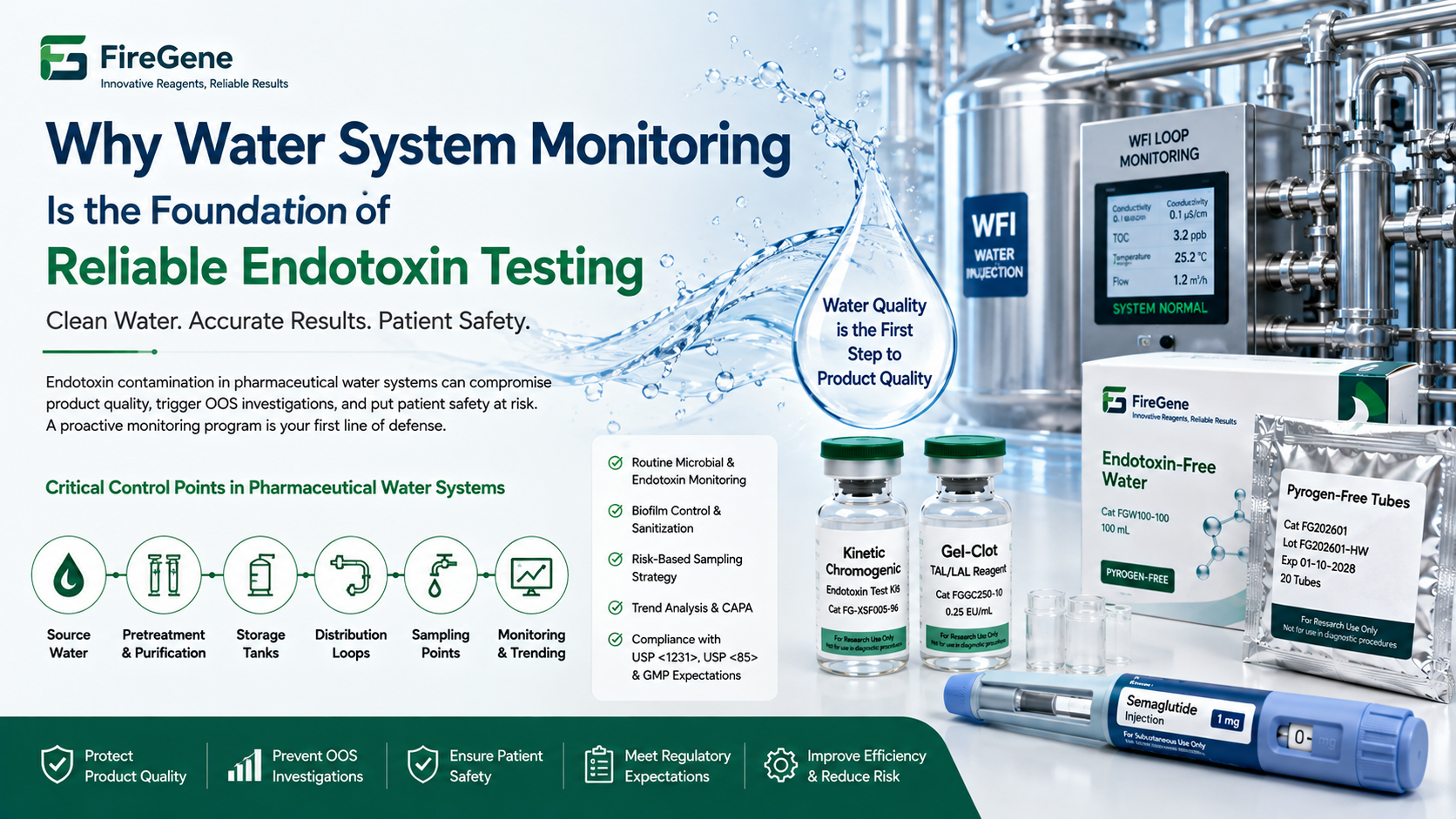
Introduction
Water is often described as the most widely used raw material in pharmaceutical manufacturing. It is used throughout nearly every stage of production—from equipment cleaning and media preparation to formulation, analytical testing, and the manufacture of injectable drug products. Because pharmaceutical water comes into direct or indirect contact with products intended for human use, maintaining its microbiological quality is essential for ensuring product safety.
Among the many quality attributes monitored in pharmaceutical water systems, bacterial endotoxin control is one of the most critical. Endotoxins are heat-stable lipopolysaccharides (LPS) released from the outer membrane of Gram-negative bacteria. Even after microorganisms have been eliminated through sanitization or filtration, endotoxins may remain in the water system and ultimately contaminate pharmaceutical products or laboratory samples.
For injectable drugs, biologics, vaccines, cell and gene therapies, and other sterile products, endotoxin contamination can lead to failed quality control testing, batch rejection, costly manufacturing delays, regulatory observations, and, most importantly, risks to patient safety.
Many laboratories focus primarily on optimizing the bacterial endotoxin assay itself. However, even the most carefully validated TAL/LAL method cannot compensate for a poorly controlled pharmaceutical water system. If endotoxins are already present in Purified Water (PW) or Water for Injection (WFI), inaccurate or inconsistent testing results become inevitable.
For this reason, regulatory agencies increasingly view pharmaceutical water management as a foundational element of contamination control and quality risk management. Guidance such as USP <1231> Water for Pharmaceutical Purposes, USP <85> Bacterial Endotoxins Test, European Pharmacopoeia requirements, and current GMP regulations all emphasize the importance of routine monitoring, trending, sanitization, and system validation.
In this guide, we explain why pharmaceutical water system monitoring forms the foundation of reliable endotoxin testing, explore common contamination risks, review regulatory expectations, and present practical strategies that help manufacturers maintain consistent water quality while improving laboratory efficiency and regulatory compliance.
Why Pharmaceutical Water Matters
Unlike most raw materials, pharmaceutical water is used repeatedly throughout manufacturing.
Typical applications include:
- Equipment cleaning
- CIP/SIP processes
- Buffer preparation
- Media preparation
- Sample dilution
- Reagent preparation
- API production
- Bioprocessing
- Chromatography
- Final formulation
- Laboratory testing
Because water is involved in so many manufacturing steps, contamination introduced into the water system can spread rapidly across multiple processes.
Consequences include:
- False endotoxin positives
- Failed recovery studies
- OOS investigations
- Product contamination
- Batch rejection
- Production downtime
- Regulatory findings
- Increased manufacturing costs
Maintaining a robust pharmaceutical water system therefore represents one of the most effective strategies for preventing endotoxin-related quality issues.
Understanding Pharmaceutical Water Systems
Not all pharmaceutical water is the same. Different grades of water are designed for different manufacturing applications, each with its own quality requirements.
Purified Water (PW)
Purified Water is commonly used for:
- Equipment rinsing
- Cleaning validation
- Buffer preparation
- Media preparation
- Intermediate manufacturing processes
Although PW has strict microbiological specifications, it is generally not intended for direct preparation of injectable products unless further processed.
Water for Injection (WFI)
Water for Injection (WFI) is the highest purity pharmaceutical water used in sterile manufacturing.
Typical applications include:
- Injectable drug formulation
- Vaccine manufacturing
- Biologics production
- Cell and gene therapy manufacturing
- Final equipment rinsing
- Reconstitution of endotoxin testing reagents
- Preparation of pharmaceutical-grade diluents
Because WFI directly affects injectable product quality, strict endotoxin limits apply throughout production, storage, and distribution.
Where Endotoxins Enter Pharmaceutical Water Systems
Even well-designed water systems are vulnerable to contamination if appropriate monitoring and maintenance programs are not in place.
The most common contamination sources include:
Biofilm Formation
Biofilms are widely recognized as the greatest long-term threat to pharmaceutical water quality.
Once microorganisms adhere to stainless steel piping or storage tanks, they begin producing extracellular polymers that form protective biofilms.
These biofilms:
- Shield bacteria from sanitization
- Continuously release endotoxins
- Increase microbial counts
- Become increasingly difficult to remove over time
Importantly, even after bacteria are destroyed, the endotoxins embedded within the biofilm may remain.
Dead Legs
Poor piping design can create stagnant sections known as dead legs.
Low-flow areas allow microorganisms to proliferate and biofilms to develop, increasing the risk of endotoxin accumulation.
Proper hygienic system design minimizes these risks.
Storage Tanks
Improperly maintained storage tanks may develop:
- Temperature fluctuations
- Stagnant zones
- Airborne contamination
- Biofilm accumulation
Routine sanitization and circulation help maintain microbiological control.
Distribution Loops
Extended water distribution loops require continuous monitoring.
Potential issues include:
- Reduced circulation velocity
- Temperature variation
- Inadequate sanitization
- Valve contamination
- Sampling port contamination
These locations frequently become sources of recurring endotoxin excursions.
Sampling Procedures
Ironically, sampling itself can introduce contamination.
Common mistakes include:
- Non-sterile containers
- Inadequate flushing
- Improper sampling technique
- Delayed testing
- Environmental exposure
Standardized sampling SOPs significantly improve monitoring accuracy.
Regulatory Expectations for Pharmaceutical Water Monitoring
Although the design of pharmaceutical water systems varies between manufacturing facilities, regulatory agencies share a common expectation: manufacturers must demonstrate continuous control over water quality throughout the entire lifecycle of the system.
Rather than relying solely on periodic testing, modern GMP regulations emphasize a risk-based monitoring strategy that combines system design, validation, routine monitoring, trend analysis, preventive maintenance, and continuous improvement.
For endotoxin control, the most frequently referenced guidance documents include:
- USP <1231> Water for Pharmaceutical Purposes
- USP <85> Bacterial Endotoxins Test
- European Pharmacopoeia (Ph. Eur.)
- FDA Current Good Manufacturing Practice (CGMP) regulations
- EU GMP Annex 1 for the manufacture of sterile medicinal products
- ICH Q9 Quality Risk Management
Together, these guidelines encourage manufacturers to view pharmaceutical water systems as critical utilities that require the same level of scientific oversight as manufacturing equipment or analytical methods.
Building an Effective Pharmaceutical Water Monitoring Program
Reliable endotoxin testing begins with a well-designed water monitoring program rather than simply collecting routine samples.
A comprehensive monitoring program typically includes five key components.
1. Routine Microbial Monitoring
Monitoring microbial counts provides an early indication of changes in water quality before significant endotoxin accumulation occurs.
Routine testing should include:
- Total microbial counts
- Identification of recurring microorganisms
- Alert and action limits
- Trend analysis
- Investigation of abnormal results
Although microbial counts and endotoxin levels are not always directly correlated, increasing microbial populations often indicate conditions that favor future endotoxin generation.
2. Routine Endotoxin Testing
Because Gram-negative bacteria continuously release lipopolysaccharides during growth and cell lysis, direct endotoxin monitoring is essential.
Many manufacturers establish routine testing schedules for:
- Water for Injection (WFI)
- Critical distribution loop locations
- Storage tanks
- Return loops
- High-risk manufacturing points
- Final rinse water
Routine monitoring helps identify contamination before it affects commercial manufacturing.
3. Chemical and Physical Monitoring
Microbiological quality should be evaluated alongside routine physical and chemical parameters, including:
- Conductivity
- Total Organic Carbon (TOC)
- Temperature
- Flow rate
- Pressure
- pH (where appropriate)
Unexpected changes in these parameters may indicate conditions that increase microbial growth or biofilm formation.
4. Trend Analysis
One of the most valuable quality tools is long-term data trending.
Rather than evaluating individual results in isolation, manufacturers should monitor:
- Seasonal variation
- Sampling location trends
- Gradual microbial increases
- Recurrent endotoxin elevations
- Sanitization effectiveness
- System performance over time
Trend analysis often detects developing problems weeks or months before specifications are exceeded.
5. Corrective and Preventive Actions (CAPA)
When abnormal results occur, laboratories should investigate the root cause rather than simply repeating the test.
Typical CAPA activities include:
- Additional sampling
- Equipment inspection
- Sanitization verification
- Review of maintenance records
- Investigation of recent engineering changes
- Biofilm assessment
- Operator retraining
Effective CAPA programs reduce recurrence while strengthening the overall Pharmaceutical Quality System (PQS).
Online Monitoring vs. Offline Testing
As pharmaceutical manufacturing becomes increasingly automated, many facilities are integrating online monitoring technologies into their water systems.
However, online monitoring does not eliminate the need for traditional laboratory testing.
Online Monitoring
Online systems continuously monitor parameters such as:
- Conductivity
- Temperature
- Flow
- Pressure
- Total Organic Carbon (TOC)
Advantages include:
- Real-time process visibility
- Immediate alarm notification
- Continuous trend data
- Faster identification of system deviations
However, current online technologies generally cannot directly replace compendial bacterial endotoxin testing.
Offline Laboratory Testing
Laboratory testing remains essential for:
- Bacterial endotoxin analysis
- Microbial enumeration
- Method validation
- Investigation of abnormal results
- Regulatory documentation
- Product release support
The most effective pharmaceutical water programs combine continuous online monitoring with scientifically validated offline microbiological testing.
Why Trend Analysis Is More Valuable Than Individual Test Results
One endotoxin result rarely tells the complete story.
For example, a water sample may meet specification today but show a gradual upward trend over several weeks.
If laboratories focus only on pass/fail criteria, these early warning signs may be overlooked.
Trend analysis provides insight into:
- Biofilm development
- Seasonal microbial variation
- Declining sanitization effectiveness
- Equipment aging
- Changes in manufacturing demand
- Distribution loop performance
Many quality issues can be prevented simply by recognizing unfavorable trends before they become Out-of-Specification (OOS) events.
Common Water System Problems That Affect Endotoxin Testing
Even laboratories using validated TAL/LAL methods may experience inconsistent endotoxin results if the pharmaceutical water system is not properly maintained.
Common issues include:
Inadequate Sanitization
Incomplete thermal or chemical sanitization allows microorganisms to survive and continue producing endotoxins.
Biofilm Development
Established biofilms continuously release endotoxins into circulating water, even when microbial counts appear acceptable.
Poor Sampling Practices
Improper sample collection techniques may introduce contamination or produce misleading results.
Examples include:
- Insufficient flushing
- Non-pyrogen-free containers
- Delayed analysis
- Inconsistent sampling procedures
Infrequent Monitoring
Sampling too infrequently increases the likelihood that developing contamination remains undetected.
Risk-based sampling frequencies should reflect system complexity and manufacturing criticality.
Ignoring Trend Data
Facilities sometimes investigate only specification failures while overlooking gradual increases that precede future deviations.
Continuous performance review is therefore an essential component of an effective monitoring program.
Case Study: Identifying an Endotoxin Excursion Before Batch Release
A sterile injectable manufacturing facility experienced occasional increases in endotoxin levels during routine Water for Injection (WFI) monitoring. Although all values remained below specification limits, quality personnel observed a gradual upward trend over several weeks.
Rather than waiting for an Out-of-Specification result, the engineering and QC teams initiated a proactive investigation.
The investigation included:
- Reviewing historical trend data from multiple sampling points
- Inspecting the WFI distribution loop
- Verifying circulation temperature and flow rate
- Assessing recent maintenance activities
- Evaluating sanitization records
- Collecting additional endotoxin and microbial samples
The investigation identified reduced flow in a section of the distribution loop that promoted localized stagnation and early biofilm formation.
After corrective maintenance and complete thermal sanitization, endotoxin values returned to historical baseline levels.
Because the issue was identified through trend analysis rather than specification failure, the manufacturer avoided product impact, batch delays, and extensive deviation investigations.
This example demonstrates why continuous water system monitoring is one of the most effective preventive tools in pharmaceutical quality control.
FireGene Solutions for Pharmaceutical Water Monitoring and Endotoxin Control
A well-designed pharmaceutical water system is only as effective as the monitoring program that supports it. Routine surveillance, validated analytical methods, and high-quality endotoxin testing reagents work together to ensure that water used throughout pharmaceutical manufacturing consistently meets microbiological quality requirements.
FireGene offers a comprehensive portfolio of bacterial endotoxin testing solutions designed to support pharmaceutical water monitoring, analytical method development, routine quality control, and GMP compliance.
Our portfolio includes:
- Kinetic Chromogenic Endotoxin Test Kit for sensitive quantitative endotoxin analysis of pharmaceutical water and finished products
- Gel-Clot TAL/LAL Reagents for compendial endotoxin limit testing
- Control Standard Endotoxin (CSE) for calibration curves, Positive Product Controls (PPCs), and recovery studies
- Endotoxin-Free Water for reagent reconstitution, standard preparation, and sample dilution
- Pyrogen-Free Tubes and Consumables to minimize the risk of laboratory-introduced endotoxin contamination
Together, these products help QC laboratories establish standardized testing workflows, improve assay reproducibility, and support compliance with USP <85>, USP <1231>, European Pharmacopoeia, and GMP expectations.
Technical Articles
- The Complete Guide to Endotoxin Test Reagents: Types, Principles, Selection, Validation, and Best Practices in 2026
- How to Validate an Endotoxin Test Method: A Step-by-Step Guide for USP <85> Compliance
- Why Endotoxin Testing Fails During Method Suitability Testing: Understanding Inhibition, Enhancement, and Matrix Interference
- Endotoxin Recovery Studies Explained: How to Design, Perform, and Interpret Recovery Experiments for USP <85> Compliance
- Understanding Low Endotoxin Recovery (LER): Mechanisms, Regulatory Perspectives, and Practical Solutions in 2026
- Endotoxin Testing in Biopharmaceutical Manufacturing: Critical Control Points from Raw Materials to Final Product Release
Frequently Asked Questions (FAQ)
1. Why is pharmaceutical water considered the foundation of reliable endotoxin testing?
Pharmaceutical water is used throughout manufacturing, equipment cleaning, formulation, and laboratory testing. If endotoxins are present in the water system, they can contaminate samples, reagents, equipment, or finished products, leading to inaccurate analytical results and increased product risk. Effective water system monitoring therefore supports every stage of bacterial endotoxin control.
2. What is the difference between Purified Water (PW) and Water for Injection (WFI)?
Purified Water (PW) is commonly used for cleaning, buffer preparation, and intermediate manufacturing processes. Water for Injection (WFI) is produced to a higher microbiological standard and is intended for manufacturing sterile injectable products, biologics, vaccines, and other parenteral preparations where strict endotoxin control is required.
3. Why can't sterile filtration remove endotoxins?
Sterile filters are designed to remove microorganisms but do not reliably remove bacterial lipopolysaccharides (LPS), the molecules responsible for endotoxin activity. As a result, water or products may remain sterile while still containing unacceptable endotoxin levels, making dedicated bacterial endotoxin testing essential.
4. What is the biggest endotoxin risk in pharmaceutical water systems?
One of the most significant risks is biofilm formation within storage tanks and distribution loops. Biofilms protect Gram-negative bacteria from routine sanitization and continuously release endotoxins into circulating water, even after bacterial cells have been destroyed.
5. How often should pharmaceutical water be monitored?
Monitoring frequency should be determined through a risk-based approach that considers system design, manufacturing operations, regulatory expectations, historical performance, and product criticality. High-risk systems, such as WFI loops used for sterile manufacturing, are generally monitored more frequently than lower-risk applications.
6. Should endotoxin testing replace microbial monitoring?
No. These tests provide complementary information. Microbial monitoring detects viable microorganisms, while bacterial endotoxin testing measures endotoxins released from Gram-negative bacteria. Both are necessary to evaluate the overall microbiological condition of a pharmaceutical water system.
7. Can online monitoring replace laboratory endotoxin testing?
Not at present. Online monitoring is highly valuable for continuously measuring parameters such as conductivity, temperature, flow rate, and Total Organic Carbon (TOC). However, compendial bacterial endotoxin testing using validated TAL/LAL methods remains necessary for confirming endotoxin levels and supporting product release decisions.
8. How does trend analysis improve pharmaceutical water management?
Trend analysis identifies gradual changes in water quality that may not be apparent from individual test results. Monitoring long-term trends helps detect early signs of biofilm development, declining sanitization effectiveness, seasonal variation, or equipment deterioration before these issues lead to Out-of-Specification (OOS) events or product impact.
9. How can manufacturers reduce endotoxin contamination in pharmaceutical water systems?
Key preventive measures include:
- Hygienic system design that minimizes dead legs
- Routine thermal or chemical sanitization
- Comprehensive microbial and endotoxin monitoring
- Risk-based sampling plans
- Regular preventive maintenance
- Continuous trend analysis
- Effective Corrective and Preventive Action (CAPA) programs
Together, these practices help maintain long-term control over pharmaceutical water quality.
10. How does FireGene support pharmaceutical water monitoring?
FireGene provides a complete endotoxin testing portfolio—including Kinetic Chromogenic Endotoxin Test Kits, Gel-Clot TAL/LAL Reagents, Control Standard Endotoxin (CSE), Endotoxin-Free Water, and Pyrogen-Free Consumables—to support water system monitoring, analytical method validation, routine quality control, recovery studies, and regulatory compliance across pharmaceutical and biotechnology manufacturing.
Key Takeaways
Pharmaceutical water is far more than a utility—it is one of the most critical raw materials in drug manufacturing and a cornerstone of reliable bacterial endotoxin control. Every stage of production, from equipment cleaning and buffer preparation to formulation and laboratory analysis, depends on maintaining consistent microbiological quality.
The most important lessons from this guide include:
- Reliable endotoxin testing begins with a well-controlled pharmaceutical water system, not just a validated analytical assay.
- Routine monitoring of Purified Water (PW) and Water for Injection (WFI) helps identify contamination before it impacts manufacturing or product quality.
- Biofilm formation, stagnant flow areas, inadequate sanitization, and poor sampling practices remain the leading causes of water system-related endotoxin contamination.
- A comprehensive monitoring program should integrate microbial testing, bacterial endotoxin testing, physical and chemical parameter monitoring, and long-term trend analysis.
- Online monitoring complements—but does not replace—validated TAL/LAL endotoxin testing performed in the laboratory.
- Combining high-quality reagents, standardized procedures, effective CAPA, and continuous data review enables manufacturers to reduce OOS investigations, strengthen GMP compliance, and protect patient safety.
Conclusion
Reliable bacterial endotoxin testing does not begin when a laboratory analyst prepares a standard curve or loads a 96-well plate. It begins much earlier—with the design, validation, maintenance, and continuous monitoring of the pharmaceutical water system that supports every stage of manufacturing.
Because water is used in equipment cleaning, formulation, process development, analytical testing, and sterile production, even minor deficiencies in water quality can affect multiple operations simultaneously. Biofilm formation, inadequate sanitization, improper sampling, or insufficient monitoring can introduce endotoxins that compromise product quality, delay batch release, and increase regulatory risk.
A proactive water monitoring strategy built on USP <1231>, USP <85>, GMP principles, and quality risk management enables manufacturers to detect problems before they become critical. By combining robust water system design with comprehensive microbial and endotoxin monitoring, trend analysis, validated TAL/LAL methods, and continuous process improvement, pharmaceutical companies can establish a resilient contamination control program that supports both operational excellence and patient safety.
Ultimately, pharmaceutical water is the foundation of every reliable endotoxin testing program. Investing in its continuous monitoring not only strengthens analytical confidence but also improves manufacturing efficiency, reduces quality risks, and helps ensure the consistent production of safe, high-quality pharmaceutical products.
FireGene Endotoxin Testing
Ready to run your endotoxin assay?
FireGene offers a complete endotoxin testing toolkit — from TAL reagents and CSE standards to pyrogen-free consumables and LAL reagent water. All products are aligned with USP <85>, EP 2.6.14, and JP 4.01.


