
1. Introduction
Bone is a highly specialized tissue that provides structural support, regulates mineral metabolism, and supports hematopoiesis. Beyond its mechanical functions, bone contains diverse cell populations involved in skeletal development, remodeling, immune regulation, and tissue regeneration.
Understanding these populations requires effective methods for isolating individual cells from complex bone structures.
However, bone tissue dissociation presents unique technical challenges. Unlike relatively soft tissues, bone contains a mineralized extracellular matrix that restricts enzyme penetration and complicates cell recovery. Inappropriate dissociation conditions can also reduce cell viability, alter gene expression, and affect the representation of specific cell populations.
Specialized enzymatic dissociation methods help researchers prepare single-cell suspensions for advanced cellular analysis.
The FireGene Bone Dissociation Kit – Enzymatic Single-Cell Prep (Cat. No. FG-BA3308) is designed to process mammalian bone and cartilage tissue using a two-solution enzymatic system.
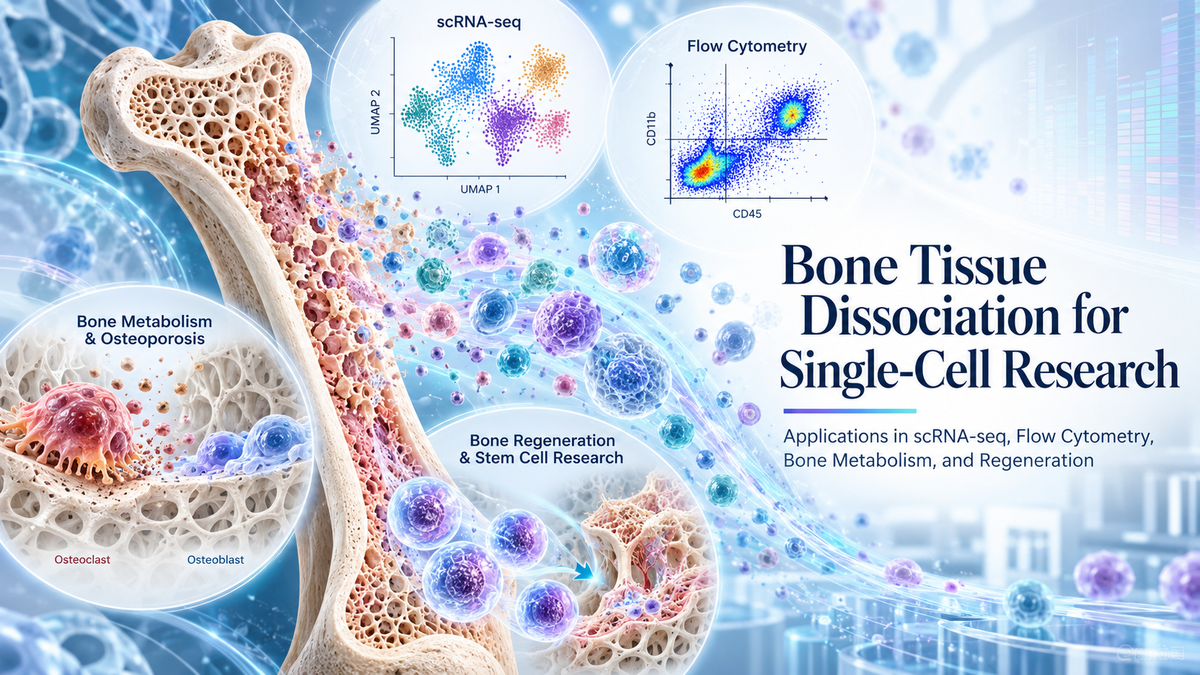
This article explores four important research applications of bone tissue dissociation: single-cell RNA sequencing, flow cytometry, osteoporosis research, and bone regeneration.
2. Application One: Single-Cell RNA Sequencing of Bone Tissue
Understanding Cellular Heterogeneity in Bone
Single-cell RNA sequencing (scRNA-seq) has transformed bone biology by enabling researchers to investigate gene expression at the individual-cell level.
Traditional bulk RNA sequencing measures average gene expression across mixed cell populations. Although informative, it may obscure differences between rare cell types or distinct cellular states.
In contrast, scRNA-seq allows researchers to identify transcriptionally distinct populations and investigate their biological functions.
Potential populations of interest include:
Osteoblast-lineage cells involved in bone formation
Osteoclast precursors associated with bone resorption
Mesenchymal stromal and progenitor cells
Endothelial cells supporting vascular organization
Immune cells involved in skeletal homeostasis
Building Single-Cell Atlases of Bone
An important application is the construction of bone tissue cell atlases.
These atlases help researchers characterize cellular diversity, identify lineage-associated transcriptional programs, and investigate signaling relationships between different cell populations.
For example, Baccin et al., in Nature Cell Biology (2020), combined single-cell and spatial transcriptomics to investigate bone marrow niche organization. Their study identified distinct stromal populations associated with specialized microenvironments and cytokine production.
Although bone marrow isolation and mineralized bone dissociation involve different sample-preparation requirements, this study demonstrates the broader value of single-cell approaches for understanding skeletal microenvironments.
Why Sample Preparation Matters
High-quality scRNA-seq depends on appropriate cell viability, sufficient recovery, limited debris, and representative cell populations.
Excessive digestion can influence transcriptional profiles, while insufficient digestion may preferentially exclude matrix-embedded cells.
A bone-specific dissociation workflow provides a practical starting point for optimizing single-cell preparation.
Research value: Bone tissue dissociation enables investigation of cellular heterogeneity, lineage differentiation, and disease-associated transcriptional changes.
3. Application Two: Bone Cell Isolation and Flow Cytometry
Characterizing Bone-Associated Cell Populations
Flow cytometry is widely used to characterize heterogeneous cell suspensions through fluorescence-based measurements.
Following bone tissue dissociation, researchers can evaluate cell viability, examine surface-marker expression, and estimate the relative abundance of specific cell populations.
Depending on the experimental design, flow cytometry may support investigations involving:
Mesenchymal stromal cell populations
Osteoclast precursor populations
Bone-associated immune cells
Endothelial and vascular-associated cells
Fluorescence-activated cell sorting (FACS) can additionally isolate selected populations for downstream molecular or functional experiments.
Applications in Osteoimmunology
Bone and immune systems are closely interconnected.
Immune cells influence osteoclast differentiation, bone remodeling, and inflammatory responses within the skeletal microenvironment.
Researchers studying osteoimmunology may use flow cytometry to investigate macrophages, monocytes, T lymphocytes, and other immune populations associated with bone disorders.
For example, comparisons between healthy and inflammatory bone tissue may reveal changes in immune-cell abundance or activation markers.
Importance of Cell Quality
Reliable flow cytometry requires single-cell suspensions with minimal aggregation and appropriate viability.
Cell clumps can affect sample acquisition and complicate data interpretation. Enzymatic digestion may also modify certain surface epitopes, making antibody-panel validation important.
Bone dissociation should therefore be followed by suitable filtration, viability assessment, and sample-specific controls.
Research value: Enzymatic bone cell isolation supports immunophenotyping, cell sorting, and investigations of the bone immune microenvironment.
4. Application Three: Osteoporosis and Bone Metabolism Research
Exploring the Mechanisms of Bone Remodeling
Bone remodeling is a continuous biological process involving coordinated bone formation and resorption.
Osteoblasts contribute to bone formation, while osteoclasts mediate bone resorption. Osteocytes also regulate skeletal adaptation through signaling networks.
Osteoporosis develops when bone remodeling becomes imbalanced, contributing to reduced bone mass and deterioration of skeletal microarchitecture.
Understanding this process requires investigation of multiple interacting cell populations rather than individual cell types alone.
Single-Cell Analysis in Osteoporosis Research
Bone tissue dissociation can support comparisons between experimental osteoporosis models and appropriate controls.
Researchers may investigate:
Changes in osteoblast differentiation-associated genes
Alterations in osteoclast precursor populations
Inflammatory signaling within bone-associated cells
Changes in mesenchymal stromal cell composition
Age-related alterations in skeletal cell populations
For example, scRNA-seq may identify transcriptional changes associated with osteogenic differentiation, while flow cytometry can provide complementary information about selected cell populations.
These approaches can help researchers generate hypotheses about the cellular mechanisms underlying bone loss.
Supporting Experimental Drug Research
Bone-derived cellular preparations may also contribute to studies evaluating candidate compounds targeting bone metabolism.
Possible experimental endpoints include cell viability, osteogenic marker expression, mineralization potential, and osteoclast differentiation.
However, functional drug evaluation generally requires additional culture, differentiation, and biochemical assays.
Importantly, dissociation efficiency and cell recovery should be compared across experimental groups to avoid confusing technical differences with biological changes.
Research value: Bone tissue dissociation supports cellular and molecular investigations of osteoporosis, skeletal aging, and bone-remodeling pathways.

5. Application Four: Bone Regeneration and Stem Cell Research
Investigating Skeletal Repair
Bone possesses a remarkable capacity for regeneration following injury.
Successful repair involves coordinated activities of progenitor cells, osteoblast-lineage cells, immune cells, vascular cells, and extracellular matrix components.
Understanding these interactions is essential for advancing tissue engineering and regenerative medicine research.
Isolation of Bone-Derived Stromal Cells
Bone dissociation can provide mixed cellular preparations containing stromal and potential progenitor populations.
Following appropriate enrichment and characterization, selected cells may be investigated for their proliferation, differentiation, and regenerative properties.
Researchers frequently evaluate osteogenic differentiation using markers such as:
RUNX2, associated with osteoblast differentiation
ALPL, encoding tissue-nonspecific alkaline phosphatase
COL1A1, associated with type I collagen production
BGLAP, encoding osteocalcin
Functional assays, including alkaline phosphatase activity and mineralization staining, can provide complementary evidence of osteogenic differentiation.
Applications in Bone Tissue Engineering
Bone-derived cells may be studied alongside biomaterial scaffolds, hydrogels, or other engineered matrices.
These experimental systems allow researchers to examine how material properties and biological signals influence cell attachment, survival, proliferation, and differentiation.
Bone dissociation can also support investigations into cellular responses following fracture or experimental bone injury.
However, isolation of a mixed cell suspension does not establish stem-cell identity. Further enrichment, phenotypic characterization, and functional validation are necessary.
Research value: Bone tissue dissociation provides a foundation for studying skeletal progenitor populations, osteogenic differentiation, and bone tissue repair.
6. FireGene Bone Dissociation Kit: Supporting Bone Cell Research
The FireGene Bone Dissociation Kit (FG-BA3308) is developed for enzymatic preparation of single-cell suspensions from mammalian bone and cartilage samples.
According to the manufacturer's product information, it uses a two-solution dissociation system designed for challenging skeletal tissues.
The kit is positioned for research applications including:
Single-cell sequencing
Cell culture
Cell-based analytical assays
Bone disease research
Regenerative medicine investigations
Its principal advantage is providing a dedicated bone tissue dissociation workflow rather than relying exclusively on protocols developed for softer tissues.
Nevertheless, digestion conditions should be adapted to sample characteristics. Hard bone and cartilage differ in matrix composition, and experimental performance depends on tissue preparation, incubation conditions, and downstream processing.
Researchers should assess cell viability, yield, population representation, and assay compatibility before routine implementation.
7. Conclusion
Effective bone tissue dissociation is an important starting point for understanding the cellular complexity of skeletal tissues.
From constructing single-cell transcriptomic atlases to analyzing immune populations, investigating osteoporosis, and exploring bone regeneration, high-quality cell preparation supports a wide range of biomedical research applications.
The FireGene Bone Dissociation Kit offers a specialized enzymatic approach for generating bone-derived single-cell suspensions intended for downstream cellular investigations.
By combining optimized sample preparation with appropriate analytical methods and quality controls, researchers can obtain more interpretable insights into bone biology, disease mechanisms, and regenerative processes.
Explore the FireGene Bone Dissociation Kit – Enzymatic Single-Cell Prep for bone tissue single-cell research.
Frequently Asked Questions
Q1. Can bone tissue dissociation support single-cell RNA sequencing?
Yes. Enzymatic dissociation can generate cell suspensions for scRNA-seq, provided that viability, RNA quality, and cell recovery satisfy the requirements of the selected sequencing workflow.
Q2. Can isolated bone cells be analyzed using flow cytometry?
Yes. Bone-derived single-cell suspensions can be used for flow cytometry after suitable filtering, staining, and quality control.
Q3. Is the FireGene Bone Dissociation Kit suitable for osteoporosis research?
The kit is positioned for bone disease research and may support cellular studies using osteoporosis-related samples or experimental models. Its performance should be validated for the selected tissue and experimental conditions.
Q4. Can dissociated bone cells be cultured?
Selected viable bone-derived cells may be cultured under appropriate conditions. Culture success depends on cell identity, tissue source, isolation quality, and culture requirements.


