
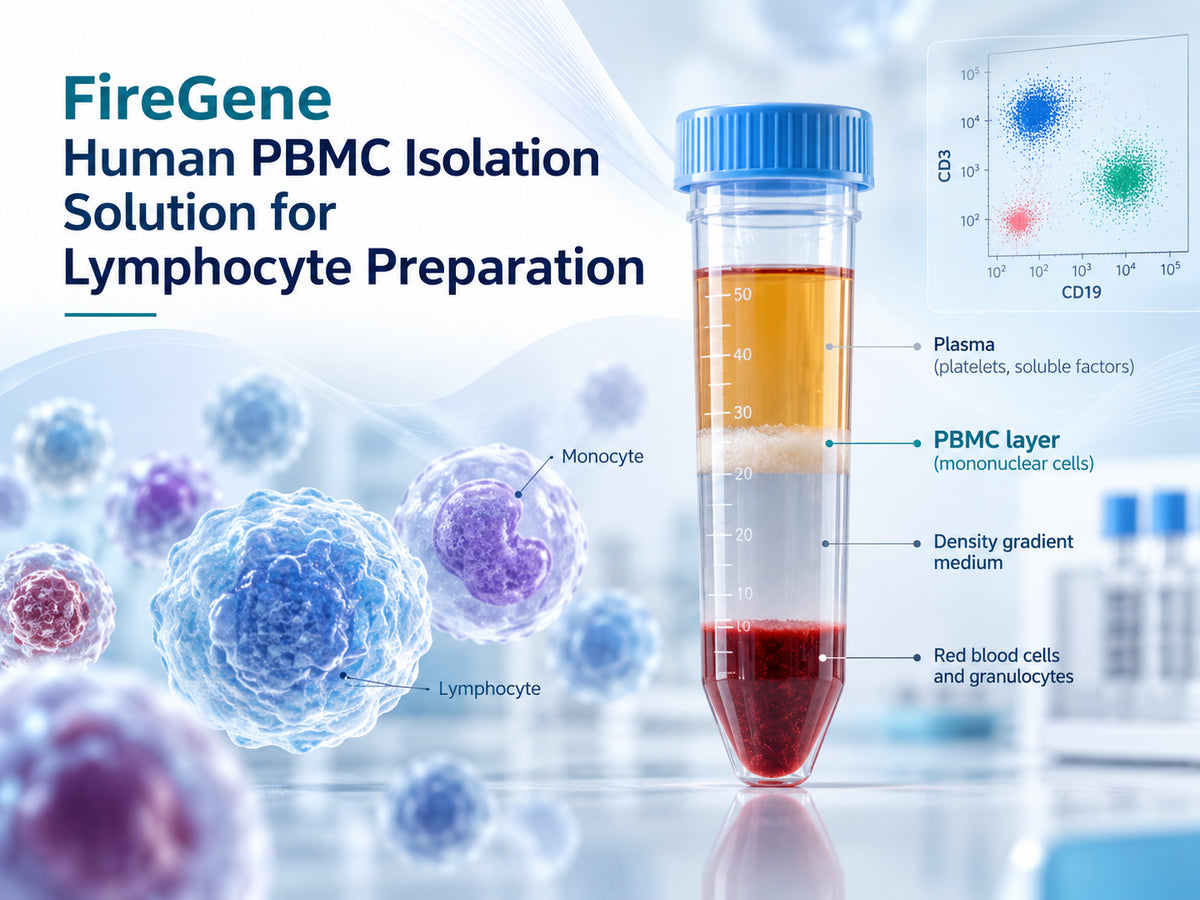
Peripheral blood mononuclear cells (PBMCs) are essential cellular resources for immunological research, immune profiling, and single-cell analysis. Efficient PBMC isolation enables researchers to obtain lymphocyte-rich cell suspensions suitable for studying immune-cell populations and their biological functions. Density gradient centrifugation is widely used to separate PBMCs from human peripheral blood based on differences in cellular density. FireGene Human PBMC Isolation Solution for Lymphocyte Preparation is designed to support this process and facilitate downstream applications, including flow cytometry, single-cell RNA sequencing, and cell culture. This article discusses the principles, preparation workflow, quality considerations, and major research applications of human PBMC isolation.
1. Introduction to Human PBMC Isolation
Peripheral blood mononuclear cells (PBMCs) represent an important population of circulating immune cells involved in adaptive and innate immune responses.
PBMCs are widely used in immunology, oncology, infectious disease research, and cellular biology because they provide accessible material for investigating immune-cell composition and function.
Human PBMC populations primarily include:
T lymphocytes: Regulate cellular immunity and antigen-specific immune responses.
B lymphocytes: Participate in antibody-mediated immunity.
Natural killer (NK) cells: Recognize and respond to selected infected or abnormal cells.
Monocytes: Contribute to innate immune defense, inflammatory signaling, and antigen presentation.
Dendritic cells: Represent a relatively small population involved in antigen presentation and immune regulation.
The isolation of these cells from peripheral blood is a fundamental step in numerous experimental workflows.
However, human blood contains substantial numbers of erythrocytes, granulocytes, and platelets that may interfere with downstream cellular analysis.
Therefore, an effective PBMC isolation workflow aims to enrich mononuclear cells while minimizing unwanted cellular contamination and preserving biological integrity.
2. Principle of Human PBMC Isolation
2.1 Density Gradient Centrifugation
Density gradient centrifugation is one of the most established methods for isolating PBMCs from human peripheral blood.
The technique separates blood components according to their buoyant density within a separation medium.
Böyum (1968) described a foundational approach for isolating human mononuclear cells through density-based centrifugation.
During centrifugation, different blood components distribute into distinct layers.
Plasma and platelets are generally located in the upper region.
PBMCs, including lymphocytes and monocytes, accumulate near the interface between the plasma-containing phase and the density separation medium.
Granulocytes and erythrocytes generally migrate toward lower-density-gradient regions or the bottom of the centrifugation tube.
Researchers can carefully collect the PBMC-enriched interface and perform washing steps to obtain a cleaner cellular suspension.
2.2 Why Density-Based Separation Is Useful
Density gradient centrifugation offers several practical advantages for human immune-cell preparation.
First, it enables enrichment of mononuclear cells without requiring an initial antibody-based selection procedure.
Second, the method preserves a mixed immune-cell population, making it useful for studies investigating interactions between lymphocytes and monocytes.
Third, density gradient separation can be integrated into subsequent purification procedures when researchers require specific immune-cell subsets.
Importantly, density gradient isolation produces a PBMC-enriched population rather than a preparation containing exclusively lymphocytes.
Additional cell-selection procedures may be required for experiments demanding highly purified T cells, B cells, or NK cells.
3. FireGene Human PBMC Isolation Solution for Lymphocyte Preparation
FireGene Human PBMC Isolation Solution is designed for preparing PBMC-enriched, lymphocyte-rich single-cell suspensions from human peripheral blood.
The product employs a density-based separation workflow involving controlled sample layering, horizontal centrifugation, mononuclear cell collection, washing, and final resuspension.
The prepared cells can be used in various cellular and molecular research applications.
3.1 Product Features
Human Peripheral Blood Compatibility
The solution is designed for processing diluted human peripheral blood samples.
Density-Based Cell Separation
The workflow supports enrichment of mononuclear cells from blood samples containing multiple cellular populations.
Compatibility with Downstream Assays
Prepared PBMC suspensions can be evaluated for flow cytometry, single-cell sequencing, cell culture, and related immunological experiments.
Optional Red Blood Cell Removal
When residual erythrocytes remain after separation, an additional red blood cell lysis step may be considered.
Research Workflow Integration
The solution provides a defined starting procedure that laboratories can qualify according to their sample-processing and analytical requirements.
3.2 Product Specifications
|
Parameter |
Specification |
|
Product |
Human PBMC Isolation Solution |
|
Brand |
FireGene |
|
Catalog Number |
FG-BA3332 |
|
Pack Size |
100 mL |
|
Sample Type |
Human peripheral blood |
|
Separation Method |
Density gradient centrifugation |
|
Documented Separation Conditions |
20°C, 700 ×g, 30 minutes |
|
Storage |
4°C, protected from light |
|
Intended Use |
Research use only |
These conditions are manufacturer-documented separation parameters. Researchers should follow the current product instructions for complete handling requirements and confirm suitability for their experimental systems.
4. General Workflow for Human PBMC Preparation
Human PBMC preparation typically consists of several interconnected steps.
4.1 Blood Sample Preparation
Freshly collected anticoagulated peripheral blood is commonly used for PBMC isolation.
Sample quality may be influenced by anticoagulant selection, collection-to-processing time, storage conditions, and mechanical handling.
Appropriate sample documentation helps laboratories identify factors that may affect cell recovery or viability.
4.2 Density Gradient Separation
The blood sample is diluted and carefully layered over the separation solution according to the manufacturer's instructions.
Controlled centrifugation establishes separation between different blood components.
Maintaining a stable interface during sample loading and centrifugation is important for obtaining a clearly identifiable mononuclear-cell layer.
4.3 PBMC Collection and Washing
Following centrifugation, the mononuclear-cell-enriched interface is collected.
Subsequent washing helps remove residual separation medium, platelets, and other unwanted sample components.
If erythrocyte contamination remains significant, an optional red blood cell removal procedure may be used after assessing its compatibility with the target cells.
4.4 Preparation of the Final Cell Suspension
The recovered cells are resuspended in an appropriate buffer or culture medium selected for the intended downstream assay.
Before proceeding, researchers should evaluate cell concentration, viability, aggregation, and sample cleanliness.
These quality checks help determine whether the isolated PBMCs are suitable for additional experimental procedures.
5. Applications of Human PBMC Isolation in Scientific Research
5.1 Flow Cytometry and Immune-Cell Profiling
Flow cytometry is one of the most important applications of isolated human PBMCs.
This analytical technique enables researchers to identify and characterize immune-cell populations using fluorescently labeled antibodies.
Common markers include:
CD3 for T cells
CD4 and CD8 for major T-cell subsets
CD19 for B cells
CD56 and CD16 for NK-cell characterization
CD14 and CD16 for monocyte subset analysis
PBMC-based flow cytometry can be used to investigate immune-cell composition, activation states, and changes associated with experimental conditions.
Maecker et al. (2012) emphasized the importance of standardized immunophenotyping methods for obtaining comparable immune-cell measurements.
Sample quality is a significant consideration because debris, dead cells, and residual erythrocytes may complicate gating and interpretation.
A properly characterized PBMC suspension therefore provides an important foundation for reliable immune phenotyping.
5.2 Single-Cell RNA Sequencing
Single-cell RNA sequencing (scRNA-seq) enables researchers to investigate gene expression in individual cells.
Unlike bulk RNA sequencing, single-cell approaches can reveal transcriptional differences between immune-cell subpopulations.
Human PBMCs are frequently used in single-cell research because they contain diverse immune-cell populations that can be distinguished through transcriptomic analysis.
Applications include investigating immune-cell heterogeneity, activation-associated transcriptional programs, and changes in cell population composition.
Sample preparation is particularly important in these experiments.
Low cell viability, excessive debris, and cellular aggregation can reduce data quality and complicate single-cell capture.
Additionally, RNA released from damaged cells may contribute to ambient RNA contamination.
Consequently, isolated PBMCs should be evaluated against the input requirements of the selected sequencing platform before library preparation.
5.3 Immunological and Inflammation Research
Human PBMCs provide valuable experimental systems for investigating immune responses and inflammatory signaling pathways.
Researchers can expose PBMC cultures to selected experimental stimuli and investigate changes in immune-cell behavior.
Common endpoints include cytokine secretion, surface-marker expression, cell proliferation, and intracellular signaling.
For example, PBMC-based experiments may examine changes in inflammatory mediators such as TNF-α, IL-6, and IFN-γ.
These studies support investigations of immune activation and the regulation of inflammatory responses.
However, PBMC populations contain multiple interacting immune-cell types, so observed biological responses may reflect contributions from several cellular subsets.
5.4 Cancer Immunology Research
PBMCs are extensively studied in cancer immunology because circulating immune cells provide information about systemic immune regulation.
Researchers may investigate T-cell activation, immune exhaustion-associated markers, NK-cell function, and immune-checkpoint signaling.
PBMCs can also be used in experimental systems assessing immune responses to tumor-associated antigens or investigational immunomodulatory compounds.
Immune-cell profiling may include markers associated with activation, differentiation, and inhibitory receptor expression.
These approaches help researchers explore the relationship between circulating immune-cell characteristics and tumor-associated immune responses.
5.5 Cell Culture and Functional Assays
Isolated human PBMCs can be maintained in appropriate culture systems for selected functional experiments.
Depending on experimental objectives, researchers may assess lymphocyte proliferation, cytokine production, cell activation, or responses to investigational compounds.
PBMC cultures are also useful for studying interactions between different immune-cell populations.
Cell culture performance depends on several factors, including initial cell viability, culture medium, stimulation conditions, and donor-related biological variability.
Therefore, downstream culture conditions should be optimized independently of the initial isolation procedure.
6. Factors Affecting PBMC Isolation Quality
Several experimental variables can influence the quality of isolated human PBMCs.
Blood Sample Handling: Delayed processing or unsuitable storage conditions may affect cell viability and immune-cell characteristics.
Centrifugation Conditions: Centrifugal force, duration, temperature, and braking conditions can influence layer formation and cellular recovery.
Interface Collection: Inaccurate collection may increase contamination by unwanted blood components or reduce PBMC yield.
Residual Red Blood Cells: Erythrocyte carryover may interfere with cell counting and some downstream assays.
Cell Aggregation: Aggregates can affect flow cytometry, cell sorting, and single-cell capture efficiency.
Cell Viability: Viability assessment is particularly important for functional studies and sequencing workflows.
Rather than relying only on total cell recovery, researchers should evaluate the final suspension according to the requirements of each downstream application.
7. Conclusion
Human PBMC isolation is a fundamental laboratory procedure supporting modern immunology, cancer research, inflammation studies, and single-cell biology.
Density gradient centrifugation provides a practical approach for enriching lymphocytes and monocytes from human peripheral blood.
FireGene Human PBMC Isolation Solution for Lymphocyte Preparation supports this workflow by providing a density-based method for preparing PBMC-enriched single-cell suspensions.
The resulting cells can be used in flow cytometry, immune profiling, single-cell sequencing, and cell-based functional studies, provided that appropriate sample-quality criteria are met.
Careful control of blood handling, separation conditions, cellular contamination, and viability helps improve the consistency of downstream research.
For laboratories conducting human immune-cell studies, a standardized PBMC preparation workflow is an important foundation for obtaining interpretable experimental results.
Explore FireGene Human PBMC Isolation Solution for Lymphocyte Preparation: https://firegene.com/products/human-pbmc-isolation-solution
For research use only. Not intended for clinical diagnosis or therapeutic applications.


