
Introduction
High-quality single-cell suspensions are the foundation of reliable modern biomedical research, including single-cell RNA sequencing (scRNA-seq), flow cytometry (FACS), spatial transcriptomics, and primary cell culture. However, tissue dissociation procedures—especially from complex organs such as blood-rich tissues, digestive organs, and brain—inevitably generate unwanted byproducts such as red blood cell (RBC) contamination, dead cells, extracellular matrix fragments, and cell aggregates.
These impurities significantly reduce downstream data quality by increasing background noise, clogging microfluidic systems, reducing cell viability, and distorting population profiling. To address these challenges, a dedicated workflow of cell suspension optimization reagents has been developed. The FG series provides a systematic solution covering red blood cell removal, anti-clumping control, dead cell elimination, and tissue-specific debris clearance.
This article introduces a complete cell suspension optimization toolkit designed to improve sample purity, enhance cell viability, and ensure reproducible results in high-resolution cellular analysis.
Challenges in Cell Suspension Preparation
During tissue dissociation, multiple technical issues can compromise sample integrity:
First, red blood cell contamination is common in highly vascular tissues. RBCs can overwhelm target cell populations and interfere with accurate cell counting.
Second, cell aggregation often occurs due to released DNA, extracellular matrix components, and incomplete enzymatic digestion. These aggregates reduce single-cell resolution and can clog FACS nozzles or microfluidic channels.
Third, dead cells and debris accumulation introduces strong background noise in sequencing libraries and can bias gene expression profiles due to RNA leakage.
Finally, tissue-specific complexity, particularly in digestive and brain tissues, results in high lipid content, dense extracellular matrix, and heterogeneous debris composition, making standard purification insufficient.
Therefore, a multi-step optimization strategy is required to ensure clean, viable, and well-dispersed single-cell suspensions.
Overview of the FG Cell Suspension Optimization Platform
The FG cell suspension optimization series provides a modular approach to sample purification and stabilization. Each reagent or kit targets a specific challenge in the workflow:
· FG-BA3311: Red Blood Cell Lysis Buffer
· FG-BA3345: Anti-Cell Aggregation Agent
· FG-BA3338: Dead Cell Removal Buffer
· FG-BA3339: Dead Cell Debris Removal Kit
· FG-BA3329: Digestive System Tissue Debris Removal Kit
· FG-BA3330: Brain Tissue Cell Debris Removal Kit
Together, these products form a comprehensive system for improving single-cell suspension quality from diverse biological sources.
FG-BA3311 Red Blood Cell Lysis Buffer
FG-BA3311 is designed to selectively remove erythrocytes from heterogeneous cell suspensions without significantly affecting nucleated cells.
RBC contamination is particularly problematic in bone marrow, spleen, and peripheral blood-derived tissues. FG-BA3311 utilizes an optimized osmotic and ionic balance to induce rapid hemolysis of red blood cells while preserving the integrity of leukocytes and other target cell populations.
Key advantages include rapid processing time, minimal impact on cell viability, and compatibility with downstream applications such as flow cytometry and sequencing. By eliminating excess hemoglobin and erythrocyte debris, FG-BA3311 improves gating accuracy and reduces background interference.
FG-BA3345 Anti-Cell Aggregation Agent
Cell aggregation is a major obstacle in single-cell workflows, often caused by released genomic DNA and extracellular matrix fragments following tissue dissociation.
FG-BA3345 functions as an anti-clumping additive that reduces nonspecific cell-cell adhesion and prevents the formation of large cellular aggregates. It enhances suspension uniformity by minimizing electrostatic and biomolecular interactions that drive clump formation.
This reagent is particularly useful during mechanical dissociation of solid tissues, where DNA-mediated viscosity increase can severely affect pipetting accuracy and microfluidic performance. The result is improved single-cell capture efficiency and reduced instrument clogging.
FG-BA3338 Dead Cell Removal Buffer
Dead cells are a major source of experimental noise in single-cell analysis. They release RNA, proteases, and intracellular metabolites that can distort gene expression profiles and reduce data quality.
FG-BA3338 provides a selective separation system that removes non-viable cells while preserving live cell populations. It improves overall sample viability by reducing apoptotic and necrotic cell contamination.
This buffer is particularly valuable for scRNA-seq workflows, where dead cell RNA leakage can significantly increase background reads and reduce clustering resolution. FG-BA3338 helps ensure a more accurate representation of true biological states.
FG-BA3339 Dead Cell Debris Removal Kit
FG-BA3339 is designed to address a more advanced purification challenge: the removal of cell debris fragments that persist even after dead cell depletion.
Unlike intact dead cells, debris consists of fragmented membranes, organelle remnants, and extracellular matrix particles. These components can interfere with optical detection systems, clog microfluidic devices, and increase nonspecific binding in downstream assays.
The FG-BA3339 system employs a separation-based purification strategy to efficiently eliminate these contaminants while maintaining high recovery of viable single cells. This leads to cleaner suspensions and improved consistency across experiments.
FG-BA3329 Digestive System Tissue Cell Debris Removal Kit
Digestive system tissues such as intestine, stomach, and liver present unique dissociation challenges due to high mucus content, dense epithelial layers, and abundant extracellular matrix.
FG-BA3329 is specifically formulated to handle these complex tissues. It removes mucus-associated debris, epithelial fragments, and digestion-resistant aggregates that commonly remain after enzymatic dissociation.
By improving suspension clarity and reducing non-cellular material, FG-BA3329 enhances downstream applications including intestinal organoid research, mucosal immunology, and gastrointestinal disease modeling. It also significantly improves microfluidic compatibility for high-throughput single-cell sequencing platforms.
FG-BA3330 Brain Tissue Cell Debris Removal Kit
Brain tissue is one of the most technically challenging samples for single-cell preparation due to its high lipid content, fragile neuronal structures, and extensive extracellular matrix networks.
FG-BA3330 is optimized to gently remove myelin debris, neuronal fragments, and lipid-rich aggregates without damaging delicate neural cells. This is particularly important for studies involving neurons, astrocytes, microglia, and oligodendrocytes.
The kit enhances sample clarity and improves cell sorting accuracy in neurological research applications such as neurodegeneration studies, brain development analysis, and neuroinflammation profiling.
Integrated Workflow for Cell Suspension Optimization
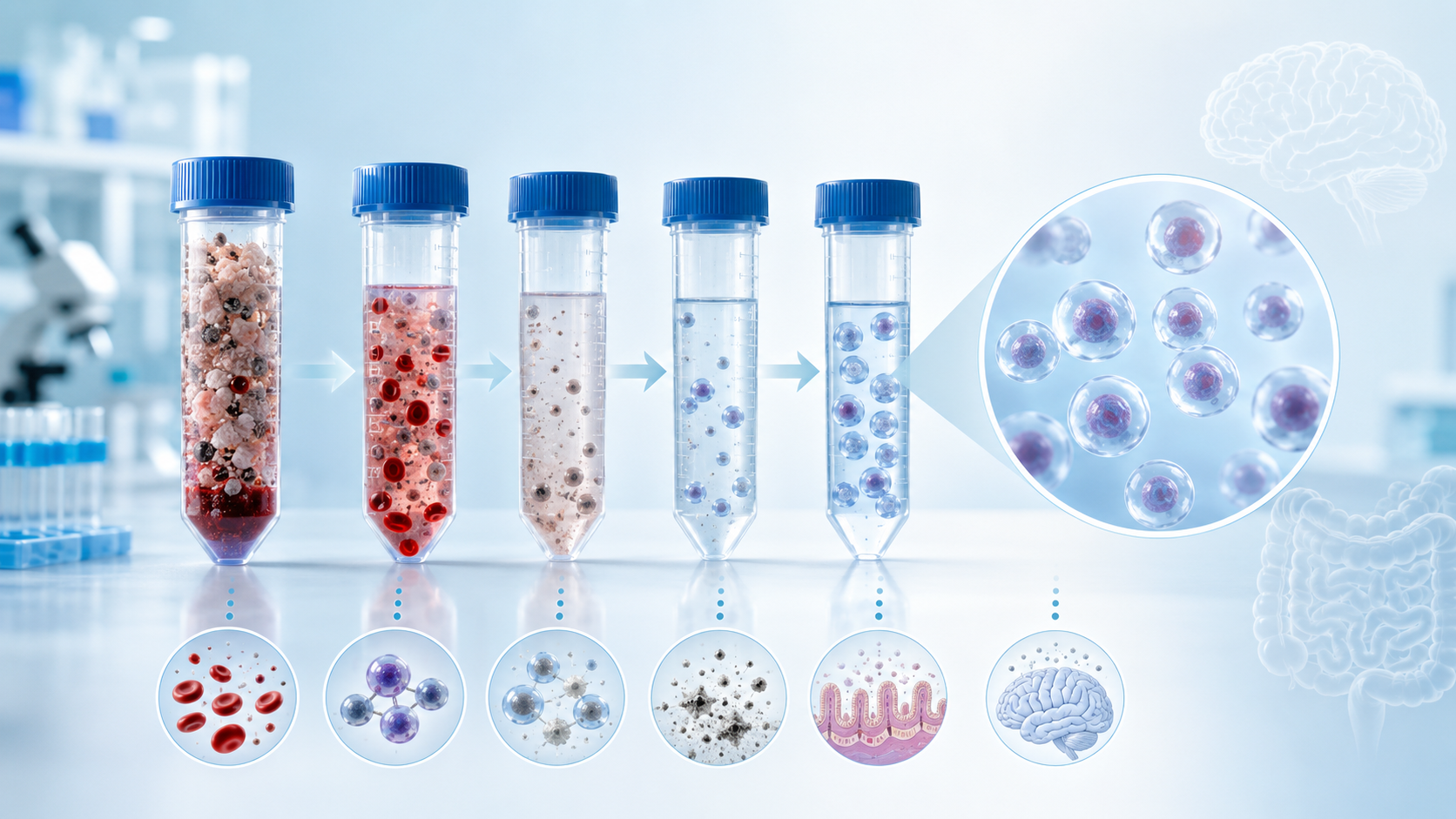
The FG platform is designed for flexible integration into standard tissue dissociation workflows. A typical optimization pipeline may include:
1. Mechanical and enzymatic tissue dissociation
2. Red blood cell removal using FG-BA3311
3. Anti-clumping treatment with FG-BA3345
4. Dead cell elimination using FG-BA3338
5. Debris purification using FG-BA3339 or tissue-specific kits (FG-BA3329 / FG-BA3330)
This modular approach allows researchers to tailor purification steps based on tissue type and experimental requirements.
Applications in Biomedical Research
The FG cell suspension optimization series supports a wide range of advanced research applications:

In single-cell RNA sequencing, it improves cell capture efficiency and reduces transcriptomic noise, enabling more accurate clustering and cell-type identification.
In flow cytometry and FACS, it enhances gating precision and reduces instrument clogging caused by aggregates and debris.
In primary cell culture, it increases attachment efficiency and cell viability by removing toxic debris and dead cell remnants.
In immunology and tissue microenvironment studies, it enables more accurate profiling of rare immune subsets by improving sample purity.
In neuroscience and gastrointestinal research, it supports high-resolution cellular mapping of complex tissues with minimal background interference.
Conclusion
High-quality single-cell suspensions are essential for reproducible and meaningful biological insights. The FG cell suspension optimization platform provides a comprehensive toolkit that addresses key challenges in sample preparation, including red blood cell contamination, cell aggregation, dead cell interference, and tissue-specific debris complexity.
By integrating FG-BA3311, FG-BA3345, FG-BA3338, FG-BA3339, FG-BA3329, and FG-BA3330 into a unified workflow, researchers can significantly improve sample quality, enhance downstream analytical performance, and achieve more reliable experimental outcomes across a wide range of biomedical applications.
This systematic approach represents a critical advancement in sample preparation technology for modern single-cell and primary cell research.
FireGene, light your research with passion, innovation, and profession.


