
Introduction
Single-cell RNA sequencing (scRNA-seq) has revolutionized biomedical research by enabling scientists to profile gene expression at the resolution of individual cells. Over the past decade, the technology has become indispensable across immunology, oncology, neuroscience, regenerative medicine, infectious disease research, and cell therapy development.
Major sequencing platforms continue to evolve rapidly, offering higher throughput, lower costs, and increasingly sophisticated bioinformatics pipelines. At the same time, researchers are generating larger datasets than ever before, often integrating transcriptomics with proteomics, epigenomics, spatial biology, and artificial intelligence (AI)-assisted analysis.
Despite these technological advances, one principle remains unchanged:
The quality of a single-cell sequencing dataset is fundamentally determined by the quality of the starting sample.
Poor sample preparation cannot be rescued by more sequencing depth or advanced computational analysis.
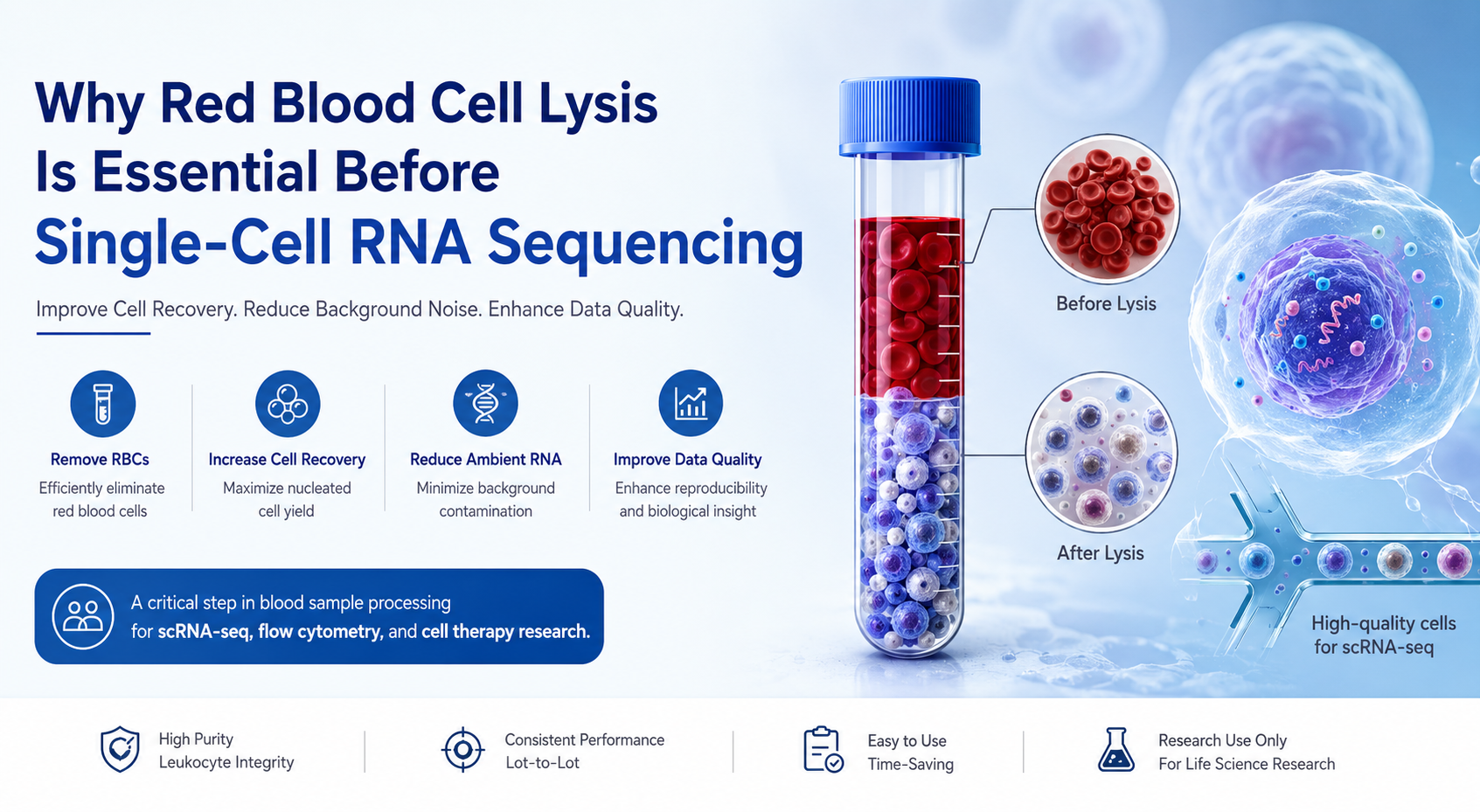
Among all pre-analytical variables, red blood cell (RBC) contamination remains one of the most underestimated causes of reduced sequencing quality. Whether researchers are processing peripheral blood, spleen, bone marrow, inflamed tissues, or hemorrhagic tumor specimens, residual erythrocytes can significantly compromise downstream analyses.
As single-cell sequencing becomes increasingly important for biomarker discovery, precision medicine, and translational research, standardized blood sample preparation has become a key focus for laboratories worldwide.
Today, many research groups consider efficient RBC removal an essential quality control step rather than an optional protocol optimization.
Why Sample Preparation Matters More Than Ever
Many researchers devote considerable effort to selecting sequencing platforms, optimizing library preparation, and refining bioinformatics workflows.
However, sequencing represents only the final stage of a much longer experimental pipeline.
A typical scRNA-seq workflow includes:
- Sample collection
- Tissue dissociation
- Blood processing
- Red blood cell removal
- Dead cell removal
- Cell counting
- Viability assessment
- Cell loading
- Library construction
- Sequencing
- Bioinformatics analysis
Errors introduced during the early stages propagate throughout the entire experiment.
For example:
- Low viability reduces usable cell numbers.
- Cell aggregates increase doublet formation.
- Excessive debris raises background noise.
- RBC contamination lowers effective sequencing efficiency.
Consequently, modern single-cell protocols increasingly emphasize sample quality before sequencing quality.
This trend has also driven demand for standardized reagents supplied by experienced Research Suppliers, enabling laboratories to reduce operator-to-operator variation while improving experimental reproducibility.
Researchers seeking a reliable workflow for erythrocyte removal can explore the FireGene Red Blood Cell Lysis Kit, which is designed for efficient RBC depletion while preserving leukocyte integrity in downstream research applications: https://firegene.com/products/red-blood-cell-lysis-kit-fg-ba3311?_pos=1&_sid=b5f023bfa&_ss=r
Why Red Blood Cells Become a Major Problem in scRNA-seq
At first glance, mature mammalian red blood cells appear harmless.
Unlike leukocytes, they lack nuclei and contain very little RNA. Since scRNA-seq focuses on transcriptionally active nucleated cells, one might assume that residual erythrocytes have minimal impact.
In practice, the opposite is often true.
Large numbers of RBCs create several technical challenges long before sequencing begins.
These include:
- Reduced target cell concentration
- Lower leukocyte recovery
- Inaccurate cell counting
- Increased sample viscosity
- Cell aggregation
- Debris accumulation
- Instrument interference
- Ambient RNA contamination
- Higher doublet rates
Collectively, these factors reduce the overall efficiency of single-cell workflows and increase technical variability between experiments.
Instead of capturing biologically meaningful immune or stromal cells, sequencing resources are partially wasted on unwanted contaminants.
How RBC Contamination Reduces Cell Capture Efficiency
Modern droplet-based sequencing platforms depend on accurate cell loading.
Ideally, every droplet should contain:
- One viable cell
- One barcode bead
- One reaction chamber
Residual erythrocytes occupy physical space within the suspension, decreasing the probability that valuable nucleated cells are encapsulated.
This problem becomes particularly important when researchers investigate rare populations such as:
- Regulatory T cells
- Tumor-infiltrating lymphocytes
- Dendritic cells
- Circulating tumor cells
- Hematopoietic stem cells
In many studies, these populations represent less than 1% of the total sample.
Even modest RBC contamination can reduce recovery sufficiently to affect downstream biological interpretation.
For clinical studies involving limited patient material, every recovered cell is valuable.
Efficient RBC removal therefore directly improves sequencing efficiency and maximizes the biological information obtained from precious samples.
Ambient RNA Contamination: The Hidden Enemy of High-Quality Sequencing
One of the most discussed topics in the single-cell community over the past few years is ambient RNA contamination.
Ambient RNA refers to extracellular RNA molecules released from damaged or lysed cells before droplet encapsulation.
These molecules may be captured together with unrelated cells, generating false-positive gene expression signals.
The consequences include:
- Reduced clustering accuracy
- Incorrect cell annotation
- Artificial marker expression
- Misidentification of rare cell populations
- Increased computational correction
Although mature RBCs contain relatively little RNA, blood samples with heavy erythrocyte contamination are often associated with hemolysis, cellular stress, and increased debris, all of which contribute to poor sample quality.
Today, several bioinformatics tools attempt to computationally remove ambient RNA after sequencing.
However, experienced researchers generally agree on one principle:
Preventing contamination during sample preparation is far more effective than correcting it after sequencing.
For this reason, standardized RBC removal remains one of the simplest and most cost-effective strategies for improving sequencing quality before expensive downstream analyses begin.
Why Cell Recovery Matters More Than Sequencing Depth
Many laboratories attempt to compensate for poor sample quality by increasing sequencing depth.
Unfortunately, sequencing more low-quality cells rarely produces better biological insights.
A high-quality dataset begins with:
- High cell viability
- Minimal debris
- Efficient erythrocyte removal
- Accurate cell counting
- Appropriate loading concentration
Optimizing these upstream variables often has a greater impact on data quality than increasing sequencing reads alone.
This is particularly important for multicenter clinical studies, where reproducibility across laboratories is essential for reliable biomarker discovery and translational research.
How Red Blood Cell Lysis Supports Both Flow Cytometry and Single-Cell RNA Sequencing
Although flow cytometry and single-cell RNA sequencing are different analytical technologies, they share one critical requirement: high-quality single-cell suspensions.
Residual red blood cells can compromise both workflows by increasing background noise, reducing the purity of target cell populations, and interfering with accurate cell quantification.
Researchers who routinely perform flow cytometry before scRNA-seq often observe that inadequate RBC removal negatively affects both experiments.
| Workflow | Impact of Residual RBCs |
|---|---|
| Flow Cytometry | Increased background events, difficult gating, inaccurate cell percentages |
| scRNA-seq | Lower cell capture efficiency, ambient RNA contamination, increased doublets |
| Cell Sorting | Reduced sorting purity and lower recovery |
| PBMC Isolation | Reduced leukocyte purity and inconsistent recovery |
For this reason, many laboratories now incorporate RBC lysis immediately after blood collection or tissue dissociation, creating a standardized workflow that supports multiple downstream applications.
A Practical Sample Preparation Workflow for Blood-Derived scRNA-seq
High-quality sequencing results begin long before library preparation.
A typical workflow includes:
Step 1. Sample Collection
Fresh peripheral blood or tissue samples should be processed as quickly as possible after collection.
Delays increase:
- Cell apoptosis
- RNA degradation
- Hemolysis
- Ambient RNA contamination
Step 2. Red Blood Cell Lysis
The sample is incubated with an optimized RBC lysis buffer under controlled conditions to selectively remove erythrocytes while preserving nucleated cells.
An optimized protocol minimizes leukocyte loss while efficiently eliminating unwanted red blood cells.
For laboratories seeking a standardized and reproducible solution, the FireGene Red Blood Cell Lysis Kit provides efficient erythrocyte removal while maintaining excellent white blood cell viability throughout downstream research workflows.
https://firegene.com/products/red-blood-cell-lysis-kit-fg-ba3311?_pos=1&_sid=b5f023bfa&_ss=r
Step 3. Washing
Following lysis, cells should be washed thoroughly to remove:
- Lysed erythrocyte debris
- Residual buffer components
- Extracellular proteins
Proper washing significantly reduces downstream background signals.
Step 4. Cell Counting and Viability Assessment
Researchers should confirm:
- Cell concentration
- Cell viability
- Aggregate formation
- Residual RBC contamination
Many sequencing facilities recommend a viability of 85–90% or higher before library preparation.
Step 5. Library Preparation
Only after confirming sample quality should cells proceed to droplet encapsulation and sequencing.
This sequence of quality control steps helps maximize sequencing efficiency while minimizing technical artifacts.
Common Mistakes During Red Blood Cell Lysis
Even experienced laboratories occasionally encounter problems during RBC removal.
The following mistakes are among the most common.
Mistake 1. Excessive Incubation
Longer incubation does not necessarily improve RBC removal.
Instead, prolonged exposure may damage fragile immune cells.
Mistake 2. Processing Samples Too Slowly
Delayed processing increases:
- Cell death
- Hemolysis
- Ambient RNA
- Debris formation
Fresh samples consistently produce superior sequencing results.
Mistake 3. Using Homemade Buffers
Although ammonium chloride solutions can be prepared in-house, inconsistencies in:
- pH
- Osmolarity
- Concentration
- Storage conditions
may reduce reproducibility between experiments.
Commercially manufactured reagents help minimize batch-to-batch variability.
Mistake 4. Insufficient Washing
Incomplete removal of lysed erythrocytes leaves behind membrane fragments and extracellular proteins that interfere with downstream analyses.
Mistake 5. Skipping Quality Control
Many failed sequencing experiments originate from inadequate quality control before library preparation.
Always verify:
- Viability
- Cell concentration
- Debris level
- RBC removal efficiency
before proceeding.
Why Standardized Reagents Improve Reproducibility

Scientific reproducibility has become one of the most discussed topics in biomedical research.
Large collaborative projects increasingly require:
- Standardized protocols
- Validated reagents
- Consistent documentation
- Lot-to-lot reproducibility
For these reasons, many laboratories prefer working with an established Research Supplier rather than preparing laboratory-made buffers for critical workflows.
A standardized Red Blood Cell Lysis Kit offers several advantages:
- Consistent reagent performance
- Simplified workflow
- Reduced operator variability
- Improved experimental reproducibility
- Technical documentation and quality support
Researchers can explore the FireGene solution for blood sample preparation here:
https://firegene.com/products/red-blood-cell-lysis-kit-fg-ba3311?_pos=1&_sid=b5f023bfa&_ss=r
2026 Trends: Why Sample Preparation Is Becoming More Important Than Sequencing
The single-cell field is rapidly evolving beyond transcriptomics alone.
Several major trends are shaping biomedical research in 2026.
1. AI-Assisted Cell Annotation
Artificial intelligence is accelerating automated cell type identification.
However, AI models cannot compensate for poor-quality input data.
Clean samples remain essential for accurate predictions.
2. Spatial Multi-Omics
Researchers increasingly integrate:
- Transcriptomics
- Proteomics
- Epigenomics
- Spatial biology
High-quality cell suspensions improve compatibility across these complementary technologies.
3. Clinical Single-Cell Studies
Large clinical cohorts demand highly standardized sample preparation protocols.
Even small differences in RBC contamination can introduce batch effects that obscure biological conclusions.
4. Cell Therapy Manufacturing
CAR-T, NK cell therapies, gene therapies, and stem cell research all rely on high-quality leukocyte isolation.
Efficient RBC removal supports both research applications and translational workflows.
5. Automation and High-Throughput Laboratories
Automated sample preparation platforms are becoming increasingly common.
Standardized commercial reagents integrate more effectively into automated workflows than laboratory-prepared buffers, improving consistency and reducing manual variability.
Case Study: How Standardized RBC Lysis Improved Sample Consistency
Consider a translational immunology laboratory processing peripheral blood samples from multiple clinical sites.
Initially, each participating center used its own RBC lysis protocol. While sequencing quality was acceptable overall, investigators observed substantial variation in:
- Cell viability
- Leukocyte recovery
- Ambient RNA levels
- Library complexity
- Cell type proportions
After adopting a unified RBC lysis workflow using a standardized commercial reagent, the laboratory reported:
- More consistent leukocyte recovery across sites
- Reduced technical variation between operators
- Cleaner flow cytometry profiles
- Improved library consistency
- Greater confidence in downstream biological comparisons
Although sequencing chemistry remained unchanged, improvements in upstream sample preparation significantly enhanced data reproducibility—illustrating why standardized RBC removal is increasingly recognized as a foundational step in modern single-cell research.
Why Choosing the Right Research Supplier Matters
As single-cell technologies continue to evolve, researchers are no longer evaluating reagents solely based on their immediate laboratory performance. Instead, they increasingly look for Research Suppliers that can provide standardized products, consistent quality, comprehensive documentation, and long-term technical support.
Whether working in academic laboratories, biotechnology companies, CROs, CDMOs, or pharmaceutical research organizations, reproducibility has become one of the most important indicators of experimental success.
A reliable supplier should provide more than a reagent bottle. Researchers increasingly expect:
- Lot-to-lot consistency
- Quality-controlled manufacturing
- Certificates of Analysis (COAs)
- Detailed product documentation
- Technical support
- Reliable inventory
- Global shipping capability
- Responsive customer service
These factors become especially important in multicenter studies, where differences in reagent quality may introduce unwanted variability between research sites.
For this reason, laboratories increasingly choose commercial RBC lysis reagents over laboratory-prepared buffers when establishing standardized sample preparation workflows.
Why FireGene Supports Modern Single-Cell Research
At FireGene, we understand that sample preparation is the foundation of reliable downstream analysis.
Our Red Blood Cell Lysis Kit has been developed to efficiently remove erythrocytes while preserving leukocyte integrity, making it suitable for a wide range of research applications.
Researchers commonly use the kit for:
- Single-cell RNA sequencing (scRNA-seq)
- Flow cytometry
- PBMC isolation
- Immunology research
- Cancer biology
- Tumor microenvironment studies
- Cell therapy research
- Stem cell research
- Leukocyte isolation
- Blood sample processing
Compared with homemade RBC lysis buffers, standardized commercial reagents offer several practical advantages:
- Reproducible erythrocyte removal
- High leukocyte viability
- Simple protocol
- Reduced operator variation
- Consistent experimental performance
- Comprehensive technical documentation
Whether your laboratory is processing a few research samples or supporting large clinical studies, standardized RBC removal helps reduce variability and improve confidence in downstream analyses.
Researchers interested in optimizing blood sample preparation can learn more about the FireGene Red Blood Cell Lysis Kit here:
https://firegene.com/products/red-blood-cell-lysis-kit-fg-ba3311?_pos=1&_sid=b5f023bfa&_ss=r
Frequently Asked Questions
1. Why should red blood cells be removed before scRNA-seq?
Because residual RBCs reduce target cell recovery, interfere with accurate cell counting, increase debris, and contribute to poor sample quality, ultimately affecting sequencing performance.
2. Do mature red blood cells contain RNA?
Mature mammalian RBCs contain no nucleus and very limited RNA. However, damaged erythrocytes and poor-quality blood samples can still contribute to ambient RNA and technical background.
3. Can RBC contamination reduce sequencing quality?
Yes.
Residual erythrocytes reduce effective cell capture, complicate downstream analysis, and increase technical variability between samples.
4. What is the recommended cell viability before scRNA-seq?
Most sequencing facilities recommend a viability of at least 85–90%, although higher viability is generally preferred.
5. Is RBC lysis compatible with 10x Genomics workflows?
Yes.
Properly optimized RBC lysis protocols are widely used before library preparation for droplet-based single-cell sequencing platforms.
6. Should RBC lysis be performed before or after PBMC isolation?
This depends on the protocol. Many laboratories perform RBC lysis before PBMC isolation, while others use a brief lysis step afterward to remove residual erythrocytes.
7. Does RBC lysis affect T-cell viability?
When performed according to validated protocols, RBC lysis is designed to selectively remove erythrocytes while preserving leukocyte viability, including T cells.
8. Can RBC contamination increase doublet rates?
Indirectly, yes.
Residual erythrocytes and debris can interfere with optimal cell loading, increasing the likelihood of doublets and reducing sequencing efficiency.
9. Is RBC lysis necessary for flow cytometry?
In many blood-derived applications, yes.
Removing erythrocytes improves gating accuracy, reduces background events, and enhances leukocyte analysis.
10. Can RBC lysis improve rare cell detection?
Yes.
By reducing competition from abundant erythrocytes, researchers improve the likelihood of recovering rare immune cell populations.
11. Why choose a commercial RBC lysis kit instead of preparing buffers in-house?
Commercial kits provide standardized formulations, quality control, reproducibility, and technical documentation that help minimize experimental variability.
12. What sample types benefit from RBC lysis?
Common applications include:
- Whole blood
- Bone marrow
- Spleen
- Tumor tissues with blood contamination
- Peripheral blood mononuclear cell preparation
13. Is RBC lysis suitable for cell therapy research?
Yes.
High-quality leukocyte preparation is essential for CAR-T, NK cell, stem cell, and other advanced cell therapy workflows.
14. How does RBC lysis improve research reproducibility?
Standardized erythrocyte removal reduces operator-dependent variation, improves sample consistency, and enhances comparability between experiments.
15. How do I select a reliable Research Supplier?
Researchers should consider product quality, documentation, technical support, manufacturing consistency, inventory availability, and experience supporting advanced life science research.
Key Takeaways
Before beginning any blood-derived single-cell sequencing experiment, researchers should ensure that:
✔ Blood samples are processed promptly after collection.
✔ Red blood cells are efficiently removed.
✔ Cell viability is confirmed before sequencing.
✔ Cell aggregates and debris are minimized.
✔ Cell concentration is accurately determined.
✔ Sample preparation protocols are standardized across projects.
✔ Commercial reagents are sourced from a reliable Research Supplier.
Following these best practices significantly improves sequencing quality, reproducibility, and confidence in downstream biological interpretation.
Conclusion
Single-cell RNA sequencing has transformed our understanding of cellular biology, enabling researchers to explore complex tissues at unprecedented resolution. However, even the most advanced sequencing platforms cannot overcome poor sample preparation.
Residual red blood cells remain one of the most common—and most preventable—sources of technical variability in blood-derived single-cell experiments. Their presence can reduce leukocyte recovery, interfere with accurate cell counting, increase ambient RNA contamination, and compromise downstream data quality.
As the fields of immunology, oncology, precision medicine, regenerative medicine, and cell therapy continue to expand, standardized blood sample preparation will play an increasingly important role in generating reliable and reproducible results.
Efficient red blood cell lysis is therefore not simply a preparatory step—it is a critical component of modern single-cell research workflows.
By adopting validated protocols and partnering with experienced Research Suppliers, laboratories can improve experimental consistency, maximize sequencing performance, and generate higher-quality biological insights.
If your research involves blood-derived samples, PBMC isolation, flow cytometry, or single-cell RNA sequencing, the FireGene Red Blood Cell Lysis Kit provides a reliable, standardized solution for efficient erythrocyte removal while preserving valuable nucleated cells for downstream analysis.
FireGene Single-Cell Sample Prep
Looking for validated dissociation kits?
FireGene's tissue dissociation kits are optimized for specific organ types — brain, tumor, liver, GI, reproductive, and more. Validated for 10x Genomics Chromium and BD Rhapsody workflows.


