
Introduction
Single-cell analysis technologies, including single-cell RNA sequencing (scRNA-seq), single-cell ATAC sequencing (scATAC-seq), and flow cytometry, have transformed biomedical research by enabling researchers to study cellular heterogeneity at unprecedented resolution.
However, the quality of single-cell data strongly depends on the quality of the starting cell suspension. One of the most common challenges during tissue dissociation and sample preparation is the accumulation of dead cells, damaged cells, and cellular debris. These unwanted components can negatively affect downstream analysis by reducing viable cell recovery, increasing background signals, and compromising sequencing quality.
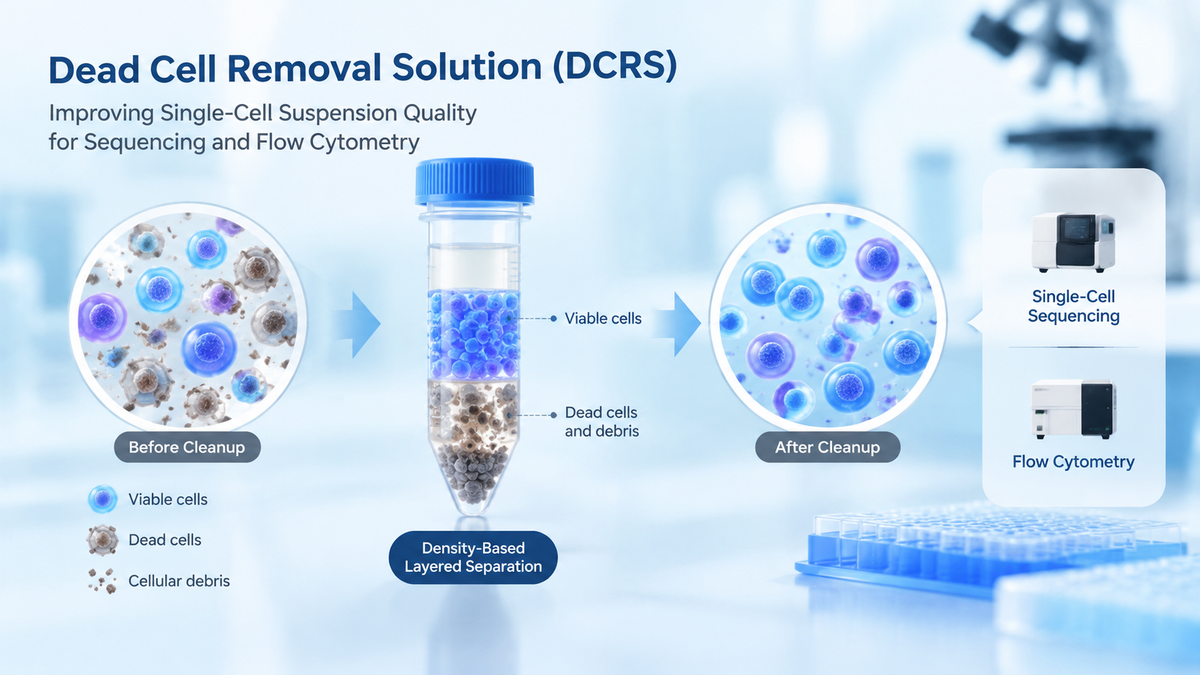
A Dead Cell Removal Solution (DCRS) provides an effective approach to improve single-cell suspension quality by selectively removing dead cells before downstream experiments.
Unlike viability staining or fluorescence-based cell sorting methods, DCRS uses a density-based layered separation technology to physically separate dead cells from viable cells. This provides a simple, fast, and instrument-independent cleanup step that can be integrated into single-cell workflows.
Why Dead Cell Removal Is Important in Single-Cell Research
The Impact of Dead Cells on Single-Cell Analysis
During tissue processing, enzymatic digestion, mechanical disruption, freezing and thawing, or prolonged sample handling, some cells inevitably become damaged or lose viability.
Dead cells can introduce several problems:
1. Reduced Single-Cell Data Quality
Dead cells often release fragmented RNA, genomic material, and intracellular components into the sample environment. In single-cell sequencing workflows, this can increase background RNA contamination and reduce the accuracy of gene expression profiling.
High levels of dead cells may result in:
· Increased ambient RNA contamination
· Lower transcript detection accuracy
· Reduced usable sequencing reads
· Poor clustering resolution
For high-quality single-cell analysis, removing damaged cells before library preparation is critical.
2. Lower Viable Cell Recovery
A high proportion of dead cells can interfere with cell counting and concentration measurements.
This may lead to:
· Incorrect cell input during sequencing preparation
· Reduced recovery of target cell populations
· Increased sample-to-sample variability
For complex tissues such as tumors, brain, and fibrotic organs, maintaining a high-quality viable cell population is especially important because rare cell populations may otherwise be lost.
3. Interference in Flow Cytometry Analysis
In flow cytometry experiments, dead cells can bind antibodies nonspecifically and generate misleading signals.
Potential consequences include:
· Increased background staining
· False-positive populations
· Difficulty defining cell populations
· Reduced confidence in immunophenotyping results
Removing dead cells before flow cytometry helps researchers obtain cleaner and more reliable data.
What Is Dead Cell Removal Solution (DCRS)?
Dead Cell Removal Solution (DCRS) is a specialized reagent designed to improve the quality of single-cell suspensions by separating dead cells and debris from viable cells.
The technology is based on density-based layered separation, which takes advantage of the physical differences between viable and damaged cells.
Unlike fluorescence-based approaches, DCRS does not depend on:
· Fluorescent viability dyes
· Antibody labeling
· Flow cytometers
· Magnetic beads
Instead, it provides a simple centrifugation-based purification step that can be performed before downstream applications.
How Does DCRS Work?
Density-Based Layered Separation Mechanism
The principle behind DCRS is based on the difference in physical properties between viable and dead cells.
Healthy cells maintain:
· Intact plasma membranes
· Normal cellular structure
· Higher cellular density
Dead cells typically experience:
· Membrane damage
· Loss of intracellular components
· Reduced density
During centrifugation, the cell suspension is applied over the DCRS separation layer.
Because dead cells have different density characteristics compared with viable cells, they separate into different layers during centrifugation.
After separation:
· Viable cells are collected from the appropriate fraction
· Dead cells and debris remain separated
· A cleaner single-cell suspension is obtained for downstream analysis
This approach allows researchers to perform dead cell removal without specialized sorting equipment.
DCRS vs Viability Staining: What Is the Difference?
Viability staining and dead cell removal serve different purposes.
Viability Staining
Viability dyes are commonly used to identify live and dead cells during analysis.
Examples include:
· Trypan blue staining
· Fluorescent viability dyes
· Flow cytometry viability markers
However, viability staining mainly provides information about cell status. It does not necessarily remove dead cells from the sample.
Researchers can identify dead cells during data analysis, but the unwanted material may already affect:
· Sequencing libraries
· Antibody staining
· Cell population analysis
DCRS
DCRS provides an actual physical cleanup step.
Advantages include:
· Removes dead cells before analysis
· Reduces debris contamination
· Improves sample quality before sequencing
· Does not require fluorescent labeling
Therefore:
Viability staining answers: "Which cells are dead?"

DCRS answers: "How can we remove dead cells before analysis?"
DCRS vs Cell Sorting: A Simpler Alternative for Sample Cleanup
Fluorescence-activated cell sorting (FACS) is a powerful technology for isolating specific cell populations. However, it requires:
· Specialized instruments
· Fluorescent antibodies or dyes
· Trained operators
· Longer processing time
For routine dead cell removal, sorting may introduce unnecessary complexity.
DCRS provides several workflow advantages:
1. No Flow Cytometer Required
DCRS can be performed using standard laboratory centrifugation equipment.
This makes it suitable for laboratories performing:
· Single-cell sequencing preparation
· Tissue dissociation workflows
· Cell suspension cleanup
2. Faster Sample Processing
Because DCRS is a pre-analytical cleanup step, researchers can remove dead cells before library preparation or flow analysis.
This reduces additional sorting procedures and simplifies workflow design.
3. Reduced Cellular Stress
Some cell sorting procedures may expose cells to additional mechanical stress.
A gentle density-based separation approach can help preserve viable cells for sensitive downstream applications.
Applications of Dead Cell Removal Solution
Single-Cell RNA Sequencing (scRNA-seq)
High-quality RNA is essential for single-cell sequencing.
DCRS helps improve:
· Cell viability
· Sequencing consistency
· Gene expression accuracy
· Identification of rare cell populations
It is especially useful for samples with increased cell damage after tissue dissociation.
Tumor Microenvironment Research
Tumor tissues contain diverse cell populations, including:
· Cancer cells
· Immune cells
· Stromal cells
· Fibroblasts
Dead cell contamination can interfere with accurate characterization of tumor heterogeneity.
Removing damaged cells helps researchers better analyze tumor ecosystems.
Brain and Neuroscience Studies
Brain tissues are sensitive to processing conditions and may generate significant cellular debris after dissociation.
DCRS can improve the quality of brain single-cell suspensions for:
· Neuronal studies
· Glial cell profiling
· Neurodevelopment research
Flow Cytometry Applications
Cleaner cell suspensions improve:
· Antibody staining quality
· Population identification
· Data interpretation
DCRS can be incorporated before flow cytometry analysis to reduce unwanted dead-cell interference.
Best Practices for Using DCRS in Single-Cell Workflows
To maximize performance, researchers should consider:
Process Samples Quickly
Long delays after tissue dissociation can increase cell death and debris accumulation.
Optimize Tissue Dissociation Conditions
Over-digestion or excessive mechanical force may reduce cell viability.
Remove Red Blood Cells When Necessary
For highly blood-contaminated samples, red blood cell removal before DCRS treatment can improve sample quality.
Perform Quality Assessment
After cleanup, evaluate:
· Cell viability
· Cell concentration
· Recovery rate
· Downstream assay performance
Conclusion
Dead Cell Removal Solution (DCRS) provides an efficient and reliable approach for improving single-cell suspension quality. By using density-based layered separation, DCRS physically removes dead cells and debris without requiring fluorescent labeling, magnetic separation, or flow-based sorting.
Compared with simple viability staining, DCRS actively cleans the sample before analysis. Compared with cell sorting, it offers a faster and more accessible workflow for routine dead cell removal.
For researchers performing single-cell sequencing, flow cytometry, and advanced cellular analysis, incorporating DCRS into sample preparation can help improve viable cell recovery, reduce background contamination, and generate higher-quality biological data.


