
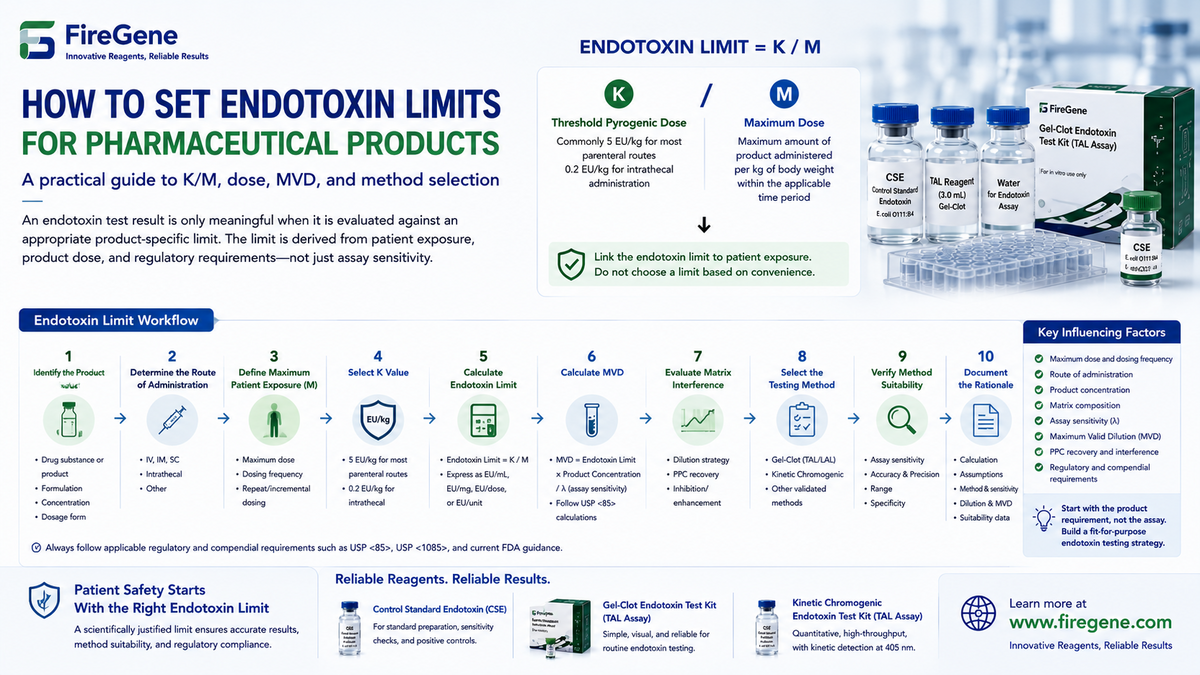
Introduction: Why Endotoxin Limits Matter
An endotoxin test result cannot be interpreted correctly without understanding the endotoxin limit that applies to the product.
A result of:
0.5 EU/mL
may be acceptable for one pharmaceutical product but unacceptable for another.
Why?
Because endotoxin acceptance criteria are not simply determined by how sensitive an endotoxin assay can be.
They are closely connected to the maximum amount of product administered to a patient, the route of administration, and the applicable regulatory or compendial requirements.
This is why establishing an appropriate endotoxin limit should be one of the earliest steps in developing a reliable pharmaceutical endotoxin testing strategy.
The basic concept can be summarized as:
Patient exposure → Endotoxin limit → Assay sensitivity → Dilution strategy → Method suitability
USP <85> provides the foundational framework for the Bacterial Endotoxins Test, while USP <1085> provides additional guidance on the proper application of bacterial endotoxin testing.
FDA's March 2026 revised guidance also provides current recommendations concerning pyrogen and endotoxin testing and acceptance criteria for drugs, biological products, and devices.
So, how should a pharmaceutical laboratory determine an endotoxin limit?
What Is an Endotoxin Limit?
An endotoxin limit is the maximum amount of bacterial endotoxin that may be present in a pharmaceutical product without exceeding the applicable pyrogenic exposure threshold.
It is commonly expressed in units such as:
- EU/mL
- EU/mg
- EU/unit
- EU/dose
The appropriate unit depends on how the product dose is defined.
The fundamental principle is:
The endotoxin limit should be related to the maximum amount of product administered to the patient.
This prevents laboratories from selecting an endotoxin acceptance criterion simply because it is convenient for analytical testing.
A scientifically justified limit should be connected to patient exposure.
FDA's pharmaceutical quality guidance explains that finished-drug endotoxin acceptance criteria should be determined based on the maximum dose that can be delivered within one hour, with special considerations for repeat or incremental dosing.
The Basic K/M Concept for Endotoxin Limit Calculation
For many pharmaceutical products, the traditional endotoxin limit calculation is expressed as:
Endotoxin Limit = K / M
Where:
- K = threshold pyrogenic dose
- M = maximum dose of product administered per kilogram of body weight within the applicable time period
For most routes of administration, the commonly referenced value of K is:
5 EU/kg
For intrathecal administration, the threshold is substantially lower:
0.2 EU/kg
FDA's current materials continue to describe this dose-based framework for endotoxin limits.
However, laboratories should always evaluate the applicable current compendial chapter, product-specific monograph, regulatory expectations, and labeling when establishing an actual product specification.
How to Calculate an Endotoxin Limit: A Simple Example
Suppose an injectable drug has a maximum human dose of:
10 mg/kg/hour
Using:
K = 5 EU/kg
The endotoxin limit on a mass basis would be:
5 EU/kg ÷ 10 mg/kg = 0.5 EU/mg
Therefore, the calculated limit would be:
0.5 EU/mg
This means that the acceptable endotoxin level is linked to how much drug is administered—not simply the concentration of endotoxin detected by the assay.
Why Maximum Dose Matters
One of the most common mistakes in endotoxin limit calculation is using an average or routine dose instead of the maximum relevant dose.
Consider a drug that can be administered at:
- 50 mg/day under normal circumstances
- 100 mg/day in a high-dose regimen
The endotoxin limit should not automatically be based on the lower routine dose if the higher dose represents the maximum relevant patient exposure under the applicable labeling.
FDA specifically notes that maximum dosing within one hour may require consideration of additional doses, maintenance doses, incremental dose increases, and repeat dosing scenarios.
Therefore, before calculating an endotoxin limit, QC and regulatory teams should confirm:
- Maximum dose
- Dosing frequency
- Route of administration
- Duration of administration
- Repeat-dose scenarios
- Patient population
- Product labeling
Route of Administration Can Change the Endotoxin Limit
Not all pharmaceutical products are subject to the same endotoxin exposure threshold.
The route of administration is therefore a critical part of endotoxin limit assessment.
Intravenous and Other Parenteral Routes
For many parenteral products, the commonly referenced K value is:
5 EU/kg
But the actual product acceptance criterion still needs to be derived using the applicable product dose and regulatory framework.
Intrathecal Products
Intrathecal administration requires particular attention because the applicable endotoxin exposure threshold is much lower.
The commonly referenced value is:
0.2 EU/kg
This difference illustrates why laboratories should never select an endotoxin limit simply by copying the specification from another product.
Endotoxin Limit in EU/mL vs EU/mg
Another important issue is the unit used to express the endotoxin limit.
A product may have a limit expressed as:
EU/mL
or:
EU/mg
or:
EU/dose
The appropriate unit depends on the product's dosing basis.
For a liquid injection, EU/mL may be appropriate.
For a drug substance or lyophilized material, EU/mg may be more meaningful.
For certain products, the relevant criterion may be based on total endotoxin exposure per dose.
The laboratory must therefore ensure that the product specification and analytical calculation use compatible units.
How Endotoxin Limits Affect Endotoxin Testing
The endotoxin limit is not just a regulatory number.
It directly affects the analytical testing strategy.
For example:
Lower endotoxin limit
↓
Greater analytical sensitivity may be required
↓
Different dilution strategy
↓
Different MVD
↓
Potentially greater matrix-interference challenges
This is why endotoxin limit calculation should ideally occur before finalizing the endotoxin test method.
What Is MVD in Endotoxin Testing?
Maximum Valid Dilution (MVD) is another important concept that connects the endotoxin limit with assay sensitivity.
In general terms, MVD represents the maximum dilution at which the sample can still be tested while maintaining the ability to detect endotoxin at the applicable product limit.
A simplified relationship is:
MVD = Endotoxin Limit × Product Concentration / λ
where λ represents the labeled sensitivity of the endotoxin reagent under the applicable method.
The exact calculation should follow the applicable compendial procedure and product-specific units.
The key idea is:
The endotoxin limit determines how much dilution the analytical method can tolerate while still providing meaningful detection.
Why MVD Is Important for Sample Preparation
Suppose a pharmaceutical product produces strong matrix interference at its original concentration.
The laboratory may need to dilute the sample.
But dilution cannot continue indefinitely.
If the sample is diluted beyond the appropriate MVD, the assay may no longer be capable of detecting endotoxin at the required product limit.
Therefore:
Matrix interference
and
MVD
must be considered together.
This is particularly important for complex formulations containing:
- Proteins
- Surfactants
- Salts
- Lipids
- Buffers
- Excipients
- High concentrations of active pharmaceutical ingredients
For a deeper discussion of dilution and matrix effects, FireGene's Endotoxin Testing Sample Preparation Guide can be naturally incorporated into the method-development workflow.
Endotoxin Limit vs Assay Sensitivity: What Is the Difference?
These two concepts are often confused.
Endotoxin Limit
Defines how much endotoxin the product may contain based on patient exposure and applicable requirements.
Assay Sensitivity
Defines how low the endotoxin test method can detect under the specified test conditions.
For Gel-Clot testing, sensitivity is commonly represented by λ.
For quantitative photometric methods, the analytical range and validated performance characteristics determine how the sample can be measured.
The relationship is:
Product requirement
→ Endotoxin limit
→ Required analytical sensitivity
→ Dilution
→ Method suitability
Therefore, a highly sensitive assay does not automatically mean that the product has a lower endotoxin limit.
The two concepts answer different questions.
Why a More Sensitive Endotoxin Test Is Not Always Better
It may seem logical to assume:
“The more sensitive the endotoxin assay, the better.”
But analytical sensitivity must be considered together with:
- Product matrix
- Endotoxin limit
- MVD
- Interference
- Precision
- Method suitability
- Intended use
An extremely sensitive method may not be useful if the product strongly interferes with the assay and cannot be diluted sufficiently within the MVD.
The best method is therefore not necessarily the one with the lowest theoretical detection limit.
It is the method that can reliably demonstrate compliance with the product-specific endotoxin requirement.
How Product Matrix Can Complicate Endotoxin Limit Testing
Pharmaceutical formulations can interfere with endotoxin assays.
Potential mechanisms include:
Inhibition
The product suppresses the reaction.
Enhancement
The product increases the apparent response.
Physical interference
The formulation changes the reaction environment or handling characteristics.
Chemical interference
Specific components interact with the endotoxin detection system.
This is why a calculated endotoxin limit alone does not guarantee that a laboratory can immediately implement a routine test.
The method must also demonstrate suitability for the specific product.
USP <1085> was developed specifically to provide additional guidance on the proper application of bacterial endotoxin tests, including considerations arising from increasingly complex parenteral formulations.
Why Positive Product Controls Matter
When a pharmaceutical sample is tested, the laboratory needs evidence that the product matrix has not interfered with endotoxin detection.
This is where a Positive Product Control (PPC) becomes important in applicable methods.
The basic concept is:
Known endotoxin spike
Product matrix
↓
Measure recovery
If the expected recovery criteria are met, this supports the suitability of the test conditions.
If recovery is outside the applicable acceptance range, the laboratory may need to investigate:
- Matrix interference
- Dilution
- Sample preparation
- Reagent performance
- Pipetting
- Product formulation
This is one reason why method suitability should be considered alongside endotoxin limit calculation, rather than as a completely separate activity.
Choosing Between Gel-Clot and Kinetic Chromogenic Endotoxin Testing
Once the endotoxin limit has been established, the laboratory can evaluate which testing approach is appropriate.
Gel-Clot Endotoxin Testing
Gel-Clot methods provide a qualitative or semi-quantitative approach based on gel formation.
They can be useful when:
- Simple visual interpretation is desired
- Routine testing volume is manageable
- The validated method is appropriate
- The product is compatible with the assay
FireGene's Gel-Clot Endotoxin Test Kit offers different sensitivities, allowing laboratories to select an appropriate TAL/LAL Reagent according to their validated testing requirements.
Kinetic Chromogenic Endotoxin Testing
Kinetic chromogenic testing provides quantitative results based on the relationship between endotoxin concentration and chromogenic response.
It can be particularly useful when laboratories need:
- Quantitative endotoxin concentration
- Higher throughput
- Numerical data for trending
- Plate-based workflow
FireGene's Kinetic Chromogenic Endotoxin Test Kit uses a 96-well format with 405 nm absorbance detection.
For more detailed information, see FireGene's Ultimate Guide to Kinetic Chromogenic Endotoxin Assays.
How the Endotoxin Limit Influences the Choice of Reagent Sensitivity
For Gel-Clot testing, the labeled sensitivity λ is an important parameter.
Suppose the calculated product endotoxin limit requires detection at a relatively low concentration.
The laboratory may need a reagent sensitivity that allows testing within the applicable MVD.
This creates a practical relationship:
Endotoxin Limit
↓
Required Detection Capability
↓
Reagent Sensitivity
↓
MVD
↓
Sample Dilution
↓
Method Suitability
Selecting reagent sensitivity before calculating the product endotoxin limit can therefore lead to an inefficient testing strategy.
The better approach is to work backward from the product requirement.
Endotoxin Limits for Biologics and Complex Products
Biological products can create additional challenges because their doses, concentrations, formulations, and manufacturing processes can be more complex.
Examples include:
- Monoclonal antibodies
- Recombinant proteins
- Vaccines
- Cell-based products
- Gene therapy products
- RNA-based therapeutics
For these products, endotoxin limit calculation should be considered together with:
- Product dose
- Route of administration
- Formulation
- Product concentration
- Matrix interference
- Sample dilution
- Method suitability
This is particularly relevant for newer modalities such as mRNA-LNP therapeutics, where complex lipid-containing formulations can complicate endotoxin testing.
FireGene's article on Endotoxin Testing for mRNA-LNP Therapeutics: Why Matrix Suitability Matters provides a useful related resource on matrix effects, PPC recovery, dilution, and MVD.
Endotoxin Limits for Water and Other Materials
Not every endotoxin test is performed on a conventional drug product.
Laboratories may also test:
- Water
- Raw materials
- Excipients
- Drug substances
- Components
- Process intermediates
- Medical devices
The applicable acceptance criteria may differ depending on the material and intended use.
Therefore, laboratories should avoid applying a generic “5 EU/kg” calculation indiscriminately to every material.
The relevant specification should be established based on the applicable product, route, dose, compendial requirements, and regulatory expectations.
FDA's current guidance specifically addresses drugs, biological products, and devices and notes the relevance of USP <85>, USP <161>, and AAMI ST72.
2026 Update: Why Endotoxin Limit Strategy Is Becoming More Important
The regulatory environment surrounding endotoxin testing is evolving.
FDA's revised March 2026 Pyrogen and Endotoxins Testing: Questions and Answers guidance updates the agency's current thinking regarding endotoxin and pyrogen testing and references gel-clot, photometric, and kinetic approaches.
FDA also clarified its position on the broader use of recombinant reagents, noting that manufacturers using recombinant methods should verify that the method is suitable for its intended purpose.
Meanwhile, USP <1085> provides additional guidance around bacterial endotoxin testing, and USP <86> introduces techniques using recombinant reagents.
These developments reinforce an important principle:
The analytical method, endotoxin limit, and product-specific suitability assessment should be considered as one connected system.
A laboratory should not select a test method independently of the product's actual endotoxin requirement.
Common Mistakes When Establishing Endotoxin Limits
Mistake 1: Using a Generic Limit for Every Product
Different products have different doses and administration routes.
Mistake 2: Using the Routine Dose Instead of the Maximum Relevant Dose
The applicable maximum exposure should be carefully evaluated.
Mistake 3: Ignoring Route of Administration
Intrathecal products require particular attention because the applicable threshold differs substantially.
Mistake 4: Confusing Endotoxin Limit With Assay Sensitivity
They are related, but they are not the same thing.
Mistake 5: Ignoring MVD
A product may require dilution to overcome interference, but dilution must remain within the applicable MVD.
Mistake 6: Selecting Reagent Sensitivity Too Early
The testing strategy should be designed around the product requirement.
Mistake 7: Assuming a Passing Standard Curve Means the Product Method Is Suitable
The product matrix can still interfere.
Mistake 8: Ignoring Changes in Product Dose
Changes to formulation strength, concentration, or dosing can potentially affect the endotoxin limit assessment.
Mistake 9: Treating USP <85> as the Only Consideration
Product-specific monographs, FDA expectations, USP chapters, labeling, and applicable device or biologics requirements may all need to be considered.
Mistake 10: Failing to Document the Scientific Basis
An endotoxin acceptance criterion should have a clear rationale and traceable calculation.
A Practical Endotoxin Limit Calculation Workflow
A pharmaceutical laboratory can use the following workflow:
Step 1: Identify the Product
Determine:
- Drug substance or drug product
- Formulation
- Concentration
- Dosage form
Step 2: Identify the Route
Determine whether the product is:
- Intravenous
- Intramuscular
- Subcutaneous
- Intrathecal
- Other applicable route
Step 3: Determine Maximum Patient Exposure
Review the applicable product labeling and dosing information.
Step 4: Determine the Applicable K Value
Use the applicable compendial or regulatory framework.
Step 5: Calculate the Endotoxin Limit
Use the appropriate dose-based calculation.
Step 6: Convert Units
Express the limit in the unit appropriate for the product:
EU/mL, EU/mg, EU/unit, or EU/dose
Step 7: Calculate MVD
Use the endotoxin limit, product concentration, and assay sensitivity as appropriate.
Step 8: Evaluate Matrix Interference
Determine whether dilution and PPC recovery support method suitability.
Step 9: Select the Testing Method
Evaluate:
- Gel-Clot
- Kinetic chromogenic
- Other applicable photometric or validated approaches
- Recombinant reagent methods where appropriate
Step 10: Document the Rationale
Record the calculation, assumptions, method, sensitivity, dilution strategy, and suitability assessment.
Endotoxin Limit Calculation Example: Putting Everything Together
Consider a hypothetical injectable product.
Product information
Maximum dose:
10 mg/kg/hour
Applicable K:
5 EU/kg
Step 1: Calculate endotoxin limit
5 EU/kg ÷ 10 mg/kg = 0.5 EU/mg
So:
Endotoxin limit = 0.5 EU/mg
Step 2: Consider product concentration
Suppose the drug product contains:
50 mg/mL
Then the corresponding concentration-based limit would need to be expressed consistently with the product's dosing basis and the applicable method.
Step 3: Select assay sensitivity
The laboratory then evaluates whether the selected TAL/LAL Reagent or other validated method provides sufficient analytical capability.
Step 4: Determine MVD
MVD is then calculated based on the applicable endotoxin limit, product concentration, and assay sensitivity.
Step 5: Evaluate interference
If the undiluted sample interferes with the assay, the laboratory can investigate dilution within the scientifically justified MVD.
This illustrates why endotoxin limit calculation, MVD, and method suitability should be considered together.
Frequently Asked Questions About Endotoxin Limits
What is the endotoxin limit for pharmaceutical products?
The endotoxin limit depends on factors including maximum patient dose, route of administration, and applicable regulatory or compendial requirements. A common dose-based framework is K/M.
What does K/M mean in endotoxin testing?
K represents the applicable threshold pyrogenic dose, while M represents the maximum relevant dose of product administered per kilogram within the applicable time period.
Is K always 5 EU/kg?
No. The applicable K value depends on the route and product circumstances. Intrathecal administration, for example, uses a substantially lower threshold.
What is MVD in endotoxin testing?
MVD is the Maximum Valid Dilution—the maximum dilution at which the sample can still be tested against the applicable endotoxin limit using the selected assay sensitivity.
Is MVD the same as the endotoxin limit?
No. The endotoxin limit defines the maximum acceptable endotoxin exposure or concentration, while MVD relates that limit to the product concentration and analytical sensitivity.
Can the same endotoxin limit be used for different products?
Not automatically. Products with different doses, routes, concentrations, or regulatory requirements may require different limits.
Does a more sensitive TAL/LAL Reagent always provide a better test?
Not necessarily. Sensitivity must be considered together with matrix interference, MVD, method suitability, and the actual product requirement.
Does the endotoxin limit determine the assay method?
It is an important factor, but not the only one. Product matrix, assay interference, required sensitivity, throughput, and method suitability also need to be evaluated.
How does product dose affect endotoxin testing?
Higher product doses can result in a more restrictive endotoxin concentration limit because the total allowable endotoxin exposure must remain within the applicable threshold.
Should endotoxin limits be reviewed after a product change?
Potentially, yes. Changes in dose, route, concentration, formulation, or labeling may affect the scientific basis of the endotoxin acceptance criterion and should be assessed under the applicable change-control process.
Conclusion: Start With the Product Requirement, Not the Assay
A reliable endotoxin testing strategy does not begin with:
“Which endotoxin kit should we use?”
It begins with:
“What endotoxin limit does this product actually need to meet?”
From there, the laboratory can work through:
Maximum dose
↓
Route of administration
↓
Endotoxin limit
↓
Product concentration
↓
MVD
↓
Assay sensitivity
↓
Matrix interference
↓
Method suitability
↓
Routine endotoxin testing
This approach helps prevent a common mistake in pharmaceutical QC: selecting an analytical method first and trying to make the product fit the assay afterward.
In 2026, as regulatory expectations evolve and laboratories have more endotoxin testing technologies available—including traditional Gel-Clot and photometric approaches as well as recombinant-reagent methods—the importance of a product-specific, scientifically justified endotoxin limit becomes even greater. FDA's 2026 guidance emphasizes current expectations for pyrogen and endotoxin testing, while USP <1085> provides additional guidance for proper application of bacterial endotoxin testing.
Ultimately, a strong endotoxin testing program should connect three elements:
Patient Safety + Scientifically Justified Endotoxin Limit + Fit-for-Purpose Analytical Method
That is the foundation of reliable pharmaceutical endotoxin testing.
FireGene Endotoxin Testing
Ready to run your endotoxin assay?
FireGene offers a complete endotoxin testing toolkit — from TAL reagents and CSE standards to pyrogen-free consumables and LAL reagent water. All products are aligned with USP <85>, EP 2.6.14, and JP 4.01.


