
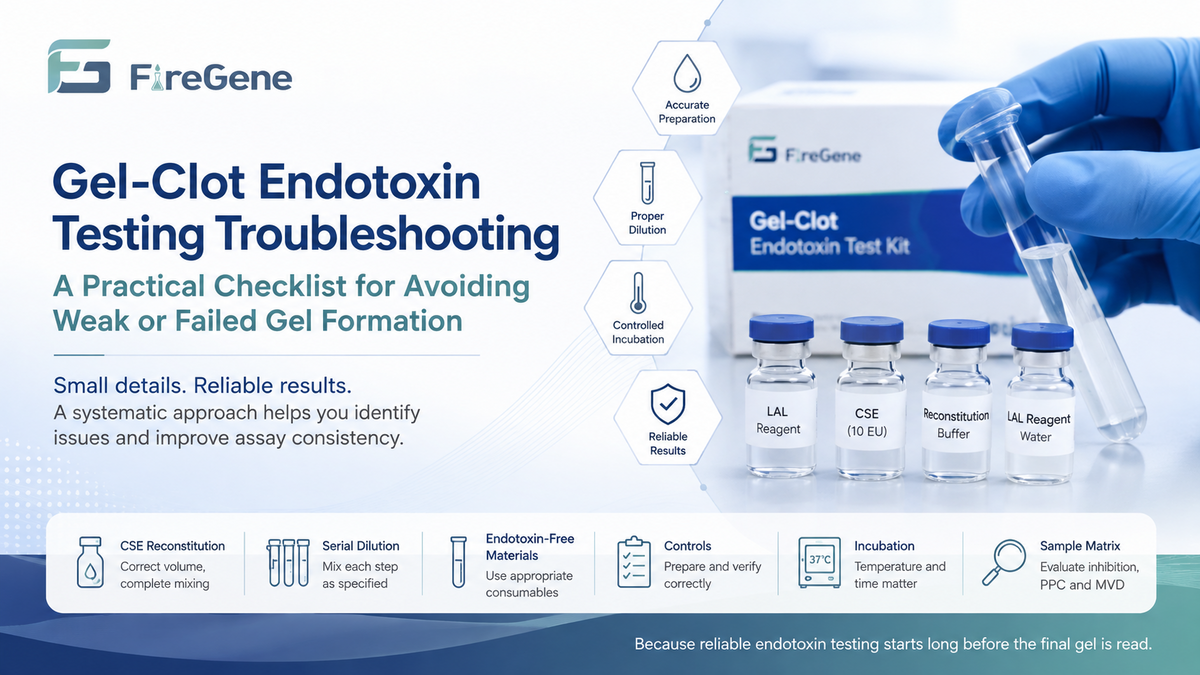
Introduction: Why Does a Gel-Clot Endotoxin Test Fail?
Gel-Clot endotoxin testing remains one of the most straightforward approaches for bacterial endotoxin detection. The basic principle is simple: when endotoxin is present at or above the labeled sensitivity of the TAL/LAL Reagent, the reaction activates a coagulation cascade and produces a gel that can be evaluated after incubation.
However, a simple assay principle does not mean that every Gel-Clot endotoxin test is automatically trouble-free.
A weak gel, unstable gel, or failed Positive Control can create an immediate troubleshooting challenge. Was the CSE prepared incorrectly? Was the reagent handled improperly? Was the incubation temperature correct? Could the tubes or water have introduced endotoxin? Is the Positive Control concentration correct? Or is the problem actually associated with the sample matrix?
The key is not to assume the cause too early.
A reliable troubleshooting process should move systematically from controls and reagent preparation to CSE preparation, dilution, materials, incubation, result reading, and finally sample-specific factors.
This guide provides a practical Gel-Clot endotoxin testing troubleshooting checklist designed to help laboratories identify common causes of weak or failed gel formation and improve the consistency of bacterial endotoxin testing.
1. Start With the Positive and Negative Controls
When a Gel-Clot endotoxin test produces an unexpected result, the first question should be:
Did the controls perform as expected?
This is one of the most important troubleshooting steps because the control results help determine whether the problem is associated with the assay system itself or specifically with the sample.
The general troubleshooting logic is:
Positive Control passes + sample fails
→ Investigate the sample.
Positive Control fails + sample fails
→ Investigate the assay setup first.
A properly designed Gel-Clot endotoxin test should include the appropriate controls required by the applicable procedure.
If the Positive Control forms a firm gel
If the Positive Control produces the expected firm gel but the sample does not, investigate:
- Sample matrix interference
- Inhibition or enhancement
- Sample preparation
- Sample dilution
- pH
- Formulation components
- Appropriate dilution selection
- Method suitability
If the Positive Control also fails
If the Positive Control does not form the expected gel, start with the assay system itself:
- CSE preparation
- CSE concentration
- TAL/LAL Reagent preparation
- Reagent storage and handling
- Dilution procedure
- Test materials
- Incubation conditions
- Control preparation
- Reagent and CSE status
This distinction is critical.
A failed sample and a failed Positive Control should not automatically be investigated in the same way.
For a broader overview of Gel-Clot principles, see FireGene's Gel-Clot Endotoxin Test Kit and its related endotoxin testing resources.
2. Verify the CSE Reconstitution Volume
One of the simplest—and most frequently overlooked—steps in endotoxin testing troubleshooting is Control Standard Endotoxin (CSE) reconstitution.
The CSE should be reconstituted using the volume specified by the applicable manufacturer's instructions.
For example, if a procedure specifies a particular reconstitution volume, using a different volume changes the theoretical concentration of the resulting CSE solution.
That concentration then affects every subsequent dilution.
In other words:
CSE reconstitution error
→ Incorrect stock concentration
→ Incorrect dilution concentration
→ Incorrect Positive Control concentration
→ Potentially misleading Gel-Clot result
CSE reconstitution troubleshooting checklist
Before starting the assay, verify:
- Correct CSE vial was selected
- Correct reconstitution solvent was used
- Correct reconstitution volume was used
- Pipette is appropriate for the required volume
- Pipette calibration is current
- Reconstitution volume was recorded
- No additional water was inadvertently added
Do not estimate reconstitution volume visually.
For endotoxin standards, even a small preparation error can become increasingly significant when the solution is subsequently diluted.
FireGene's Control Standard Endotoxin (CSE) is intended for endotoxin standard preparation and control applications. The product page also provides specific information regarding CSE reconstitution and mixing.
3. Mix the Reconstituted CSE Thoroughly
Correct reconstitution volume alone is not enough.
After reconstitution, the CSE must be mixed according to the applicable procedure.
Incomplete mixing can produce a non-homogeneous solution, meaning the concentration withdrawn from the vial may not accurately represent the intended concentration.
One common misconception is:
“The solution looks clear, so it must already be completely mixed.”
Not necessarily.
Visual clarity and adequate homogenization are not the same thing.
If the procedure specifies a particular mixing technique or duration, that procedure should be followed rather than replaced with an assumed equivalent technique.
CSE mixing checklist
Confirm that:
- CSE was reconstituted using the specified solvent
- The specified mixing procedure was followed
- Required mixing time was followed
- The solution was completely dissolved
- Reconstituted CSE was handled according to the manufacturer's instructions
FireGene's CSE product information specifically emphasizes thorough vortex mixing following reconstitution, illustrating why this step should not be treated as a minor detail.
4. Pay Special Attention to Serial Dilution
Serial dilution is another critical source of error during Gel-Clot endotoxin testing.
Every dilution step affects the final concentration of the Positive Control or endotoxin standard.
A small error early in the dilution series can propagate through multiple subsequent steps.
For example:
Incorrect stock concentration
↓
Incorrect first dilution
↓
Incorrect second dilution
↓
Incorrect final Positive Control concentration
↓
Weak or failed gel formation
Serial dilution troubleshooting checklist
For each dilution, verify:
- Correct dilution solvent was used
- Correct dilution factor was calculated
- Correct volume was transferred
- Each dilution was mixed as specified
- Mixing time was consistent
- Appropriate pipette tips were used
- Dilution sequence was documented
- Concentrations were independently checked
When preparing important controls or validation-related dilutions, having another qualified person independently review the calculations can reduce avoidable calculation errors.
For quantitative or method-development work, consistent preparation of endotoxin standards is particularly important because the same CSE may be used across multiple assay formats. FireGene's CSE is listed as compatible with Gel-Clot and other endotoxin assay formats.
5. Check the Water and Other Endotoxin-Free Materials
A common troubleshooting mistake is to inspect only the TAL/LAL Reagent.
But endotoxin can potentially be introduced through water, tubes, pipette tips, glassware, vials, and other materials used during preparation.
The problem can therefore occur somewhere along the entire preparation pathway.
For example:
CSE
→ Water
→ Tube
→ Pipette tip
→ Dilution
→ Positive Control
If one component is not appropriate for endotoxin testing, the final result may be affected.
Laboratories should therefore use appropriate endotoxin-free or depyrogenated materials according to the validated procedure.
Materials checklist
Before testing, verify:
- Endotoxin Assay Water is appropriate
- Tubes are endotoxin-free or appropriately depyrogenated
- Glassware is properly depyrogenated when applicable
- Pipette tips are appropriate
- Containers are compatible with the procedure
- Materials have not been exposed to potential endotoxin sources
FireGene's Endotoxin Assay Water is specifically intended for bacterial endotoxin testing, including CSE reconstitution, CSE dilution, sample preparation, and negative-control applications.
This makes water selection an important part of Gel-Clot endotoxin testing troubleshooting, rather than a minor laboratory detail.
6. Check Storage and Handling Conditions
Correct reagent storage does not begin and end with placing a vial in the refrigerator.
The complete handling chain should be considered:
Transportation → Receipt → Storage → Preparation → Testing
An unexpected endotoxin test result may sometimes be associated with an event that occurred before the assay was performed.
Check:
- Storage temperature
- Transportation conditions
- Temperature excursions
- Receipt condition
- Vial integrity
- Expiration date
- Handling history
- Reconstitution or opening history
Storage troubleshooting checklist
Before testing, confirm:
- Storage temperature was within the specified range
- No known temperature excursion occurred
- Reagent was handled appropriately during transportation
- Vial was inspected before use
- No visible damage was observed
- Expiration date was checked
- Opened or reconstituted material was used within the specified period
If there was a delayed shipment, suspected temperature excursion, or unusual storage event, document it.
These records can become valuable evidence during a subsequent investigation.
7. Do Not Automatically Blame the Expiration Date
The expiration date is an important quality-control checkpoint.
Reagents should not be used beyond their stated expiration date.
However, an unexpected Gel-Clot result should not automatically be attributed to the reagent simply because the test was performed near its expiration date.
A proper investigation should also consider:
- Reagent preparation
- CSE concentration
- Reconstitution
- Storage history
- Transportation
- Incubation
- Control preparation
- Laboratory materials
- Sample preparation
In other words:
Expiration status is an investigation variable—not automatically the root cause.
This distinction is important when conducting a scientifically defensible endotoxin testing investigation.
8. Verify the Positive Control Concentration
The Positive Control is one of the most important components of a Gel-Clot endotoxin test.
Before testing, verify how its concentration was calculated.
Common sources of error include:
- Incorrect CSE stock concentration
- Incorrect reconstitution volume
- Incorrect dilution factor
- Confusion between λ and other target concentrations
- Incorrect final volume
- Pipetting errors
- Incorrect CSE potency information
The labeled sensitivity λ is an important parameter when establishing the appropriate Positive Control concentration, but laboratories should always follow the applicable method and manufacturer's instructions.
Positive Control checklist
Confirm:
- TAL/LAL sensitivity (λ) is correct
- CSE potency information is correct
- Reconstitution volume is correct
- Dilution calculation has been checked
- Final Positive Control concentration is correct
- Appropriate control was prepared
- Positive Control was tested in parallel with the assay
A calculation error can result in a Positive Control concentration that is lower than intended, making subsequent troubleshooting unnecessarily complicated.
9. Confirm Incubation Temperature and Time
Gel-Clot formation depends on controlled incubation conditions.
The test should be incubated according to the applicable procedure, including the specified temperature and incubation time.
Both should be controlled.
Incubation troubleshooting checklist
Verify:
- Incubation temperature meets the specified requirement
- Incubation time is correct
- Timer was started at the correct point
- Tubes were positioned appropriately
- Controls and samples experienced consistent conditions
- Tubes were not unnecessarily disturbed
Do not overlook the last point.
Because the result depends on formation of a physical gel structure, unnecessary movement during incubation can complicate interpretation.
10. Handle Tubes Carefully During Result Reading
Gel-Clot endotoxin testing is visually evaluated.
That means the result-reading step itself matters.
After incubation, tubes should be evaluated according to the applicable procedure and handled consistently.
A weak or partially formed gel should not automatically be interpreted as a firm positive if it does not satisfy the established acceptance criteria.
Result-reading checklist
- Follow the specified reading procedure
- Handle tubes consistently
- Avoid unnecessary shaking
- Evaluate Positive and Negative Controls together
- Document results immediately
- Photograph unusual or borderline results when useful
Photographs can be particularly helpful when discussing weak gel formation with technical support or during an internal investigation.
11. If the Positive Control Passes but the Sample Fails, Investigate the Sample Matrix
This is where troubleshooting moves from the assay system to the product.
If the Positive Control forms the expected gel but the sample does not behave as expected, sample-related factors become much more important.
Potentially challenging matrices include:
- Peptides
- Recombinant proteins
- Biologics
- Drug substances
- Formulated products
- Protein extracts
- Buffer-containing products
These materials may contain components that interfere with endotoxin detection.
Potential variables include:
- pH
- Salt concentration
- Buffer composition
- Protein concentration
- Surfactants
- Excipients
- Other formulation components
For these samples, laboratories should evaluate inhibition/enhancement and method suitability according to the applicable procedure.
Sample troubleshooting checklist
Check:
- Sample pH
- Sample composition
- Sample concentration
- Appropriate sample dilution
- PPC/spike recovery where applicable
- MVD
- Matrix interference
The key principle is:
A sample failure does not automatically mean the TAL/LAL Reagent has failed.
The Positive Control and sample results must be interpreted together.
FireGene's Endotoxin Testing Sample Preparation Guide is a useful related resource for dilution, matrix interference, recovery, and sample preparation.
12. Do Not Confuse MVD With Routine Sample Dilution
Maximum Valid Dilution (MVD) is an important concept in bacterial endotoxin testing, but it should not automatically be treated as the dilution that must be used for every routine sample.
The appropriate dilution depends on factors such as:
- Endotoxin limit
- Assay sensitivity
- Product concentration
- Sample matrix
- Demonstrated method suitability
If a sample shows inhibition at a lower dilution, an appropriate dilution within the applicable MVD may need to be investigated.
MVD troubleshooting checklist
Confirm:
- Endotoxin limit is established
- Assay sensitivity is confirmed
- MVD calculation is documented
- Routine dilution is scientifically justified
- PPC recovery is acceptable at the selected dilution
This is especially important when troubleshooting samples that fail at one dilution but behave differently at another.
13. Keep a Complete Endotoxin Testing Troubleshooting Record
When an endotoxin test produces an unexpected result, simply repeating the assay without documenting what happened may not identify the root cause.
Instead, record the complete testing conditions.
A useful troubleshooting record should include the following.
Reagent Information
- Product name
- Lot number
- Expiration date
- Storage conditions
CSE Information
- Lot/potency
- Reconstitution volume
- Reconstitution procedure
- Mixing time
- Dilution scheme
Materials
- Endotoxin Assay Water
- Tubes
- Pipette tips
- Vials
- Depyrogenation status
Assay Conditions
- λ
- Positive Control concentration
- Negative Control
- PPC where applicable
- Incubation temperature
- Incubation time
- Reading procedure
Sample Information
- Sample type
- Sample concentration
- Buffer/formulation
- pH
- Dilution
- MVD
- PPC recovery
The more complete the record, the easier it becomes to compare a successful test with a failed or questionable test.
Gel-Clot Endotoxin Testing Troubleshooting Checklist
Before starting a Gel-Clot endotoxin test, laboratories can use this quick self-check.
Reagent
☐ Correct TAL/LAL Reagent selected
☐ Expiration date checked
☐ Storage conditions confirmed
☐ Vial inspected
CSE
☐ Correct CSE selected
☐ Correct reconstitution volume used
☐ Appropriate Endotoxin Assay Water used
☐ CSE mixed according to the specified procedure
☐ CSE used within the applicable handling period
Dilution
☐ Dilution calculation checked
☐ Correct dilution solvent used
☐ Correct transfer volumes used
☐ Each dilution mixed appropriately
☐ Suitable endotoxin-free/depyrogenated tubes used
Controls
☐ Positive Control prepared correctly
☐ Negative Control included
☐ PPC included when applicable
☐ Control concentrations verified
Incubation
☐ Correct temperature
☐ Correct incubation time
☐ Tubes kept undisturbed
Sample
☐ Sample matrix identified
☐ pH evaluated where relevant
☐ Appropriate dilution selected
☐ MVD calculated where applicable
☐ Inhibition/enhancement evaluated where required
Documentation
☐ Preparation volumes recorded
☐ Dilution scheme recorded
☐ Reagent and CSE information recorded
☐ Unexpected observations documented
☐ Photos taken when useful
Common Gel-Clot Endotoxin Testing Troubleshooting Scenarios
A simple decision tree can make troubleshooting much faster.
Scenario 1: Positive Control fails + Negative Control passes
Focus first on:
CSE → Positive Control concentration → TAL/LAL Reagent → reconstitution → dilution → materials → incubation
Do not begin by blaming the sample.
Scenario 2: Positive Control passes + sample fails
Focus on:
Sample matrix → dilution → inhibition/enhancement → PPC → MVD → sample preparation
Scenario 3: Both Positive and Negative Controls behave unexpectedly
Investigate the broader assay setup:
Reagent → water → materials → preparation → incubation → handling
Scenario 4: Result is borderline or difficult to interpret
Review:
Incubation → tube handling → reading procedure → control performance → documentation
This structured approach is generally more efficient than changing several variables simultaneously.
How to Prevent Gel-Clot Endotoxin Test Failures Before They Happen
Troubleshooting is important, but prevention is even better.
A reliable Gel-Clot endotoxin testing workflow should control several critical points:
1. Standardize CSE Preparation
Use consistent reconstitution and dilution procedures.
2. Control the Water
Use water appropriate for bacterial endotoxin testing.
FireGene's Endotoxin Assay Water is designed for applications including CSE reconstitution, standard dilution, sample preparation, and negative controls.
3. Use Appropriate Labware
Select endotoxin-free or properly depyrogenated materials according to the method.
FireGene also offers Pyrogen-Free Vials designed for CSE reconstitution, serial dilution, and endotoxin challenge-vial preparation.
4. Verify Controls Before Interpreting Samples
The control system provides the foundation for interpreting the sample result.
5. Minimize Unnecessary Procedural Variation
Small differences in pipetting, mixing, incubation, and handling can make troubleshooting more difficult.
6. Document Everything
A complete record allows laboratories to distinguish between a one-time error and a recurring problem.
When Should You Consider a Different Endotoxin Testing Method?
Gel-Clot remains useful because it is relatively simple and visually intuitive.
However, some laboratories may require quantitative data, higher throughput, or automated analysis.
In those situations, a Kinetic Chromogenic Endotoxin Test may be more appropriate depending on the product, validated method, laboratory equipment, and intended application.
FireGene's Kinetic Chromogenic Endotoxin Test Kit provides a quantitative kinetic approach using a 96-well format and 405 nm absorbance detection.
For a broader comparison of methods, see:
The Ultimate Guide to Kinetic Chromogenic Endotoxin Assays
However, switching methods should not be viewed as a shortcut for troubleshooting. The selected method still needs to be demonstrated suitable for the intended product and application.
Frequently Asked Questions About Gel-Clot Endotoxin Testing Troubleshooting
Why does my Gel-Clot Positive Control fail to form a firm gel?
Potential causes include incorrect CSE reconstitution, incorrect control concentration, incomplete mixing, dilution errors, inappropriate materials, reagent handling issues, incubation problems, or other procedural variables.
Start by reviewing the Positive Control preparation and assay conditions before investigating the sample.
What should I check first when a Gel-Clot endotoxin test fails?
Check the Positive Control and Negative Control first.
If the Positive Control fails, investigate the assay system.
If the Positive Control passes but the sample fails, investigate sample-specific factors such as matrix interference and dilution.
Can incorrect CSE reconstitution cause weak gel formation?
Yes. An incorrect reconstitution volume or inadequate preparation can result in an incorrect endotoxin concentration and affect the subsequent Positive Control preparation.
Why is CSE mixing important?
Incomplete mixing can produce a non-homogeneous endotoxin solution, meaning the concentration transferred for subsequent dilution may not accurately represent the intended concentration.
Can water cause problems in Gel-Clot endotoxin testing?
Yes. Water used for CSE reconstitution, dilution, or sample preparation should be appropriate for bacterial endotoxin testing. Water containing endotoxin may contribute unwanted background or affect the reliability of the assay.
What if my Positive Control passes but the sample fails?
Investigate the sample matrix, dilution, pH, formulation components, inhibition/enhancement, PPC recovery, and method suitability.
Is MVD the same as the routine sample dilution?
No. MVD represents the maximum valid dilution under the applicable calculation. It does not automatically mean that every sample should be tested at the MVD.
Can expired TAL/LAL Reagent cause Gel-Clot failure?
It may be a contributing factor, but expiration should not automatically be considered the root cause. Storage, preparation, CSE concentration, incubation, materials, and other variables should also be investigated.
Why should tubes remain undisturbed during incubation?
Gel-Clot testing relies on formation of a physical gel structure. Unnecessary movement during incubation can interfere with or complicate subsequent interpretation.
What information should be recorded during troubleshooting?
At minimum, record reagent and CSE information, preparation volumes, dilution calculations, materials, controls, incubation conditions, sample information, and any unusual observations.
Final Takeaway: Troubleshoot the System, Not Just the Result
A weak or failed gel in a Gel-Clot endotoxin test should be treated as a troubleshooting signal, not an immediate conclusion about the cause.
The most effective approach is systematic.
If the Positive Control fails:
Start with:
CSE preparation → reconstitution → dilution → control concentration → reagent → water → materials → storage → incubation → handling
If the Positive Control passes but the sample fails:
Shift attention toward:
Sample matrix → dilution → PPC → inhibition/enhancement → MVD → method suitability
Most importantly, do not overlook the small procedural details.
Reconstitution volume, CSE mixing, serial dilution, endotoxin-free materials, Positive Control preparation, incubation conditions, and result reading can all affect the reliability of a Gel-Clot endotoxin test.
A simple pre-test checklist can prevent many avoidable errors.
A complete troubleshooting record can make the remaining investigation faster, more objective, and easier to document.
For laboratories performing routine bacterial endotoxin testing, the objective should not simply be to obtain a result.
The objective is to ensure that the result is generated under controlled, documented, and reproducible conditions.
FireGene Endotoxin Testing
Ready to run your endotoxin assay?
FireGene offers a complete endotoxin testing toolkit — from TAL reagents and CSE standards to pyrogen-free consumables and LAL reagent water. All products are aligned with USP <85>, EP 2.6.14, and JP 4.01.


