
Introduction
Cell and gene therapy (CGT) manufacturing is transforming modern medicine. From CAR-T therapies and stem cell products to viral vector-based gene therapies, advanced therapeutics are creating unprecedented opportunities for treating previously untreatable diseases.
However, alongside these scientific breakthroughs comes a growing challenge: controlling endotoxin contamination throughout increasingly complex manufacturing processes.
Unlike traditional biologics, many cell and gene therapy products cannot undergo terminal sterilization. Consequently, contamination control must be built directly into process design, raw material selection, environmental monitoring, and analytical testing strategies.
While most manufacturers perform routine Bacterial Endotoxins Testing (BET) before product release, investigations continue to show that endotoxin excursions often originate from hidden sources that are overlooked during routine quality control activities.
Understanding where endotoxins originate—and how they evade detection—is becoming essential for manufacturers seeking to maintain compliance, ensure patient safety, and avoid costly manufacturing delays.
This article explores the most common hidden sources of endotoxin contamination in cell and gene therapy manufacturing and outlines practical strategies for building a modern endotoxin control program in 2026.
Why Endotoxin Contamination Matters in Cell and Gene Therapy Manufacturing
Endotoxins are lipopolysaccharides (LPS) derived from the outer membrane of Gram-negative bacteria.
Even trace amounts may:
- Trigger pyrogenic responses
- Induce cytokine release
- Alter cell function
- Affect product potency
- Compromise patient safety
- Cause batch rejection
Because endotoxins may remain present even after bacterial cells have been destroyed, a process can appear microbiologically clean while still failing endotoxin specifications.
This distinction is particularly important for:
- CAR-T manufacturing
- Stem cell therapies
- AAV production
- Lentiviral vector manufacturing
- Gene editing platforms
- Exosome-based therapeutics
As a result, endotoxin contamination in cell and gene therapy manufacturing remains one of the most closely monitored quality attributes throughout product development and commercialization.
Why Endotoxin Risk Is Receiving More Attention in 2026
Several industry trends have increased the importance of endotoxin control.
Expansion of Viral Vector Manufacturing
Many viral vector workflows rely on bacterial fermentation and plasmid production processes that inherently introduce endotoxin risks.
Growth of Personalized Medicine
Autologous manufacturing frequently involves multiple open manipulations and operator interactions.
Increasing Regulatory Expectations
Global regulators increasingly emphasize:
- Risk-based quality management
- Process understanding
- Contamination control strategies
- Scientifically justified testing methods
Emergence of Complex Formulations
Lipid nanoparticles and advanced delivery systems have increased industry awareness of Low Endotoxin Recovery (LER) and endotoxin masking.
For a deeper discussion, see our guide on Low Endotoxin Recovery (LER) .
What Causes Endotoxin Contamination in Cell and Gene Therapy Manufacturing?
Many QC investigations focus primarily on microbial contamination.
However, endotoxins often originate from sources that remain undetected until final release testing.
The following are among the most common hidden contamination pathways.
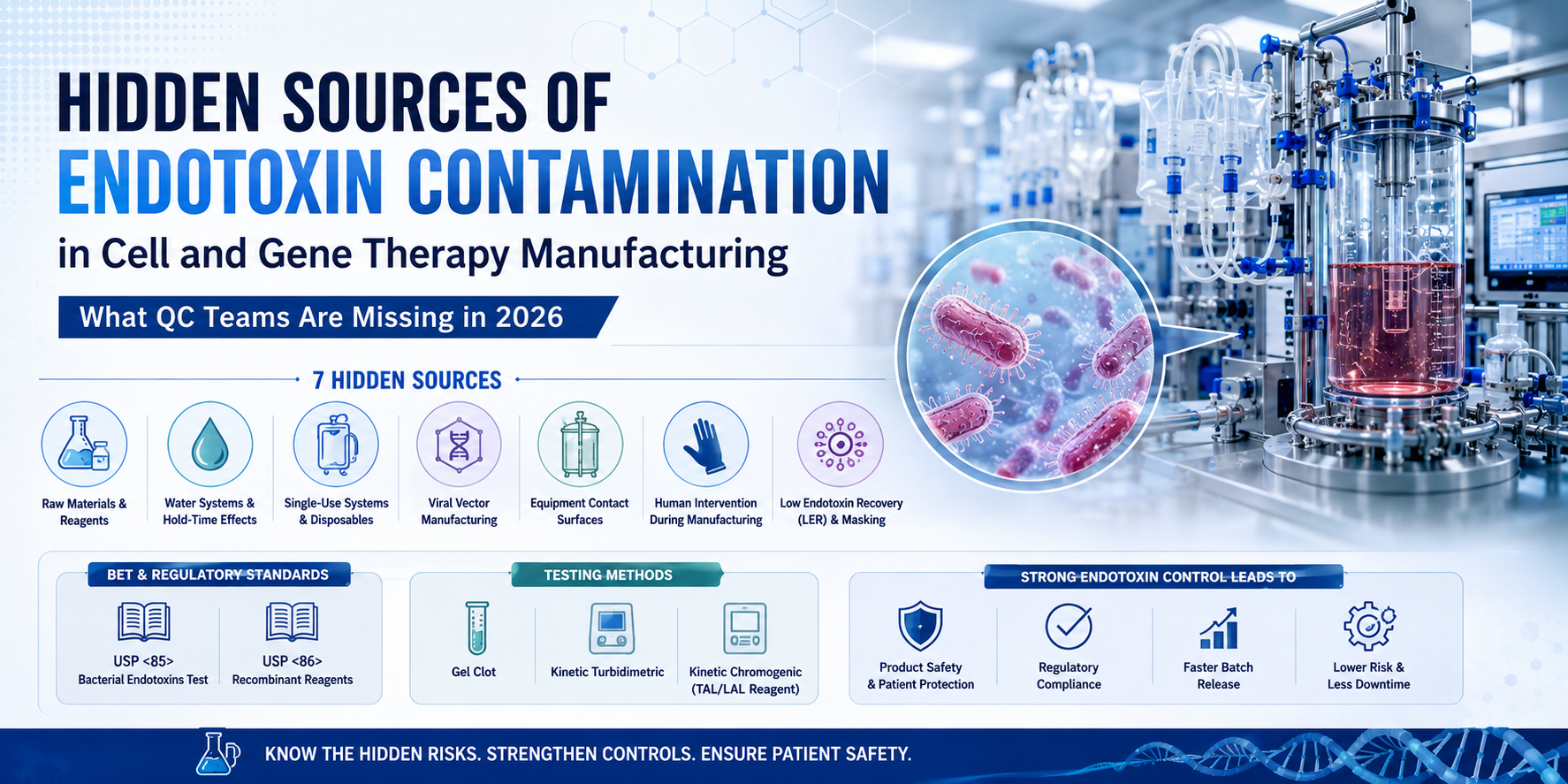
Hidden Source #1: Raw Materials and Ancillary Reagents
Raw materials remain one of the largest contributors to endotoxin risk.
High-risk materials include:
- Cytokines
- Growth factors
- Cell culture media
- Serum replacements
- Enzymatic reagents
- Buffer components
- Plasmid preparation reagents
Industry guidance from PDA, USP, and leading endotoxin testing organizations consistently identifies raw materials as a major source of endotoxin excursions during biologics manufacturing.
Why QC Teams Miss This Risk
Materials may meet sterility requirements while still containing measurable endotoxin levels.
Sterility does not guarantee endotoxin-free status.
Recommended Controls
- Supplier qualification
- Incoming BET testing
- Endotoxin specifications
- Vendor audits
- Material risk assessments
Hidden Source #2: Water Systems and Hold-Time Effects
Water systems remain among the most frequently investigated sources of endotoxin contamination.
Potential contributors include:
- Distribution loop dead legs
- Biofilm formation
- Temperature fluctuations
- Extended storage periods
- Inadequate sanitization
Real-World Observation
Many endotoxin investigations begin after water or buffer solutions remain within specification initially but accumulate endotoxin burden during prolonged hold times.
Critical Monitoring Points
- Water for Injection (WFI)
- Purified water
- Point-of-use outlets
- Buffer preparation vessels
- Intermediate process solutions
Trending water system performance over time is often more valuable than reviewing isolated test results.
Hidden Source #3: Single-Use Systems Are Not Automatically Endotoxin-Free
Single-use technologies have revolutionized CGT manufacturing.
However, a common misconception persists:
Sterile does not mean endotoxin-free.
Potential contamination sources include:
- Disposable bags
- Tubing assemblies
- Connectors
- Filters
- Sampling devices
Trace endotoxin contamination may be introduced during component manufacturing or handling before delivery to the facility.
Best Practices
Evaluate:
- Supplier endotoxin control programs
- Component certificates
- Incoming inspections
- Risk-based verification testing
Hidden Source #4: Viral Vector Manufacturing Operations
Viral vector manufacturing presents unique endotoxin challenges.
Common risk areas include:
- Plasmid DNA production
- Bacterial fermentation
- Cell lysis processes
- Chromatography systems
- Buffer exchange steps
Because bacterial hosts are frequently used upstream, endotoxin removal becomes a critical process objective.
High-Risk Scenario
Residual endotoxins introduced during plasmid production may persist throughout downstream processing if purification strategies are not optimized.
Hidden Source #5: Equipment Contact Surfaces
Endotoxins can strongly adhere to manufacturing surfaces.
Potential reservoirs include:
- Stainless steel vessels
- Valves
- Sampling ports
- Gaskets
- Transfer lines
- Instrument probes
Many investigations reveal that hard-to-clean areas are frequently overlooked during routine cleaning validation studies.
Important Consideration
Cleaning procedures validated for microbial reduction may not always demonstrate equivalent endotoxin removal effectiveness.
Hidden Source #6: Human Intervention During Manufacturing
Personnel remain one of the most significant contamination vectors.
Potential transfer routes include:
- Gloves
- Garments
- Work surfaces
- Material transfers
- Sampling activities
Although environmental monitoring programs often focus on microorganisms, endotoxin transfer may occur without detectable microbial contamination.
Reducing unnecessary operator intervention remains one of the most effective contamination prevention strategies.
Hidden Source #7: Low Endotoxin Recovery (LER) and Endotoxin Masking
Perhaps the most dangerous contamination source is one that remains undetected.
Low Endotoxin Recovery (LER) occurs when endotoxins become masked and demonstrate reduced recovery during testing.
This phenomenon has been observed in formulations containing:
- Surfactants
- Chelating agents
- Lipid nanoparticles
- Complex biologic matrices
Why It Matters
A product may appear compliant while endotoxins remain present.
This can result in inaccurate risk assessments and false confidence in product quality.
LER has become a major topic within modern cell and gene therapy manufacturing and should be considered during method suitability studies.
Where Does Bacterial Endotoxins Testing (BET) Fit into CGT Manufacturing?
Endotoxin testing remains a critical component of contamination control programs.
Most manufacturers continue to perform Bacterial Endotoxins Testing (BET) in accordance with USP <85> Bacterial Endotoxins Test requirements.
BET supports:
- Raw material qualification
- In-process monitoring
- Water system control
- Product release testing
- Investigations and CAPA activities
However, testing alone cannot prevent contamination.
Leading manufacturers increasingly combine BET with:
- Supplier qualification
- Process risk assessments
- Water monitoring
- Environmental controls
- Continuous trend analysis
to create comprehensive endotoxin control strategies.
USP <85>, USP <86>, and the Future of Endotoxin Testing
Learn more in our detailed analysis of USP <86> and FDA 2026 Guidance .
Historically, endotoxin testing has relied on TAL/LAL Reagent-based methodologies.
Today, USP <85> remains the primary compendial standard governing bacterial endotoxins testing.
The introduction of USP <86> has expanded the regulatory landscape by providing a framework for recombinant reagent-based methods.
Despite these developments, validated TAL/LAL Reagent workflows continue to represent the most widely used approach for endotoxin testing across pharmaceutical and biotechnology manufacturing.
Organizations should evaluate testing strategies based on:
- Regulatory requirements
- Method suitability
- Product characteristics
- Risk assessment outcomes
Endotoxin Risk Assessment Workflow
A Modern Contamination Control Strategy
Raw Material Qualification
          ↓
Supplier Assessment
          ↓
Incoming BET Testing
          ↓
Water System Monitoring
          ↓
Manufacturing Risk Assessment
          ↓
In-Process Endotoxin Testing
          ↓
Method Suitability Verification
          ↓
Final Product Release Testing
          ↓
Trend Analysis & CAPA
          ↓
Continuous Improvement
Manufacturers that integrate endotoxin testing into a broader quality management framework consistently achieve stronger contamination control outcomes.
Choosing the Right Endotoxin Testing Method
Gel Clot Method
Advantages:
- Established compendial history
- Simple implementation
Limitations:
- Semi-quantitative
- Lower throughput
Kinetic Turbidimetric Method
Advantages:
- Quantitative
- Automated
Commonly used in routine QC environments.
Kinetic Chromogenic Method
Advantages:
- High sensitivity
- Broad dynamic range
- Excellent quantitative performance
Increasingly preferred for:
- Cell therapy endotoxin testing
- Gene therapy endotoxin testing
- Viral vector manufacturing
- Rapid release applications
Many laboratories rely on validated TAL/LAL Reagent-based kinetic chromogenic assays to support highly sensitive quantitative endotoxin detection.
Frequently Asked Questions
What causes endotoxin contamination in cell and gene therapy manufacturing?
Common sources include raw materials, water systems, single-use components, viral vector processes, equipment surfaces, personnel interactions, and endotoxin masking.
Can sterile materials still contain endotoxins?
Yes. Sterility indicates the absence of viable microorganisms, whereas endotoxins may remain present even after bacterial cells have been eliminated.
What is the difference between bioburden and endotoxin?
Bioburden measures living microorganisms, while endotoxin testing measures bacterial lipopolysaccharides.
What is Low Endotoxin Recovery (LER)?
LER is a phenomenon in which endotoxins become masked and demonstrate reduced recovery during testing.
Can endotoxins pass through sterile filtration?
Yes. Sterile filtration removes microorganisms but does not necessarily remove endotoxins.
What is an acceptable endotoxin limit?
Acceptable limits vary according to product type, route of administration, and applicable pharmacopeial requirements.
What is the difference between USP <85> and USP <86>?
USP <85> focuses on traditional endotoxin testing methods, while USP <86> provides guidance for recombinant reagent-based approaches.
Are TAL/LAL Reagent methods still accepted?
Yes. TAL/LAL Reagent methods remain widely accepted throughout the pharmaceutical and biotechnology industries.
Which endotoxin testing method is most commonly used in CGT manufacturing?
Kinetic chromogenic methods are increasingly favored due to their sensitivity and quantitative capabilities.
Why is endotoxin testing important for viral vector manufacturing?
Because bacterial-derived plasmids and fermentation processes introduce unique endotoxin risks throughout vector production workflows.
Recommended Resources
Related Articles:
- USP <86> and FDA 2026 Guidance: Navigating the New Dual-Track Era of Endotoxin Testing
- Why Kinetic Chromogenic Endotoxin Testing Is Becoming Essential for Cell and Gene Therapy Manufacturing in 2026
- Low Endotoxin Recovery (LER): Causes, Endotoxin Masking Mechanisms, Regulatory Expectations, and Practical Solutions for Modern Endotoxin Testing
- Why Endotoxin Testing Is More Important Than Ever in 2026: Choosing the Right TAL/LAL Reagent for Modern Biopharma Research
Conclusion
As cell and gene therapy manufacturing becomes increasingly sophisticated, endotoxin control must evolve beyond simple release testing.
The most significant contamination risks often originate from hidden sources embedded within routine manufacturing operations, including raw materials, water systems, equipment surfaces, single-use technologies, operator interactions, and endotoxin masking phenomena.
By combining risk-based quality management, robust Bacterial Endotoxins Testing (BET), scientifically validated TAL/LAL Reagent workflows, and proactive contamination control strategies, manufacturers can strengthen product quality, improve regulatory readiness, and reduce the likelihood of costly endotoxin excursions.
In 2026, successful organizations will not simply test for endotoxins—they will systematically prevent endotoxin contamination before it occurs.
References
- FDA. Guidance for Industry: Pyrogen and Endotoxins Testing – Questions and Answers.
- USP <85> Bacterial Endotoxins Test.
- USP <86> Bacterial Endotoxins Test Using Recombinant Reagents.
- ICH Q9 Quality Risk Management.
- EMA Guideline on Human Cell-Based Medicinal Products.
- PDA Technical Report No. 82: Low Endotoxin Recovery and Endotoxin Masking.
- Williams KL. Endotoxins: Pyrogens, LAL Testing and Depyrogenation.
- PDA Journal of Pharmaceutical Science and Technology.
FireGene Endotoxin Testing
Ready to run your endotoxin assay?
FireGene offers a complete endotoxin testing toolkit — from TAL reagents and CSE standards to pyrogen-free consumables and LAL reagent water. All products are aligned with USP <85>, EP 2.6.14, and JP 4.01.


