
Introduction
Reliable bacterial endotoxin testing does not begin when a sample is added to a reaction well. It begins with sample preparation.
For pharmaceutical QC laboratories, sample preparation is often one of the most underestimated steps in the entire endotoxin testing workflow. Even when analysts use qualified TAL/LAL reagents, calibrated equipment, and validated procedures, inappropriate dilution, incorrect pH, unsuitable storage conditions, adsorption, matrix interference, or contamination during preparation can compromise the final result.
This is particularly important for modern pharmaceutical products.
Simple aqueous solutions may require relatively straightforward preparation, while biologics, monoclonal antibodies, peptides, vaccines, cell and gene therapy products, and highly concentrated formulations can present much greater analytical challenges. Their formulation components may interfere with endotoxin detection, resulting in inhibition, enhancement, poor spike recovery, or even Low Endotoxin Recovery (LER).
A robust sample preparation strategy therefore needs to answer several fundamental questions:
- How should the sample be diluted?
- What dilution provides reliable endotoxin recovery?
- Is the sample matrix interfering with the assay?
- Is the sample compatible with the selected TAL/LAL method?
- Could endotoxin adsorb to the container or sample surface?
- How should samples be stored before testing?
- Are the water and consumables used during preparation endotoxin-free?
- When should additional method suitability studies be performed?
In this practical guide, we examine the most important principles of endotoxin test sample preparation and explain how pharmaceutical laboratories can improve accuracy, reproducibility, and confidence in their results.
1. Why Sample Preparation Is Critical in Endotoxin Testing
Endotoxin testing is fundamentally a biological reaction-based analytical process.
The result can be affected not only by the amount of endotoxin present but also by the characteristics of the sample matrix.
A pharmaceutical formulation may alter the endotoxin reaction through several mechanisms.
For example, a formulation could:
- Inhibit the reaction
- Enhance the reaction
- Change endotoxin availability
- Interact with endotoxin molecules
- Affect enzyme activity
- Alter pH or ionic strength
- Cause adsorption to containers
- Produce turbidity or optical interference
This means that a sample can contain endotoxin while still producing an unreliable analytical result if the preparation procedure is not appropriately controlled.
For this reason, sample preparation should be considered part of the analytical method, not merely a preliminary laboratory step.
2. Understand the Product Matrix Before Testing
The first step in sample preparation is understanding what is actually in the product.
Before developing a dilution strategy, analysts should review:
- Active pharmaceutical ingredient
- Excipients
- Buffer composition
- pH
- Ionic strength
- Surfactants
- Protein concentration
- Preservatives
- Chelating agents
- Organic components
- Product concentration
This information can help predict whether the formulation is likely to interfere with endotoxin detection.
For example, complex biologic formulations may contain proteins and surfactants that can interact with endotoxin molecules. Highly concentrated products may also require substantial dilution before they can be tested reliably.
Therefore, simply transferring an undiluted pharmaceutical sample into the assay may not be appropriate.
3. Determine the Endotoxin Limit
Before selecting a sample dilution, the applicable endotoxin limit should be established.
The endotoxin limit represents the maximum acceptable amount of endotoxin for the product and its intended route of administration.
For pharmaceutical products, the limit is generally linked to factors such as:
- Dose
- Route of administration
- Product characteristics
- Pharmacological considerations
- Applicable compendial or regulatory requirements
The endotoxin limit is important because it determines how sensitive the analytical method needs to be and helps establish the Maximum Valid Dilution (MVD).
A dilution strategy should therefore never be selected independently of the product's endotoxin limit.
4. Understanding Maximum Valid Dilution (MVD)
One of the most important concepts in endotoxin sample preparation is Maximum Valid Dilution, or MVD.
MVD represents the maximum dilution at which a product can be tested while still maintaining the ability to detect endotoxin at the applicable endotoxin limit.
A commonly used relationship is:
MVD = Endotoxin Limit ÷ Lysate Sensitivity
For example, if a product has an endotoxin limit of 0.5 EU/mL and the assay sensitivity is 0.05 EU/mL:
MVD = 0.5 ÷ 0.05 = 10
This means the product should not be diluted beyond a 1:10 dilution if the method is to remain capable of detecting endotoxin at the applicable limit.
However, MVD should not automatically be interpreted as the recommended routine dilution.
The practical testing dilution may be significantly lower.
5. MVD Is a Maximum—Not Necessarily the Best Dilution
This distinction is critical.
A laboratory may calculate an MVD of 1:100 and assume that testing at 1:100 is optimal.
That is not necessarily the case.
The objective is to identify a dilution that:
- Reduces matrix interference;
- Maintains sufficient analytical sensitivity;
- Produces acceptable spike recovery;
- Provides reproducible results; and
- Remains within the validated testing range.
For some products, a 1:10 dilution may provide excellent recovery.
For others, a 1:50 or 1:100 dilution may be necessary to overcome matrix effects.
The correct dilution should therefore be established experimentally through method suitability and recovery studies rather than selected solely from theoretical calculations.
6. Evaluate Inhibition and Enhancement During Sample Preparation
One of the primary goals of sample preparation is to minimize matrix interference.
Inhibition
Inhibition occurs when components of the sample suppress the endotoxin reaction.
The analytical result may therefore appear lower than the actual endotoxin concentration.
This is particularly concerning because it can create a false sense of safety.
Enhancement
Enhancement occurs when the sample increases the apparent endotoxin response.
This may produce an artificially elevated result and unnecessary investigations.
Both effects can be evaluated through appropriate Positive Product Control (PPC) or spike recovery experiments.
7. Positive Product Control Is Essential
A Positive Product Control is an important tool for determining whether the product matrix allows reliable endotoxin detection.
In a typical recovery study, a known amount of endotoxin is added to the sample.
The measured result is then compared with the expected increase.
If the recovery falls outside the laboratory's validated acceptance criteria, the sample preparation conditions may require further investigation.
Potential adjustments include:
- Increasing dilution
- Changing the dilution medium
- Adjusting sample pH where scientifically justified
- Modifying sample preparation procedures
- Evaluating alternative assay conditions
The key point is simple:
A passing standard curve does not prove that the product matrix is compatible with the assay.
The product itself must also demonstrate suitable analytical performance.
8. Sample Dilution and Serial Dilution Strategy
Serial dilution is commonly used when evaluating endotoxin test sample preparation.
For example, an analyst may investigate:
- 1:2
- 1:4
- 1:8
- 1:16
or other appropriate dilution levels based on the product and assay.
The objective is to identify a dilution range where:
- Matrix interference is minimized;
- PPC recovery is acceptable;
- Replicates are consistent;
- Endotoxin concentrations remain measurable;
- The dilution remains within the MVD.
Testing multiple dilution levels during method development provides significantly more information than selecting one dilution without experimental justification.
9. Avoid Excessive Dilution
Although dilution can reduce matrix interference, excessive dilution creates another problem.
If the endotoxin concentration becomes too low relative to assay sensitivity, the test may lose its ability to reliably detect endotoxin near the product specification.
This is why the MVD is so important.
For example, if the applicable endotoxin limit requires detection at 0.05 EU/mL and the sample is diluted far beyond the validated range, a low result may simply reflect inadequate analytical sensitivity.
Therefore:
More dilution does not always mean better testing.
The ideal dilution balances matrix compatibility and analytical sensitivity.
10. Control Sample pH
pH can strongly influence biological reactions.
Extreme sample pH may interfere with the endotoxin reaction and affect assay performance.
Before testing, laboratories should therefore evaluate whether the sample pH is compatible with the selected endotoxin assay.
Potential sources of pH-related problems include:
- Strongly acidic formulations
- Highly alkaline formulations
- Concentrated buffers
- Certain formulation excipients
If pH adjustment is used as part of sample preparation, the procedure should be scientifically justified and appropriately validated.
Analysts should not make arbitrary pH adjustments simply to obtain a passing result.
11. Consider Protein and Surfactant Effects
Complex pharmaceutical formulations may contain proteins and surfactants that influence endotoxin detection.
This is particularly relevant for:
- Monoclonal antibodies
- Recombinant proteins
- Peptide therapeutics
- Lipid-containing formulations
- Vaccine products
- Advanced biologics
Certain formulation components can interact with endotoxin molecules and alter their availability to the assay.
This is one reason why Low Endotoxin Recovery (LER) has become an important consideration in biologics manufacturing.
If a formulation has a high potential for endotoxin masking, laboratories may need to perform additional time-dependent recovery studies rather than relying on a single recovery measurement.
12. Sample Storage Can Change Endotoxin Results
Sample preparation does not end immediately after dilution.
Storage conditions can also affect endotoxin detectability.
Important factors include:
- Temperature
- Storage duration
- Container material
- Freeze-thaw cycles
- Product concentration
- Protein concentration
- Surfactant concentration
For critical products, laboratories should establish validated sample handling and storage procedures.
Where LER or endotoxin masking is a concern, time-dependent testing can help determine whether endotoxin recovery changes after storage.
This is particularly important when there is a significant delay between sample collection and endotoxin analysis.
13. Use Endotoxin-Free Water and Consumables
Sample preparation is one of the easiest places to introduce laboratory contamination.
Analysts should use appropriately qualified:
- Endotoxin-Free Water
- Pyrogen-Free Tubes
- Pipette Tips
- Reaction Vessels
- Microplates
- Sample Containers
Even small amounts of introduced endotoxin can become significant when testing products with very low endotoxin limits.
Laboratory consumables should therefore be treated as part of the analytical control strategy.
14. Minimize Adsorption and Sample Loss
Endotoxin molecules may interact with surfaces under certain conditions.
This can complicate sample preparation, particularly at very low concentrations.
Potentially relevant surfaces include:
- Glass
- Plastic
- Tubing
- Pipette tips
- Sample containers
The extent of adsorption depends on the endotoxin, formulation, concentration, container material, and environmental conditions.
When working near very low detection levels, laboratories should evaluate whether sample handling could contribute to unexpected recovery behavior.
15. Sample Mixing Must Be Consistent
Inconsistent sample mixing can produce variable results between replicates.
This is especially important for formulations containing:
- Proteins
- Lipids
- Suspended particles
- Viscous components
- Surfactants
However, aggressive mixing can also introduce bubbles or potentially alter the sample.
The laboratory should therefore establish a standardized mixing procedure that is appropriate for the product.
Consistency is more important than simply mixing as vigorously as possible.
16. Sample Preparation for Kinetic Chromogenic Endotoxin Testing
Kinetic Chromogenic assays are particularly sensitive to sample preparation quality because the analytical result depends on the kinetics of the color-forming reaction.
Before testing, analysts should confirm:
- Appropriate sample dilution
- Suitable sample pH
- Adequate mixing
- Absence of visible interference
- Correct reagent preparation
- Appropriate plate handling
- Valid standard curve
- Acceptable PPC recovery
A 96-well format can provide high throughput, but it also means that small preparation errors may affect multiple samples on the same plate.
Standardized preparation workflows can therefore significantly improve laboratory reproducibility.
17. When Should Method Suitability Be Reassessed?
Method suitability should not be treated as a one-time event forever.
Reassessment may be appropriate following significant changes to:
- Formulation
- Product concentration
- Excipients
- Raw material suppliers
- Manufacturing process
- Sample storage conditions
- Sample preparation procedure
- Endotoxin testing reagent
- Analytical instrument
Change control should determine whether the modification could affect endotoxin recovery or assay performance.
For example, replacing a surfactant supplier may appear to be a minor manufacturing change, but if the new material interacts differently with endotoxin, the analytical method could behave differently.
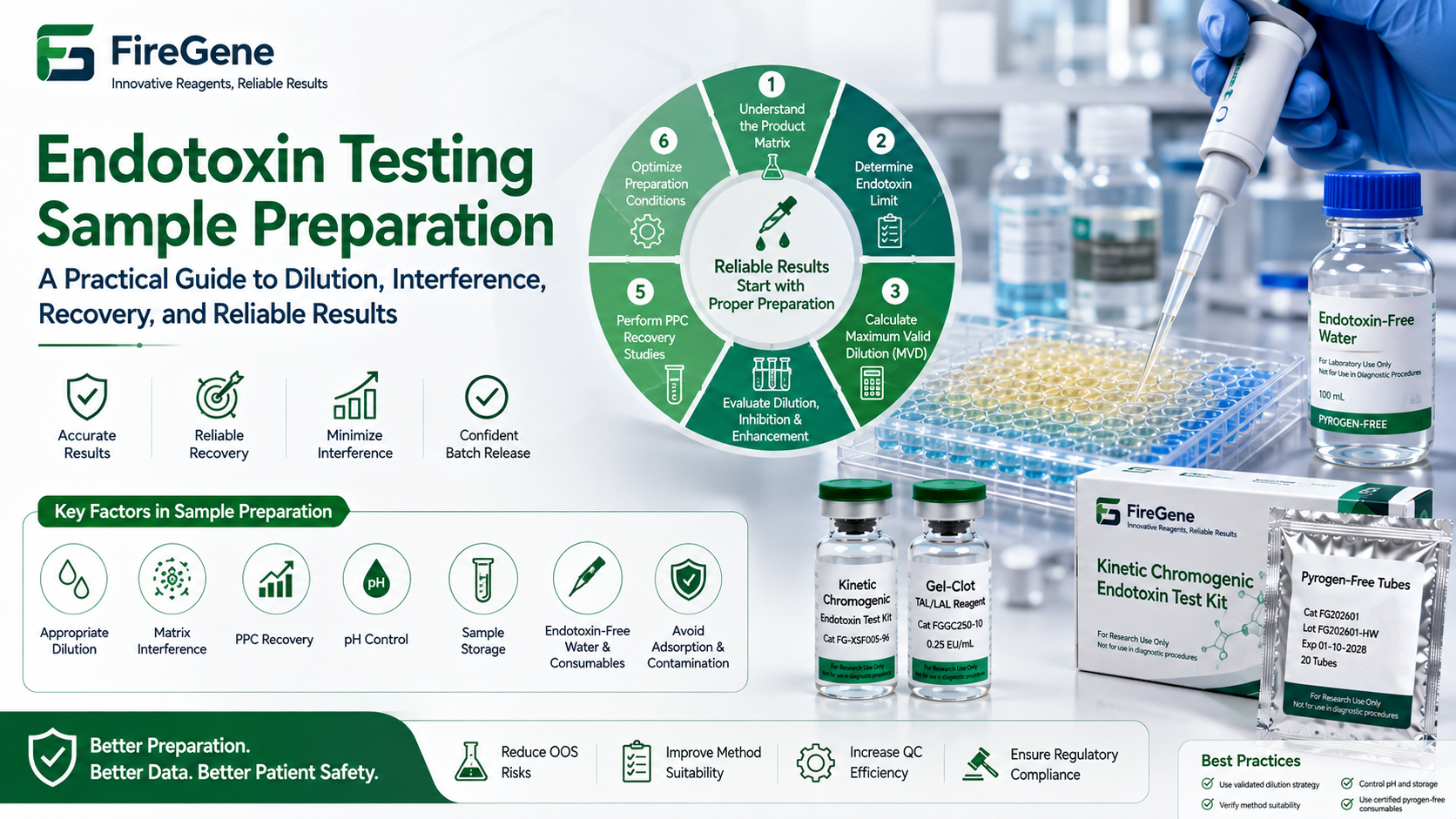
18. A Practical Sample Preparation Workflow
A robust endotoxin sample preparation workflow can be summarized as follows:
Step 1: Understand the product
Review formulation composition, concentration, pH, and intended use.
Step 2: Establish the endotoxin limit
Determine the applicable product-specific endotoxin limit.
Step 3: Calculate MVD
Use the endotoxin limit and assay sensitivity to determine the maximum valid dilution.
Step 4: Select candidate dilutions
Choose several dilution levels below the MVD for method suitability evaluation.
Step 5: Evaluate PPC recovery
Determine whether the sample matrix inhibits or enhances endotoxin detection.
Step 6: Optimize the dilution
Select a dilution that balances recovery, sensitivity, and reproducibility.
Step 7: Standardize sample handling
Define mixing, storage, dilution, and transfer procedures.
Step 8: Validate the procedure
Document the final sample preparation procedure within the analytical method.
Step 9: Monitor performance
Trend PPC recovery and endotoxin results over time.
Step 10: Reassess after significant changes
Use change control to determine whether method suitability requires reevaluation.
Common Sample Preparation Mistakes
Before running an endotoxin test, analysts should check for several common mistakes:
Mistake 1: Testing highly concentrated samples without dilution.
Mistake 2: Using the MVD as the default routine dilution.
Mistake 3: Diluting beyond the validated range.
Mistake 4: Ignoring PPC recovery.
Mistake 5: Using non-pyrogen-free water.
Mistake 6: Reusing improperly controlled containers.
Mistake 7: Ignoring pH-related interference.
Mistake 8: Failing to evaluate LER for high-risk biologic formulations.
Mistake 9: Allowing inconsistent sample storage times.
Mistake 10: Changing the formulation without reassessing method suitability.
Avoiding these errors can significantly improve endotoxin testing reliability.
How FireGene Supports Reliable Sample Preparation
FireGene provides endotoxin testing reagents and supporting consumables designed to help laboratories establish controlled sample preparation workflows.
The FireGene portfolio includes:
- Kinetic Chromogenic Endotoxin Test Kits
- Gel-Clot TAL/LAL Reagents
- Control Standard Endotoxin (CSE)
- Endotoxin-Free Water
- Pyrogen-Free Tubes
These products can support different stages of endotoxin testing, including:
- Routine sample analysis
- Standard curve preparation
- Positive Product Control testing
- Recovery studies
- Method suitability evaluation
- Laboratory contamination control
For laboratories performing high-throughput kinetic chromogenic endotoxin testing, standardized use of compatible reagents, endotoxin-free water, and pyrogen-free consumables can help reduce variability during sample preparation.
Frequently Asked Questions
What is the most important step in endotoxin sample preparation?
There is no single universal step, but establishing an appropriate dilution and demonstrating acceptable recovery are among the most critical considerations. The preparation procedure must minimize matrix interference while maintaining adequate analytical sensitivity.
Can I test an undiluted pharmaceutical sample?
Sometimes, but not automatically. The sample should first be evaluated for assay compatibility. Highly concentrated or complex formulations may require dilution to reduce inhibition or enhancement.
Is the MVD the recommended dilution?
No. MVD represents the maximum valid dilution under the applicable testing conditions. The actual routine dilution should be established based on method suitability and recovery performance.
Why is PPC recovery important?
PPC recovery demonstrates whether the product matrix allows a known endotoxin spike to be detected appropriately. It helps identify inhibition or enhancement that may otherwise produce unreliable results.
Can dilution eliminate LER?
Dilution may reduce some matrix effects, but it does not necessarily eliminate Low Endotoxin Recovery. LER should be evaluated based on the specific formulation and testing conditions.
Why should endotoxin-free water be used?
Non-pyrogen-free water can introduce endotoxin into the sample and cause inaccurate results, particularly when testing products with low endotoxin limits.
Does sample storage affect endotoxin results?
Yes. Storage duration, temperature, formulation composition, container material, and other factors can influence endotoxin detectability in certain products.
When should sample preparation be revalidated?
Significant changes to the formulation, manufacturing process, sample storage, dilution procedure, reagent system, or other critical analytical conditions may trigger method suitability reassessment.
Key Takeaways
Reliable endotoxin testing starts with reliable sample preparation.
The most important principles are:
- Understand the product matrix before selecting a dilution.
- Establish the endotoxin limit before calculating MVD.
- Treat MVD as a maximum—not automatically as the optimal dilution.
- Demonstrate acceptable PPC recovery.
- Evaluate inhibition and enhancement.
- Consider LER when testing complex biologic formulations.
- Control sample pH, storage, mixing, and dilution.
- Use endotoxin-free water and pyrogen-free consumables.
- Standardize the complete preparation workflow.
- Reassess method suitability after significant product or process changes.
Conclusion
Sample preparation is one of the most critical—and frequently underestimated—components of bacterial endotoxin testing.
A reliable endotoxin result depends on much more than the sensitivity of the TAL/LAL reagent. Product composition, dilution, pH, storage, sample handling, consumables, matrix interference, endotoxin recovery, and laboratory technique can all influence the final result.
For simple pharmaceutical solutions, sample preparation may be relatively straightforward. For biologics, monoclonal antibodies, peptide drugs, vaccines, and other complex products, however, sample preparation can become one of the most challenging parts of analytical method development.
The best approach is therefore to treat sample preparation as a scientifically controlled component of the endotoxin testing method.
By establishing the appropriate endotoxin limit, calculating MVD, evaluating multiple dilution levels, demonstrating acceptable PPC recovery, investigating potential LER, and standardizing sample handling, QC laboratories can improve analytical reliability and reduce unnecessary testing failures.
Ultimately, the quality of an endotoxin test is only as strong as the sample preparation behind it. A well-designed preparation strategy helps laboratories generate accurate, reproducible, and scientifically defensible results—supporting efficient QC operations, confident batch release, and pharmaceutical patient safety.
FireGene Endotoxin Testing
Ready to run your endotoxin assay?
FireGene offers a complete endotoxin testing toolkit — from TAL reagents and CSE standards to pyrogen-free consumables and LAL reagent water. All products are aligned with USP <85>, EP 2.6.14, and JP 4.01.


