
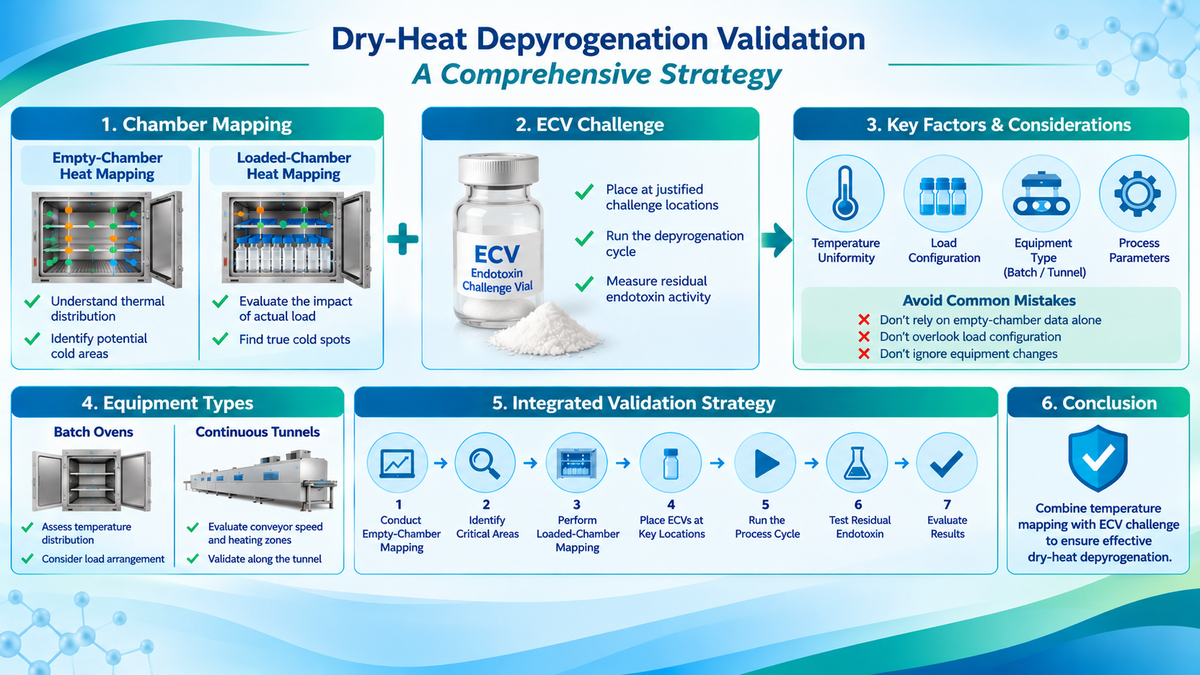
I. Why Chamber Mapping Is Important
Dry-heat depyrogenation depends on delivering sufficient thermal exposure to the materials being processed.
However, the temperature inside a chamber is not necessarily identical at every location.
Airflow patterns, chamber geometry, heating elements, load density, and the physical characteristics of containers can all influence the temperature profile.
This is why temperature mapping is an important part of dry-heat process evaluation.
Two types of studies are particularly relevant:
-
Empty-chamber heat distribution studies
-
Loaded-chamber heat distribution studies
Although they may use similar temperature monitoring equipment, they answer different questions.
II. What Is Empty-Chamber Heat Mapping?
Empty-chamber heat mapping evaluates temperature distribution when the oven or chamber contains no production load.
Temperature sensors are placed at representative locations throughout the chamber.
Depending on the equipment design, these locations may include:
-
Chamber corners
-
Center areas
-
Positions near the door
-
Areas close to the air return
-
Locations near the heating system
The purpose is to understand how the equipment distributes heat without the influence of a production load.
Empty-chamber mapping can help identify temperature variation, potential cold areas, and locations requiring additional investigation.
It also provides useful information about the equipment's basic thermal behavior.
However, empty-chamber results do not necessarily predict temperature distribution under actual operating conditions.
III. What Changes When the Chamber Is Loaded?
Introducing a load can change the way heat moves through the chamber.
For example, densely arranged glass containers may influence airflow differently from an empty chamber.
The load may also affect heating rates and the time required for different materials to reach the intended temperature.
Factors that can influence loaded-chamber conditions include:
1. Load Density
A larger or more densely arranged load may create different airflow conditions.
2. Container Geometry
Different container shapes and dimensions can influence how heat reaches the surfaces and internal spaces.
3. Material Characteristics
The thermal properties and mass of the processed material may affect heating behavior.
4. Loading Arrangement
Spacing, orientation, and stacking can influence local temperature distribution.
Consequently, a location identified as a cold spot during empty-chamber mapping may not remain the coldest location under loaded conditions.
IV. Why Loaded-Chamber Mapping Deserves Special Attention
Loaded-chamber studies evaluate the equipment under conditions closer to actual production.
The loading configuration should be selected according to the validation objective and justified operating conditions.
Where appropriate, maximum or worst-case loading conditions should be evaluated.
Temperature sensors should be positioned to capture relevant chamber locations, while additional sensors may be used to assess heat penetration into representative materials or containers.
The study should document:
-
Load quantity and configuration
-
Sensor identification and placement
-
Temperature recording intervals
-
Actual temperature profiles
-
Heating and cooling behavior
-
Locations with less favorable thermal conditions
The resulting data help establish the thermal conditions experienced by the actual load.
V. How ECVs Complement Heat Mapping
Heat mapping and ECV challenge studies provide different types of evidence.
Heat mapping evaluates temperature distribution.
An Endotoxin Challenge Vial evaluates the reduction of endotoxin activity following the depyrogenation process.
This distinction is important.
A temperature profile alone does not directly demonstrate the amount of endotoxin reduction achieved.
Similarly, an ECV result does not provide a complete picture of chamber temperature uniformity.
Combining these approaches can provide a more comprehensive evaluation.
A practical validation strategy may include:
-
Conducting empty-chamber heat distribution studies.
-
Identifying preliminary areas requiring attention.
-
Conducting loaded-chamber heat distribution studies.
-
Evaluating relevant cold locations under the actual loading configuration.
-
Placing ECVs at justified challenge locations.
-
Running the approved process cycle.
-
Measuring residual endotoxin activity.
-
Evaluating results against predefined acceptance criteria.
The placement of ECVs should be based on the validation study design, not simply on convenient locations.
VI. Batch Ovens and Continuous Depyrogenation Tunnels
The mapping strategy may differ depending on equipment type.
Batch Ovens
For batch ovens, attention is generally directed toward temperature distribution throughout the chamber and the effect of the loading arrangement.
The study should consider how the load influences heating conditions during the complete cycle.
Continuous Tunnels
For continuous tunnels, the validation strategy should also consider conveyor speed, heating-zone exposure, and the temperature profile along the tunnel.
Different conveyor positions may experience different thermal conditions.
The relationship between conveyor speed and exposure time is particularly important.
For this reason, challenge placement and temperature monitoring should be justified according to the tunnel design and process configuration.
VII. Common Mistakes in Chamber Mapping
Several issues can weaken the interpretation of heat distribution studies.
Using empty-chamber results as the only evidence
Empty-chamber data do not necessarily represent actual production conditions.
Failing to document the load configuration
Without accurate load information, it may be difficult to determine whether the study represents routine operation.
Assuming the cold spot never changes
The coldest location may change when the loading pattern or equipment conditions change.
Using ECVs without considering thermal mapping
ECV placement should be scientifically justified and linked to the validation study design.
Ignoring equipment changes
Changes to airflow, heating components, or conveyor settings may affect previously established thermal conditions.
VIII. Building a More Complete Validation Strategy
A strong validation strategy should integrate equipment qualification, temperature mapping, load evaluation, and endotoxin challenge testing.
The objective is to understand both the thermal environment and the actual endotoxin reduction achieved under the tested conditions.
For additional guidance, see FireGene's ECV resources:
-
ECV placement and worst-case depyrogenation validation: https://firegene.com/blogs/knowledge-center
-
ECV product information: https://firegene.com/products/endotoxin-challenge-vial-ecv?variant=48118964650196
IX. Conclusion
Empty-chamber and loaded-chamber heat mapping are not interchangeable.
Empty-chamber studies help characterize the equipment's thermal distribution, while loaded-chamber studies evaluate the influence of actual process loads.
When combined with properly designed ECV challenge studies, these investigations can provide complementary evidence supporting dry-heat depyrogenation validation.
The most reliable approach is to evaluate the equipment, load, and endotoxin reduction as connected but distinct parts of the validation strategy.
References
-
USP General Chapter <1228.1>, Dry Heat Depyrogenation: https://doi.org/10.31003/USPNF_M8098_01_01
-
USP General Chapter <1228.5>, Endotoxin Indicators for Depyrogenation: https://doi.org/10.31003/USPNF_M10256_01_01
-
ISPE, Validation of a Depyrogenation Tunnel: https://ispe.org/pharmaceutical-engineering/ispeak/validation-depyrogenation-tunnel
FireGene Endotoxin Testing
Ready to run your endotoxin assay?
FireGene offers a complete endotoxin testing toolkit — from TAL reagents and CSE standards to pyrogen-free consumables and LAL reagent water. All products are aligned with USP <85>, EP 2.6.14, and JP 4.01.


