
Endotoxin testing is an essential quality-control step in pharmaceutical, biologics, medical device, and life science research. Because bacterial endotoxins can cause severe pyrogenic reactions, sensitive and reliable endotoxin detection is critical for products intended for parenteral administration and other applications where endotoxin contamination must be controlled.
One of the most important parameters when selecting an LAL/TAL endotoxin assay is assay sensitivity. Sensitivity is commonly expressed in EU/mL (Endotoxin Units per milliliter) and indicates the lowest endotoxin concentration that a particular assay can reliably detect under specified conditions.
But what do different sensitivity levels mean in practice? And how should researchers select the appropriate sensitivity for their samples?
This guide explains common endotoxin assay sensitivities, their typical applications, and the factors that should be considered when choosing an endotoxin test method.
What Is Endotoxin Assay Sensitivity?
In an endotoxin assay, sensitivity refers to the lowest concentration of endotoxin that the assay is designed to detect.
For example, an assay with a sensitivity of 0.03 EU/mL can detect endotoxin at a lower concentration than an assay with a sensitivity of 0.5 EU/mL.
Generally:
Lower EU/mL = higher analytical sensitivity
Common assay sensitivity levels include:
· 0.03 EU/mL
· 0.06 EU/mL
· 0.125 EU/mL
· 0.25 EU/mL
· 0.5 EU/mL
The appropriate sensitivity depends on the sample type, expected endotoxin concentration, dilution factor, applicable endotoxin limit, and assay method.
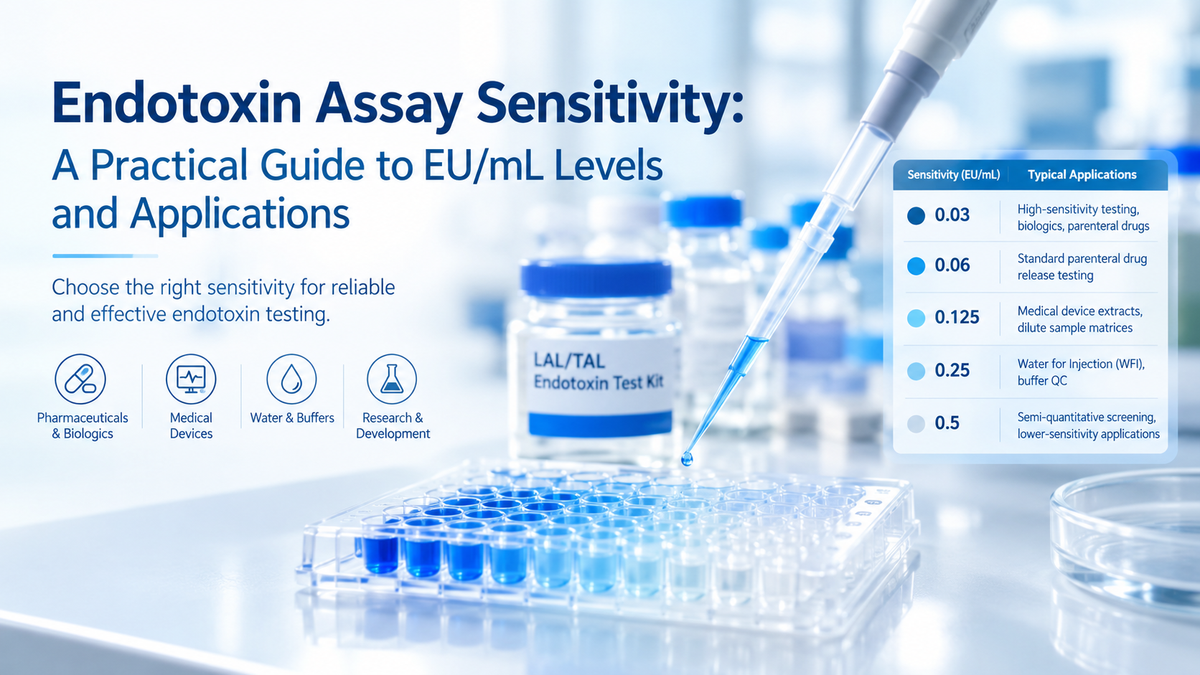
Common Endotoxin Assay Sensitivities and Applications
|
Sensitivity |
Typical Applications |
|
0.03 EU/mL |
High-sensitivity testing, biologics, parenteral drugs |
|
0.06 EU/mL |
Standard parenteral drug release testing |
|
0.125 EU/mL |
Medical device extracts, dilute sample matrices |
|
0.25 EU/mL |
Water for Injection (WFI), buffer QC |
|
0.5 EU/mL |
Semi-quantitative screening, lower-sensitivity applications |
These categories are general examples rather than universal regulatory assignments. The required assay sensitivity should always be determined based on the specific product, test procedure, and applicable requirements.
1. 0.03 EU/mL: High-Sensitivity Endotoxin Testing
A 0.03 EU/mL sensitivity is suitable when very low levels of endotoxin need to be detected.
High-sensitivity endotoxin testing can be particularly useful for:
· Biologics
· Parenteral drug products
· Sensitive research samples
· Low-endotoxin formulations
· Samples requiring a low detection threshold
Biological products can contain complex components that make endotoxin testing more challenging. A highly sensitive assay can provide a useful analytical range for detecting low levels of contamination.
However, higher sensitivity does not automatically mean that an assay is better for every sample. If a sample requires substantial dilution because of interference, the effective detection capability must also be considered.
2. 0.06 EU/mL: Routine Parenteral Testing
An assay sensitivity of 0.06 EU/mL can be appropriate for routine endotoxin testing where a relatively low detection threshold is required.
Potential applications include:
· Pharmaceutical quality control
· Parenteral drug testing
· Biopharmaceutical development
· Process monitoring
· Batch release testing
For routine QC laboratories, the balance between sensitivity, assay performance, sample compatibility, and testing cost is often more important than simply selecting the lowest available sensitivity.
A practical endotoxin assay should provide consistent results while maintaining appropriate detection capability for the intended sample.
3. 0.125 EU/mL: Medical Device Extracts and Dilute Samples
0.125 EU/mL sensitivity may be useful for testing medical device extracts and certain diluted sample matrices.
Medical device endotoxin testing can involve extraction procedures in which endotoxin is transferred from the device into an extraction solution. The resulting sample may require dilution or other preparation before testing.
In these situations, researchers should consider:
· Extraction volume
· Sample concentration
· Dilution factor
· Potential assay interference
· Applicable endotoxin acceptance criteria
The sensitivity of the assay should be sufficient to detect endotoxin at concentrations relevant to the final testing requirement.
4. 0.25 EU/mL: Water and Buffer Quality Control
An endotoxin assay with 0.25 EU/mL sensitivity can be useful for certain routine water and buffer QC applications.
Water is particularly important in endotoxin testing because contaminated water can introduce additional endotoxin into the sample.
For example, laboratory personnel may use endotoxin-controlled water for:
· Reagent preparation
· Sample dilution
· Buffer preparation
· Endotoxin standards
· Routine laboratory testing
For pharmaceutical applications, however, the relevant water specification should be evaluated according to the applicable pharmacopeial or regulatory requirements rather than selecting an assay based solely on nominal sensitivity.
5. 0.5 EU/mL: Screening and Lower-Sensitivity Applications
An assay sensitivity of 0.5 EU/mL may be appropriate when extremely low endotoxin detection is not required.
Potential applications include:
· Preliminary screening
· Process monitoring
· Research applications
· Samples expected to contain relatively higher endotoxin levels
· Lower-sensitivity testing workflows
Using an unnecessarily sensitive assay can sometimes increase the impact of sample interference or require additional dilution and optimization.
Therefore, assay selection should be based on the actual testing objective rather than simply choosing the lowest EU/mL value.
Sensitivity vs. Endotoxin Limit: What Is the Difference?
One common misunderstanding is treating assay sensitivity and endotoxin limit as the same thing.
They are not.
Assay sensitivity describes the analytical detection capability of the test method.
Endotoxin limit refers to the maximum allowable endotoxin level for a specific product or application under the applicable requirements.
For pharmaceutical products, the endotoxin limit may depend on factors such as:
· Route of administration
· Dose
· Product type
· Patient exposure
· Applicable regulatory requirements
Therefore, a laboratory should first determine the relevant endotoxin acceptance criterion and then select an assay whose sensitivity and validated working range are appropriate for that requirement.
How to Choose the Right Endotoxin Assay Sensitivity
Choosing the right sensitivity involves more than comparing EU/mL numbers.
1. Determine the expected endotoxin concentration
If the expected endotoxin level is very low, a higher-sensitivity assay may be necessary.
2. Consider sample dilution
Sample dilution can reduce interference, but it also changes the effective detection capability of the assay.
3. Evaluate inhibition and enhancement
Certain pharmaceutical ingredients, buffers, surfactants, and biological matrices can interfere with LAL/TAL reactions.
A Positive Product Control (PPC) is commonly used to help evaluate whether the sample matrix interferes with endotoxin recovery.
4. Consider the assay format
Different endotoxin testing formats, including gel-clot, kinetic chromogenic, and other validated methods, may have different workflows and performance characteristics.
5. Balance sensitivity and practicality
The ideal assay should provide sufficient sensitivity while offering reliable reproducibility, manageable sample preparation, and compatibility with the laboratory workflow.
Why Sensitivity Matters in Endotoxin Testing
Selecting the appropriate endotoxin assay sensitivity is essential for obtaining meaningful and reliable test results.
A 0.03 EU/mL assay may be useful for high-sensitivity applications, while 0.5 EU/mL may be sufficient for certain screening workflows. Between these levels, 0.06, 0.125, and 0.25 EU/mL sensitivities can support different testing requirements.
However, sensitivity should never be considered in isolation. Sample matrix, dilution, interference, endotoxin limits, assay range, and validation requirements all influence whether a particular assay is suitable.
For laboratories performing routine endotoxin testing, selecting the right LAL/TAL assay means finding the best balance between sensitivity, reliability, sample compatibility, and cost-effectiveness.
Conclusion
Endotoxin assay sensitivity, expressed in EU/mL, is a key parameter for selecting an appropriate bacterial endotoxin testing method. Lower EU/mL values generally indicate higher analytical sensitivity, but the most sensitive assay is not necessarily the best choice for every application.
By evaluating the sample matrix, expected endotoxin level, dilution requirements, interference potential, and applicable endotoxin limits, laboratories can select an endotoxin assay that provides reliable and practical quality control.


