
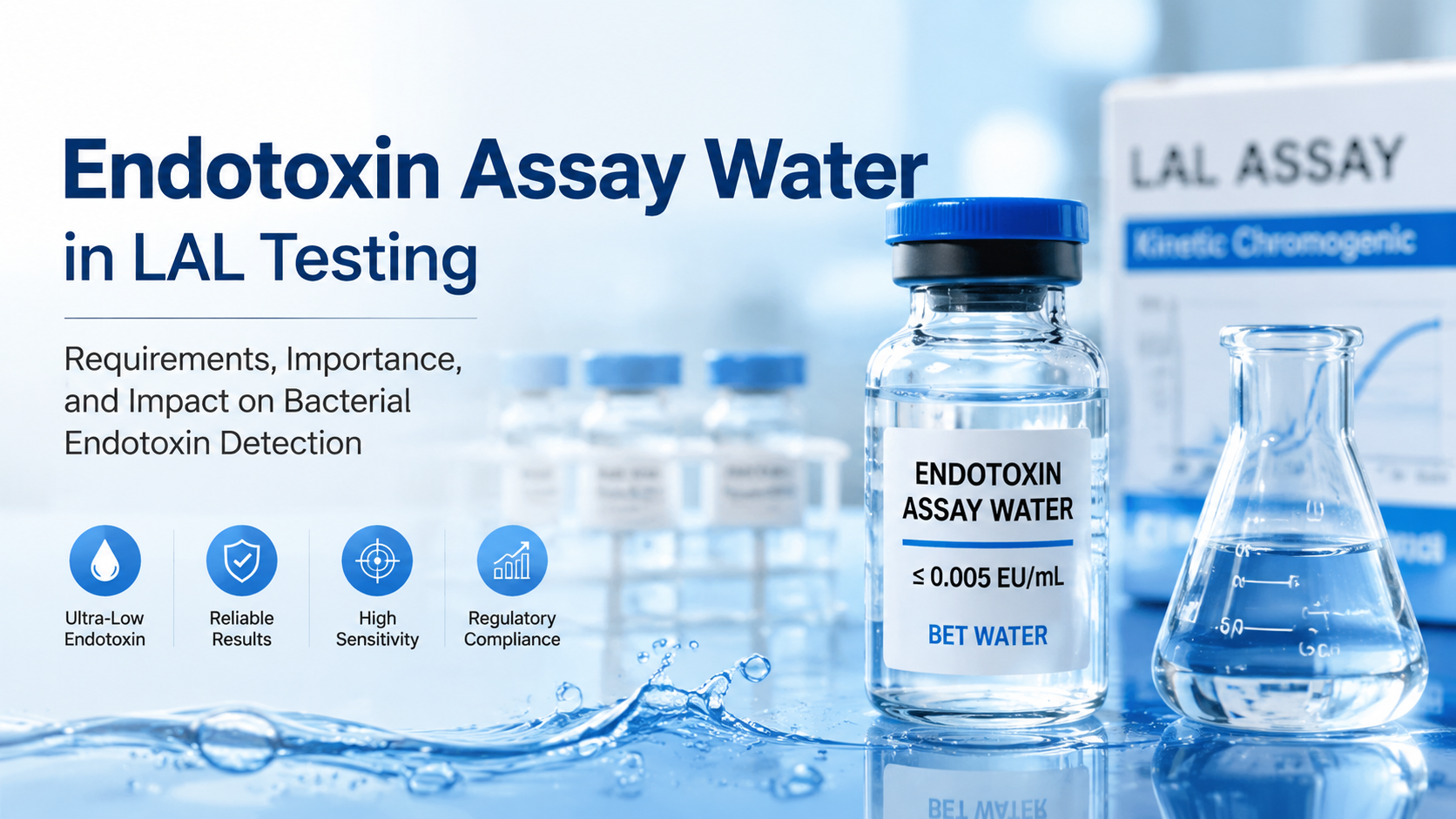
Endotoxin Assay Water, also known as LAL Reagent Water or Water for Bacterial Endotoxins Test (BET), is an essential component in bacterial endotoxin detection workflows. Because LAL and recombinant Factor C (rFC) assays can detect extremely low levels of endotoxin, the quality of test water directly affects assay accuracy, sensitivity, and reliability. This article explains endotoxin limits for BET water, its role in LAL testing, potential problems caused by contaminated water, and best practices for selecting and using endotoxin-free water in pharmaceutical and biotechnology laboratories.
1. Introduction to Endotoxin Assay Water
Bacterial endotoxin testing (BET) is one of the most important quality control procedures in pharmaceutical, biotechnology, and medical device industries. Endotoxins, also known as lipopolysaccharides (LPS), are components of the outer membrane of Gram-negative bacteria. Even trace amounts of endotoxin contamination can trigger strong immune responses in humans, making endotoxin control critical for injectable drugs, vaccines, biological products, and medical devices.
Among various endotoxin detection methods, the Limulus Amebocyte Lysate (LAL) assay and recombinant Factor C (rFC) assay are widely used because of their high sensitivity.
However, the accuracy of these assays depends not only on the quality of reagents but also on the purity of water used during testing. Endotoxin Assay Water, also called LAL Reagent Water or Water for Bacterial Endotoxins Test (BET), is specifically designed to minimize background endotoxin contamination and ensure reliable results.
2. What Is Endotoxin Assay Water?
Endotoxin Assay Water is a highly purified water product manufactured specifically for bacterial endotoxin testing applications.
Unlike ordinary purified water or laboratory-grade ultrapure water, BET water undergoes additional purification and quality control processes to ensure extremely low endotoxin levels.
Common names include:
· Endotoxin Assay Water
· LAL Reagent Water
· BET Water
· Water for Bacterial Endotoxins Test
· Pyrogen-Free Water
These products are primarily used for:
· Reconstitution of LAL reagents
· Preparation of endotoxin standards
· Sample dilution
· Negative controls
· Positive Product Control (PPC) preparation
Because endotoxin detection assays can measure very small amounts of endotoxin, even minor contamination from water can influence experimental results.
3. Endotoxin Limit Requirement for BET Water
According to major pharmacopoeia standards, including:
· USP <85> Bacterial Endotoxins Test
· European Pharmacopoeia (EP) 2.6.14
· Japanese Pharmacopoeia (JP) 4.01
water used for endotoxin testing should meet the following requirement:
Endotoxin concentration: ≤ 0.005 EU/mL
This means:
|
Parameter |
Requirement |
|
Endotoxin level |
≤ 0.005 EU/mL |
|
Equivalent concentration |
≤ 5 EU/L |
|
Application |
LAL, TAL, and rFC testing |
|
Purpose |
Minimize background endotoxin interference |
Some manufacturers may label these products as “endotoxin-free” or “pyrogen-free.” However, the critical quality specification for BET applications is that endotoxin levels remain below the required limit.
4. Why Is Low-Endotoxin Water Critical for LAL Testing?
The LAL assay is based on a highly sensitive biological reaction between endotoxin and enzymes derived from horseshoe crab blood cells.
The detection capability of LAL assays can reach very low concentrations, commonly:
· 0.005–50 EU/mL for many routine assays
· Even lower detection ranges for highly sensitive methods
Because the assay is extremely sensitive, any endotoxin contamination from water can become part of the detected signal.

The final result represents:
Sample endotoxin + background endotoxin contamination
Therefore, the water used in the assay must contribute as little endotoxin background as possible.
5. How Poor-Quality Water Affects Endotoxin Testing
5.1 Increased Background Endotoxin Signal
If water contains excessive endotoxin, it can increase background values during testing.
For example:
Sample endotoxin concentration:
0.10 EU/mL
Water contamination:
0.05 EU/mL
The detected result may become:
0.15 EU/mL
This creates inaccurate results and may cause:
· False-positive results
· Overestimation of endotoxin levels
· Incorrect product quality assessment
5.2 Interference With Endotoxin Standard Curves
A reliable LAL assay requires accurate endotoxin standards for calibration.
Typical standard concentrations may include:
· 1 EU/mL
· 0.1 EU/mL
· 0.01 EU/mL
· 0.001 EU/mL
At low concentrations, contamination from water becomes especially significant.
For example:
Prepared standard:
0.01 EU/mL
Water background:
0.005 EU/mL
The actual signal may increase by approximately 50%.
This can lead to:
· Incorrect standard curve calculation
· Poor correlation coefficient
· Reduced assay precision
· Failed assay validation

5.3 Failure of Negative Controls
Negative controls are essential in BET testing.
Normally, the negative control contains:
· LAL reagent
· BET water
· Dilution solution
A qualified negative control should show no detectable endotoxin reaction.
If contaminated water is used, possible outcomes include:
· Increased blank absorbance
· Unexpected gel formation in gel clot assays
· Elevated fluorescence signals in rFC assays
As a result, the entire test run may fail.
5.4 Incorrect Positive Product Control Recovery
Many endotoxin assays require Positive Product Control (PPC) testing to evaluate sample interference.
The acceptable endotoxin recovery range is generally:
50–200%
Water containing endotoxin contamination may artificially increase recovery values.
Possible consequences include:
· PPC recovery above acceptance criteria
· Incorrect interpretation of sample interference
· Failed method suitability testing
6. Endotoxin Assay Water in Different Detection Methods
Endotoxin Assay Water is compatible with multiple endotoxin detection technologies.
|
Detection Method |
Water Requirement |
|
Gel Clot LAL |
LAL Reagent Water |
|
Kinetic Turbidimetric LAL |
BET Water |
|
Kinetic Chromogenic LAL |
Endotoxin Assay Water |
|
Recombinant Factor C (rFC) |
Low Endotoxin Water |
Regardless of the detection platform, minimizing background endotoxin is essential for reliable quantification.
7. Endotoxin Assay Water vs. Regular Ultrapure Water
Many laboratories use ultrapure water systems that provide:
· High resistivity
· Low total organic carbon (TOC)
· Low chemical impurities
However, ultrapure water does not always meet BET requirements.
Potential endotoxin sources include:
· Bacterial growth in water systems
· Biofilm formation in pipelines
· Storage container contamination
· Improper handling
Therefore, BET testing requires specially controlled water with:
· Low endotoxin levels
· Pyrogen-free processing
· Appropriate packaging
· Quality verification
8. Best Practices for Using Endotoxin Assay Water
8.1 Use BET Water for Standard Preparation
Endotoxin standards should always be prepared using qualified endotoxin assay water.
Avoid using:
· Tap water
· Distilled water
· General laboratory water
because these may introduce uncontrolled endotoxin background.
8.2 Use BET Water for Sample Dilution
When samples require dilution during endotoxin testing, the dilution solution should not introduce additional endotoxin.
Using qualified BET water improves:
· Accuracy
· Reproducibility
· Method validation performance
8.3 Store and Handle Properly
Even high-quality endotoxin assay water can become contaminated after opening.
Recommended practices:
· Use sterile, pyrogen-free containers
· Avoid repeated opening and closing
· Minimize exposure time
· Follow manufacturer storage recommendations
9. Conclusion
Endotoxin Assay Water, LAL Reagent Water, and BET Water play a fundamental role in reliable bacterial endotoxin detection. With an endotoxin specification of ≤0.005 EU/mL, qualified BET water provides a controlled low-background environment for LAL and rFC assays.
Poor-quality water can negatively affect testing performance by increasing background signals, shifting standard curves, causing negative control failures, and producing inaccurate endotoxin measurements.
For pharmaceutical, biotechnology, and research laboratories, selecting high-quality endotoxin assay water is not simply a routine reagent choice—it is a critical step to ensure accurate, reproducible, and compliant endotoxin testing results.


