
Introduction
For decades, bacterial endotoxin testing has been an essential component of pharmaceutical quality control.
But the role of endotoxin testing is changing.
Traditional endotoxin testing was often viewed primarily as a batch-release test: analyze a sample, determine whether the endotoxin result meets the specification, and release or reject the batch.
Today, pharmaceutical manufacturing is moving toward a much more data-driven model.
Biologics are becoming more complex. Manufacturing processes are becoming more sophisticated. QC laboratories are handling larger numbers of samples. At the same time, regulators and pharmaceutical manufacturers are increasingly interested in alternative, nonanimal-derived endotoxin testing technologies.
These changes are making kinetic chromogenic endotoxin testing increasingly relevant.
Unlike a simple qualitative endpoint, kinetic chromogenic testing generates quantitative optical data by monitoring the development of color over time. This makes it particularly attractive for laboratories that need quantitative results, higher throughput, automated workflows, and long-term endotoxin trending.
At the same time, the 2026 regulatory environment is creating an important new dimension.
The FDA's March 2026 revised guidance on pyrogen and endotoxin testing explicitly broadens its discussion beyond traditional LAL testing and addresses recombinant reagent approaches. FDA states that manufacturers using recombinant reagents should verify that the assay is suitable for its intended purpose.
USP <86>, Bacterial Endotoxins Test Using Recombinant Reagents, also provides additional techniques using nonanimal-derived reagents, including recombinant Factor C and recombinant cascade reagent approaches.
So where does kinetic chromogenic testing fit into this rapidly changing landscape?
The answer requires looking beyond the instrument or reagent itself.
A reliable kinetic chromogenic endotoxin workflow depends on:
Qualified Reagent + Appropriate Instrument + Sample Preparation + Method Suitability + PPC Recovery + Contamination Control + Data Interpretation
This guide explains how pharmaceutical laboratories can understand, implement, and optimize kinetic chromogenic endotoxin testing in 2026.
1. What Is Kinetic Chromogenic Endotoxin Testing?
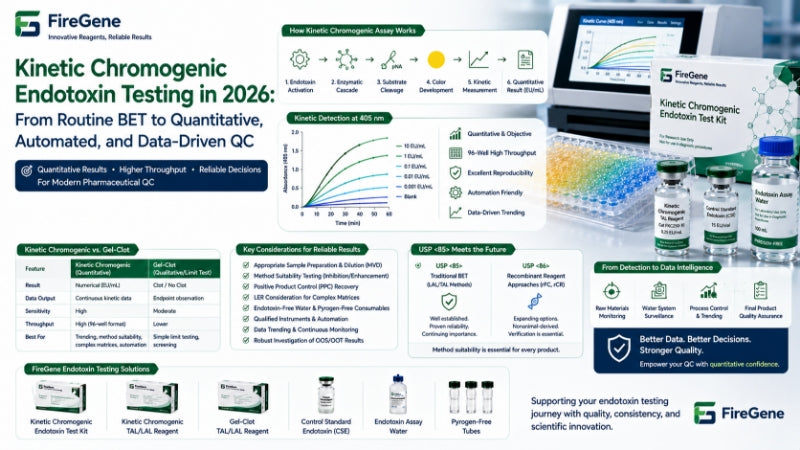
Kinetic chromogenic endotoxin testing is a quantitative photometric bacterial endotoxin test.
The basic principle is based on an endotoxin-triggered enzymatic cascade.
When endotoxin is present, it activates the appropriate pathway within the endotoxin reagent. The activated enzymes then react with a synthetic chromogenic substrate, producing a colored compound.
The instrument continuously or periodically measures absorbance during the reaction.
The analytical signal can be expressed through:
- Reaction time
- Reaction rate
- Absorbance change
- Standard curve response
The sample endotoxin concentration is then calculated based on the validated calibration relationship.
In simplified form:
Endotoxin → Enzymatic Cascade → Chromogenic Substrate → Color Development → Absorbance → Quantitative Endotoxin Result
This is fundamentally different from simply observing whether a visible gel forms.
2. Why Is Kinetic Chromogenic Testing Becoming More Important in 2026?
Several industry trends are converging.
More complex pharmaceutical products
Modern pipelines increasingly include:
- Monoclonal antibodies
- Recombinant proteins
- Peptides
- Vaccines
- Cell and gene therapy products
- Advanced injectable formulations
- Lipid-containing formulations
These products can create challenging sample matrices.
Higher QC throughput
Pharmaceutical laboratories may need to test:
- Raw materials
- Excipients
- Pharmaceutical water
- Process intermediates
- Drug substances
- Drug products
- Stability samples
- Method suitability samples
A 96-well kinetic format can make large testing programs more manageable.
Greater demand for quantitative data
Instead of simply asking whether a product passes a limit, laboratories increasingly want to know:
How much endotoxin is present?
and:
How is the endotoxin level changing over time?
Increasing interest in nonanimal-derived methods
USP <86> and the FDA's 2026 guidance demonstrate the growing regulatory attention toward recombinant endotoxin testing approaches.
These trends are collectively pushing endotoxin testing toward a more quantitative and data-driven future.
3. How Does the Kinetic Chromogenic Reaction Work?
Although the exact reagent architecture depends on the assay, the general concept can be illustrated as follows:
Step 1 — Endotoxin recognition
Endotoxin activates the endotoxin-sensitive pathway.
Step 2 — Enzymatic activation
The cascade produces activated enzymes.
Step 3 — Chromogenic substrate cleavage
The activated enzymes cleave a synthetic substrate.
Step 4 — Color development
A colored reaction product is generated.
Step 5 — Optical measurement
A microplate reader measures absorbance.
Step 6 — Kinetic calculation
The software evaluates the reaction behavior.
Step 7 — Quantification
The sample concentration is calculated using the validated standard curve.
The key advantage is that the laboratory obtains quantitative kinetic information rather than only a visual endpoint.
4. Why 96-Well Plates Are Important for Modern Endotoxin Testing
The 96-well format has become an important part of high-throughput endotoxin testing.
A single plate can accommodate combinations of:
- Standards
- Blank controls
- Negative controls
- PPC samples
- Product samples
- Replicates
This allows laboratories to perform multiple measurements within one analytical run.
For example, a typical workflow might include:
Standard Curve
↓
Negative Control
↓
PPC
↓
Sample Replicates
↓
Additional Controls
The exact plate layout should always follow the validated analytical procedure and reagent manufacturer's instructions.
For laboratories running large numbers of samples, the format can significantly reduce repetitive manual operations compared with one-sample-at-a-time workflows.
5. Kinetic Chromogenic vs. Gel-Clot Endotoxin Testing
Gel-clot testing remains an important endotoxin testing method.
Its major advantage is simplicity.
The basic result is determined by whether an appropriate clot forms under defined conditions.
Kinetic chromogenic testing provides a different type of information.
Instead of:
Clot / No Clot
the laboratory obtains:
Quantitative Optical Data
This can be particularly useful when the laboratory needs to:
- Trend endotoxin levels
- Compare batches
- Investigate OOS or OOT results
- Evaluate process changes
- Study raw materials
- Perform recovery experiments
- Monitor water systems
- Support higher-throughput QC
However, this does not mean kinetic chromogenic testing is automatically superior for every application.
The appropriate method depends on:
- Product characteristics
- Required sensitivity
- Endotoxin limit
- Matrix complexity
- Equipment
- Throughput
- Validated method performance
- Applicable regulatory requirements
Method selection should therefore be risk-based and product-specific.
6. Kinetic Chromogenic Testing and USP <85>
USP <85>, Bacterial Endotoxins Test, remains a major reference for bacterial endotoxin testing.
FDA's March 2026 guidance specifically discusses the principles of gel-clot, photometric, and kinetic testing and provides recommendations related to USP <85> and endotoxin testing of drugs, biological products, and devices.
For laboratories using a kinetic chromogenic approach, this means that the method should not be viewed simply as:
"A reagent plus a plate reader."
It is a complete analytical procedure.
The laboratory needs to establish and control:
- Reagent preparation
- Standard preparation
- Sample preparation
- Dilution
- Incubation
- Instrument parameters
- Standard curve
- Controls
- PPC recovery
- Calculations
- Acceptance criteria
The analytical system must be demonstrated to work appropriately for the intended product.
7. USP <86>: Why Recombinant Reagents Are Changing the Landscape
One of the most significant developments in endotoxin testing is USP <86>.
USP <86> introduces additional bacterial endotoxin testing techniques using nonanimal-derived reagents.
These include:
Recombinant Factor C
rFC-based methods use recombinant Factor C as the endotoxin recognition component.
Recombinant Cascade Reagent
rCR systems can contain recombinant Factor C, Factor B, and recombinant proclotting enzyme, reproducing multiple components of the endotoxin-responsive cascade.
The significance goes beyond reagent chemistry.
It represents a broader shift toward:
Alternative → Recombinant → Quantitative → Automated → Data-Driven Endotoxin Testing
FDA recognized USP <86> as a consensus standard for medical devices in December 2025, while the agency's March 2026 guidance also explicitly discusses recombinant reagent approaches.
8. Does USP <86> Mean Traditional LAL/TAL Testing Is Obsolete?
No.
This is an important point for QC laboratories.
The introduction of recombinant reagent technologies does not mean that conventional LAL/TAL methods suddenly become invalid.
Traditional LAL/TAL-based endotoxin testing has:
- Extensive historical use
- Established analytical procedures
- Existing validation experience
- Broad laboratory familiarity
- Existing commercial infrastructure
For a laboratory with a validated kinetic chromogenic TAL/LAL method, changing the reagent system may require significant work.
Potential considerations include:
- Method verification
- Comparability
- SOP revision
- Analyst training
- Instrument compatibility
- Data review
- Regulatory assessment
FDA's 2026 guidance explicitly states that sponsors using recombinant reagents should verify that the assay method is suitable for its intended purpose.
Therefore, the future is more likely to be about method selection and fit-for-purpose testing than a simple replacement of one technology by another.
9. Method Suitability Is Still the Core of Reliable Endotoxin Testing
One of the biggest mistakes in endotoxin testing is assuming that a reagent that performs well in a standard solution will automatically perform well in every pharmaceutical formulation.
It will not.
A pharmaceutical matrix can affect the reaction through:
- Inhibition
- Enhancement
- pH effects
- Protein interactions
- Chelation
- Surfactant effects
- Optical interference
- Endotoxin masking
Therefore, laboratories need to establish method suitability for the specific sample matrix.
This remains true whether the laboratory uses:
- Traditional LAL/TAL
- rFC
- rCR
- Kinetic chromogenic
- Other validated photometric approaches
USP's current endotoxin guidance work specifically highlights test interferences, PPC criteria, laboratory materials, calculations, OOS investigations, and recombinant reagents as important areas of endotoxin-testing practice.
10. PPC Recovery: The Control That Should Never Be Ignored
Positive Product Control, or PPC, is one of the most important elements of method suitability.
The concept is simple.
A known amount of endotoxin is introduced into the product matrix.
The laboratory then measures the recovery.
If the recovery is outside the established acceptance range, the product matrix may be interfering with the test.
Potential causes include:
- Inhibition
- Enhancement
- Inappropriate dilution
- Product concentration
- pH
- Formulation components
- Endotoxin masking
PPC should therefore be viewed as analytical evidence, not merely a checkbox on the worksheet.
A good QC laboratory asks:
Why did the PPC recover the way it did?
rather than simply:
Did the PPC pass?
11. Low Endotoxin Recovery Is an Increasing Concern for Biologics
LER has become one of the most discussed challenges in modern endotoxin testing.
Certain pharmaceutical formulations can interact with endotoxin in ways that reduce its availability to the assay.
This can produce an apparently low endotoxin result.
The problem is particularly relevant for some formulations containing combinations of:
- Proteins
- Surfactants
- Chelating agents
- Specific buffers
The analytical challenge is that the result may look acceptable while the assay's ability to detect endotoxin has been compromised.
This is why laboratories testing biologics should distinguish between:
Simple dilution-based inhibition
and
Potential endotoxin masking / LER
FireGene's previous guide Understanding Low Endotoxin Recovery (LER): Mechanisms, Regulatory Perspectives, and Practical Solutions in 2026 provides a dedicated discussion of this issue.
12. Sample Preparation Can Be More Important Than the Reader
A high-quality microplate reader does not guarantee a high-quality endotoxin result.
The analytical workflow begins before the plate enters the instrument.
Important sample preparation parameters include:
- Sample concentration
- Dilution factor
- MVD
- pH
- Mixing
- Holding time
- Storage
- Container compatibility
For example, excessive dilution may reduce matrix interference but can also move the endotoxin concentration below the assay's useful analytical range.
Insufficient dilution may leave matrix interference unresolved.
The objective is therefore not:
Maximum Dilution
but:
Appropriate Validated Dilution
FireGene's Endotoxin Testing Sample Preparation: A Practical Guide to Dilution, Interference, Recovery, and Reliable Results can be used as a complementary resource for this topic.
13. Why Pharmaceutical Water Still Matters
Kinetic chromogenic testing is highly sensitive.
That is an advantage—but it also means the laboratory must control its background endotoxin sources.
One of the most important is laboratory water.
Ordinary laboratory water should not automatically be assumed to be suitable for endotoxin testing.
Water used for:
- Reagent preparation
- Standard dilution
- Sample dilution
- Assay preparation
should meet the applicable endotoxin requirements for its intended use.
FireGene's Endotoxin Assay Water is designed for laboratory endotoxin testing applications and can support reagent reconstitution and standard/sample preparation.
This is also why water system monitoring is important beyond the analytical laboratory itself.
See Why Water System Monitoring Is the Foundation of Reliable Endotoxin Testing for a deeper discussion.
14. The Importance of Pyrogen-Free Consumables
The same principle applies to laboratory consumables.
If a tube, pipette tip, microplate, vial, or other contact surface introduces endotoxin into the assay, the analytical system can produce misleading results.
Potential consequences include:
- False-positive results
- Elevated blanks
- Unexpected standard behavior
- Increased background
- Poor reproducibility
Therefore, endotoxin testing requires a controlled laboratory environment.
FireGene's portfolio includes pyrogen-free tubes and other endotoxin-testing consumables designed to reduce the risk of introducing exogenous endotoxin during testing.
15. Automation Is One of the Biggest Opportunities for Kinetic Chromogenic Testing
Because kinetic chromogenic assays are plate-based and quantitative, they can be integrated into automated laboratory workflows.
A potential workflow is:
Sample Identification
↓
Automated Dilution
↓
Plate Preparation
↓
Reagent Addition
↓
Kinetic Incubation
↓
405 nm Measurement
↓
Standard Curve Calculation
↓
Automated Result Review
↓
Electronic Data Management
This can reduce manual pipetting and increase throughput.
However, automation introduces new validation considerations.
Laboratories should control:
- Pipetting accuracy
- Plate mapping
- Software configuration
- Instrument qualification
- Data integrity
- Audit trails
- Calculation algorithms
Automation should therefore be viewed as a tool for improving consistency—not as a replacement for analytical controls.
16. Why Quantitative Endotoxin Data Matters
One of the strongest advantages of kinetic chromogenic testing is the amount of numerical information generated.
Imagine a manufacturing process producing the following endotoxin results:
0.012 EU/mL
↓
0.019 EU/mL
↓
0.026 EU/mL
↓
0.034 EU/mL
↓
0.048 EU/mL
Every result could potentially remain below the applicable specification.
But the trend deserves attention.
Quantitative data can help QC teams identify:
- Process drift
- Water system changes
- Supplier changes
- Raw material deterioration
- Cleaning problems
- Developing contamination
This moves endotoxin testing from:
Pass / Fail
toward:
Monitor / Trend / Predict / Investigate
That is one of the most important reasons kinetic chromogenic testing fits naturally into modern pharmaceutical QC.
17. Kinetic Chromogenic Testing for Raw Materials
Endotoxin testing is not limited to final drug products.
Raw materials can be important control points.
Potentially relevant materials include:
- Excipients
- Buffers
- Amino acids
- Proteins
- Sugars
- Process intermediates
- Biological materials
A risk-based raw material strategy can help prevent endotoxin from entering the manufacturing process in the first place.
The overall strategy can be visualized as:
Supplier Qualification
↓
Incoming Material Testing
↓
Process Monitoring
↓
Final Product Testing
This is generally stronger than relying exclusively on final-product testing.
18. Kinetic Chromogenic Testing for Pharmaceutical Water
Water systems are another natural application for quantitative endotoxin testing.
Potential monitoring locations include:
- Purification systems
- Storage tanks
- Distribution loops
- Points of use
Quantitative results can help laboratories establish historical baselines.
The objective is not simply to identify an isolated failure.
It is also to identify changes in system behavior.
A stable water system should produce a predictable pattern.
Unexpected increases should trigger appropriate investigation based on the site's procedures and risk assessment.
19. Kinetic Chromogenic Testing for Biologics
Biologics can be particularly challenging because their formulations may contain multiple components capable of affecting endotoxin detection.
Examples include:
- Monoclonal antibodies
- Recombinant proteins
- Peptides
- Vaccines
- Cell therapy-related materials
- Gene therapy-related materials
Potential analytical issues include:
- High protein concentration
- Surfactant interactions
- Chelation
- pH effects
- Endotoxin masking
- Optical interference
Therefore, the implementation of a kinetic chromogenic method for biologics should include robust method suitability studies.
FireGene's related article Endotoxin Testing for Monoclonal Antibody Manufacturing: Challenges and Best Practices provides additional context.
20. What Should a Modern Kinetic Chromogenic Workflow Include?
A robust workflow can be divided into seven layers.
Layer 1 — Reagent
Qualified TAL/LAL or recombinant reagent.
Layer 2 — Standards
Appropriate endotoxin standards and controls.
Layer 3 — Water
Qualified endotoxin-controlled water.
Layer 4 — Consumables
Pyrogen-free tubes, plates, tips, and related materials.
Layer 5 — Instrument
A compatible kinetic microplate reader.
Layer 6 — Method
Validated sample preparation, dilution, PPC, and acceptance criteria.
Layer 7 — Data
Standard curve, sample results, trend analysis, and investigation records.
The important point is that the reagent is only one component of the system.
21. Common Mistakes When Implementing Kinetic Chromogenic Endotoxin Testing
Mistake 1: Choosing the reagent before understanding the product
The product matrix should influence method selection.
Mistake 2: Assuming more dilution is always better
Dilution can reduce interference but can also reduce analytical sensitivity.
Mistake 3: Ignoring PPC behavior
Poor recovery may reveal matrix interference.
Mistake 4: Using ordinary laboratory consumables
They may introduce background endotoxin.
Mistake 5: Treating the microplate reader as the entire analytical system
Reader qualification alone does not establish method suitability.
Mistake 6: Ignoring LER
Low endotoxin recovery can produce misleadingly low results.
Mistake 7: Looking only at pass/fail
Quantitative results can reveal trends that individual batch decisions cannot.
Mistake 8: Assuming USP <86> eliminates verification
FDA's current guidance emphasizes that recombinant reagent methods still need to be demonstrated suitable for their intended use.
22. A Practical Implementation Roadmap
For laboratories considering or upgrading a kinetic chromogenic endotoxin testing workflow, the following sequence can be useful.
Step 1: Define the testing objective
Determine whether the method will be used for:
- Raw materials
- Water
- In-process samples
- Drug substances
- Drug products
- Release testing
- Method suitability
Step 2: Determine the endotoxin limit
Establish the applicable product-specific endotoxin requirement.
Step 3: Evaluate the matrix
Identify components that may cause interference.
Step 4: Select the analytical method
Compare gel-clot, kinetic chromogenic, kinetic turbidimetric, or recombinant approaches as appropriate.
Step 5: Confirm instrument compatibility
Verify wavelength, kinetic capability, temperature control, plate format, and software.
Step 6: Develop sample preparation
Establish dilution and other sample-handling conditions.
Step 7: Perform method suitability
Evaluate PPC recovery and relevant interference.
Step 8: Validate or verify the method
Follow the applicable compendial and regulatory framework.
Step 9: Establish routine QC
Create SOPs, training, controls, and documentation.
Step 10: Trend the data
Use quantitative results to support ongoing process understanding.
23. What Does the Future of Kinetic Chromogenic Testing Look Like?
The future is unlikely to be defined by a single endotoxin testing technology.
Instead, several technologies will coexist.
Traditional LAL/TAL methods will continue to be important.
Recombinant Factor C and recombinant cascade reagent approaches will continue gaining attention.
Automation will increase.
96-well workflows will become more common in high-throughput laboratories.
And quantitative endotoxin data will become increasingly valuable for quality trending.
The broader direction can be summarized as:
Qualitative → Quantitative
Manual → Automated
Single Result → Trend Analysis
Animal-Derived → Increasingly Nonanimal-Derived Options
Final Testing → Lifecycle Control
The FDA's March 2026 guidance reflects this changing landscape by broadening its discussion of endotoxin testing to accommodate recombinant reagents while emphasizing suitability for the intended use.
24. Why FireGene Kinetic Chromogenic Endotoxin Testing Can Support Modern QC Workflows
For laboratories looking for a quantitative TAL/LAL-based workflow, FireGene's Kinetic Chromogenic Endotoxin Test Kit is designed around a 96-well format and 405 nm kinetic absorbance detection.
This format can support applications such as:
- Pharmaceutical QC
- Raw material testing
- Water testing
- Method suitability
- PPC recovery studies
- Batch release testing
- Endotoxin trend monitoring
Explore FireGene Kinetic Chromogenic Endotoxin Test Kit
FireGene also provides supporting endotoxin testing products, including:
- TAL/LAL Reagent
- Gel-Clot TAL/LAL Reagent
- Control Standard Endotoxin (CSE)
- Endotoxin Assay Water
- Pyrogen-free tubes
Using compatible reagents, standards, water, and consumables can help laboratories build a more controlled endotoxin testing workflow.
Frequently Asked Questions
What is the main advantage of kinetic chromogenic endotoxin testing?
The major advantage is quantitative measurement. Instead of simply determining whether a clot forms, the assay measures reaction kinetics and generates numerical endotoxin results.
What wavelength is used for kinetic chromogenic testing?
Many chromogenic endotoxin assays use absorbance around 405 nm. FireGene's Kinetic Chromogenic Endotoxin Test Kit uses 405 nm detection. Always follow the specific validated method and manufacturer's instructions.
Is kinetic chromogenic better than gel-clot testing?
Not necessarily. Kinetic chromogenic testing offers quantitative data and high-throughput potential, while gel-clot testing offers a simple and established limit-test format. The appropriate method depends on the application.
Can kinetic chromogenic testing be used for biologics?
Yes, but biologic formulations may present significant matrix interference. Product-specific method suitability and PPC recovery should be evaluated.
What is PPC recovery?
PPC recovery measures how well a known endotoxin spike can be recovered from the product matrix. It is an important tool for evaluating inhibition or enhancement.
What is LER?
Low Endotoxin Recovery occurs when endotoxin becomes less detectable under certain sample conditions, potentially leading to underestimated endotoxin results.
Does USP <86> replace USP <85>?
No. USP <86> provides additional techniques using recombinant reagents. It does not simply eliminate the need for the conventional endotoxin testing framework under USP <85>.
Can recombinant endotoxin testing be used immediately after purchasing a kit?
No. The laboratory needs to establish that the method is suitable for its intended material or product. FDA specifically emphasizes this suitability assessment for recombinant reagent methods.
Why is endotoxin-free water important?
Because the assay is highly sensitive. Water containing endotoxin can contribute background contamination and compromise analytical results.
Can kinetic chromogenic endotoxin testing be automated?
Yes. Its microplate-based quantitative format is compatible with many automated workflows, provided the complete system is appropriately qualified and validated.
Key Takeaways
Kinetic chromogenic endotoxin testing is evolving from a routine analytical assay into a component of a broader, data-driven pharmaceutical QC strategy.
The most important points are:
- Kinetic chromogenic testing provides quantitative endotoxin results.
- 96-well formats can support higher-throughput workflows.
- 405 nm absorbance detection is commonly used in chromogenic endotoxin assays, including FireGene's kinetic chromogenic kit.
- Method suitability remains essential for every complex product matrix.
- PPC recovery provides critical information about matrix interference.
- LER deserves special attention in biologic formulations.
- Qualified water and pyrogen-free consumables are essential to reliable testing.
- Automation can improve throughput but requires appropriate qualification.
- USP <86> is expanding the regulatory framework for recombinant endotoxin testing.
- FDA's 2026 guidance reflects the growing acceptance and evaluation of recombinant approaches.
- Traditional TAL/LAL kinetic chromogenic testing remains an important option for many laboratories.
- Quantitative endotoxin results can support long-term trend analysis rather than simple pass/fail decisions.
Conclusion
The future of endotoxin testing is becoming increasingly quantitative, automated, and data-driven.
Kinetic chromogenic testing fits naturally into this transition because it can transform endotoxin detection into a numerical analytical workflow that supports high-throughput testing, method suitability studies, process monitoring, and quality trending.
At the same time, the emergence of recombinant reagent technologies and USP <86> is creating new opportunities for laboratories seeking nonanimal-derived endotoxin testing approaches.
But technology alone does not guarantee reliable results.
The quality of an endotoxin result ultimately depends on the complete analytical system:
Reagent + Standard + Water + Consumables + Sample Preparation + Instrument + Method Suitability + PPC + Data Analysis
For pharmaceutical QC laboratories in 2026, the key question is no longer simply:
“Can we detect endotoxin?”
It is:
“Can we generate quantitative endotoxin data that is reliable, reproducible, traceable, and scientifically defensible?”
That is the real value of modern kinetic chromogenic endotoxin testing.
FireGene Endotoxin Testing
Ready to run your endotoxin assay?
FireGene offers a complete endotoxin testing toolkit — from TAL reagents and CSE standards to pyrogen-free consumables and LAL reagent water. All products are aligned with USP <85>, EP 2.6.14, and JP 4.01.


