
Introduction
In kinetic chromogenic endotoxin testing, choosing the right reagent sensitivity and sample dilution can determine whether an assay produces reliable results—or an invalid, misleading, or difficult-to-interpret result.
A laboratory may have:
- A qualified kinetic chromogenic TAL/LAL Reagent
- A calibrated microplate reader
- Qualified endotoxin standards
- Pyrogen-free consumables
- A validated SOP
Yet the test can still fail.
Why?
Because the sample itself may not be compatible with the selected analytical conditions.
A pharmaceutical product can inhibit or enhance the endotoxin reaction. A sample may require dilution to reduce matrix interference. At the same time, excessive dilution can push the endotoxin concentration below the useful quantification range.
This creates a fundamental balance:
Dilute enough to control interference—but not so much that endotoxin becomes difficult to quantify.
That balance is one of the most important practical considerations in kinetic chromogenic endotoxin testing.
For laboratories using FireGene TAL/LAL Reagent, understanding the relationship between endotoxin limit, assay sensitivity, dilution factor, MVD, and PPC recovery can make method development and routine testing much more predictable.
1. Why Sensitivity Selection Matters in Endotoxin Testing
The sensitivity of an endotoxin assay determines the lowest endotoxin concentration that the analytical method is designed to detect or quantify under defined conditions.
For a kinetic chromogenic assay, sensitivity is closely related to the validated standard curve and the instrument's ability to measure the reaction.
A simplified example might look like:
0.001 EU/mL
0.01 EU/mL
0.1 EU/mL
1 EU/mL
The exact range depends on the specific reagent, lot, method, and validated assay conditions.
The key point is:
The most sensitive reagent is not automatically the best choice.
If a product has a significant matrix effect, selecting an extremely sensitive assay and using a very concentrated sample may still result in interference.
Conversely, excessive dilution may reduce interference but make the actual endotoxin concentration too low for reliable quantification.
Therefore, sensitivity should always be considered together with:
Endotoxin Limit + Sample Concentration + Dilution Factor + Matrix Effects + MVD
2. Start With the Endotoxin Limit
Before selecting a kinetic chromogenic sensitivity, the laboratory should establish the applicable endotoxin limit for the product.
This is the starting point for the entire calculation.
A simplified conceptual relationship is:
Endotoxin Limit → Required Detection Capability → Appropriate Dilution → Suitable Assay Sensitivity
The endotoxin limit depends on the product and its intended route of administration or applicable regulatory framework.
It should not simply be copied from another product.
Two injectable products may have very different endotoxin limits.
Therefore, the first question should always be:
What endotoxin concentration must this product be able to reliably detect or quantify?
Only after answering that question should the laboratory optimize dilution and sensitivity.
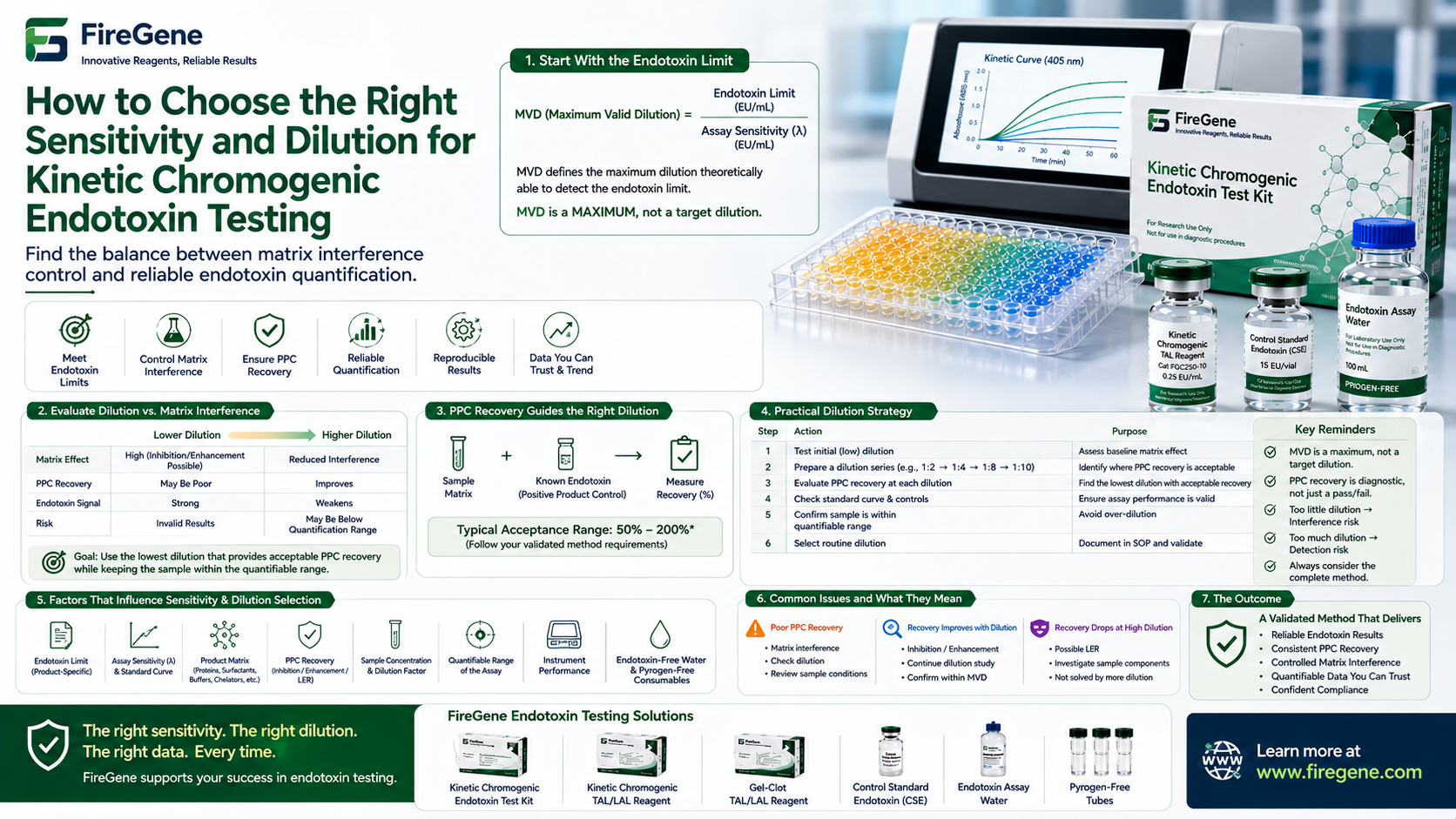
3. What Is MVD in Endotoxin Testing?
One of the most important concepts in endotoxin method development is the Maximum Valid Dilution (MVD).
The MVD represents the maximum dilution at which the sample can be diluted while still allowing the assay to detect endotoxin at the applicable product limit.
A commonly used conceptual formula is:
MVD = Endotoxin Limit / λ
where:
- MVD = Maximum Valid Dilution
- Endotoxin Limit = applicable product endotoxin limit
- λ = labeled sensitivity of the endotoxin test
For example, if a product has an endotoxin limit of:
0.5 EU/mL
and the selected assay sensitivity is:
0.05 EU/mL
then:
MVD = 0.5 / 0.05 = 10
The laboratory could therefore theoretically dilute the sample up to 1:10 while maintaining the ability to detect the specified endotoxin limit, assuming the method is otherwise suitable.
The actual method must follow the applicable pharmacopoeial requirements and validated procedure.
4. Why MVD Does Not Mean “Always Dilute to the Maximum”
This is one of the most common misunderstandings in endotoxin testing.
MVD is a maximum, not a target.
If a sample can be tested successfully at a 1:2 dilution, there is usually no analytical reason to automatically dilute it to 1:10.
Consider a simplified example.
A sample has:
Endotoxin Limit = 0.5 EU/mL
Assay Sensitivity = 0.05 EU/mL
Therefore:
MVD = 10
The laboratory might test:
1:2
1:5
1:10
But the best dilution is not automatically 1:10.
The optimal dilution should be determined based on:
- Matrix interference
- PPC recovery
- Quantifiable range
- Sample concentration
- Product characteristics
- Method suitability
- Routine assay performance
The objective is:
The lowest practical dilution that produces reliable, interference-free results.
5. The Relationship Between Dilution and Matrix Interference
Dilution is one of the simplest ways to reduce matrix interference.
Suppose a product contains a component that inhibits the endotoxin reaction.
At:
1:1
the matrix concentration is highest.
The assay may show:
Poor PPC recovery
After dilution:
1:2 → improved recovery
1:4 → acceptable recovery
1:8 → acceptable recovery
At some point, however, additional dilution provides little analytical benefit.
Instead, it simply reduces the concentration of endotoxin available for measurement.
This creates the classic endotoxin testing trade-off:
Too Little Dilution
Potential:
- Inhibition
- Enhancement
- Poor PPC recovery
- Invalid method suitability
Too Much Dilution
Potential:
- Lower signal
- Reduced quantification reliability
- Endotoxin concentration approaching the assay's lower range
- Increased uncertainty
The optimal dilution lies between these two extremes.
6. PPC Recovery Is the Key to Finding the Right Dilution
Positive Product Control, or PPC, provides critical information about whether the product matrix is interfering with the assay.
The basic concept is:
Product Sample + Known Endotoxin Spike → Measure Recovery
The recovery is then compared with the applicable acceptance criteria.
If the recovery is acceptable, the tested dilution provides evidence that the matrix is not significantly interfering under those conditions.
If recovery is poor, the laboratory may investigate:
- Additional dilution
- Alternative sample preparation
- pH adjustment where scientifically justified
- Buffer conditions
- Product concentration
- Potential endotoxin masking
- LER
This is why PPC should be considered an analytical diagnostic tool.
Not simply:
“Pass or fail.”
But:
“What does the PPC tell us about our sample matrix?”
7. A Practical Dilution Strategy
For a new pharmaceutical product, a laboratory can approach method development systematically.
Step 1: Test the undiluted or initial sample concentration
Determine whether the matrix produces acceptable PPC recovery.
Step 2: Introduce a controlled dilution series
For example:
1:2 → 1:4 → 1:8
The exact dilution series should be scientifically justified and consistent with the applicable procedure.
Step 3: Compare PPC recovery
Determine where the matrix effect becomes acceptable.
Step 4: Check the standard curve and controls
A good PPC result alone is not sufficient.
Step 5: Confirm the result is within the appropriate analytical range
The diluted sample still needs to be quantifiable.
Step 6: Select the lowest validated dilution that provides reliable performance
This becomes part of the validated method.
8. Why “More Sensitive” Does Not Always Mean “Better”
This sounds counterintuitive.
A laboratory might think:
“If I use the lowest possible endotoxin sensitivity, I will get the most accurate result.”
Not necessarily.
Sensitivity must match the entire analytical system.
Consider a highly concentrated protein formulation.
At very low dilution, the product may strongly interfere with the assay.
The laboratory could choose a highly sensitive reagent, but the matrix may still suppress the endotoxin response.
In that case, the problem is not insufficient sensitivity.
The problem is matrix compatibility.
The correct solution may be:
Appropriate dilution + validated sensitivity
rather than:
Maximum sensitivity + concentrated sample
9. Why Excessive Dilution Can Create Another Problem
Now consider the opposite situation.
Suppose the actual sample contains:
0.02 EU/mL
If the laboratory performs a:
1:10 dilution
the theoretical concentration becomes:
0.002 EU/mL
If the assay's useful quantification range does not support that concentration under the validated conditions, the result may become difficult to quantify reliably.
Therefore, excessive dilution can create a problem even when PPC recovery looks excellent.
This is why method suitability should consider both:
Matrix Interference
and
Analytical Detectability
10. Sensitivity, Dilution, and Quantification Range Must Work Together
A useful way to visualize the relationship is:
Product Matrix
↓
Dilution
↓
Effective Endotoxin Concentration
↓
Assay Sensitivity
↓
Standard Curve
↓
Quantitative Result
Every stage influences the next.
For example:
Scenario A
High matrix interference + low dilution
→ Poor PPC
→ Method unsuitable
Scenario B
Low matrix interference + appropriate dilution
→ Acceptable PPC
→ Quantifiable sample
→ Suitable method
Scenario C
High dilution
→ Good PPC
→ Sample concentration too low
→ Poor quantitative performance
The ideal method is therefore not simply the one with the highest sensitivity.
It is the one that provides reliable performance across the complete analytical range.
11. How Product Type Influences Dilution Strategy
Different pharmaceutical matrices behave differently.
Small-Molecule Drug Products
Many small-molecule formulations may be relatively straightforward, but pH, solvents, preservatives, and other excipients can still interfere with endotoxin testing.
Monoclonal Antibodies
Protein concentration can create matrix effects.
Surfactants and formulation components may also affect endotoxin availability.
See FireGene's related article:
Endotoxin Testing for Monoclonal Antibody Manufacturing
Peptide Formulations
Peptides can introduce unique pH and formulation challenges.
Vaccines
Complex biological matrices may require careful dilution and recovery studies.
Cell and Gene Therapy Products
These products can have highly complex matrices and limited sample availability.
See:
Endotoxin Testing for Cell and Gene Therapy
The important principle is:
Dilution strategy should be product-specific, not copied from another assay.
12. The Special Problem of Low Endotoxin Recovery
Dilution can solve some forms of inhibition.
But it does not automatically solve LER.
Low Endotoxin Recovery can involve interactions between endotoxin and formulation components that reduce the apparent availability of endotoxin for detection.
This is particularly important for certain biologic formulations.
A laboratory might observe:
Initial endotoxin recovery: low
↓
Dilution: temporarily improved
↓
Later recovery: unexpectedly decreases
This type of behavior requires investigation rather than simply increasing dilution.
For more information, FireGene's:
can be incorporated into the site's endotoxin testing content cluster.
13. Kinetic Chromogenic Testing Makes Dilution Effects More Visible
One advantage of kinetic chromogenic testing is that the laboratory receives quantitative kinetic information.
Instead of only observing a final endpoint, the system can evaluate reaction behavior over time.
This can help analysts investigate:
- Standard curve performance
- Reaction kinetics
- Sample response
- PPC behavior
- Unexpected outliers
The International Pharmacopoeia describes the kinetic-chromogenic assay as measuring either the time required to reach a defined absorbance or the rate of color development. It also emphasizes preparatory testing to demonstrate valid standard-curve performance and absence of sample interference.
This is one reason kinetic chromogenic testing can be particularly useful for laboratories developing quantitative endotoxin workflows.
14. Why the Standard Curve Is Critical
A kinetic chromogenic assay is only as reliable as its calibration.
The standard curve establishes the relationship between:
Known Endotoxin Concentration
and
Measured Reaction Response
If the standard curve is poor, the sample result becomes questionable.
Potential causes of abnormal standard curves include:
- Incorrect standard preparation
- Pipetting errors
- Incorrect dilution
- Reagent problems
- Temperature issues
- Instrument problems
- Contamination
- Incorrect software settings
Therefore, analysts should never evaluate the sample result in isolation.
The complete assay should be reviewed.
15. The Importance of Endotoxin-Free Water and Consumables
Dilution is only useful when the dilution materials themselves are controlled.
If endotoxin-containing water is used for dilution, the laboratory can introduce endotoxin into the sample.
Similarly, contaminated:
- Tubes
- Pipette tips
- Microplates
- Vials
- Reservoirs
can compromise the assay.
FDA's pharmaceutical microbiology procedures specifically recognize the importance of pyrogen-free water and materials for kinetic chromogenic and turbidimetric assays.
This is why sample preparation should be treated as part of endotoxin control rather than a simple pre-analytical step.
16. Choosing a Kinetic Chromogenic Reagent
When evaluating a TAL/LAL Reagent for kinetic chromogenic endotoxin testing, laboratories should consider more than sensitivity.
Important factors include:
Sensitivity
Does the reagent provide an appropriate range for the product?
Standard Curve
Is the calibration range appropriate for the intended application?
Linearity
Does the assay provide reliable quantitative behavior?
Precision
Can the method produce reproducible results?
Interference Resistance
Does the reagent perform appropriately with challenging matrices?
Instrument Compatibility
Can the reagent be used with the laboratory's microplate reader?
Throughput
Does the format fit the laboratory's testing volume?
Documentation
Are appropriate COA, validation, and technical documents available?
A suitable reagent is one that fits the whole method, not simply one with the lowest stated detection level.
17. FireGene Kinetic Chromogenic TAL/LAL Reagent
For laboratories using a conventional 96-well kinetic chromogenic workflow, FireGene offers a Kinetic Chromogenic Endotoxin Test Kit designed for quantitative endotoxin testing with 405 nm absorbance detection.
The product format can support workflows involving:
- Standard curves
- Negative controls
- PPC
- Sample replicates
- Quantitative endotoxin measurement
FireGene Kinetic Chromogenic Endotoxin Test Kit
The key advantage of a 96-well workflow is flexibility.
A laboratory can organize multiple standards, controls, PPC samples, and test samples on the same plate according to its validated SOP.
18. A Practical Example: Selecting Dilution for a New Product
Consider a hypothetical injectable product.
The laboratory establishes:
Endotoxin Limit = 0.5 EU/mL
The selected kinetic chromogenic reagent has:
λ = 0.05 EU/mL
Therefore:
MVD = 0.5 / 0.05 = 10
The laboratory evaluates several dilutions:
1:1
PPC recovery: unacceptable
→ Evidence of matrix interference
1:2
PPC recovery: improved but still outside acceptance
→ More dilution required
1:4
PPC recovery: acceptable
→ Candidate dilution
1:8
PPC recovery: acceptable
→ Also potentially suitable
1:10
PPC recovery: acceptable
→ Maximum valid dilution
Which dilution should be selected?
Not necessarily 1:10.
If the 1:4 dilution produces:
- Acceptable PPC
- Reliable standard curve
- Quantifiable sample result
- Good precision
then 1:4 may be preferable to 1:10, assuming it is consistent with the validated method and applicable requirements.
This illustrates a fundamental principle:
MVD defines the upper boundary; method suitability determines the practical dilution.
19. What Happens When No Dilution Works?
Sometimes a product continues to interfere even near its MVD.
This is a more complicated situation.
The laboratory may need to investigate:
- Product formulation
- pH
- Buffer composition
- Surfactants
- Chelating agents
- Protein concentration
- Sample preparation
- Alternative assay conditions
- Alternative endotoxin testing technologies
The correct response is not simply:
“Dilute more.”
Once the MVD has been reached, additional dilution may no longer provide a valid analytical approach for demonstrating compliance with the applicable endotoxin limit.
This is where method development becomes essential.
20. Don't Confuse Inhibition With Low Endotoxin Recovery
These two problems can look similar but should not automatically be treated as identical.
Inhibition
The matrix suppresses the endotoxin response during the assay.
Dilution may reduce the effect.
Enhancement
The matrix increases the apparent reaction.
LER
Endotoxin may become less available for detection because of interactions with formulation components.
The practical distinction matters because the corrective strategy can be different.
A laboratory that treats every poor recovery result as ordinary inhibition may overlook a more complicated endotoxin-matrix interaction.
21. Dilution Strategy for Routine QC
Once a method has been established, routine testing should become predictable.
The SOP should clearly define:
- Sample preparation
- Initial dilution
- Subsequent dilution if required
- Sample volume
- Reagent volume
- PPC conditions
- Controls
- Acceptance criteria
- Calculation
- Result reporting
Analysts should not independently change dilution factors simply because a single result looks unusual.
Changes should be handled through the laboratory's established procedures for deviations, investigations, or method adjustments.
This is particularly important in regulated pharmaceutical environments.
22. How Automation Can Improve Dilution Accuracy
Manual dilution is one of the most common sources of variability in high-throughput analytical testing.
Potential problems include:
- Pipetting inconsistency
- Incorrect dilution factor
- Sample misidentification
- Plate mapping errors
- Transcription errors
Automation can reduce some of these risks.
Modern endotoxin testing platforms increasingly integrate automated sample handling and kinetic measurement. Some commercial systems use automated or cartridge-based workflows to reduce manual assay steps and operator variability.
However, automation does not eliminate the need for method suitability.
A robot can perform the wrong dilution with excellent precision.
Therefore:
Automation improves execution.
Method validation determines whether the execution is appropriate.
23. A Better Way to Think About Endotoxin Sensitivity
Instead of asking:
“What is the most sensitive endotoxin assay?”
QC laboratories should ask:
“What sensitivity provides the most reliable measurement for this product at a scientifically justified dilution?”
This changes the decision-making process.
The correct workflow becomes:
Product
↓
Endotoxin Limit
↓
Required Detection Capability
↓
Candidate Sensitivity
↓
MVD
↓
Dilution Study
↓
PPC Recovery
↓
Quantifiable Range
↓
Validated Routine Dilution
This is a much more defensible approach.
24. Common Mistakes in Sensitivity and Dilution Selection
Mistake 1: Always choosing the lowest sensitivity
More sensitivity does not automatically mean better results.
Mistake 2: Automatically using MVD
MVD is a maximum, not a target dilution.
Mistake 3: Diluting until PPC passes without checking quantification
A passing PPC does not guarantee that the sample concentration remains analytically useful.
Mistake 4: Ignoring the product matrix
Every product should be evaluated according to its own formulation.
Mistake 5: Changing dilution during routine testing without justification
Routine testing should follow the validated procedure.
Mistake 6: Assuming dilution solves LER
LER may require a different investigation strategy.
Mistake 7: Ignoring water and consumables
Contaminated dilution materials can invalidate the entire assay.
25. A Practical Decision Tree
A simple decision framework can help laboratories evaluate a new product.
Question 1
Is the endotoxin limit clearly established?
If no → establish the applicable limit.
↓
Question 2
Is the selected assay sensitivity appropriate?
If no → evaluate another sensitivity.
↓
Question 3
Does the initial sample concentration interfere?
If yes → evaluate controlled dilution.
↓
Question 4
Does PPC recovery become acceptable?
If no → investigate matrix interference.
↓
Question 5
Is the diluted sample still within the appropriate analytical range?
If no → reconsider sensitivity/dilution strategy.
↓
Question 6
Does the method meet all acceptance criteria?
If yes → establish the validated routine procedure.
This approach is much more reliable than choosing a dilution based on habit.
26. The Future of Kinetic Chromogenic Endotoxin Testing
The future of kinetic chromogenic testing is moving toward more standardized and quantitative workflows.
Several trends are becoming increasingly important:
Higher Throughput
96-well and automated formats can support larger testing programs.
Better Quantification
Quantitative results provide more information than simple pass/fail observations.
More Automation
Automated pipetting and data processing can reduce manual variability.
Recombinant Technologies
rFC and rCR approaches are expanding the options available to laboratories.
Better Matrix Understanding
PPC, interference testing, and LER investigations are becoming increasingly important.
Data-Driven QC
Quantitative endotoxin results can support trend analysis and process monitoring.
A 2026 multicenter study evaluating recombinant cascade reagent kinetic chromogenic assays across 11 laboratories and 34 pharmaceutical products found strong consistency with LAL and reported broad product suitability, further highlighting the growing importance of quantitative kinetic chromogenic approaches.
At the same time, FDA's March 2026 guidance continues to recognize kinetic and photometric approaches and emphasizes appropriate testing and method suitability.
Frequently Asked Questions
What is MVD in endotoxin testing?
MVD stands for Maximum Valid Dilution. It represents the maximum sample dilution that can theoretically still detect endotoxin at the applicable endotoxin limit using the selected assay sensitivity.
Should I always use the MVD?
No. MVD is a maximum, not a required dilution. The appropriate routine dilution should be established through method suitability and recovery studies.
Does higher sensitivity always produce better endotoxin results?
No. Sensitivity must be matched to the product matrix, endotoxin limit, dilution strategy, and analytical range.
Why does dilution improve PPC recovery?
Dilution can reduce the concentration of matrix components that interfere with the endotoxin reaction, potentially improving PPC recovery.
Can excessive dilution cause problems?
Yes. Excessive dilution can reduce the effective endotoxin concentration below the useful quantitative range of the assay.
What if PPC recovery is still poor at the MVD?
The laboratory should investigate the product matrix and method rather than simply increasing dilution beyond the MVD.
Does dilution solve LER?
Not necessarily. LER can involve complex interactions between endotoxin and formulation components and may require dedicated investigation.
What is the role of PPC in kinetic chromogenic testing?
PPC helps demonstrate that the sample matrix does not significantly interfere with endotoxin detection under the tested conditions.
Can the same dilution be used for every pharmaceutical product?
No. Dilution should be product- and method-specific.
What is the most important factor when selecting a kinetic chromogenic reagent?
The reagent should be evaluated as part of the complete analytical method, including sensitivity, standard curve performance, interference, instrument compatibility, and product suitability.
Key Takeaways
When developing or optimizing a kinetic chromogenic endotoxin test, remember these principles:
1. Start with the endotoxin limit.
Do not select sensitivity first.
2. Calculate the MVD.
Understand the maximum allowable dilution for the method.
3. Do not automatically use the MVD.
Find the lowest practical dilution that provides reliable recovery and quantification.
4. Use PPC to understand the matrix.
Poor recovery can reveal inhibition or enhancement.
5. Watch for LER.
Not every recovery problem is simple inhibition.
6. Keep the sample within the useful analytical range.
Good PPC recovery is not enough if the sample cannot be reliably quantified.
7. Control dilution materials.
Use appropriate endotoxin-controlled water and pyrogen-free consumables.
8. Treat sample preparation as part of the analytical method.
It is not merely a preliminary laboratory step.
9. Consider automation carefully.
Automation can improve consistency, but it does not replace method suitability.
10. Choose sensitivity based on the complete workflow.
The best assay is not necessarily the most sensitive assay.
Conclusion
Choosing the right sensitivity and dilution is one of the most important practical decisions in kinetic chromogenic endotoxin testing.
The goal is not simply to maximize sensitivity.
It is not simply to maximize dilution.
And it is not simply to achieve acceptable PPC recovery.
The real objective is to establish a balanced analytical window in which:
- The matrix does not significantly interfere
- The endotoxin remains detectable
- The sample falls within the appropriate analytical range
- PPC recovery is acceptable
- The method is reproducible
- The result is scientifically defensible
This is why modern endotoxin testing should be approached as a complete analytical system rather than a simple reagent-based test.
For pharmaceutical QC laboratories, the most useful question is therefore not:
“What dilution should we use?”
but:
“What dilution provides reliable endotoxin quantification while controlling matrix interference and remaining within the validated method?”
That is the foundation of a robust kinetic chromogenic endotoxin testing strategy.
FireGene Endotoxin Testing
Ready to run your endotoxin assay?
FireGene offers a complete endotoxin testing toolkit — from TAL reagents and CSE standards to pyrogen-free consumables and LAL reagent water. All products are aligned with USP <85>, EP 2.6.14, and JP 4.01.


