
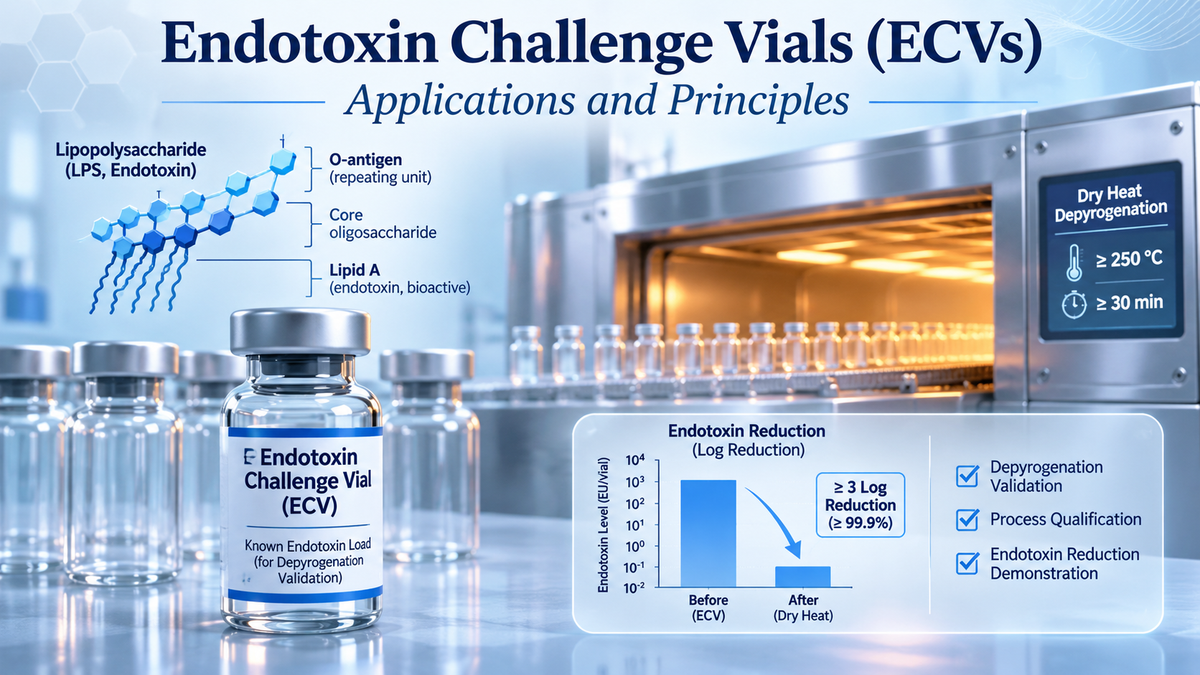
Endotoxin Challenge Vials (ECVs) are specialized analytical tools used to assess the effectiveness of depyrogenation processes in pharmaceutical manufacturing and laboratory applications. These vials contain a characterized quantity of bacterial endotoxin and serve as standardized challenges for evaluating endotoxin reduction under controlled processing conditions. ECVs are particularly important in dry heat depyrogenation validation, where they help demonstrate that manufacturing equipment and established thermal cycles achieve the required reduction in endotoxin activity. This article examines the fundamental principles of ECVs, their applications in pharmaceutical production, analytical testing methods, and key considerations for obtaining reliable validation results.
1. Introduction
Bacterial endotoxin contamination represents a significant concern in pharmaceutical manufacturing, especially during the production of injectable medications, sterile formulations, and parenteral products.
Endotoxins originate primarily from the outer membranes of Gram-negative bacteria and consist of lipopolysaccharides (LPS). When introduced into the bloodstream, endotoxins can stimulate inflammatory responses and, at sufficiently high exposures, contribute to fever and other serious adverse reactions.
Unlike viable bacteria, endotoxins may remain biologically active after microorganisms have been destroyed. Consequently, conventional sterilization procedures do not necessarily provide sufficient endotoxin removal or inactivation.
For this reason, pharmaceutical manufacturers employ dedicated depyrogenation procedures to reduce endotoxin contamination on manufacturing equipment, containers, and other product-contact materials.
Endotoxin Challenge Vials (ECVs) provide a practical means of assessing the effectiveness of these procedures.
By introducing a characterized endotoxin challenge into a controlled process, ECVs help determine whether the selected treatment conditions produce an acceptable reduction in measurable endotoxin activity.
2. What Are Endotoxin Challenge Vials?
Endotoxin Challenge Vials are prepared containers containing a specified amount of bacterial endotoxin. They are designed primarily for evaluating depyrogenation processes, particularly those involving dry heat.
ECVs are a form of endotoxin indicator, although endotoxin indicators may also be available in other configurations.
The endotoxin challenge is typically prepared from purified bacterial lipopolysaccharides, commonly derived from Escherichia coli.
During manufacturing, a characterized endotoxin preparation is introduced into an appropriate container and processed according to the manufacturer's specifications.
The resulting indicator provides a measurable challenge that can be incorporated into a depyrogenation validation study.
2.1 Essential Characteristics
High-quality ECVs should provide several important characteristics:
Characterized endotoxin activity: Each vial contains a defined endotoxin challenge expressed in Endotoxin Units (EU).
Consistent preparation: Controlled manufacturing supports reproducible endotoxin loading and performance.
Suitable thermal compatibility: The indicator configuration should withstand the intended treatment conditions.
Documented recovery characteristics: Untreated controls should allow appropriate recovery of the endotoxin challenge.
Analytical compatibility: Recovered endotoxin should be measurable using a suitable bacterial endotoxin testing method.
These characteristics support reliable comparisons between untreated indicators and indicators exposed to depyrogenation processes.
2.2 Understanding Endotoxin Units
Endotoxin activity is generally expressed in Endotoxin Units (EU).
An EU represents endotoxin activity relative to an established reference standard rather than a fixed mass of lipopolysaccharide.
The endotoxin challenge contained in an ECV must be sufficiently high to support meaningful evaluation of the intended process reduction.
The appropriate challenge level depends on the validation requirements, analytical sensitivity, and relevant regulatory guidance.
3. Scientific Principles of ECV Testing
The fundamental principle of Endotoxin Challenge Vial testing is the measurement of endotoxin activity before and after a depyrogenation treatment.
3.1 Structure and Properties of Bacterial Endotoxins
Lipopolysaccharides are complex molecules typically composed of three regions:
Lipid A: The hydrophobic structural component associated with much of the biological activity of bacterial endotoxin.
Core oligosaccharide: A carbohydrate region connecting lipid A with the outer polysaccharide portion.
O-antigen: A variable polysaccharide chain that contributes to structural diversity among different bacterial strains.
The molecular organization of endotoxins contributes to their relative resistance to many conventional sterilization conditions.
Because the elimination of viable microorganisms does not guarantee the removal of endotoxin activity, dedicated depyrogenation validation is necessary when endotoxin control is a critical manufacturing requirement.
3.2 Dry Heat Depyrogenation
Dry heat depyrogenation is a commonly used technique for reducing bacterial endotoxin activity on heat-stable materials.
The process involves exposing materials to controlled elevated temperatures for a defined period.
Sufficient thermal treatment can induce chemical and structural changes in endotoxin molecules, reducing their measurable biological activity.
However, depyrogenation performance depends on multiple variables, including:
Processing temperature and exposure duration
Container dimensions and material properties
Heat distribution and thermal penetration
Equipment configuration and loading conditions
Characteristics of the endotoxin challenge
Therefore, the effectiveness of a dry heat cycle must be established through appropriate validation rather than assumed from temperature settings alone.
3.3 Understanding the 3-Log Reduction Principle
One of the most widely recognized benchmarks for dry heat depyrogenation validation is a reduction of at least three logarithmic units in endotoxin activity.
A 3-log reduction represents a 1,000-fold decrease, corresponding to a 99.9% reduction.
Logarithmic reduction is calculated using the following equation:
Log Reduction = log₁₀ (Initial Endotoxin Activity / Residual Endotoxin Activity)
For example, consider an ECV study in which the untreated control contains 10,000 EU/vial.
If the residual endotoxin activity after treatment is 10 EU/vial:
Log Reduction = log₁₀ (10,000 / 10) = 3
The process has therefore demonstrated a 3-log reduction.
When residual endotoxin activity is below the validated quantitation limit, the result should be reported using an appropriate analytical limit rather than interpreted as absolute absence of endotoxin.
The applicable acceptance criteria must be established according to the specific manufacturing process and relevant regulatory requirements.
4. How Are Endotoxin Challenge Vials Used?
ECV testing is normally performed as part of a predefined depyrogenation validation protocol.
Although individual procedures vary depending on the equipment and indicator specifications, the overall workflow follows several essential stages.
4.1 Selection of Suitable ECVs
The first stage involves selecting indicators with an appropriate endotoxin challenge and documented performance characteristics.
The selected ECVs should be compatible with the processing conditions and suitable for the planned analytical method.
Manufacturer documentation, including relevant certificates and handling instructions, should be reviewed before use.
4.2 Preparation of Control Indicators
Untreated control ECVs are used to establish the recoverable initial endotoxin challenge.
These controls are essential because the labeled endotoxin activity and the amount recovered analytically may not always be identical.
The validated recovery procedure should demonstrate that the challenge can be measured reliably.
4.3 Placement Within Depyrogenation Equipment
ECVs are positioned at selected locations within the equipment being validated.
Placement should reflect the results of appropriate temperature mapping, heat penetration studies, and worst-case assessments.
For example, indicators may be positioned in areas receiving the least effective thermal exposure.
This approach helps evaluate whether the process performs adequately under challenging operating conditions.
4.4 Exposure to the Depyrogenation Cycle
The indicators are exposed to the established dry heat treatment.
Relevant parameters may include processing temperature, exposure time, conveyor speed, equipment loading, and container orientation.
All critical parameters should be documented according to the validation protocol.
4.5 Endotoxin Extraction and Analysis
Following processing, the residual endotoxin is recovered using a qualified extraction method.
The recovered samples are analyzed using an appropriate bacterial endotoxin assay.
Results from treated indicators are compared with those from untreated controls to determine the achieved reduction.
4.6 Evaluation of Validation Results
The calculated reduction is assessed against predefined acceptance criteria.
A successful validation study should demonstrate that the depyrogenation process consistently meets its established requirements under the evaluated operating conditions.
5. Major Applications of Endotoxin Challenge Vials
ECVs are widely relevant to pharmaceutical manufacturing processes in which endotoxin control is critical.
5.1 Pharmaceutical Glass Vial Preparation
Glass containers used for injectable pharmaceutical products must meet applicable cleanliness and endotoxin requirements.
Dry heat depyrogenation is commonly employed to prepare heat-stable glass vials before aseptic filling.
ECVs help verify that the selected processing conditions achieve the intended reduction in endotoxin activity.
Their use provides supporting evidence for the qualification of container preparation processes.
5.2 Depyrogenation Tunnel Validation
Continuous depyrogenation tunnels are frequently integrated into pharmaceutical filling lines.
These systems transport containers through controlled heating and cooling zones.
ECVs can be incorporated into qualification studies to evaluate the effectiveness of the established thermal process.
Validation studies may investigate different conveyor speeds, loading arrangements, and container configurations to identify challenging operating conditions.
5.3 Dry Heat Oven Qualification
Batch dry heat ovens are used to process various heat-stable materials and pharmaceutical manufacturing components.
ECVs provide a measurable endotoxin challenge that can be used to assess the depyrogenation capability of these systems.
Their application complements other qualification activities, including temperature distribution studies and equipment performance assessments.
5.4 Pharmaceutical Quality Assurance
ECVs also support broader quality assurance programs.
They may be used during initial process qualification, selected periodic requalification activities, and investigations following significant manufacturing changes.
For example, changes in equipment configuration or operating parameters may require additional evidence that the depyrogenation process remains effective.
5.5 Contract Testing Laboratories
Contract research and testing organizations may perform ECV-based studies for pharmaceutical manufacturers.
These services can include endotoxin challenge testing, analytical method suitability assessment, and validation documentation.
Reliable testing requires appropriately characterized indicators, qualified analytical procedures, and traceable results.
6. Analytical Methods Used in ECV Testing
The residual endotoxin activity recovered from ECVs is commonly measured using bacterial endotoxin testing methods.
Among these, Limulus Amebocyte Lysate (LAL) assays have been extensively used in pharmaceutical quality control.
6.1 Gel-Clot LAL Method
The gel-clot method relies on an endotoxin-dependent clotting reaction.
When endotoxin is present at or above the assay's specified sensitivity, a stable gel may form under appropriate conditions.
This technique is commonly used for qualitative or semiquantitative endotoxin assessment.
For ECV validation, the method must provide sufficient sensitivity to support the intended reduction determination.
6.2 Chromogenic LAL Method
Chromogenic LAL assays measure the enzymatic cleavage of a chromogenic substrate following endotoxin-dependent activation.
The resulting color change is measured spectrophotometrically and related to endotoxin activity through calibration.
This approach supports quantitative endotoxin determination when appropriate method suitability criteria are met.
6.3 Turbidimetric LAL Method
Turbidimetric assays monitor changes in optical turbidity associated with the LAL reaction.
In kinetic formats, the time required to reach a defined turbidity threshold is correlated with endotoxin concentration.
These methods can provide quantitative measurements over an established analytical range.
6.4 Analytical Method Suitability
Regardless of the selected method, laboratories should evaluate analytical sensitivity, recovery performance, and possible sample interference.
Inhibition or enhancement of the assay reaction can produce misleading results.
Therefore, suitable controls and validated dilution procedures are essential for reliable ECV testing.
7. Key Factors Affecting ECV Validation Performance
Several technical factors can influence the accuracy and reproducibility of endotoxin challenge studies.
7.1 Endotoxin Recovery Efficiency
Incomplete endotoxin recovery from untreated controls may compromise the interpretation of validation results.
Extraction procedures should therefore be qualified to demonstrate appropriate recovery under the specified conditions.
7.2 Indicator Consistency
Differences in endotoxin loading or recovery characteristics may contribute to variability between indicators.
Using appropriately manufactured and characterized ECVs helps improve consistency.
7.3 Temperature Distribution
Depyrogenation effectiveness depends on the thermal exposure received by the materials being processed.
Temperature mapping and heat penetration studies are necessary for identifying representative worst-case locations.
7.4 Assay Detection Limits
The selected analytical method must be capable of supporting the required reduction measurement.
Assay sensitivity, sample dilution, and quantitation limits should be considered when interpreting low residual endotoxin concentrations.
7.5 Documentation and Traceability
A complete validation study should document indicator identification, equipment conditions, processing parameters, sample recovery, analytical results, and any deviations.
Accurate records support reproducibility, quality review, and regulatory inspection readiness.
8. Endotoxin Challenge Vials vs. Biological Indicators
Although ECVs and biological indicators are both used in pharmaceutical process validation, they evaluate different aspects of manufacturing performance.
Biological indicators contain viable microorganisms, often bacterial spores, selected for their resistance to a particular sterilization process.
They are used to assess microbial inactivation.
In contrast, ECVs contain bacterial endotoxin and are designed to assess reductions in endotoxin activity.
The distinction is important because a process that successfully destroys microorganisms may not adequately reduce endotoxins.
Consequently, biological indicator testing alone cannot establish that a depyrogenation process has achieved its intended endotoxin reduction.
The appropriate indicator must be selected according to the specific process objective.
9. Regulatory Considerations for ECV-Based Validation
Pharmaceutical depyrogenation validation is supported by established regulatory guidance, pharmacopeial standards, and quality management principles.
Relevant references include FDA guidance concerning sterile pharmaceutical manufacturing and USP general chapters addressing bacterial endotoxin testing, endotoxin indicators, and dry heat depyrogenation.
These materials emphasize the importance of scientifically justified processing conditions, representative challenges, appropriate controls, and documented validation evidence.
For dry heat processes, the widely recognized 3-log reduction benchmark provides an important basis for evaluating endotoxin reduction capability.
However, the overall validation strategy should also consider initial contamination levels, product-specific endotoxin limits, equipment characteristics, and the intended manufacturing application.
ECV testing should therefore form part of a comprehensive contamination control and process qualification strategy.
10. Conclusion
Endotoxin Challenge Vials provide a practical and scientifically established approach to evaluating the effectiveness of pharmaceutical depyrogenation processes.
By introducing a characterized bacterial endotoxin challenge, ECVs enable laboratories to measure endotoxin reduction following controlled thermal treatment.
Their applications include pharmaceutical glass container preparation, depyrogenation tunnel qualification, dry heat oven validation, and quality assurance studies.
Reliable ECV testing requires suitable indicator selection, qualified endotoxin recovery procedures, appropriate analytical methods, and justified acceptance criteria.
When integrated into a comprehensive validation program, ECVs provide valuable evidence supporting the consistent performance of depyrogenation processes and the broader goal of pharmaceutical endotoxin control.
Frequently Asked Questions (FAQs)
1. What is an Endotoxin Challenge Vial?
An Endotoxin Challenge Vial is a prepared container containing a characterized bacterial endotoxin challenge. It is primarily used to evaluate the effectiveness of depyrogenation processes.
2. What does a 3-log endotoxin reduction mean?
A 3-log reduction represents a 1,000-fold decrease in endotoxin activity, equivalent to a 99.9% reduction.
3. Where are ECVs commonly used?
ECVs are commonly used in dry heat depyrogenation validation, pharmaceutical glass vial preparation, depyrogenation tunnel qualification, and related pharmaceutical quality assurance activities.
4. Can ECVs be tested using LAL methods?
Yes. Recovered endotoxin can be measured using suitable gel-clot, chromogenic, or turbidimetric LAL methods, provided analytical method suitability has been established.
5. What is the difference between an ECV and a biological indicator?
ECVs assess endotoxin reduction during depyrogenation, whereas biological indicators assess microbial inactivation during sterilization.
6. Why is endotoxin recovery important in ECV testing?
Appropriate endotoxin recovery ensures that the initial challenge is reliably measured and that subsequent reduction calculations are scientifically meaningful.
For research, laboratory testing, and applicable pharmaceutical process-validation use only. Follow the manufacturer's instructions and approved validation procedures.


