
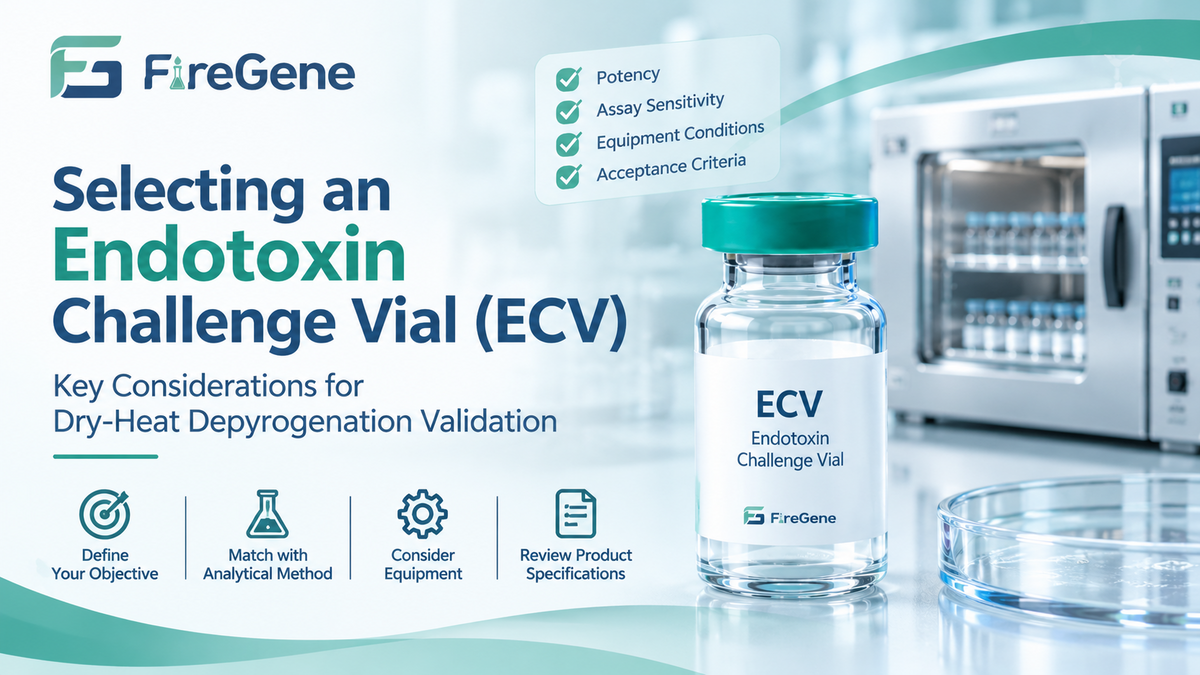
Selecting an Endotoxin Challenge Vial (ECV) is an important step in designing a dry-heat depyrogenation validation study. The challenge material must be appropriate for the process being evaluated, the intended endotoxin reduction, and the analytical method used to measure residual activity.
However, choosing an ECV is not simply a matter of selecting the vial with the highest endotoxin potency. Challenge level, recovery, assay sensitivity, equipment conditions, and predefined acceptance criteria must be considered together.
I. Define the Objective of the Validation Study
Start by identifying the question the study needs to answer.
A manufacturer may need to qualify a newly installed dry-heat oven, evaluate a depyrogenation tunnel, assess a modified loading configuration, or perform periodic revalidation of an established process.
Each objective may require a different study design. The common principle is that the challenge material and analytical method must generate evidence appropriate to the intended validation claim.
Before selecting an ECV, define the equipment or process under evaluation, the relevant operating conditions, the intended load configuration, and the acceptance criteria.
The protocol should also specify how the initial challenge value will be established and how residual endotoxin activity will be measured.
II. Understand ECV Potency and Its Practical Implications
ECV potency is commonly expressed in endotoxin units per vial (EU/vial). An endotoxin unit describes biological activity relative to an established endotoxin reference standard rather than simply the physical mass of endotoxin.
The initial challenge value is important because it establishes the starting point for evaluating endotoxin reduction.
For example, if the initial recovered activity is 5,000 EU/vial, a 3-log reduction corresponds to a residual activity of 5 EU/vial.
The calculation is:
Target residual activity = Initial endotoxin activity / 10^L
Here, L represents the target log reduction.
For a 3-log reduction:
Target residual activity = 5,000 / 10^3 = 5 EU/vial
This example illustrates why challenge potency and analytical sensitivity must be considered together. The selected method must be capable of supporting the intended conclusion at the expected residual level.
III. Match the ECV to the Analytical Method
The analytical method is a critical part of ECV selection.
After heat exposure, residual endotoxin activity may be evaluated using an appropriate bacterial endotoxins test, such as gel-clot, kinetic chromogenic, endpoint chromogenic, or kinetic turbidimetric testing, depending on the method and intended application.
The selected method must have a suitable working range and a recovery procedure appropriate for the study.
When assessing method suitability, consider:
-
Expected residual endotoxin activity.
-
Analytical sensitivity and validated working range.
-
Reconstitution volume and dilution factors.
-
Sample recovery and control performance.
-
Potential interference from the sample or preparation procedure.
-
The calculation method specified in the protocol.
FireGene offers a Kinetic Chromogenic Endotoxin Test Kit for quantitative endotoxin analysis. Its suitability for a particular ECV study must be established using the actual validation requirements and sample preparation procedure.
For regulatory context on bacterial endotoxins testing, consult the FDA's Guidance for Industry: Pyrogen and Endotoxins Testing.
IV. Consider the Equipment and Intended Application
Different equipment configurations create different validation challenges.
Dry-Heat Ovens
Oven qualification and revalidation may require evaluation of temperature distribution, load configuration, and locations that experience less favorable thermal conditions.
The ECV placement plan should be based on equipment characterization and the approved protocol.
Depyrogenation Tunnels
Continuous depyrogenation tunnels introduce additional considerations, including conveyor movement, loading patterns, and different processing zones.
The study should account for the equipment design and validated operating conditions rather than assuming that an oven placement strategy can be transferred directly to a tunnel.
Pharmaceutical Glass Containers
Glass vials, ampoules, and other suitable containers are common applications for dry-heat depyrogenation.
Container geometry, mass, arrangement, and loading configuration may affect thermal behavior. Validation should reflect the conditions relevant to the intended production process.
Routine Revalidation
For an established process, the selection and placement of challenge materials should remain consistent with the approved revalidation strategy unless changes are scientifically justified.
Equipment maintenance, process modifications, and loading changes may require an assessment of whether the existing validation remains applicable.
V. Review the ECV Product Specifications
Before ordering, review the product documentation to confirm that the challenge material is suitable for the intended application.
The FireGene Endotoxin Challenge Vial, SKU FG-DNEVC002, is described as a lyophilized bacterial endotoxin preparation derived from Escherichia coli O111.
The product page lists the following specifications for the applicable product:
-
Potency range: 2,000–10,000 EU/vial.
-
Format: lyophilized powder.
-
Container: glass vial.
-
Listed configuration: 2 mL/vial, 10 vials/kit.
-
Storage: 2–8°C, sealed, before opening.
-
Listed shelf life: 24 months.
The product page also lists a 10 mL/vial configuration. Confirm the selected size and current packaging details before ordering.
Use the current product instructions and lot-specific documentation to confirm the applicable potency, storage conditions, handling requirements, and expiration information. Do not assume that specifications from one configuration or lot apply to every product variant.
VI. Avoid Common ECV Selection Mistakes
Selecting a challenge solely because it has a high potency
Higher potency is not automatically better. The challenge must be appropriate for the study objective and measurable with the selected analytical method.
Ignoring the assay's lower measurement range
A study may require measurement of residual activity far below the initial challenge. Confirm that the analytical procedure can support the intended calculation.
Using an unsupported initial value
Follow the approved protocol for using assigned potency, untreated-control recovery, or another justified baseline.
Treating ECVs and CSE as interchangeable
ECVs are intended for depyrogenation challenge studies. Control Standard Endotoxin (CSE) is used for purposes such as bacterial endotoxins test calibration-related activities, sensitivity verification, and other analytical procedures specified by the applicable method.
Although both materials contain bacterial endotoxin, they serve different functions. For further background, see FireGene's ECV vs. CSE vs. RSE guide.
Overlooking documentation requirements
Product specifications alone do not replace the validation protocol, lot-specific records, analytical controls, or documented acceptance criteria.
VII. Build a Complete Validation Strategy
An ECV is one component of a broader depyrogenation validation strategy.
A scientifically justified program integrates equipment qualification, thermal mapping, challenge placement, cycle parameters, endotoxin recovery, analytical method suitability, predefined acceptance criteria, and documentation.
USP General Chapter 1228: Depyrogenation and General Chapter 1228.5: Endotoxin Indicators for Depyrogenation provide relevant technical context for depyrogenation processes and endotoxin challenge materials.
Manufacturers should consult the applicable compendial requirements and internal quality procedures when determining study design and acceptance criteria.
VIII. Frequently Asked Questions
What should I consider first when selecting an ECV?
Start with the validation objective, required endotoxin reduction, initial challenge value, and analytical method. These factors determine whether the proposed challenge material can support the intended study.
Is a higher-potency ECV always preferable?
No. The challenge must be appropriate for the process and measurable using the selected analytical method. Higher potency may introduce additional analytical requirements.
Can the same ECV be used for oven and tunnel validation?
The same product may be suitable for different applications, but suitability must be established for each study. Placement, equipment conditions, and protocol requirements may differ.
Should I choose the ECV before selecting the endotoxin assay?
The two should be evaluated together. Challenge potency and assay sensitivity directly affect the ability to demonstrate the intended endotoxin reduction.
Conclusion
Choosing an appropriate Endotoxin Challenge Vial requires a clear understanding of the validation objective, challenge potency, analytical capability, and equipment conditions. Evaluating these factors together helps laboratories design meaningful studies and avoid results that cannot support the intended conclusion.
Explore the FireGene Endotoxin Challenge Vial for dry-heat depyrogenation validation, and review the FireGene Kinetic Chromogenic Endotoxin Test Kit for quantitative endotoxin analysis.
FireGene Endotoxin Testing
Ready to run your endotoxin assay?
FireGene offers a complete endotoxin testing toolkit — from TAL reagents and CSE standards to pyrogen-free consumables and LAL reagent water. All products are aligned with USP <85>, EP 2.6.14, and JP 4.01.


