
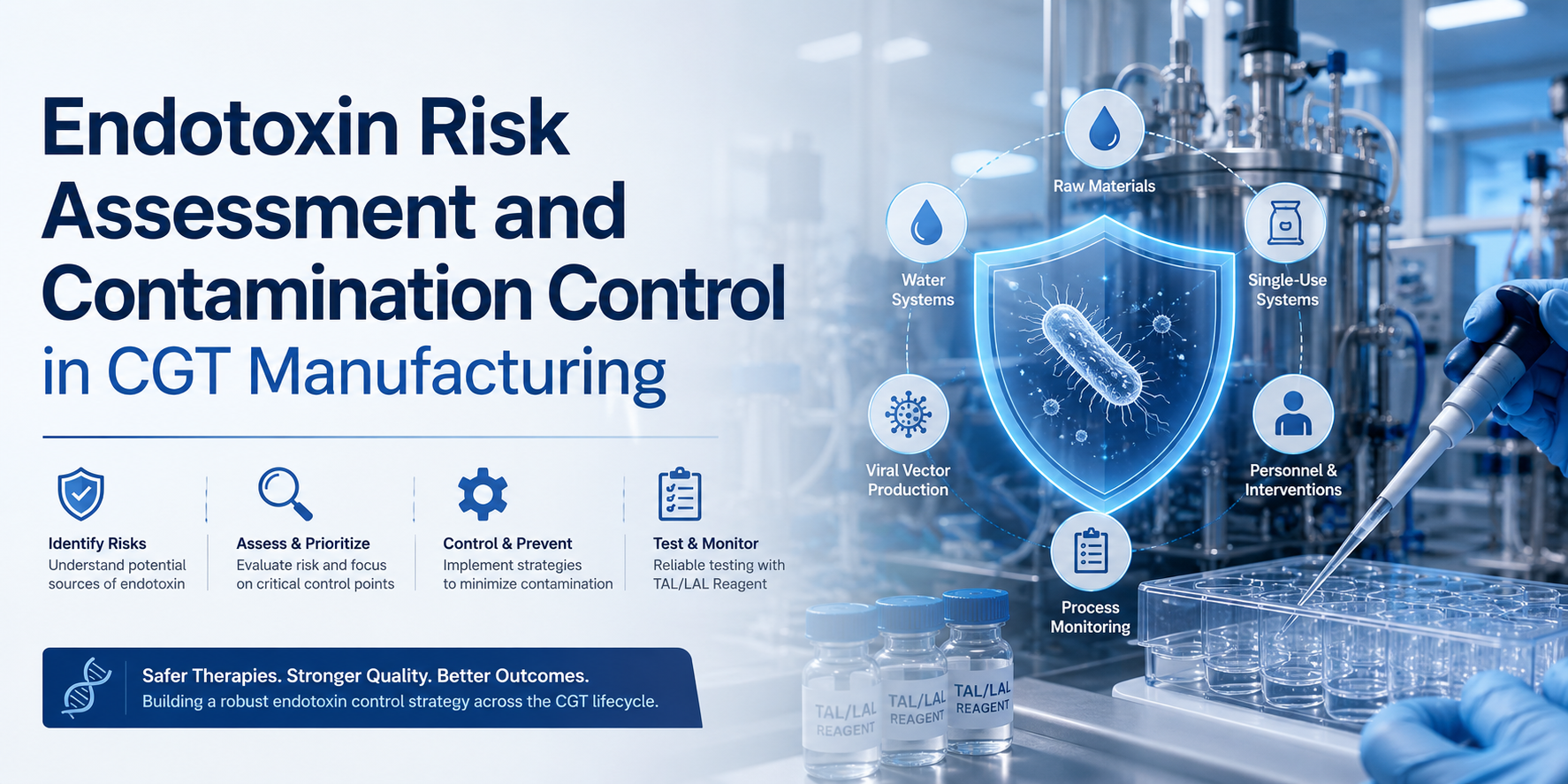
Introduction
Cell and gene therapies have moved from experimental platforms to commercial reality. Hundreds of clinical programs are advancing worldwide, and manufacturing facilities are scaling rapidly to meet increasing demand. According to reports from the Alliance for Regenerative Medicine, investment and clinical activity in the cell and gene therapy sector continue to grow year after year, placing greater pressure on manufacturers to maintain product quality while increasing production capacity.
Among the many quality challenges facing advanced therapy manufacturers, endotoxin contamination remains one of the most significant.
Unlike microbial contamination, endotoxins cannot be eliminated simply by sterilization. They may persist after bacteria are destroyed and can trigger severe pyrogenic and inflammatory responses in patients even at extremely low concentrations.
For this reason, regulatory agencies require endotoxin testing as part of product release. However, modern GMP expectations extend far beyond final product testing. Manufacturers are increasingly expected to implement proactive contamination control strategies supported by risk assessment, process understanding, supplier qualification, and routine monitoring.
The most successful quality programs do not simply detect endotoxins. They identify contamination risks before they become product quality failures.
This guide explores practical approaches to endotoxin risk assessment and contamination control in cell and gene therapy manufacturing, including common contamination sources, critical control points, Low Endotoxin Recovery (LER), investigation strategies, and the role of TAL/LAL Reagent testing throughout the product lifecycle.
Why Endotoxin Contamination Matters in Cell and Gene Therapy Manufacturing
Endotoxins are lipopolysaccharides (LPS) derived from the outer membrane of Gram-negative bacteria.
When introduced into the human body, endotoxins may cause:
- Fever and pyrogenic reactions
- Excessive immune activation
- Inflammatory responses
- Product batch rejection
- Manufacturing deviations
- Regulatory observations
- Supply chain disruptions
Cell and gene therapy products are particularly sensitive because they frequently involve:
- Living cells
- Viral vectors
- Complex biological raw materials
- Multi-step manufacturing processes
- Extended processing timelines
Each additional material and process step introduces another opportunity for endotoxin contamination.
Importantly, a product can be sterile and still fail endotoxin testing.
This distinction is often overlooked outside specialized quality and microbiology teams.
From Endotoxin Testing to Endotoxin Risk Management
Historically, endotoxin control focused primarily on release testing.
Today, regulators increasingly expect manufacturers to implement risk-based contamination control strategies aligned with:
- ICH Q9 Quality Risk Management
- EU GMP Annex 1
- FDA Guidance for Industry
- USP <85>
- USP <86>
Endotoxin testing answers one question:
Is endotoxin detectable in this sample?
Endotoxin risk assessment answers a broader question:
Where can endotoxin contamination occur, and how can it be prevented before it affects product quality?
This shift from detection to prevention is one of the most important trends in modern pharmaceutical quality systems.
Regulatory Expectations in 2026
Current endotoxin control programs are typically built upon:
- USP <85> Bacterial Endotoxins Test
- USP <86> Bacterial Endotoxins Test Using Recombinant Reagents
- FDA Guidance for Pyrogen and Endotoxins Testing
- EU GMP Annex 1
- ICH Q9 Quality Risk Management
Although recombinant methods continue to gain attention following the publication of USP <86>, TAL/LAL Reagent-based methods remain the most widely implemented endotoxin testing technologies throughout the pharmaceutical industry.
Most commercial manufacturing facilities continue to rely on:
- Gel Clot TAL/LAL Reagent
- Kinetic Chromogenic TAL/LAL Reagent
- Kinetic Turbidimetric TAL/LAL Reagent
for routine endotoxin testing and process monitoring.
For a deeper discussion of regulatory trends and method selection considerations, see:
[USP <86> and FDA 2026 Guidance: Navigating the New Dual-Track Era of Endotoxin Testing]
The Most Common Sources of Endotoxin Contamination
Raw Materials
Raw materials consistently represent one of the highest-risk contamination categories.
Examples include:
- Cell culture media
- Cytokines
- Growth factors
- Plasmid DNA
- Buffers
- Process intermediates
Even well-qualified suppliers may experience variability between lots.
As a result, many manufacturers incorporate incoming material endotoxin testing into supplier qualification programs.
Risk Level: Critical
Water Systems
Water systems remain one of the most frequently cited sources of endotoxin contamination in pharmaceutical manufacturing.
Potential contributors include:
- Biofilm formation
- Inadequate sanitization
- Dead-leg piping
- Distribution loop contamination
- Maintenance deficiencies
Routine monitoring and trending are essential.
Risk Level: Critical
Single-Use Technologies
Single-use systems have transformed biologics manufacturing.
Industry surveys suggest that more than 70% of biologics facilities now incorporate single-use technologies in at least part of their operations.
Examples include:
- Disposable bioreactors
- Tubing assemblies
- Transfer bags
- Connectors
- Filters
Although these components are typically sterile, sterility does not necessarily indicate low endotoxin burden.
Risk Level: High
Viral Vector Manufacturing
AAV and lentiviral vector manufacturing involve numerous biological materials and processing steps.
Potential endotoxin sources include:
- Plasmid preparation
- Cell banks
- Transfection reagents
- Harvest operations
- Purification intermediates
Each stage introduces additional contamination opportunities.
Risk Level: High
Personnel and Process Interventions
Human intervention remains one of the most difficult contamination risks to control completely.
Examples include:
- Sampling activities
- Equipment setup
- Material transfers
- Aseptic interventions
Risk Level: Moderate
Endotoxin Risk Matrix for Cell and Gene Therapy Manufacturing
A practical way to prioritize contamination control activities is through risk ranking.
| Potential Source | Likelihood | Severity | Overall Risk |
|---|---|---|---|
| Water Systems | High | High | Critical |
| Raw Materials | High | High | Critical |
| Viral Vector Production | Medium | High | High |
| Single-Use Assemblies | Medium | Medium | High |
| Personnel Intervention | Medium | Medium | Moderate |
| Environmental Sources | Low | Medium | Low |
This type of risk matrix helps quality teams focus monitoring resources where they are most likely to reduce product risk.
Identifying Critical Control Points (CCPs)
Not all process steps require the same level of monitoring.
Examples of common CCPs include:
Incoming Raw Material Release
Early screening prevents contaminated materials from entering manufacturing.
Water-for-Injection Systems
Continuous monitoring is essential.
Viral Vector Harvest
Frequently identified as a high-risk manufacturing stage.
Final Formulation
Often represents the last opportunity to identify contamination before release.
Example Investigation Scenario
A commercial lentiviral vector manufacturing facility observed repeated elevated endotoxin results during release testing.
Initial review showed:
- Acceptable environmental monitoring
- No equipment failures
- No major process deviations
- Qualified suppliers
A structured endotoxin risk assessment ultimately identified a single-use transfer assembly introduced during upstream processing as the likely contamination source.
Corrective actions included:
- Enhanced incoming component testing
- Supplier requalification
- Additional in-process monitoring
- Updated risk assessment procedures
The investigation demonstrated a common reality of endotoxin control:
The source of contamination is often discovered far upstream from where contamination is ultimately detected.
Low Endotoxin Recovery (LER): The Hidden Challenge
One of the most important endotoxin-related developments of the last decade has been the recognition of Low Endotoxin Recovery (LER).
LER occurs when formulation components reduce the detectability of endotoxin.
Potential masking agents include:
- Surfactants
- Polysorbates
- Chelators
- Protein-rich formulations
Potential consequences include:
- False-negative results
- Underestimated contamination risk
- Product quality concerns
- Regulatory scrutiny
LER evaluation should be incorporated into every modern endotoxin risk assessment program.
For a detailed discussion of endotoxin masking mechanisms, see:
How USP <86 Influences Method Selection
USP <86> has expanded the range of available endotoxin testing approaches.
When selecting an endotoxin testing method, manufacturers should consider:
- Product matrix complexity
- Method suitability data
- Potential LER concerns
- Regulatory expectations
- Validation requirements
Rather than viewing USP <85> and USP <86> as competing standards, many organizations treat them as complementary tools within a broader contamination control strategy.
Why Kinetic Chromogenic TAL/LAL Reagent Testing Is Growing
Many QC laboratories increasingly favor kinetic chromogenic TAL/LAL Reagent assays because they provide:
- Quantitative results
- Broad dynamic range
- High throughput
- Automated analysis
- Improved trend monitoring
These characteristics make kinetic chromogenic assays particularly valuable for contamination control programs focused on long-term risk management.
For more information:
What To Do When Endotoxin Testing Fails
An unexpected endotoxin result should never be treated as an isolated laboratory event.
A structured investigation typically includes:
Step 1: Confirm the Result
Review:
- Positive controls
- Negative controls
- Standard curve performance
- Analyst observations
Step 2: Assess Laboratory Factors
Evaluate:
- Pipetting accuracy
- Reagent integrity
- Instrument performance
- Sample preparation procedures
Step 3: Investigate Manufacturing Inputs
Review:
- Water systems
- Raw materials
- Supplier changes
- Single-use components
Step 4: Evaluate Process Deviations
Assess:
- Unexpected interventions
- Equipment maintenance
- Environmental excursions
Step 5: Assess Potential LER
Determine whether endotoxin masking could have affected previous results.
Step 6: Implement CAPA
Corrective and preventive actions should be documented, implemented, and verified through ongoing monitoring.
Building a Comprehensive Endotoxin Control Program
Effective contamination control requires four integrated pillars.
Prevention
- Supplier qualification
- Water system control
- Process design
Detection
- TAL/LAL Reagent testing
- Environmental monitoring
- In-process testing
Investigation
- Root cause analysis
- Trending review
- Deviation management
Continuous Improvement
- Risk assessment updates
- Method suitability reviews
- LER evaluations
- CAPA effectiveness monitoring
Key Takeaways
- Endotoxin testing alone is not sufficient for modern cell and gene therapy manufacturing.
- Raw materials and water systems remain the most common sources of endotoxin contamination.
- Effective risk assessment begins during process design, not product release.
- Low Endotoxin Recovery (LER) should be evaluated proactively.
- USP <86> expands available testing options but does not eliminate the importance of established TAL/LAL Reagent methods.
- Successful contamination control programs integrate prevention, detection, investigation, and continuous improvement.
Frequently Asked Questions
What is endotoxin risk assessment?
A systematic process used to identify, evaluate, and control endotoxin contamination risks throughout manufacturing.
What is the difference between endotoxin testing and endotoxin risk assessment?
Testing detects contamination, while risk assessment focuses on preventing contamination.
Can sterile products contain endotoxin?
Yes. Sterility does not guarantee the absence of endotoxins.
What are the most common endotoxin contamination sources?
Raw materials, water systems, viral vector manufacturing processes, and single-use technologies.
Can endotoxin pass through sterile filters?
Yes. Endotoxins may remain present even when microorganisms have been removed.
What is endotoxin masking?
A phenomenon in which formulation components reduce endotoxin detectability.
What is method suitability testing?
A study demonstrating that a product matrix does not interfere with endotoxin detection.
What is the difference between USP <85> and USP <86>?
USP <85> covers traditional bacterial endotoxins testing methods, while USP <86> addresses recombinant reagent approaches.
Are recombinant endotoxin tests accepted by regulators?
Acceptance depends on validation data, method suitability, and regional requirements.
Why do endotoxin results vary between lots?
Variability may result from raw materials, manufacturing processes, environmental factors, or product matrix effects.
What is the endotoxin limit for cell therapy products?
Limits depend on product type, route of administration, and applicable regulatory guidance.
How do you investigate an endotoxin failure?
Through structured review of laboratory controls, manufacturing inputs, process deviations, water systems, and CAPA implementation.
Conclusion
As cell and gene therapy manufacturing continues to mature, endotoxin control strategies must evolve beyond simple release testing.
The organizations that consistently achieve successful inspections, reliable product quality, and efficient manufacturing operations are those that view endotoxin control as a lifecycle activity rather than a single analytical test.
By combining risk assessment, contamination control, supplier management, LER evaluation, and robust TAL/LAL Reagent testing programs, manufacturers can identify contamination risks early, reduce deviations, and improve overall product quality.
In the future of advanced therapies, the most effective endotoxin strategy will not be better detection alone—it will be preventing endotoxin contamination before it happens.
FireGene Endotoxin Testing
Ready to run your endotoxin assay?
FireGene offers a complete endotoxin testing toolkit — from TAL reagents and CSE standards to pyrogen-free consumables and LAL reagent water. All products are aligned with USP <85>, EP 2.6.14, and JP 4.01.


