
Introduction
Protein markers (protein ladders) are essential molecular weight references in SDS-PAGE electrophoresis and Western blot experiments. They allow accurate estimation of protein size and validation of gel and transfer performance.
However, researchers frequently encounter protein marker abnormalities, including band disappearance, smearing, and overexposed signals. These issues can significantly affect experimental interpretation and reproducibility.
This guide summarizes the most common protein marker problems, their underlying causes, and optimized troubleshooting strategies.
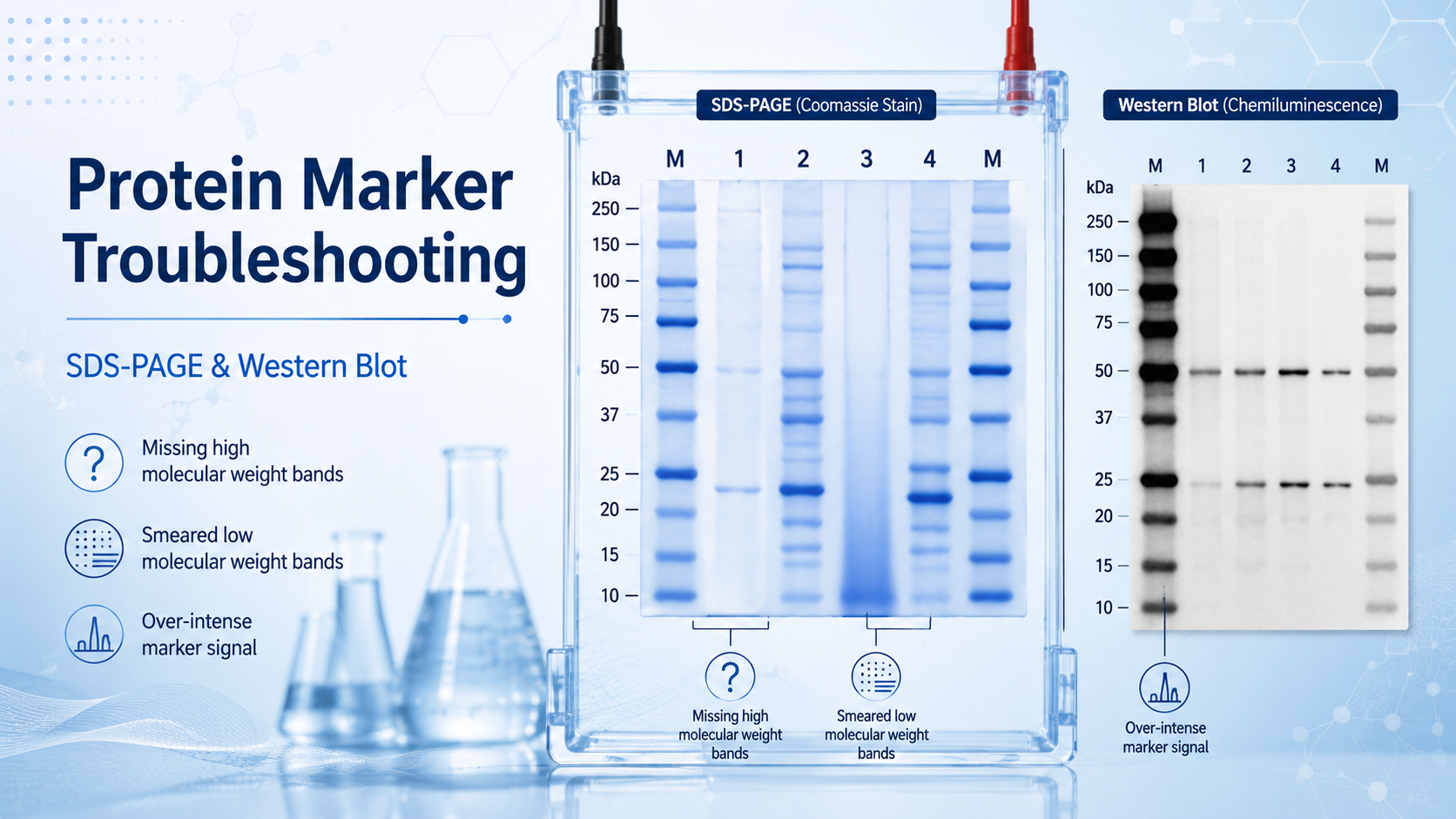
1. High Molecular Weight Marker Bands Disappear in SDS-PAGE
Phenomenon
· High molecular weight bands fail to enter gel
· Bands remain near wells
· Bands disappear during electrophoresis
Causes
· Protein marker degradation (freeze–thaw, improper storage)
· Electrophoresis system short-circuit
· Excess running buffer causing inner/outer chamber connection
· Electrode aging or failure
Solutions
· Maintain proper buffer levels
· Prevent buffer overflow between chambers
· Replace running buffer regularly
Inspect and replace electrodes if needed

2. Low Molecular Weight Marker Bands Smear or Disappear
Phenomenon
· Smearing of small molecular weight bands
· Loss of sharp resolution
· Complete disappearance of low MW markers
Causes
· Missing or insufficient SDS in running buffer
· SDS concentration below ~0.1%
· SDS degradation due to poor storage
Solutions
· Prepare fresh SDS running buffer
· Verify SDS concentration before each run
· Store SDS in dry, sealed conditions
· Avoid buffer reuse

3. Protein Marker Over-Signal (“Explosion”) in Western Blot
Phenomenon
· Extremely strong ladder bands
· Thick or blurred marker lanes
· High background signal around marker region
Causes
· Excess antibody concentration
· Overextended incubation time
· Excess marker loading
· Detection saturation during imaging
Solutions
· Reduce primary antibody dilution (e.g., 1:1000–1:5000 optimization range)
· Shorten incubation time
· Reduce marker loading volume
· Optimize blocking conditions (5% milk or BSA)
· Adjust exposure time during imaging

FAQ (SEO + Featured Snippet Optimized)
What causes protein marker bands to disappear in SDS-PAGE?
Protein marker disappearance is usually caused by electrophoresis system failure such as buffer short-circuiting or electrode malfunction, or by degraded protein marker due to improper storage or repeated freeze–thaw cycles.
Why do low molecular weight marker bands smear?
Smearing of low molecular weight bands is primarily caused by insufficient or degraded SDS in the running buffer, which results in incomplete protein denaturation and unstable migration behavior.
How can I prevent SDS-PAGE marker issues?
To prevent marker issues, always:
· Use fresh SDS running buffer
· Maintain correct buffer composition (0.1% SDS)
· Avoid buffer contamination or reuse
· Ensure proper electrophoresis chamber setup
Why does my Western blot marker show very strong or “exploded” bands?
Overly strong marker signals occur due to excessive antibody concentration, prolonged incubation, or overloading of marker proteins, leading to signal saturation and non-specific binding.
How do I reduce marker signal intensity in Western blot?
You can reduce marker intensity by:
· Lowering primary antibody concentration
· Reducing incubation time
· Decreasing marker loading volume
· Improving blocking efficiency
· Optimizing exposure time during imaging
Is protein marker stability important for electrophoresis accuracy?
Yes. Protein marker stability directly affects band resolution and accuracy. Degraded markers may show missing bands, smearing, or inconsistent migration patterns.
FireGene, light your research with passion, innovation, and profession.


