
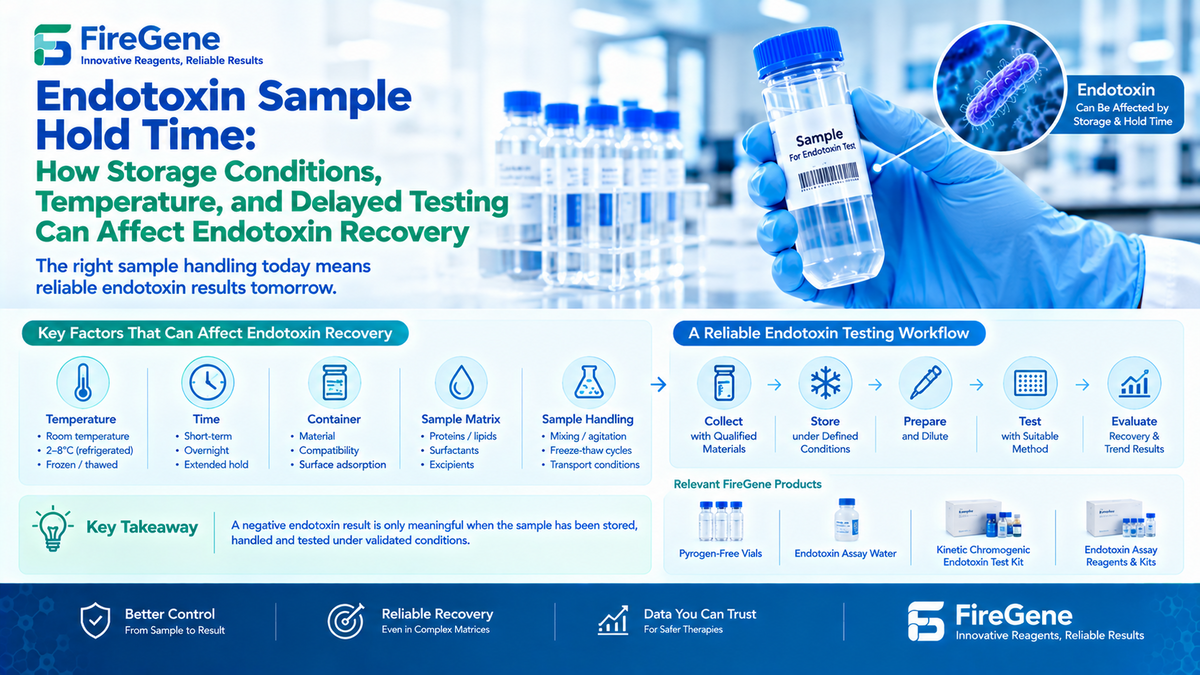
Introduction: The Endotoxin Test Starts Before the Plate or Tube
When an endotoxin test produces an unexpected result, laboratories often begin the investigation with the assay itself.
Was the reagent prepared correctly?
Was the standard curve acceptable?
Was the sample diluted properly?
Was there inhibition or enhancement?
Did the positive product control meet recovery requirements?
These are important questions. But there is another question that is sometimes overlooked:
How long did the sample wait before it was tested, and under what conditions was it stored?
Endotoxin testing does not begin when the sample is added to the TAL/LAL reagent or loaded onto a microplate. It begins when the sample is collected.
Between sampling and analysis, the sample may experience changes in temperature, container contact, concentration, pH, aggregation, adsorption, or matrix behavior. These changes can affect how much endotoxin remains detectable by the analytical method.
This is particularly important for pharmaceutical products, biopharmaceuticals, intermediates, process samples, water systems, and other materials in which endotoxin concentrations may be close to the applicable acceptance limit or assay detection range.
The issue becomes even more important when samples cannot be tested immediately.
A laboratory may collect samples during a manufacturing operation, transport them from one area to another, wait for instrument availability, or hold them overnight before analysis. Without scientifically justified storage and hold-time conditions, a result obtained later may not necessarily represent the endotoxin state of the sample at the time it was collected.
For modern quality control laboratories, therefore, sample hold time should be treated as part of the endotoxin testing strategy—not simply as an administrative detail.
1. What Is Endotoxin Sample Hold Time?
Endotoxin sample hold time is the period between sample collection and endotoxin analysis during which the sample is stored or transported under defined conditions.
A typical workflow may look like this:
Sample collection → container closure → transport → temporary storage → sample preparation → endotoxin testing → result interpretation
Every step between collection and testing can potentially influence the measured endotoxin concentration.
For example, a sample may be collected at 9:00 AM but not tested until 4:00 PM. Another sample may be collected on Friday afternoon and tested Monday morning. A process sample may also be transferred between manufacturing and QC laboratories before analysis.
These situations are not automatically unacceptable. The critical issue is whether the selected hold time and storage conditions have been demonstrated to preserve the reliability of the endotoxin measurement.
FDA's current 2026 guidance on pyrogen and endotoxin testing continues to emphasize appropriate endotoxin testing practices under USP <85>, USP <161>, and related standards.
FDA inspection guidance also states that microbial and endotoxin samples generally should not be stored for longer than 24 hours at 2–8°C unless supporting data justify alternative conditions.
This does not mean that every sample must be tested within exactly 24 hours under every circumstance. Instead, it highlights an important principle:
Storage time and temperature should be controlled and scientifically justified.
2. Why Can Delayed Testing Change Endotoxin Recovery?
Endotoxin is not simply an inert number floating independently in every sample matrix.
Lipopolysaccharide (LPS) can interact with proteins, lipids, surfaces, aggregates, detergents, buffers, and other components of a formulation.
As a result, the concentration of detectable endotoxin may change even when no new endotoxin has entered the sample.
Several mechanisms can contribute.
2.1 Adsorption to Container Surfaces
At low endotoxin concentrations, surface interactions can become particularly important.
Endotoxin molecules or endotoxin-containing aggregates may interact with the walls of tubes, vials, bottles, or other containers.
If endotoxin becomes less available to the analytical reagent, the measured concentration may decrease.
This is one reason why laboratories should not assume that an ordinary laboratory tube is automatically appropriate for low-level endotoxin testing.
Using qualified, pyrogen-free consumables helps reduce the risk of introducing contamination or creating uncontrolled sample interactions.
For laboratories performing routine testing, FireGene's Pyrogen-Free Vials can be incorporated into sample collection and handling workflows where qualified endotoxin-controlled containers are required.
3. Temperature Is a Critical Variable
Temperature is one of the easiest sample-handling variables to overlook.
A laboratory may have a general sample-storage requirement, but an endotoxin sample may require a more specific assessment.
For example:
- Room-temperature holding
- Refrigerated storage at 2–8°C
- Frozen storage
- Repeated freeze-thaw cycles
- Temperature excursions during transport
can potentially produce different recovery behavior depending on the sample matrix.
The appropriate condition should therefore be determined based on the material and intended test procedure rather than assuming that one storage condition works for every product.
For some pharmaceutical samples, refrigeration may be appropriate for short-term storage. For other matrices, refrigeration can change physical properties, promote precipitation, alter protein interactions, or influence endotoxin availability.
Freezing can introduce another variable.
When a sample is frozen and thawed, changes in aggregation, phase behavior, protein structure, or lipid organization may occur. These effects can be particularly relevant to complex biological products.
Therefore:
“Stored correctly” does not simply mean “stored cold.”
The storage condition must be demonstrated to preserve the ability of the endotoxin test to recover the endotoxin present in the sample.
4. Why Low-Endotoxin Samples Require More Attention
Hold-time effects can become especially important when the expected endotoxin concentration is close to the assay's lower working range.
Consider a simplified example.
A sample initially contains approximately 0.05 EU/mL of recoverable endotoxin.
If sample handling reduces the measurable recovery substantially, the final result could move closer to the assay's lower quantitation or detection region.
At that point, relatively small analytical changes can have a much larger practical impact.
This creates a difficult situation:
The laboratory may report a low endotoxin result, while the actual issue is that the sample's endotoxin was not fully recoverable under the selected storage and handling conditions.
That is why endotoxin recovery should be evaluated as a function of time and storage conditions, rather than assuming that the concentration remains unchanged indefinitely.
5. Sample Hold Time and Low Endotoxin Recovery
Low endotoxin recovery (LER) is already a major concern for complex pharmaceutical formulations, especially products containing proteins, surfactants, lipids, and other components that can interact with endotoxin.
But sample hold time can add another layer of complexity.
A formulation may demonstrate acceptable endotoxin recovery immediately after preparation but lower recovery after prolonged storage.
This creates an important distinction:
Assay interference is not always constant over time.
A sample may behave differently at:
- 0 hours
- 4 hours
- 8 hours
- 24 hours
- 48 hours
depending on the matrix.
For this reason, a hold-time study can be especially valuable when a product has:
- A complex formulation
- Very low endotoxin specifications
- A history of LER
- Significant protein or lipid content
- Long transportation times
- Overnight sample storage
- Multiple QC testing locations
- Significant delays between manufacturing and testing
The existing FireGene guide on low endotoxin recovery provides additional background on the mechanisms and practical challenges associated with LER.
6. How to Design an Endotoxin Hold-Time Study
A scientifically useful hold-time study should reproduce the actual conditions that samples are expected to experience during routine operations.
The objective is not simply to demonstrate that endotoxin can be detected.
The objective is to determine whether the sample remains suitable for endotoxin analysis throughout the proposed hold period.
A practical study can include several variables.
Time Points
Depending on the intended workflow, laboratories may evaluate multiple time points such as:
- Initial testing
- Short-term hold
- End-of-shift hold
- Overnight hold
- Maximum proposed hold time
The exact time points should be based on the actual operational process.
If samples are routinely tested within 12 hours, studying only a 72-hour period may not answer the most important operational question.
Likewise, if the laboratory needs to justify a 24-hour hold, the study should adequately challenge that period.
7. Evaluate the Actual Storage Conditions
The study should reflect the real storage condition rather than an idealized laboratory condition.
For example, if routine samples are stored at 2–8°C, the study should evaluate that condition.
If samples may experience transportation before refrigeration, the transportation period should also be considered.
Important variables can include:
- Storage temperature
- Storage duration
- Container type
- Sample volume
- Headspace
- Light exposure where relevant
- Agitation or mixing
- Freeze-thaw exposure
- Transport conditions
The goal is to create a defensible relationship between the validated laboratory procedure and the actual manufacturing workflow.
8. Use Endotoxin-Spiked Samples to Evaluate Recovery
One of the most useful approaches is to challenge the matrix with a known quantity of endotoxin and evaluate recovery over time.
FDA materials have specifically discussed assessing the effect of hold time on endotoxin recovery by spiking known endotoxin standards into product samples and testing recoverable endotoxin over time.
This approach helps answer a critical question:
Does the sample continue to allow reliable endotoxin recovery throughout the proposed hold period?
The study should use an appropriate control strategy and include suitable replicates.
The exact design should be justified based on the product, assay, and intended use.
Importantly, the study should not be treated as a generic experiment that can automatically be applied to every product.
Different formulations may behave differently.
9. Do Not Forget Positive Product Controls
Positive Product Control (PPC) recovery is central to evaluating endotoxin assay suitability.
If a sample contains components that inhibit or enhance the reaction, the assay may produce a misleading result.
Hold-time studies therefore need to consider whether the sample's interference characteristics remain stable throughout the storage period.
A useful strategy is to evaluate PPC recovery at relevant time points.
For example:
Fresh sample → PPC recovery
Stored sample → PPC recovery
Maximum hold-time sample → PPC recovery
If recovery changes significantly with storage time, the laboratory should investigate whether the sample matrix or endotoxin availability has changed.
This is particularly important for quantitative kinetic methods, where changes in reaction kinetics can provide additional information beyond a simple positive/negative result.
10. Kinetic Chromogenic Testing and Sample Hold Time
Kinetic chromogenic endotoxin testing provides quantitative information across a defined analytical range.
However, quantitative output does not eliminate pre-analytical variables.
A highly precise assay can still produce an inaccurate result if the sample was poorly handled before analysis.
For this reason, laboratories using kinetic chromogenic testing should consider sample hold time together with:
- Standard curve performance
- Sample dilution
- PPC recovery
- MVD
- Assay sensitivity
- Reaction kinetics
- Replicate agreement
- Sample storage conditions
FireGene's Kinetic Chromogenic Endotoxin Test Kit is designed for quantitative endotoxin determination across a broad working range and can be incorporated into a controlled sample-handling and QC workflow.
The analytical method may be sophisticated, but the basic principle remains:
Reliable measurement requires reliable samples.
11. Sample Container Selection Matters
The sample container is another part of the endotoxin testing system.
An inappropriate container can introduce contamination or contribute to endotoxin loss.
For low-level testing, laboratories should pay particular attention to:
- Pyrogen-free status
- Container material
- Container compatibility
- Closure integrity
- Sample volume
- Storage duration
- Surface-to-volume ratio
A small sample volume stored in a relatively large container has a different surface-to-volume relationship from a larger sample volume.
This can become relevant when endotoxin concentrations are very low.
Qualified pyrogen-free vials can help standardize the sample-contact surface and reduce uncontrolled contamination risks during collection and storage.
12. Endotoxin Assay Water Is Also Part of the Workflow
Sample hold-time control does not replace good reagent and dilution practices.
Water quality remains important throughout endotoxin testing.
Water used to prepare standards, dilutions, controls, or other assay solutions should be appropriately qualified for endotoxin testing.
Using contaminated or unsuitable water can introduce background endotoxin and complicate interpretation of low-level results.
FireGene's Endotoxin Assay Water is intended for bacterial endotoxin testing workflows and can be used for appropriate reagent preparation, dilution, and control applications.
This illustrates an important concept:
Endotoxin control is a system, not a single reagent.
Sample collection, storage, water, consumables, reagents, instruments, analyst technique, and data interpretation all contribute to the final result.
13. What Happens When Samples Are Held Too Long?
An extended hold time does not automatically mean that the result is invalid.
However, it creates a question that must be answered scientifically:
Has the sample remained suitable for endotoxin testing during the entire hold period?
Potential warning signs include:
- Lower-than-expected endotoxin recovery
- Changing PPC recovery
- Increasing variability between replicates
- Unexpected differences between freshly tested and stored samples
- OOS or atypical low results
- Results approaching the assay's lower range
- Unexpected differences between laboratories
- Changes after freeze-thaw exposure
- Visible precipitation or phase separation
If these patterns occur, the investigation should consider sample handling and hold time—not only the analytical reagent.
14. What Should a Laboratory SOP Define?
A well-controlled endotoxin testing SOP should clearly define what happens between sample collection and analysis.
At minimum, the procedure should address:
1. Sample collection
Who collects the sample, from where, and using what container?
2. Container requirements
Are pyrogen-free tubes or vials required?
3. Maximum hold time
How long may the sample remain before testing?
4. Storage temperature
What temperature range is permitted?
5. Transport
How should samples move from manufacturing to QC?
6. Mixing requirements
Should the sample be gently mixed before aliquoting?
7. Freeze-thaw control
Are freezing and thawing permitted?
8. Sample preparation
What dilution or treatment is required before testing?
9. Documentation
How are collection time, receipt time, storage conditions, and test start time recorded?
10. Excursion management
What happens when a sample exceeds the defined hold time or storage range?
These details transform sample handling from an informal laboratory habit into a controlled part of the analytical procedure.
15. What If a Sample Exceeds Its Validated Hold Time?
This situation should be addressed in the laboratory's SOP rather than handled informally.
For example, if a sample was validated for a maximum 24-hour hold but was accidentally tested after 36 hours, the laboratory should not simply assume that the result is acceptable—or automatically reject it.
The deviation should be documented and evaluated according to the site's quality system.
Relevant questions may include:
- How long was the actual hold time?
- What was the storage temperature?
- Was the temperature continuously monitored?
- Was the sample container appropriate?
- Does existing validation data cover the excursion?
- Was the sample matrix known to be sensitive to hold time?
- Were PPC and assay controls acceptable?
- Is additional investigation required?
The appropriate response should be determined through the site's established deviation, OOS, and quality procedures.
16. Hold-Time Studies Should Be Product-Specific
One of the most important lessons in endotoxin sample handling is that there is no universal hold-time value that applies equally to every product.
A simple aqueous solution may behave very differently from:
- A monoclonal antibody
- A peptide formulation
- An mRNA-LNP product
- A cell-culture supplement
- A protein-rich intermediate
- A highly concentrated API
- A surfactant-containing formulation
The more complex the matrix, the greater the need to understand how storage affects endotoxin availability and assay interference.
This is why a scientifically justified hold-time study should be connected to the actual product and intended analytical method.
17. How Hold-Time Control Fits Into the Larger Endotoxin Strategy
Endotoxin control should be viewed as a lifecycle process.
It starts with raw materials and water.
It continues through equipment cleaning, manufacturing, sampling, transportation, storage, sample preparation, and analytical testing.
A simplified control chain is:
Raw materials → Process water → Manufacturing equipment → Process controls → Sample collection → Sample storage → Endotoxin testing → Trend monitoring
A weakness at any point can affect the final result.
This is particularly important because a laboratory result is only as representative as the sample that reaches the laboratory.
For this reason, endotoxin testing should not be separated from the broader contamination-control strategy.
FireGene's collection of endotoxin assay reagents and kits can support different stages of this workflow, including endotoxin detection, standards, assay water, and pyrogen-free consumables.
18. A Practical Checklist for Endotoxin Sample Hold-Time Control
Before implementing a routine hold-time procedure, QC laboratories should ask:
Sample Collection
- Is the sample collected using qualified, pyrogen-free materials?
- Is the sample representative of the manufacturing process?
- Is the collection time documented?
Storage
- Is the storage temperature defined?
- Is the maximum hold time established?
- Are temperature excursions recorded?
Container
- Is the container suitable for endotoxin testing?
- Could adsorption or contamination affect the result?
Assay Suitability
- Has endotoxin recovery been evaluated over the intended hold period?
- Has PPC recovery been assessed?
- Has matrix interference been investigated?
Testing
- Is the selected TAL/LAL or recombinant reagent method appropriate?
- Is the assay sensitivity suitable for the sample?
- Are standards and controls acceptable?
Quality System
- Are collection and testing times traceable?
- Is there a procedure for hold-time excursions?
- Are historical results trended?
If several of these questions cannot be answered clearly, the sample-handling process may need further qualification.
Conclusion: Reliable Endotoxin Testing Depends on More Than the Assay
Endotoxin testing is often viewed as an analytical procedure performed at the end of a manufacturing or QC workflow.
In reality, the reliability of the result can be influenced long before the sample reaches the reagent.
Sample hold time, storage temperature, container selection, transport, matrix behavior, and sample preparation can all affect endotoxin recovery.
This becomes particularly important when testing low-endotoxin products or complex pharmaceutical formulations, where relatively small changes in recoverability can influence the final interpretation.
The most reliable approach is therefore to:
- Define sample handling requirements
- Establish scientifically justified hold times
- Control storage temperature
- Use qualified endotoxin-controlled containers
- Evaluate endotoxin recovery over time
- Monitor PPC recovery and matrix interference
- Document collection and testing times
- Investigate hold-time excursions
- Integrate sample handling into the overall endotoxin control strategy
As FDA's current guidance and inspection expectations illustrate, sample storage and testing time are part of the broader control framework for reliable microbiological and endotoxin testing.
Ultimately, the goal is simple:
Do not just control the endotoxin assay. Control the sample before the assay begins.
That is how laboratories can move from simply generating an endotoxin result to generating a result they can confidently interpret, trend, and defend.
FireGene Endotoxin Testing
Ready to run your endotoxin assay?
FireGene offers a complete endotoxin testing toolkit — from TAL reagents and CSE standards to pyrogen-free consumables and LAL reagent water. All products are aligned with USP <85>, EP 2.6.14, and JP 4.01.


