
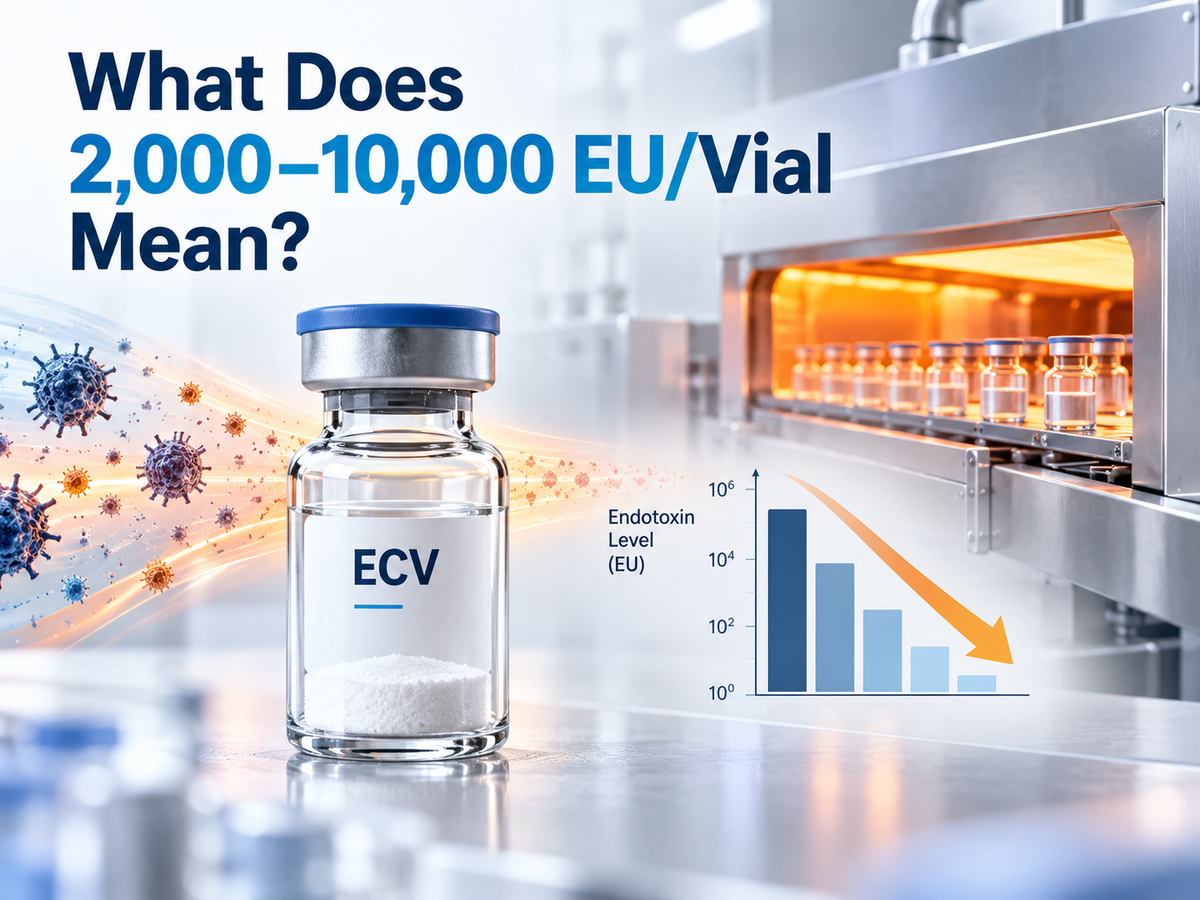
When selecting an Endotoxin Challenge Vial (ECV) for dry-heat depyrogenation validation, one specification often attracts particular attention:
Potency: 2,000–10,000 EU/vial
At first glance, this may look like a simple product specification. In practice, however, endotoxin potency is one of the most important parameters in designing a meaningful depyrogenation validation study.
The endotoxin quantity placed in each vial determines whether the validation system can adequately demonstrate the expected reduction in endotoxin activity after heat treatment. It also interacts directly with the sensitivity of the bacterial endotoxin test used after processing.
Understanding what EU/vial means—and why the challenge level cannot simply be selected arbitrarily—is therefore essential for pharmaceutical validation laboratories, quality-control teams, and engineers working with dry-heat ovens and depyrogenation tunnels.
What Does EU/vial Mean?
EU stands for Endotoxin Unit, a measure of the biological activity of bacterial endotoxin.
Unlike milligrams or micrograms, EU does not simply describe the physical mass of endotoxin. Instead, it describes its activity relative to an established endotoxin reference standard.
Therefore:
2,000 EU/vial means that one vial contains an endotoxin challenge with an assigned activity of approximately 2,000 Endotoxin Units.
Similarly:
10,000 EU/vial means that one vial contains approximately 10,000 Endotoxin Units of activity.
For an ECV product with a specified potency range of 2,000–10,000 EU/vial, individual production lots may have different assigned potency values within that range.
For example, a particular lot might be characterized at:
5,200 EU/vial
while another lot could have a different assigned value.
For validation calculations, the relevant potency should therefore be taken from the lot-specific Certificate of Analysis (COA) or determined through the validated recovery procedure used by the laboratory.
Why Is Endotoxin Potency Important in Depyrogenation Validation?
The purpose of an ECV is not simply to show that endotoxin was present before heat treatment.
It provides a quantitative challenge against which the effectiveness of the depyrogenation process can be measured.
This is usually expressed as endotoxin log reduction.
The basic relationship is:
Log Reduction = log10 Initial Recoverable Endotoxin − log10 Residual Recoverable Endotoxin
For example, consider an initial challenge of:
5,000 EU/vial
If the residual recoverable endotoxin after the dry-heat cycle is:
5 EU/vial
then:
log10(5,000 / 5) = 3
The process has therefore demonstrated a 3-log reduction, corresponding to a 1,000-fold reduction in recoverable endotoxin activity.
FDA materials have historically described at least a 3-log endotoxin reduction as an expected benchmark in relevant depyrogenation validation contexts. Compendial guidance likewise commonly uses the demonstration of a 3-log reduction when discussing dry-heat depyrogenation effectiveness.
Why Are ECVs Often Loaded with Thousands of EU?
A challenge containing several thousand EU provides a practical analytical window for demonstrating substantial endotoxin destruction.
Suppose the laboratory wants to demonstrate at least a 3-log reduction.
The theoretical residual concentrations corresponding to several starting loads would be:
|
Initial Endotoxin Load |
Residual Level After 3-Log Reduction |
|
2,000 EU/vial |
2 EU/vial |
|
5,000 EU/vial |
5 EU/vial |
|
10,000 EU/vial |
10 EU/vial |
This illustrates why challenge potency and analytical sensitivity must be considered together.
If an ECV begins at 5,000 EU and approximately 5 EU is recovered after processing, a 3-log reduction can be demonstrated quantitatively.
A sufficiently high initial challenge can therefore provide a clear analytical margin between the untreated positive-control vial and the heat-treated vial.
Is 2,000–10,000 EU/vial a Regulatory Requirement?
No.
This distinction is important.
A potency specification such as 2,000–10,000 EU/vial is a product-design range. It should not be interpreted as meaning that every regulatory authority or pharmacopoeia requires every ECV to contain between exactly 2,000 and 10,000 EU.
Current compendial thinking emphasizes a scientifically justified relationship between:
the initial endotoxin challenge, the required log reduction, the recovery method, and the sensitivity of the bacterial endotoxin assay.
USP-related guidance on endotoxin indicators specifically notes that a challenge exceeding 1,000 EU is not universally necessary merely to prove a 3-log reduction. If a sufficiently sensitive analytical method is available, a lower initial challenge may still allow the required reduction to be demonstrated. Conversely, some processes with unusually high endogenous endotoxin burdens may require substantially greater reduction than three logs.
Therefore, 2,000–10,000 EU/vial should be understood as a useful ECV potency range—not as a universal regulatory boundary.
What Happens If the Endotoxin Challenge Is Too Low?
An excessively low challenge may make it difficult to demonstrate the required log reduction with sufficient analytical confidence.
Consider an initial challenge of only:
10 EU/vial
A 3-log reduction would theoretically produce:
0.01 EU/vial
The analytical method would therefore need to reliably recover and detect endotoxin at or below that level.
If the test method cannot quantify such low residual concentrations, it may become impossible to demonstrate the intended reduction directly.
The limitation is therefore not simply the challenge vial itself.
It is the relationship between:
starting potency → expected reduction → residual endotoxin → assay sensitivity.
A poorly selected challenge level can create an analytical floor that prevents meaningful calculation of process performance.
Can the Challenge Be Too High?
Higher is not automatically better.
An extremely high artificial endotoxin challenge may exceed what is scientifically necessary for the process being evaluated.
Modern validation strategies increasingly favor risk-based and process-relevant challenge design rather than simply applying the largest possible endotoxin load.
USP-related guidance points out that a fixed ≥3-log challenge may sometimes be excessive when the normal incoming endotoxin burden is already very low. Conversely, in a process containing very high endogenous endotoxin levels, a 3-log reduction might actually be insufficient to reach the required final condition.
Thus, the validation question should not simply be:
“How much endotoxin can we put into the vial?”
A better question is:
“What challenge level allows us to demonstrate, with an appropriately sensitive method, that this depyrogenation process achieves the required reduction?”
Why Lot-Specific Potency Matters
If an ECV product is specified as 2,000–10,000 EU/vial, laboratories should not automatically use the midpoint of that range in validation calculations.
For example, assuming:
5,000 EU/vial
simply because it lies in the middle of the specification could produce an inaccurate log-reduction result.
Instead, validation should be based on the appropriate lot-specific assigned or recovered endotoxin value.
For example:
Lot A COA potency: 4,650 EU/vial
Untreated positive-control recovery:
4,200 EU/vial
Heat-treated recovery:
2.8 EU/vial
The validation protocol should clearly define which value is used as the initial value for the log-reduction calculation and how recovery of untreated controls is handled.
This is particularly important because endotoxin recovery can be influenced by reconstitution, container surfaces, analytical procedures, and other method variables.
The Relationship Between ECV Potency and BET Sensitivity
An ECV cannot be evaluated independently of the Bacterial Endotoxins Test (BET) used to measure it.
Depending on the laboratory method, residual endotoxin may be measured using approaches such as:
gel-clot testing;
kinetic chromogenic testing;
endpoint chromogenic testing; or
kinetic turbidimetric testing.
The analytical method must have sufficient sensitivity and an appropriate validated working range to distinguish between the untreated challenge and the residual endotoxin following depyrogenation.
For example:
Initial recovery: 5,000 EU/vial
Target: ≥3-log reduction
The method must be capable of establishing residual activity at approximately 5 EU/vial or lower, after accounting for reconstitution volume, dilution, recovery, and assay configuration.
This is why ECV potency, BET sensitivity, sample recovery, dilution strategy, and validation acceptance criteria should be established together rather than independently.
Why 2,000–10,000 EU/vial Is a Practical Range
For many conventional dry-heat depyrogenation validation applications, an ECV potency in the low-thousands-to-ten-thousands EU range offers several practical advantages.
It provides:
A substantial starting challenge
The initial activity is sufficiently above typical BET detection limits.
A practical 3-log analytical window
After a 1,000-fold reduction, residual activity remains within a range that can often be evaluated using appropriately selected BET methods.
Clear comparison between processed and unprocessed indicators
Untreated ECV controls establish the recoverable starting challenge, while treated ECVs indicate the degree of endotoxin destruction.
Compatibility with qualification studies
ECVs can be positioned at predetermined worst-case or cold-spot locations in dry-heat ovens and depyrogenation tunnels to challenge process performance.
However, the appropriate challenge level must ultimately be justified within the specific validation protocol.
Conclusion
The specification “Potency: 2,000–10,000 EU/vial” describes the amount of biological endotoxin activity contained in an Endotoxin Challenge Vial.
Its significance extends well beyond a simple product specification.
The initial endotoxin load establishes the analytical starting point from which depyrogenation effectiveness is measured. A challenge in this range can provide sufficient dynamic range to demonstrate a substantial reduction in endotoxin activity, including the commonly referenced 3-log reduction benchmark used in dry-heat depyrogenation validation.
However, 2,000–10,000 EU/vial is not a universal regulatory requirement or absolute boundary.
The scientifically appropriate challenge level depends on the intended process, actual endotoxin burden, required reduction, assay sensitivity, recovery procedure, and predefined validation acceptance criteria. Current compendial thinking explicitly recognizes that lower challenges may be suitable when analytical sensitivity permits, while higher-burden processes may require reductions exceeding three logs.
For this reason, ECV potency should always be evaluated as part of the complete validation system:
Known Endotoxin Challenge → Dry-Heat Exposure → Residual Endotoxin Measurement → Log-Reduction Calculation → Process Validation
Used in this way, an Endotoxin Challenge Vial provides quantitative evidence that a dry-heat system is not merely sterilizing equipment, but is actually performing its intended depyrogenation function.


